


On November 12, 2026, “9 Kings,” a roguelike kingdom-building strategy game developed by Sad Socket, will end its Early Access period and release Version 1.0—the official release—for PC (Steam).
This game blends multiple genres—roguelike, tower defense, and auto-battler—into a kingdom-building strategy title that captivates players with simple controls and deep, strategic builds driven by powerful synergies.
Players choose one of nine kings and use cards to deploy buildings and troops to fend off the relentless waves of invading enemy armies.
In this article, we’ll provide a preview of Version 1.0 and share our review based on reaching the true ending after conquering the 99th year.
Infinite Synergy from a Limited Board
The game’s appeal lies, above all, in its roguelike elements and the synergies—which hold infinite potential—born from the combinations of cards.
The board on which you build your kingdom is grid-based, and in the initial state, you place units—including your castle—on a 3×3 grid of nine squares.
There are various types of cards, including troops that engage in combat, buildings that provide annual buffs to surrounding squares, enchantments that grant additional effects, and spells that take effect only when cast. Each of the nine kings has nine types of cards, including their castle, but in actual gameplay, you don’t build your kingdom using just these nine types.

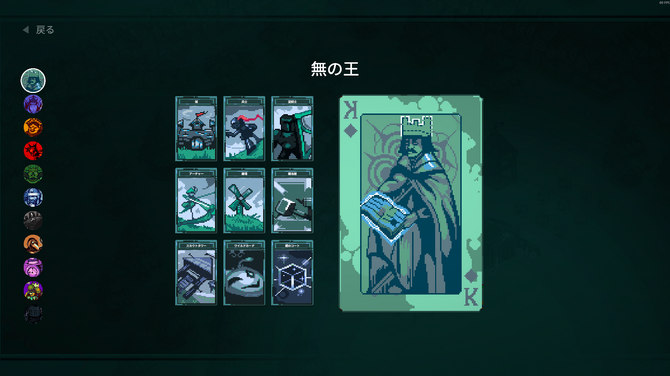
By defeating a hostile nation, three types of cards are randomly selected from that nation’s deck and added to your hand. You aim to create different synergies each time by combining your own nation’s base cards with the cards obtained from hostile nations in this way.
At the start of the game, three hostile nations are randomly selected, but as the game progresses, you can declare war or make peace with them, so strategically choosing which nations to oppose in order to acquire the cards you want is crucial.


Furthermore, it’s not just about the strength of individual cards. You must decide where to place buildings that boost surrounding units and cards whose effects are amplified under specific conditions. The goal is to maximize synergy within the limited space on the board.
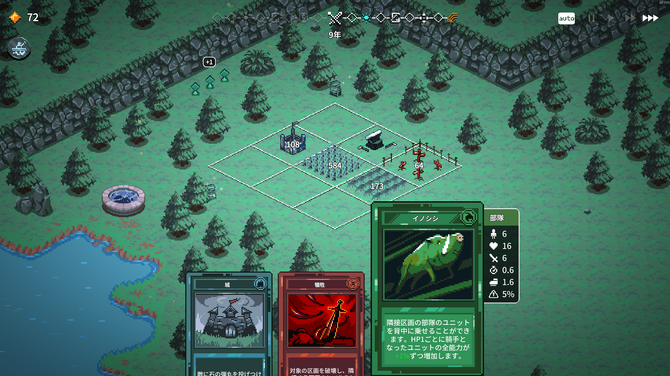
The thrill of that moment—when, after much trial and error, the synergies click into place and a combat power beyond your imagination emerges—is truly exceptional.
Since combat proceeds automatically, the player’s judgment is primarily tested during the preparation phase. Once you’ve selected your cards and decided on their placement, all that’s left is to trust the kingdom you’ve built and watch it unfold—a quintessential “auto-battler” experience.
Diverse Builds Created by the 9 Kings
Each of the nine kings featured in the game has a distinct theme—such as the “Blood King,” centered on self-damage and self-destruction, or the “Greedy King,” focused on resource management. Since even the fundamental approach to building a deck to maximize their strengths changes, using a different king allows you to aim for a completely different build.
Since it’s not just a matter of different card types, using a different King provided a fresh experience. I’m particularly fond of the “King of Magic.” On the other hand, I felt that the range of effective builds seemed limited for some Kings.

As long as you’re aiming for a standard clear by Year 33, using the double-speed combat feature means a single playthrough takes about 20 minutes. Since manual attacks—like the castle’s catapults—can also be automated, once you’ve set your formation, you can proceed through battles at a brisk pace.
A wide variety of modes beyond standard play, including quests and asynchronous multiplayer
In addition to standard single-player gameplay, this title also features Quest Mode and Multiplayer Mode.
In Quest Mode, you travel through nine regions and tackle a total of 81 different challenges. Special conditions—such as starting cards and enemy nations—are set at the beginning, requiring you to build your kingdom with a different approach than in a standard run.


Multiplayer, on the other hand, uses an asynchronous battle system. You don’t have to wait for opponents in real time; instead, you can battle kingdoms built by other players at your own pace.
With a ranking system and leaderboards in place, I felt it was possible to focus primarily on multiplayer rather than just treating it as an extra challenge.

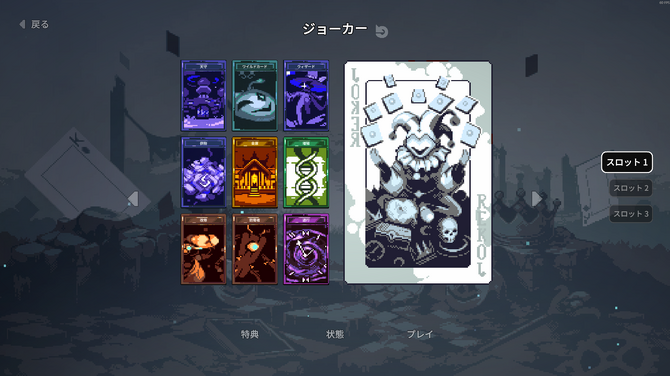
Furthermore, Version 1.0 will introduce a new mode called “Joker,” where you can freely customize your starting deck and rules. One of the game’s main attractions is that, in addition to pursuing synergies in standard runs, you can enjoy building decks under a variety of conditions.

A Long-Term Campaign Aiming for Year 99: Its Difficulty and Shortcomings
On the other hand, the long-term campaign aimed at the true ending in Year 99 drastically changes the game’s impression. A single playthrough can last nearly an hour, and the difficulty rises significantly. “Unlike a standard clear in Year 33, this requires meticulous management of your combat strength.”
When I actually played through it, there were times when—even after using buildings that allow for exponential power-ups (increasing firepower by 10% annually) to boost HP and attack power to sky-high levels—it was still difficult to achieve an overwhelming victory. The strength of the enemies, which take a considerable amount of time to defeat even against your own forces’ endlessly inflating power, is truly formidable.The difficulty balancing, which anticipates this extreme inflation, may be one of the game’s charms.

However, one thing that bothered me was how difficult it was to gauge the enemies’ strength. While you can check your own forces’ stats by hovering the cursor over characters on the board, there was no way to verify the enemies’ stats. It was hard to tell how strong the enemies were or what caused a defeat, making it difficult to use the lessons from a loss to improve your next build.
While luck is an inherent part of roguelikes, it’s a bit of a shame that you don’t receive sufficient feedback when a kingdom you’ve spent a long time building is defeated.
Additionally, the randomness of card draws is relatively strong, and on higher difficulty levels, there were times when I had to spend resources to reroll repeatedly in order to create powerful synergies.

The detailed pixel art, sound design, and lively combat animations also left a positive impression. The UI and card descriptions are easy to understand, and I was able to appreciate the game’s appeal right from my first playthrough.
During long-term campaigns aiming for the 99th year, the game occasionally felt sluggish, but not to the point of hindering gameplay.
The tower defense elements are relatively subtle, and the actual gameplay feels more like a build-based auto-battler. While there are some drawbacks—such as a lack of information on higher difficulty levels and the high degree of randomness—I feel these fall within an acceptable range for a roguelike.

Above all, the joy of discovering synergies between cards and building your own powerful deck is more than enough. I highly recommend this game to players who enjoy titles like the *Slay the Spire* series or *Balatro*, where combinations can lead to explosive power.
Game*Spark Review: “9 Kings” PC (Steam)/iOS/Android November 12, 2026
Lead units that grow exponentially stronger to build the mightiest kingdom!
-
GOOD
- Unlimited upgrade potential that allows for extreme power inflation
- A diverse array of unique kings
- Short play sessions make replaying the game a breeze
BAD
- Exponential power growth is too strong, slightly limiting build variety
- Lack of feedback on why you lost



