


You don’t have to force yourself to interact with strangers. From relationships with AI NPCs to over 1,000 types of free items and the outlook for the Nintendo Switch 2 version—here’s what the developers have to say about their attention to detail.

"Petit Planet" is a life simulation game developed by HoYoverse. For the company, which has primarily focused on RPGs such as "Genshin Impact" and "Honkai: Star Rail," this title marks a new challenge in a different genre.
At the “HoYoverse Media Tour 2026,” held in South Korea starting November 3, 2026, attendees were able to try out the game and participate in a joint interview with the developers.
We spoke with Lead Game Designer Murphy and Lead Artist Yinli (honorifics omitted hereafter). We’ll share what the development team had to say—from improvements made after the final beta test to their development concepts, how the game stands out from their other titles, and their outlook for the Nintendo Switch 2 version.
*The content of the joint interview has been edited for readability while preserving the order of the remarks.
■Why HoYoverse Took on the Challenge of a Life Simulation
――The final beta test was held until recently. Based on player feedback, what adjustments are you making for the official release?
Murphy: We’ve received a wide range of feedback, and we’ve first made adjustments to elements such as the monetization system, social features, and the main story.
We’ve also added new seasonal events. We’re continuing to improve the systems for interacting with other players and with NPCs known as “neighbors.”
We’re placing particular emphasis on making the overall gameplay flow more smoothly. In the beta version, there were parts where players felt a slight lag while playing, or where the systems didn’t function as smoothly as they should have.
We’re addressing those issues and making adjustments to ensure a more comfortable gaming experience. I believe you’ll be able to experience these improvements for yourselves in the official release.
――I believe HoYoverse’s titles have primarily focused on RPGs and action games up until now. “Petit Planet” seems to be your first “slow life” game—so why did you decide to take on this genre in the first place? Could you tell us how the project got started?
Yinli: As you mentioned, with the *Genshin Impact* and *Honkai* series, we’ve primarily focused on developing RPGs and action games.
Precisely because we’ve never worked on a slow-life game before, the desire to take on this new genre has been a major source of motivation.
We believe there is significant player demand for slow-life games in today’s gaming industry. With that in mind, we aimed to create content for *Petit Planet* that would emotionally engage players.
Specifically, this involves building relationships with a wide range of players and NPCs through the social system, as well as enjoying various ways to play within the game.
Furthermore, by incorporating the game development technologies and know-how that HoYoverse has cultivated over the years, we believe we can bring a fresh experience to this genre. We are moving forward with development with the goal of making this a reality.
――Are there any ways in which the experience gained from previous titles is being applied to *Petit Planet*? Also, please tell us if there were any particular challenges you faced precisely because this is a completely different genre.
Yinli: In terms of how we’re applying our past experience, “character development” is the first thing that comes to mind. Through our previous titles, HoYoverse has honed the skills needed to create compelling characters.
Storytelling is also one of our strengths. Furthermore, we consider our stable development structure, production processes for continuously delivering new versions, and quality control systems to be key strengths.
By applying this experience to *Petit Planet*, I believe we can achieve a level of quality that will satisfy our players. The teamwork required to have many members working toward a single vision is another aspect we’ve been able to leverage from our previous titles.
On the other hand, one challenge we faced was how to ensure the entire team shared a common understanding of the abstract concept of “slow life.”
It’s not easy for every single member of the development team to understand what “slow life” means and translate that understanding into actual production work. Therefore, we spent a long time holding repeated discussions to align our understanding. I believe that through this process, the entire team finally came to share the same vision and was able to move forward with production.
――There are already many life simulation and “slow life” games out there. Specifically, what sets *Petit Planet* apart, and what is HoYoverse’s unique take on the concept?
Murphy: There are four main points.
First, it’s a “live-service game.” We’re aiming to create content where *Petit Planet* grows alongside the player community over the long term.
Second, the setting is a “planet.” Players can explore not only their own planet but also the universe beyond it, gathering resources and enjoying new encounters along the way.
Third, there are “AI NPCs.” For example, “Naro,” an AI-powered NPC, is designed to remember conversations with players. It learns from your conversations and actions, and responds differently based on that information.
And fourth is the “UGC system.” We’ve made it possible to customize a much wider range of elements—not just furniture placement or terrain elevation, but also the colors of rivers and oceans, as well as the appearance of the sky. By making the most of the planetary setting, we want to allow players to express their imagination and creativity more freely.
――The game features a variety of creatures, including real-world ones such as fish, insects, and plants. When creating these elements, do you seek the cooperation of experts?
Yinli: We have team members who are very passionate about insects and natural elements.
We’re drawing on their knowledge while also researching a vast amount of books and reference materials to guide our production. We also verify the accuracy of the reference materials we use. In that sense, you could say that members of our team serve as experts in their own right.
――HoYoverse’s existing titles often feature time-limited events. On the other hand, since *Petit Planet* is a slow-life game, we’d like to avoid giving players the feeling that they’re being rushed by events. What is your approach to designing time-limited events?
Yinli: We plan to incorporate limited-time content into this game as well, such as festivals and seasonal events.
However, we want to keep the time constraints as flexible as possible.
We’ll adjust the event durations so players can progress at their own pace. At the same time, in real life, events like Christmas happen during specific seasons, and festivals don’t last forever. We want to preserve those elements of limited-time experiences found in real life within this game as well.
Even though these events are time-limited, we want to ensure players can enjoy them at a relaxed pace without feeling rushed.
■ How Is It Different from “Animal Crossing”? From Bonds with NPCs to the Outlook for the Switch 2 Version
――I think this game shares many similarities with the *Animal Crossing* series. Could you tell us what aspects of *Animal Crossing* the development team admires, and how you aim to differentiate *Petit Planet*?
Murphy: *Animal Crossing* is an excellent game, and one we deeply respect. In particular, it has made a significant contribution to the “slow-life” genre, and I think it’s wonderful how players can immerse themselves in that world for such a long time. We’ve analyzed that game extensively, and there’s no denying that we’ve been influenced by it.
As for features unique to *Petit Planet*, these include the planetary setting I mentioned earlier, the ability to explore the vast universe, and our commitment to updating content over the long term as a live service.
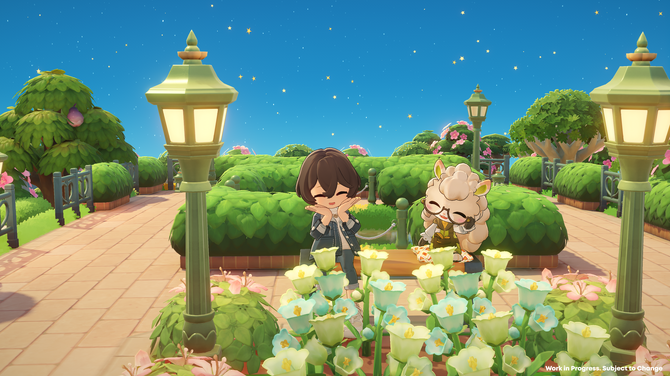
Regarding the social system, we aim to provide ample spaces and opportunities for those who seek to interact with other players. A key feature is the ability to build connections and bonds not only with friends you already know but also with strangers.
In the bustling town called “Star Market,” you can interact with players you don’t know. On the other hand, for those who aren’t comfortable socializing, we want to create an environment where simply sitting in the same place or gazing at the same things can give you a sense of connection with others.
If the relationship progresses from there, you can actually strike up a conversation or build a closer bond. We’ve created an environment where you can enjoy these various types of relationships.
――While playing this time, what I felt had particularly evolved was the “relationships with the NPCs” living on my planet. Each NPC has its own story, and I found the way intimacy deepens to be very original. How far can these relationships ultimately develop?
Murphy: If I had to describe it in one word, it would be “best friend.” In other words, the relationship can develop into something like a best friend.
Specifically, as your relationship deepens, you’ll gradually uncover the unique story and personality of each individual NPC. For example, you’ll learn why that character has the personality they do now and what events shaped their past.
Sometimes, they’ll even reveal a side of themselves to the player that they hadn’t shown before.
In real life, too, as you get closer to someone, your understanding of them deepens, right? In this game, we also want to express those changes in relationships and new discoveries.
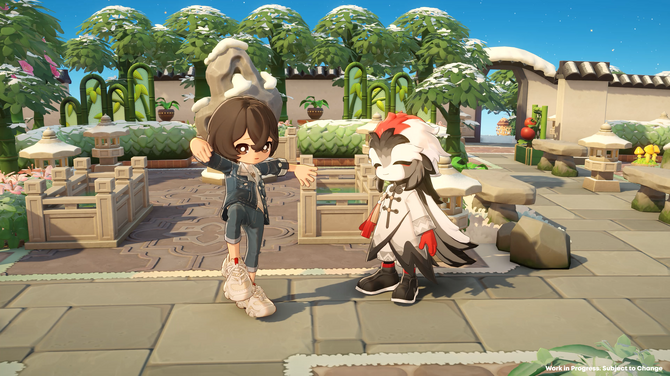
Yinli: Regarding the NPCs, we’ve established detailed settings for each one’s personality, story, place in the world, and role within the game. Building on that, we’ve also expressed each character’s individuality through the art design. We’ve created unique animations, facial expressions, and skin tones to ensure that every character possesses their own distinct charm.
We’ve also given each NPC their own charming traits, so I hope you’ll be sure to look out for them in the official release.
――Could you tell us why you decided to develop the Nintendo Switch 2 version? Also, will it be possible to share or sync data between the Nintendo Switch 2 version, the PC version, and the smartphone version?
Yinli: First, regarding the background behind our decision to release on Nintendo Switch 2, the main reason was that we believed our project was a good fit for the platform.
Therefore, from the very beginning of the project, releasing on the Nintendo Switch 2 has been one of our key strategic goals. We find it very rewarding to see this goal moving toward realization.
We’re also confident that, through our previous titles and development experience, HoYoverse has honed the technical capabilities necessary to release a game on the Nintendo Switch 2.
Regarding data synchronization, as of now, the official release is scheduled to allow data sharing between the PC and smartphone versions. We are currently in discussions with Nintendo regarding data synchronization between the Nintendo Switch 2 and the PC, or between the Nintendo Switch 2 and smartphones.

――The Nintendo Switch 2 offers various ways to play, such as Handheld Mode, TV Mode, and mouse control using the Joy-Con 2. Do you have any plans to add gameplay features that take advantage of the Switch 2’s unique capabilities in the future?
Yinli: At this stage, our development is focused on releasing the game on the Nintendo Switch 2 without any issues and at a quality level that will satisfy our players. We have not yet begun full-scale work on gameplay styles that take advantage of the Nintendo Switch 2’s unique features, as you mentioned in your question. If we have any information to share in the future, we will let you know.
――Personally, I think it would be fun if, for example, you could control fishing by shaking Joy-Con 2.
Yinli: I’ll pass that along to the development team (laughs).
――This snow season had a set duration, but will players who start the game partway through be able to experience the story that has unfolded so far? Also, will we still be able to meet the neighbors we encountered during the season even after it ends?
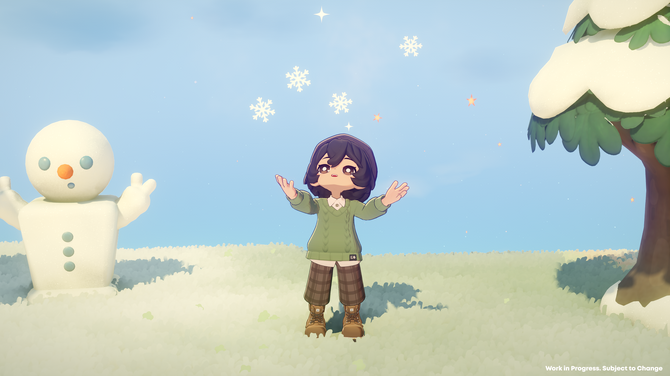
Murphy: Regarding the “Snow Viewing Season” that we were able to experience at this event, even if you join partway through, you’ll be able to experience all the content available during that season. We also plan to provide a way to play past seasons at a later date.
As for season-exclusive NPCs, while you may temporarily be unable to meet them after an event ends, we’re exploring ways for players to reunite with them in the future.
――In yesterday’s presentation, your discussion of the emotions you aim to evoke in players and the experiences you want to realize within modern society was particularly memorable. How do you translate those abstract concepts into the actual game systems?
Yinli: That’s a very difficult question, but I’d like to explain it using one example.
It concerns the action of picking up items, which I also mentioned in the presentation.
In the real world, picking up an object requires several steps. We conducted various tests to determine how to incorporate those subtle nuances into the game.
For example, early in development, we tried a system where players had to pick up each item one by one, as if they were actually doing manual labor. However, that didn’t provide a very good gameplay experience. So, we’ve been repeatedly testing with different user demographics and on various devices to make improvements.
――In terms of the actual development process, could you tell us about any particular challenges or memorable moments in your respective areas of responsibility?
Yinli: From an art perspective, the biggest challenge was, without a doubt, translating the abstract concept of “slow life” into actual production work.
We struggled to ensure that every team member understood this philosophy and could express it concretely in their respective tasks. I feel that sharing the concept was a much bigger challenge than the technical difficulties.
Murphy: From a game design perspective, designing the social system was particularly difficult.
There are many different types of players. Some want to actively interact with others, while others are more introverted and find it stressful when suddenly asked to interact. The challenge was ensuring that both types of players could enjoy the game comfortably. For that reason, we gather feedback from players every time we conduct a test and make repeated fine-tuning adjustments.
――During this playtest, I was struck by how the insects and fish have such cute, rounded designs. What approaches did you take to retain the characteristics of real-life creatures while minimizing any physiological aversion? Also, could you tell us about any creatures that were particularly difficult to create, or any that you personally like?
Yinli: Striking a balance between realism and cuteness was indeed a challenging aspect of the development process.
That’s why we conduct thorough research before production. We created a guideline for the design direction, with the left side representing realistic depictions and the right side representing anime or cartoon-style depictions. Based on research into what level of stylization people of various age groups and preferences can accept within that spectrum, we finalized the designs.
Personally, I prefer plants to creatures. Actually, plants were more challenging to design in some ways. Also, plants undergo visual changes, such as their leaves changing color with the seasons. We’ve incorporated those aspects into the game as well. I’m particularly fond of “fruit trees.” I find it charming that trees bearing various fruits appear, and their appearance changes with the seasons.
Murphy: My favorite is the “big fish” that appears in the game.
In this game, fish sizes vary by species, and their actual sizes are reflected in-game. When you reel in a very large fish, the player appears to be lifting it with both hands. At Star Market, you can even see players walking around while holding up giant fish.
My favorite fish is a species that actually exists in real life and is characterized by its long tail. I like it because catching this fish makes people think you’re a skilled angler.
――In this demo version, a lot of furniture and outfits were unlocked, and I was surprised by the sheer variety. How many pieces of furniture and outfits are available? Also, how will new items be added after the service launches?
■ Over 1,000 Free Items! We Also Delve into the Operational Policy and the Role of AI NPCs
Murphy: As of now, we have over 1,000 types of furniture and outfits available for free.
You can obtain these items by progressing through the basic daily life content. You can also acquire items that reflect a character’s personality by interacting with your neighbors. If you become friends with a character, you can even get matching outfits with them.
Furthermore, there’s the shop run by the NPC “Glen,” where the lineup is updated daily.
You may also discover furniture and outfits you haven’t seen on your own planet by visiting other players’ planets. We plan to continue adding new furniture and outfits in the future through version updates and seasonal events.
Some of these items incorporate elements of Chinese culture. Going forward, we hope to draw inspiration not only from China but also from various cultures around the world and incorporate those ideas into the designs of furniture, outfits, and other items.
――As a live service, what kind of schedule will you follow for content updates? For example, how long will the Snow Viewing season we experienced this time last? Also, are the main version updates and seasonal updates separate from one another?
Murphy: Regarding the core game systems, we’ll make improvements and updates as needed based on player feedback. We also plan to add festivals and events as needed.
As for seasonal events like the “Snow Viewing” season you experienced this time, we’re planning to run them over a longer period than in existing HoYoverse titles. Within each season, we’ll add new content or make updates at even shorter intervals.
While traditional titles like *Genshin Impact* typically release version updates approximately every six weeks, *Petit Planet* does not yet have a clearly defined update cycle.
Basically, our policy is to update content over a longer period.
――Can we consider regular version updates and seasonal updates to be the same thing?
Murphy: Yes. They are the same concept.
――Could you also tell us about monetization?
Murphy: Basically, we do not incorporate any “pay-to-win” mechanics.
We’ve designed the game so that players can experience the core gameplay, interactions with NPCs, and the social system without making any in-game purchases.
The main monetization elements we’re focusing on are items that change a character’s appearance. These are primarily cosmetic items, such as character outfits and furniture.
――I’ve been playing since the early beta, and I was surprised to hear that the NPCs, known as neighbors, speak human language. I imagine conversations could work with text alone, but could you tell me why you chose to have them speak human language and even include voice acting?
Yinli: First of all, the “neighbors” aren’t simply there to help players obtain items or achieve certain goals. We’ve designed them to be companions on equal footing with the players. Each NPC has their own unique personality, character, and emotions.
We felt that having voice acting would create a more realistic and immersive experience when conveying those emotions to players on an equal footing.
Furthermore, we don’t believe that text and appearance alone are sufficient to express a character’s personality. The tone in which a character speaks and the sound of their voice are also crucial elements that shape their personality.
We hope that, in addition to their appearance, their voices will help players deepen their understanding of the characters and serve as a starting point for building relationships. We plan to continue providing voice acting for as many characters as possible.
――This game also features AI-powered NPCs. At the same time, these NPCs have detailed backstories and narratives. How do you balance AI-generated dialogue with the stories crafted by the development team?
Yinli: The development team carefully crafts the main story and the narratives we want to convey to players. At this point, we are not using AI to generate the stories or scenarios themselves.
As for AI NPCs, we’ve given each one a unique personality, set of values, and character profile. The AI’s role is to converse and interact with players in natural language based on those settings.
While we do not use AI NPCs for the setting or creation of the story itself, we will continue to research new ways to play and express ourselves using AI in the future.
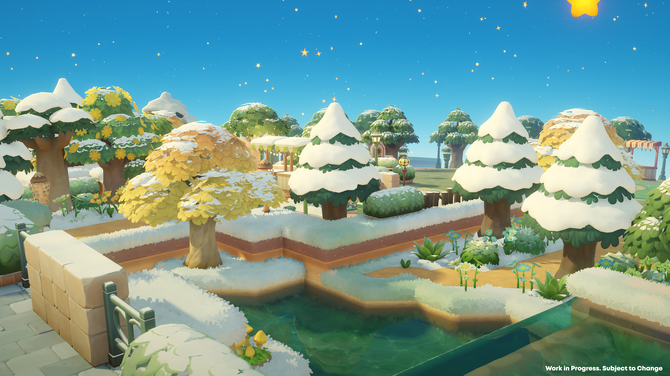
――During the snow season, the white background can sometimes make it difficult to see characters and furniture. What kind of artistic solutions have you implemented to address this issue?
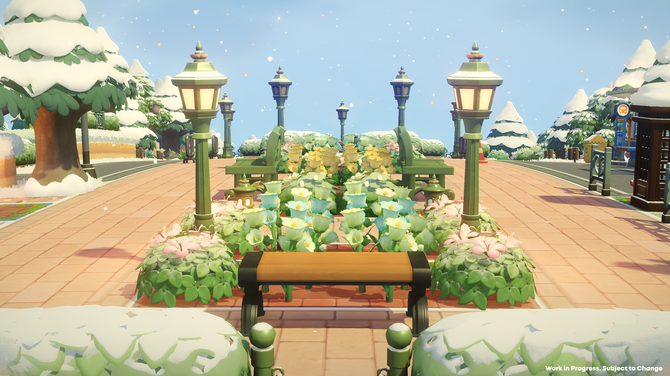
Yinli: We conducted various tests regarding the rendering of snowy landscapes. We experimented with how snow accumulates on various objects, such as buildings and furniture.
However, when snow accumulated even on small pieces of furniture, it sometimes made their distinctive features hard to recognize or detracted from the overall atmosphere. So, we adjusted the snow effects for each piece of furniture and building to determine what looked best. Through trial and error with each individual element, we’re crafting the overall visuals for the snow season.
――In this demo version, it seems like the Star Market has been expanded, and there are more mini-games as well. After the official launch, how do you plan to develop the Star Market?
Murphy: We designed the Star Market to be a place where players can meet one another. However, players have different personalities and styles of interaction. We’re focusing on a design that allows players of all types to find their own place there.
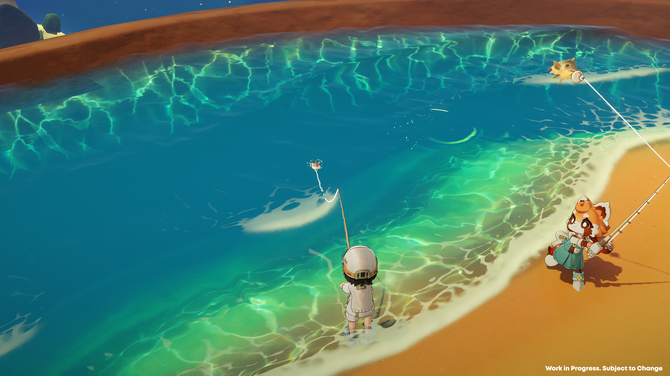
For example, in this version, there’s a spot where you can enjoy fishing on your own. Even players who are hesitant to actively interact with others can spend time there at their own pace. On the other hand, for those who want to enjoy livelier activities, we’ve also prepared areas where they can dance together with other players.
Moving forward, we plan to continue adding a variety of activities and spaces to Star Market to meet the needs of every player.
――Since this is a life simulation game, I think it’s important for players to be able to live freely. At the same time, through the initial beta tests and this hands-on demo, I got the sense that you’re also putting a lot of effort into storytelling. What kind of stories do you plan to develop going forward?
Murphy: Regarding the story, we’re considering three main directions.
First is the seasonal story.
Just like this Snow Viewing Season, we’ve prepared unique stories for each seasonal event. We hope players will continue to enjoy stories with different atmospheres and content every time a new season begins. These seasonal stories will serve as a major pillar for future story development.
Second are the backstories of each individual NPC.
In this game, every NPC has a backstory, and we’ve prepared a substantial amount of text to support them. As players interact with NPCs and deepen their relationships, these stories will gradually be revealed. These individual NPC stories are also a crucial element of the game’s storytelling.
And third are the small stories that arise from everyday life. As you log into the game each day, you may encounter little discoveries or unexpected events. You might go fishing and catch a fish you didn’t expect, or run into someone by chance. We believe that even these casual, everyday occurrences become stories in their own right for players.
We believe that not only the pre-written scenarios but also the small discoveries and surprises that players experience in their daily lives are an important part of our storytelling.
――Thank you very much for your time today!
© COGNOSPHERE. All Rights Reserved.
