


On November 5, 2026, Preferred Networks (PFN), a Japanese AI company, released “PLaMo 3 Translate,” an AI specialized in translation, as an open-weight model available for free.
Many gamers have given up on playing games after seeing “English only” listed as the supported language on a Steam store page. Volunteer translation efforts have long supported the ability to play such untranslated titles in Japanese.Since the newly released “PLaMo 3 Translate” operates entirely within the user’s local PC environment without requiring an internet connection, it has the potential to significantly lower the barriers to volunteer translation and gathering information from overseas.
Limitations of Cloud Translation and Challenges of Volunteer Translation
For titles without official localization, volunteers have traditionally extracted in-game text, manually revised machine-translated drafts, and distributed them as patches. For a long time, cloud-based translation services handled this initial translation work; however, the free version of DeepL—a leading service—imposes usage limits.
For volunteer translation projects handling game text ranging from hundreds to thousands of lines, hitting these usage limits means the translation process comes to a halt, effectively interrupting the work itself. Cloud-based tools also presented challenges when users needed to quickly translate only the changes added in an update or when working in areas with unstable internet connections.
AI Equivalent to “PLaMo Translation” Released for Free
According to announcements on PFN’s official X (formerly Twitter) and in a press release, the model released this time is identical to the AI actually powering the company’s “PLaMo Translation” service. By simply installing the model itself and the tools required to run it, users can utilize the translation functionality—previously available only online—in an offline environment.
Furthermore, according to the model page and license information on Hugging Face, “PLaMo 3 Translate” primarily features the following characteristics:
Lightweight design that runs on smartphones: PFN has released a demo video showing the translation feature running on a smartphone in airplane mode.
No usage limits: Since processing occurs on the local device without communicating with external servers, you can use the service without worrying about character limits or usage caps.
Support for 53 languages: It supports translation between 53 languages, including Japanese and English.
Free for personal use: It can be used free of charge and without registration for hobby or non-commercial purposes; commercial use is also free for companies up to a certain size.
Term and Style Specification Features: You can specify translations for specific proper nouns and select a writing style (polite “desu/masu” style or casual “da/dearu” style) based on the immediate context.For example, if you provide the context “I’m making origami” along with the sentence “I cut my hair,” the system will output “I cut the paper.” This mechanism helps prevent mistranslations of ambiguous terms, which are a common challenge in game localization.
Following the release of this model with these capabilities, it has attracted interest not only from users of generative AI but also from a wide range of audiences, including the gaming community.
Game Translation Tools Are Appearing One After Another
Within just a few days of the model’s release, independent developers have been releasing a steady stream of related tools that can be used for gaming purposes. Efforts have begun not only to translate existing data through volunteer contributions and access overseas information but also to translate in-game screens in real time.
For example, on November 7, 2026, “sonoba,” a PC resident app that instantly replaces English text on the screen with Japanese, was announced in a developer’s X post.It reportedly processes subtitles in about 1 second and short sentences in about 0.2 seconds; a demo video showcases real-time translation using a custom sample screen.
Additionally, starting with a developer’s X post on November 5, 2026, the browser extension “PLaMo_Translate_EX”—which can be used without account registration or usage limits—and the desktop app “plamo-translate-desktop,” which operates offline once downloaded, were also released.
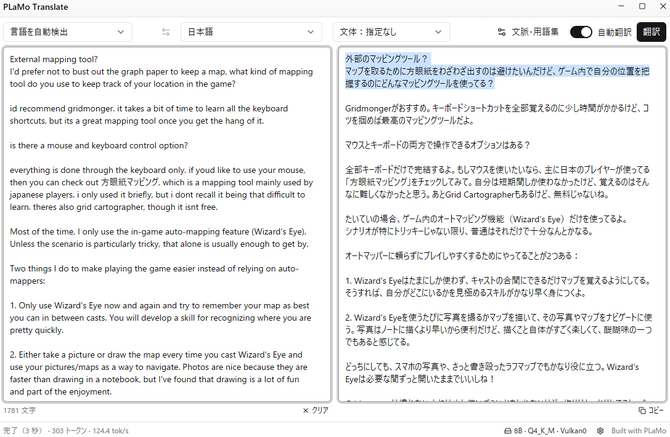
Furthermore, “game-l10n-updater,” a localization support tool designed to streamline the translation of changes resulting from game updates, has also been released.It is designed to translate only added or modified text—thereby avoiding overwriting manually revised translations—and incorporates a mechanism to verify on the actual screen whether the character count increases after translation and causes text to overflow from UI buttons. The developers themselves have reported the verification results in a technical explanation article.
“PLaMo 3 Translate” is currently available for free. To try it out easily, you can install dedicated execution tools such as “PLaMo_Translate_EX” or “plamo-translate-desktop” to experience AI translation in a local environment.
