


Ollie Bader, a subculture journalist, has become known to many Japanese people as “the foreigner who knows way too much about robot games and robot anime.” In recent years, his name has appeared not only in international publications like *Forbes* but also as a contributor to the official *Mobile Suit Gundam* website. He is also a game creator who has worked on various titles, including *Fortnite* and *Gears of War: Judgment*.
In this article, we’d like to share a glimpse of his perspective and aesthetic sensibilities regarding “robot games and robot anime” through his writing.
When Sega Transformed a Flight Combat Game Series into an Enjoyable *Macross* Game
We’ve previously discussed how Artdink’s *Macross* games and the idea that a *Macross* game developed by the *Ace Combat* team would likely be a masterpiece, but this time, I’d like to look back at the *Macross* game Sega developed for the PlayStation 2.
The main reason I’m so drawn to the idea of a *Macross* game developed by the *Ace Combat* team is that Sega had already demonstrated that an excellent *Macross* game could be created using a flight combat game as its foundation.
Specifically, Sega had a flight combat game series called *Aero Dancing*, which was released for the Dreamcast and PlayStation 2. This series was also released overseas, but for some reason, the title was changed to *Aero Wings*.
These games enjoyed a certain degree of popularity overseas and were well-known among many gamers at the time, as they were considered rivals to Namco’s *Ace Combat* series.
Consequently, when a *Macross* game developed by the same team at Sega AM2 was announced, many fans were extremely excited.
However, as was typical of “Macross” games at the time, this title was ultimately released only in Japan.
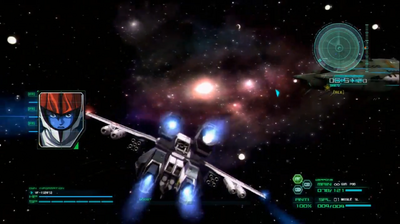

A Surprisingly Well-Made Flight Combat Game, But with a Unique Mecha Control Scheme

As expected, the flight combat in Sega’s “Macross” game was exceptionally well-done. Controlling the various Valkyries was intuitive and responsive, allowing for enjoyable aerial battles.
However, the most distinctive feature of these variable fighters was their ability to transform into two additional forms.
As with many robot games of the time, Sega implemented separate control schemes for each Valkyrie’s Gerwalk and Battloid forms. As a result, players had to readjust to a new control scheme every time they switched forms, making the controls feel somewhat clunky during transformations.
I recall that this was one of the main criticisms raised by overseas gamers at the time. I also remember that fellow game developers were critical of this approach.
If you’re interested in how robot game controls are generally perceived overseas, I’ve covered this in quite some detail in a previous article, so please be sure to check it out.

Spectacular Cinematics That Thrilled Overseas Fans
Of course, this game was only released in Japan, but those of us who imported it and played it in Japanese were deeply impressed by several of the game’s spectacular cinematic sequences.
For me, the highlight was the final stretch of the TV series route. The scene where you use reactive shells to destroy a massive Zentradi battleship while an entire enemy fleet engages in fierce artillery fire in the background was truly magnificent.
This was a masterfully executed sequence. While the gameplay itself at this point was relatively simple—merely closing in on and destroying enemy battleships—the animated skybox created a strong sense of immersion in the battle as a whole.
The cutscenes were also outstanding, perfectly recreating the anime’s direction and atmosphere. I remember thinking at the time that these scenes were truly well-crafted.
I’ve shown these sequences to friends involved in game development, and even back then, they were all left speechless, gazing in awe. As a PlayStation 2 game, Sega had undoubtedly created a truly impressive title.
Combat Using the Handy Head Laser and Gun Pods in Battloid Form
Another point I’d like to mention here is that most of the variable fighters in this game were equipped with head lasers—though, of course, the VF-4 was an exception.
In the original anime, the head laser was treated as a secondary weapon. However, in *Macross Zero*, which was released about a year earlier, there was a scene where the head laser was used to shoot down incoming missiles, which made it a well-known feature.
This made perfect sense from a mechanical design perspective as well. In Battloid mode, the primary optical sensors are located in the head, allowing the laser to directly track targets.
It also served as an effective way to utilize the Battloid form. The ability to intercept incoming missiles with the head laser was practically essential for players who wanted to achieve an S-rank on each mission without taking damage.
Furthermore, in Battloid mode, the variable fighter’s gun pods were equipped with an auto-aim function, which proved extremely useful when facing multiple enemies at close range.
As a result, while it took some time to get used to the controls for each form, each form had a distinctly different role, and all of them were extremely useful.
Solving the Problem of Fly-By Air Combat
I think what impressed people overseas the most when they saw this game was that it solved one of the biggest problems in flight combat games.
That problem is the need to use pitch, yaw, and roll to reorient your aircraft and bring the enemy back into your field of view after passing by it.This type of “jostling” (a passing battle reminiscent of jousting) and the subsequent need to reacquire the enemy aircraft are frequently cited as criticisms of flight combat games overseas.
Games like *Ace Combat* and *HAWX* feature mechanisms that allow players to continue visually tracking enemy aircraft even while changing the aircraft’s orientation. However, *Macross* offered a new and different approach, one unique to a title influenced by anime.
Specifically, by using the Gerwalk form—and more often, the Battloid form—the aircraft would automatically turn to reacquire the enemy. This eliminated the delay in reacquiring the target that occurred after passing an enemy aircraft in Fighter form.
In fact, this was one of the elements used as justification during internal discussions about why we should introduce robot forms in *Strike Suit Zero*, a game I later worked on. However, the Strike Suits in *Strike Suit Zero* had only two forms: Fighter and Robot.
I have stated many times before that *Blue Meteor SPT Rayzner* was one of the works that had the greatest influence on the game design of *Strike Suit Zero*.However, Sega’s *Macross* games, released for the PlayStation 2, also served as extremely useful concrete examples for explaining the benefits that robot forms bring to gameplay.
A fun title that proved robot elements could be incorporated into flight combat games
Although the controls for the Gerwalk and Battloid forms in Sega’s *Macross* game for the PlayStation 2 were a bit rough around the edges, it was still a very compelling game that made a strong impression on my colleagues at the time.
I, too, enjoyed earning an S-rank on every mission in the game and unlocking all the available variable fighters.
I also saw a trailer indicating that the YF-19 and YF-21 from *Macross Plus* were originally planned to be included in the game, but it seems they were removed just before release.
It was a shame that the game wasn’t released overseas at the time due to complex rights issues surrounding “Robotech.” However, it was somewhat well-known among overseas game developers and *Macross* fans.
Furthermore, this game demonstrated that, with a little ingenuity, a flight combat game could serve as the foundation for an excellent *Macross* title. And this brings us back to the topic of *Ace Combat*.
Considering that the current *Ace Combat 8* is beginning to incorporate elements from *Ace Combat 3*—which features a far more futuristic setting—I feel that creating another flight combat game based on *Macross* could be a success.
Furthermore, licensing issues with “Robotech” overseas have now been largely resolved. With that in mind, isn’t it about time we gave a new *Macross* flight combat game another chance?
Incidentally, Mr. O’Leary is reportedly looking for a studio or collaborators to create a “robot game.” Any studios or organizations interested in working with Mr. O’Leary to create a “robot game” are encouraged to contact him directly via the profile link at the end of this article.
