


Japanese people don’t tend to write reviews
――For *The Witch’s Garden*, which is already out in its official version, and *Cinderia*, which is currently in Early Access, which countries have the most users?
Kim: Overall, users from East Asia make up the largest group. Since the official release, we’ve had more feedback from the U.S. than we expected, which we’re very grateful for.
Koyu: For *Cinderia*, half of the players are from China, and 70% are from Asia as a whole. The rest are from Europe, the U.S., and other regions.
What I found interesting—I just checked a moment ago—is that *The Witch’s Garden* currently has a high percentage of Japanese players. The number of reviews from Japan is about the same as from South Korea. What’s more, there are over 300 Japanese-language reviews. Japanese people don’t usually write reviews very often.For *Cinderia*, even though Japan has the second-largest user base, the number of Japanese reviews has only just surpassed 100… In China, we get about one review for every 50 copies sold, but in Japan, it feels like we get one review only after selling over 100 copies.
Kim: As for the numbers, since I’m a programmer, I don’t know the exact statistics, but I had heard that there were more Japanese users than I expected. Actually… while everyone on the team checks all the reviews, of course, I personally get really hurt when I see bad reviews, so I haven’t been reading them much. That’s why I really didn’t know.
――As a developer, it’s something you can’t help but be concerned about, isn’t it? Regarding the wishlist for *Crymlight*, what’s the current situation, within the scope you can share?
Isobe: About 40% are from Asia, followed by North America, and then Europe. In terms of language, English is the second most common after Japanese. The “Cry” series originally started with *CRYSTAR*, and I think the fact that it had a large user base in North America and Europe probably plays a role here as well.I think people are interested simply because it’s a new title with the “Cry” name attached.
Koyu: Excuse me, may I ask for some specific numbers?
Isobe: The wishlist currently stands at around 70,000 (at the time). The challenge is how much awareness we can build among Chinese players going forward. With our recent titles, Japan has consistently ranked first after release, but in terms of user numbers, China is overwhelmingly larger.
Koyu: How many people are on the development team?
Isobe: Let me see… We’re not exactly a large company, but since we’re operating as a company, it’s more like “the company has a small team.” As for the core team I’m directly coordinating with, I’d say there are probably fewer than 20 people.
――How many people are working on *Cinderia*?
Koyu: When we first started, it was about five or six people. Now we’re over ten, though some staff members are juggling this with other projects.
Kim: If we’re just talking about the *Witch’s Garden* project, we’re currently developing it with about nine people. Since we started out as a team of college students, there are only about four or five of us who are core members. As *Witch’s Garden* has grown into a larger project, various people around us have joined in to help out. We don’t know yet what our next project will be.
Ultimately, we want people from our hometown to play it
――Are there any areas where you’d like the game to become more popular in the future?
Kim: Honestly… anywhere (laughs).
I think our team’s art style tends to be particularly well-received in East Asia.However—and this is my personal opinion, not the team’s—the roguelike genre itself originated in the West, as seen in *The Binding of Isaac* and *Hades*, which I mentioned earlier, and more recently, *Cult of the Lamb* also shares some similarities with us in terms of art style.So personally, I’d like to see if we can make a bit more of an impact in the West as well.
Koyu: There are two sides to this. First, I’d really like *Cinderia* to resonate a bit more with Western audiences.In my opinion, when people in the West see these anime-style characters, they naturally assume at first glance, “This doesn’t look like it’ll be fun.” This art style actually becomes a drawback. Ideally, I’d like to promote the game aggressively, make it fun to play, and correct that prejudice—though I wouldn’t necessarily call it a prejudice.
On top of that, ultimately, I really want it to be popular with people in China. There’s an overwhelmingly large number of gamers there, and besides… well, I really want people back home to enjoy it.
—Is there anything specific you’re planning to do to achieve that?
Koyu: I’ve been attending various game shows and conferences lately, but some trips have taken as long as 16 hours by plane… Right now, I’m thinking of dedicating a bit more time to actually making the game. I believe that if the game itself is fun, everything else—sales and all—will naturally fall into place. Well, that said, we’ll still do our best with promotion.
Isobe: Of course, we want it to be well-received in Japan, but since we don’t support that many programming languages, our first priority is to physically expand the number of languages we support.But the budget… (laughs) *Crime Light* has a lot of technical terms, and we just can’t guarantee the quality with AI translation. So, we’re planning to release it in the major languages first, and hopefully add more supported languages down the road.
If the three titles were to collaborate—"Draw them in and make them cry"
――Since we’ve gathered these three titles here, feel free to let your imagination run wild. If a collaboration were possible, what kind of thing would you like to try?
Kim: As a programmer, a realistic answer would be that skins would be the safest bet. However, since I’ve been in charge of action and combat pacing during development, the first thing that comes to mind is having bosses appear in each other’s games. I think that would be really fun.
Koyu: I’d love to do a bundle with *The Witch’s Garden*.
*Crime Light* is about to be released, so I don’t have any concrete ideas yet about what we could do, but I really felt the passion behind the story. I’d love to know how you managed to write a story like that. (laughs)
Isobe: You’re absolutely right—your two works really have that “Action, action!” vibe, don’t they?We really value the story as well, so even though we’re both roguelikes, I get the impression ours is a little different. Many of our players say they “want to see the story,” so we prioritize that too. So, if we were to collaborate… I’d like to have each of our characters appear and make them confess their sins.
Koyu: Bring them in.
Isobe: Let’s incorporate them. I’m sure it’ll be a story that brings tears to your eyes. (laughs)
At that point, a staff member from the *Cinderia* team who was sitting with us chimed in with a suggestion. “I think there are ways we can collaborate outside the game as well.We set up a large booth at an event in Shanghai before, and I’ve been thinking for a while about whether we could partner with similar types of games to make better use of the booth. The costs are high, and there are aspects we can’t fully cover on our own. Since I think the user bases of these three titles are similar, could we collaborate in the future, perhaps through a joint booth?” The idea is that we could join forces not just within the game, but outside of it as well.
Team Tapas also had a delightful surprise in store. For that day’s roundtable discussion, the team’s artists had prepared brand-new illustrations of characters from all three games, drawn in the “Team Tapas style.” Participants reacted with comments like “Cute!” and “I’m so happy!” Perhaps the collaboration has already begun.
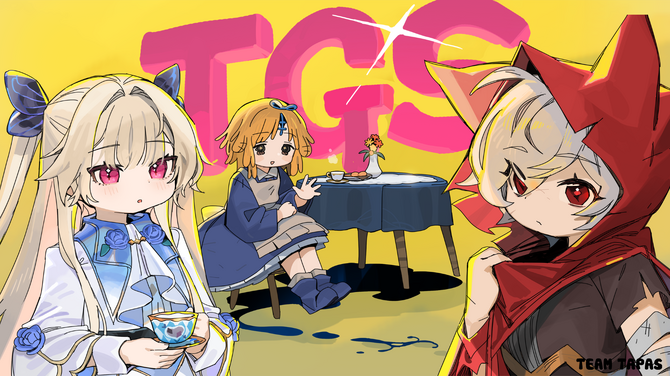
“I’d be happy if I could become friends with everyone.”
—Finally, please share your plans for the future and a message for our readers.
Kim: First of all, I’d like to express my sincere gratitude to everyone who has played *The Witch’s Garden*. Although we’ve just reached the official release, we plan to add various modes, such as Challenge Mode, in the future. We look forward to your continued support with future updates. And please stay tuned for Team Tapas’s upcoming titles!
Isobe: Unlike the other two, our title hasn’t been released yet, so we hope to work with everyone to make it even better by actively incorporating the feedback and comments we’re receiving through the demo currently available. We look forward to playing it with you all on release day.Please be sure to add it to your wish list—I hope this will help build excitement for the “Kurai” series, so I’d appreciate your support.
Koyu: Um… well, I really want to communicate more with Japanese players. Japanese people just don’t write reviews at all.
I’ve said a lot of weird things today, and I’m regretting it a bit. Anyway, I just want to make more friends with everyone—with Japanese people and Japanese players. I’d be happy if I could become friends with everyone.
――Thank you very much for your time today.
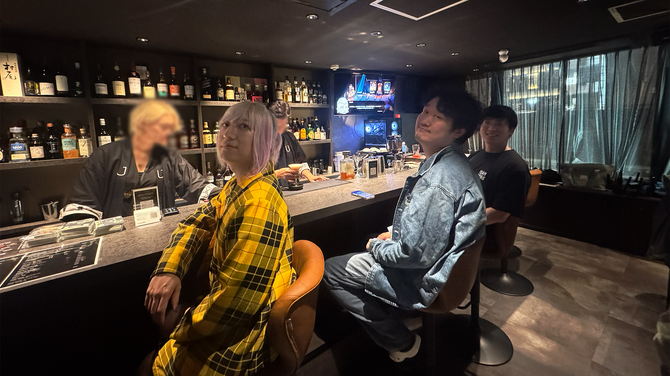
Koyu, who flatly answered the question “Why make a roguelike?” with “To be honest, it’s the cost”; Kim, who chose the genre based on the feel of the action; and Isobe, who needed the “restart” structure for the sake of the story. While their starting points were all different, they share a common approach of making repeated adjustments while listening to player feedback.It was also striking that both Mr. Koame and Mr. Kim based their numerical decisions on the premise that “players are a little clumsier than creators think.”
What stuck with me most, however, was Ms. Koame, who spoke all the way through in Japanese—a language that isn’t her native tongue. She prefaced her candid remarks multiple times with “This is a risky topic,” and her final words weren’t a promotional slogan, but simply, “I want to be friends with Japanese players.”For him—who repeatedly noted that Japanese players don’t tend to write reviews—a single line in Japanese posted in the Steam reviews section might be the best “friend request” of all. If you enjoy the game, please be sure to share your thoughts in a review.
*Crymelight* is scheduled for release on PC (Steam), Nintendo Switch 2, and PS5 on Thursday, November 5, 2026. A demo available on Steam lets you play through the end of Chapter 1.*Cinderia* is currently available in Early Access on PC (Steam), and *The Witch’s Garden* is available on PC (Steam).
