


This series features interviews with the developers of intriguing new indie games. In this installment, we present a mini-interview with the developers of “Sefira,” a roguelike action RPG developed by TEAM HORAY and released for PC and Mac on July 31.
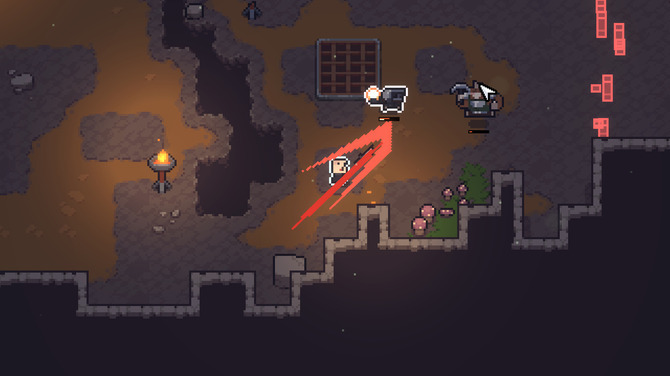
This top-down roguelike action RPG is brought to you by the team behind the 2D side-scrolling action game *Dungreed*. Players take on the role of a brave rabbit embarking on a journey to save their homeland from destruction. Master six types of weapons with over 200 upgrades and acquire new abilities with each playthrough.Another key feature is the inventory management system, where players place approximately 300 types of artifacts and tablets—each with unique effects—into boxes to unlock new abilities. The game also supports online co-op for up to four players and is available in Japanese.
“Sefira” is available now for 1,980 yen.

――First, please introduce yourself. What’s your favorite game?
Taehyun: Hello, I’m Taehyun Ahn, team leader of TEAM HORAY. Following the release of our debut title, *Dungreed*, in 2018, we’ve now officially launched our new game, *Sefira*.
As a game developer, I believe it’s important to enjoy a variety of games without being confined to a specific genre, so I’ve played titles across a wide range of genres.There are so many great games that it’s hard to pick just one, but if I had to name three that come to mind right now, they would be *SEKIRO: SHADOWS DIE TWICE*, *Noita*, and *Persona 5 The Royal*.I think each of these is a wonderful title that successfully combines a strong sense of identity with exceptionally high quality within their respective genres: action, roguelike, and JRPG.
――Could you tell us about the key features of this game? Also, how did you come up with the idea for it?
Taehyun: I believe the biggest feature of *Sefira* is its inventory system.While this is fundamentally an “inventory-building” game, I also wanted players to experience the exhilarating sense of speed typical of a high-speed action game. That’s why I spent a great deal of time figuring out how to create an “inventory system that is simple yet deep.”
In *Sefira*, there are two types of items: “Artifacts” and “Tablets.” To maximize the performance of Artifacts, you need to arrange them strategically within your inventory. The prototype for this item structure actually comes from our previous title, *Dungreed*.In *Dungreed*, there were items called “accessories” that granted special effects when equipped. When we decided to create a top-down roguelike as our next project, we wanted to allow players to equip many of these accessories.Recalling how deeply I’d been impressed by the charm system in *Diablo II* when I was a child, I adopted a system where items take effect simply by being in the inventory.
But that’s not all.I was further inspired by the spell system in *Noita*. In *Noita*, you can create a vast array of variations simply by how you arrange spells within a staff. We thought this was incredibly cool, so we went through a lot of trial and error trying to figure out how we could incorporate the fun of “power-ups through arrangement” into *Sefira*.
However, simply replicating *Noita*’s spell system would have made the game too complex, so after much deliberation, we arrived at the concept of “tablets.”Each artifact has a level, and a stone tablet raises the level of adjacent artifacts. In this way, we sought to strike a balance that allows players to experience the “joy of placement” without making the system overly complex.
――Were there any games that influenced the development of this title?
Taehyun: In addition to *Noita* and *Diablo II*, which I mentioned earlier, numerous other games have had a major influence on *Sefira*. For example, in terms of how to convey the story to players within the roguelike genre, we drew inspiration from *Hades*, and regarding the ability to try completely different builds every time you play, we were inspired by *Nova Drift*.
Furthermore, our previous title, *Dungreed*, served as a major starting point. We aimed to build upon the aspects of *Dungreed* that received high praise while improving the areas we felt were lacking.

――Please share one of the most memorable moments from the development of this game.
Taehyun: When we first started developing *Sefira*, we designed it as a single-player game. But one day, I suddenly decided, “I want to add multiplayer.”I was optimistic, thinking, “It probably won’t be that hard,” but converting a game built for single-player into one that supports multiplayer turned out to be an unimaginable amount of work. It was practically like rewriting the code from scratch.
After about a year of development, we were finally able to unveil multiplayer in the pre-release demo. It was an incredibly tough journey, but seeing players enjoy the game with their friends makes me feel from the bottom of my heart that “adding multiplayer was truly the right decision.”
That said, this was also a major lesson for us. For our next project, we plan to create a much more detailed plan from the very beginning to avoid having to rewrite the code later on.
――What kind of user feedback have you received since release? Please share any particularly memorable comments.
Taehyun: Since Early Access, we’ve received an overwhelming amount of feedback and words of encouragement through various channels, including our official Discord, the Steam community, and email. Throughout that time, we’ve done our absolute best to incorporate players’ opinions into the game as much as possible. I believe it’s precisely because of these cumulative efforts that “Sefira” is what it is today.
Recently (as of the time of this interview), the number of reviews on Steam has surpassed 11,000, and 94% of them are positive. Honestly, it feels like a dream.
What has impressed me the most recently is that players have taken the initiative to set up build-sharing sites and upload videos of their builds to YouTube.Some players perfectly understand exactly what we intended, while others discover amazing combinations that even our development team never imagined. Seeing all of this is incredibly fun for us, too.
――Taking user feedback into account, could you tell us about your plans for future updates?
Taehyun: We’re currently working on developing new content and balance adjustments for *Sefira* based on the feedback we’ve received from players. We haven’t set a specific roadmap for after the official release, but we plan to roll out updates sequentially as soon as they’re ready.
We’re also considering adding support for the Steam Workshop. While setting up a Workshop isn’t particularly difficult in itself, since *Sefira* is a multiplayer game, we’re currently carefully exploring a system that allows Workshop content to integrate naturally without causing any inconvenience to our players.
Please continue to look forward to the future of *Sefira*!
――Could you tell us about the Japanese language support for this game? How has the response been from Japan?
Taehyun: “Sefira” supports gameplay in Japanese. We are currently working on the Japanese translation with the help of some acquaintances. We’ve also received a lot of feedback regarding the translation from Japanese players, and we’re actively incorporating that feedback into our updates.
――Is it okay to stream or monetize this game?
Taehyun: Yes, of course! You don’t need to ask for our permission at all. The entire development team is really looking forward to seeing all kinds of videos—whether they’re sharing your impressions of the game, streaming multiplayer sessions with friends, or showcasing recommended builds.
――Finally, please share a message for our Japanese readers.
Taehyun: It’s been eight years since Game*Spark published an interview about *Dungreed* back in 2018. I’m truly delighted to be able to greet everyone in Japan again like this!
I personally love traveling to Japan, and I’m slowly studying Japanese (though I’m still very much a beginner).This time, we exhibited *Sefira* at the “Tokyo Game Show 2026,” and I had a truly wonderful time talking with so many Japanese players. I hope that someday I’ll have another opportunity to interact directly with Japanese game developers and players!
Going forward, we plan to continue delivering updates for *Sefira*, of course, as well as new games that many people will enjoy. Please look forward to TEAM HORAY’s future endeavors!
――Thank you very much.


◆ About “Spotlight on Indie Mini-Q&A”
This series features email interviews with indie developers shortly after their games are released. To ensure regular publication, we’ve standardized the questions, with the goal of sharing the voices of as many developers as possible. Please also enjoy our other interview articles, which now number over 1,000.
