


While there are many “Hollywood-style games” that blend gunfights and explosions with cinematic flair, it’s rare to come across a game where you can become the hero of a kung fu movie.
*Phantom Blade Zero*, which builds its combat system on the foundation of Chinese martial arts, was such an intense and incredible action game for me—a huge fan of Hong Kong action stars like Jackie Chan, Jet Li, and Donnie Yen (who also served as the game’s creative consultant)—that it went beyond just “hitting the spot”; it was so intense I thought I might actually die.When I encounter an action game this overwhelmingly good, along with the joy, I can’t help but feel a twinge of anxiety, wondering, “Will I ever be satisfied with any game I play from now on?”
That said, it wasn’t all fun and games from the very start.
In the early stages of the game, the combat felt a bit fiddly, and I found myself thinking, “This might not be what I expected.”Based on the trailers I’d seen before release, I went into the game expecting pure action where I’d rely solely on my own skills. But the moment I realized this was actually an action RPG where exploration and character growth are just as important, the game’s world, balance, and gameplay experience all clicked into place at breakneck speed—and it became a title that left me cheering inside nonstop.In this article, I’ll share my impressions of the game in the form of a review.
Additionally, for the purpose of writing this article, I received a PS5 version code from S-GAME.
Action that stays true to the basics yet remains engaging
The action in *Phantom Blade Zero* is similar to a “parry game,” where stringing together just guards is key, and the system itself doesn’t feature any notable innovations.
However, the game is fully equipped with unique features and elements that set it apart—namely, the fact that it “incorporates the fluid action of kung fu movies into its combat system.” In other words, its appeal is concentrated entirely on the fact that “players can become the cool protagonist of a kung fu movie.”
In short, both the enemies and the protagonist move incredibly well! They throw their entire bodies into the action, soaring through the air and spinning as they clash with each other using spectacular martial arts techniques at full force. Even the run-of-the-mill grunts deliver attacks with tremendous force, and at first, you’ll likely be overwhelmed by the sheer speed of it all.
Against enemies who launch rapid attacks, you’ll need to block or dodge. While you can parry by holding down the block button, this consumes your Killing Intent Gauge (stamina). Since you can’t block enemy attacks once your Killing Intent Gauge hits zero, holding down the block button also carries the risk of being cornered by enemies.
If you time your block perfectly to match an enemy’s attack—a “Just Guard”—you won’t consume your own Rage Gauge and can efficiently deplete the enemy’s. Depleting their Rage Gauge triggers a Guard Break, leaving them staggered and open to a flurry of attacks. Now it’s your turn to show off your spectacular kung fu.
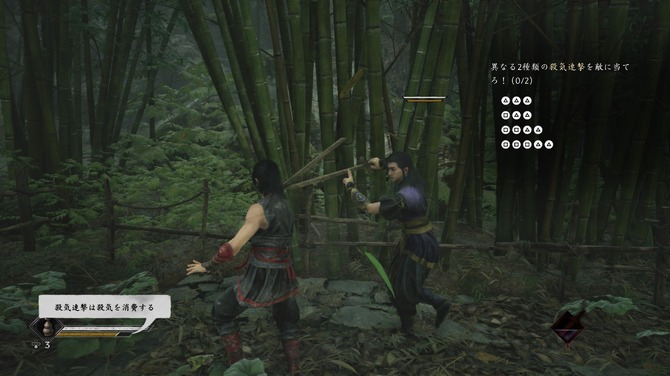
Attack actions branch out from a combination of the Square button’s normal combos and the Triangle button’s Killing Intent combos, each with its own unique animations. Killing Intent combos consume your Killing Intent gauge and allow you to break the opponent’s guard more quickly.Landing Normal or Killing Intent Combos fills the Pure Killing Intent Gauge, and consuming this gauge allows you to unleash a “Special Move” that deals massive damage. If you approach an enemy that is both near death and in a Guard Break state, an “Execution” is triggered, finishing them off with a move that is as beautiful as it is brutal.
To summarize, the basic flow of battle involves parrying the enemy’s fierce attacks with Just Guards or dodges, then dealing damage with combos and Ultimate Techniques during Guard Break to deliver the finishing blow. While the system is simple, the Kung Fu action looks absolutely stunning, and I was immediately captivated the moment I started playing.
Furthermore, the protagonist can equip two main weapons and two secondary weapons—activated with the R2 button—allowing you to chain attacks by switching between them or deal massive damage with a single powerful strike.

Switching main weapons fills the Killing Intent gauge to maximum, so it was fun to devise my own “powerful” and “cool” moves—such as following up a Killing Intent combo with Weapon A with a standard combo using Weapon B.Since switching weapons has a cooldown of a few seconds, the gameplay feels slightly different from systems like those in *Devil May Cry 5* or *NINJA GAIDEN 4*, where you chain combos with real-time weapon switching—making the timing of your switches crucial.

This game revolves around perfectly blocking enemy combos, which is why it features a unique customization option. Believe it or not, you can adjust the “tone” and “intensity” of weapon collision sounds right in the audio settings.
You can find the sound that suits your preferences, whether you prefer a deep, heavy tone or a sharp, crisp one.Since I’m a firm believer that “the louder the sound effects in an action game, the better,” I set the impact sounds to be slightly louder and with a heavier tone, which made combat feel even more satisfying. The vibration feedback when performing a just guard against enemy attacks also has a pleasant contrast between strong and weak impacts, and since you can adjust the sound settings, it’s fun to experiment and find the parry setup that works best for you.
Endless Motivation Through Exploration and Growth
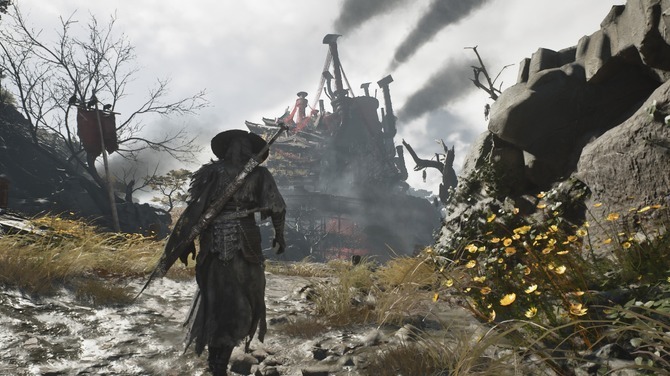
The reason I mentioned at the beginning of this article that “combat feels uncharacteristically fiddly in the early stages of the game” was because I hadn’t prioritized exploration and character growth. I had mistakenly assumed this was a game like *SEKIRO: SHADOWS DIE TWICE*, where you advance almost entirely on your own skill.Partway through, the moment I “realized” that “it’s also important to focus on developing the protagonist’s skills and weapons, and that requires thoroughly exploring the field,” my motivation soared and the game became even more enjoyable.
An important point to note is that, unlike Souls-like ARPGs, enemies in this game do not respawn on the field. To actively level up the protagonist, you need to explore and complete side quests.At first glance, this might sound like a slightly tedious mechanic, but there are two major reasons that make you want to take detours. One is the presence of compelling bosses that exist separately from the main story progression. The other is that you can obtain unique weapons from the bosses you defeat.
First, regarding the no-respawn mechanic, I personally found it quite appealing. It simply offers many benefits to the player. For example, suppose there are three moderately strong grunts along the way; if you defeat one and then get a Game Over, two grunts will remain in the same spot.This system acts as a safety net for beginners, allowing them to clear even tricky sections after a few attempts, and I also appreciate how the gradual disappearance of enemies makes it feel like you’re “purifying” the world.
While you can’t farm experience points by exploiting the respawn mechanic, this game also doesn’t make you lose experience when you die. *Phantom Blade Zero* solves the problem of monotony—fighting the same enemies over and over in the same spot—with a truly bold approach: by placing numerous compelling bosses throughout its vast fields.
If you take detours while exploring the field, you may encounter boss characters; if you defeat them in battle, you’ll be able to use the weapons they were carrying. You can equip these as either main or secondary weapons, and the level of detail in each weapon’s design is truly remarkable.
As mentioned earlier, the main weapon’s actions branch out from a combination of normal combos and “Kill Intent” combos, and the animations for every single weapon are meticulously crafted. Many players will likely start swinging their new weapons around the moment they acquire them, and they’re sure to be impressed by the fluid movements and striking individuality of each one.
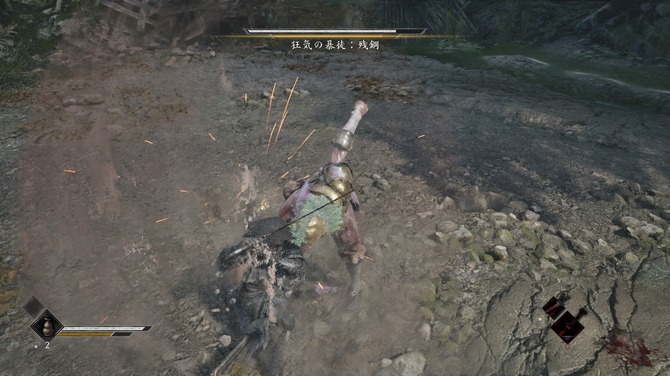

Furthermore, when you enhance your weapons using experience points and materials obtained through field exploration, leveling them up unlocks new techniques. Whether it’s holding down a button, entering simple commands, or performing counterattacks, each weapon offers not only distinct movements but also different gameplay styles—which makes fighting enemies even more enjoyable.Since the experience points and materials used to upgrade weapons can be reset and reacquired, it’s possible to power up a newly obtained weapon all at once. I realized this a bit late myself, but by taking advantage of this system, enemies become easier to defeat, and the game’s appeal as an action RPG truly comes into its own. Upgrading is crucial.
Additionally, certain areas of the field become accessible only when using specific weapons. This creates a motivational cycle: you acquire a cool weapon → you can access a new area → you encounter a different boss → you gain new actions through experience points → you want to fight more, so you explore further. With compelling bosses and weapons scattered throughout the field as rewards, I was able to enjoy exploring all the way to the end without ever feeling bored.

As for the fields themselves, the balance between size and density is just right. It doesn’t have the vastness of an open world; instead, each field is structured with several routes leading to main and side quests. With vertically layered fields, a manageable number of branching paths, and fast-travel points, I never felt the stress of getting lost more than necessary while progressing.
You can earn experience points by collecting text passages placed along the way and items like “Flowers of Memory,” which increase your maximum HP when you collect multiple of them. Since enemies don’t respawn, the game effectively uses them as markers—for example, “I haven’t seen any enemies for a while, so I must have passed this area” or “If I spot an enemy, it means I haven’t taken that route yet.”

After obtaining a key needed to progress through a certain side quest and moving forward—just as I was thinking, “I wonder if there’s a little event coming up?”—I was genuinely surprised when a vast new area was unlocked. This game simply has an incredible amount of content.
A fresh and endlessly engaging variety of boss battles

I mentioned the appeal of boss battles as a motivator for exploration, but the wide variety of battle scenes is also a must-see.
A wide variety of bosses await, ranging from humanoid enemies the same size as the protagonist to giants that appear to be over 3 meters tall, illusionists who dance through the air, and even—of all things—a lion dance.While each character is eccentric, their cool designs give a sense of a cohesive world. Every single one of them launches fierce attacks with unique and spectacular moves, so as a kung fu fan, there were moments when I got so mesmerized that I ended up dying (just an excuse).
Many bosses will finish off a combo with a powerful, aura-emitting strike.A “blue attack” can be effectively countered with a “just guard,” while a “red attack”—which cannot be blocked—can be turned into a counterattack by performing a “just dodge.” Moves like sliding past an enemy’s attack to circle around behind them, or landing a roundhouse kick right after parrying their strike, are incredibly satisfying and cool—they let you interrupt their moves and seize the initiative.
Additionally, attacks that turn the background monochrome will drain almost your entire Killing Intent gauge if you block them, so dodging is just as effective here as it is for red attacks. If you do end up blocking one, you’ll need to recover by switching weapons to fully restore your Killing Intent gauge and create a situation where you can guard against the enemy’s follow-up attack.

The window for dodging red attacks is particularly tight, and I took damage quite frequently until I got used to it. Since these attacks follow intense combos and are often accompanied by an aura of some sort, they require tremendous concentration and quick decision-making.The rapid back-and-forth between offense and defense gave me a strong sense of immersion—I found myself thinking, “Ah, I’m actually doing kung fu right now…!” It’s far more mentally and physically demanding than it appears in trailers or gameplay footage, and the catharsis you feel when you overcome these exchanges is sure to captivate many players.
Furthermore, in the main story’s key boss battles, Round 2—featuring the boss’s second form—awaits. Since it attacks with move sets almost entirely different from its first form, it felt like fighting an entirely different boss. Given the immense effort that must already go into a single character, I was genuinely moved by the luxury of having this many unique animations prepared for a single character.There’s virtually no sense of repetition that makes you think, “This boss again?” Whether you’re progressing through the main story or exploring side quests, fresh battles are served up one after another.

While these boss battles are incredibly engaging, there are two aspects regarding the sense of accomplishment that give me pause. The system where retries start from the second form, while making the battle pace more comfortable, might feel like it dampens the sense of accomplishment for some players. In many so-called “die-and-retry” games, you need to defeat the boss from the first form through the second form or beyond in one go, while skillfully managing your limited healing items.As you adapt to each form’s movements, you gradually land more hits than you take, leading to a sense of catharsis when you finally defeat the formidable foe. In this game, however, if you’re defeated during the boss’s second form, you restart from that point—so compared to other high-difficulty games, the sense of accomplishment upon victory felt slightly weaker.
Additionally, the enemies’ onslaught is so ferocious that it’s hard to feel like you’ve truly read their moves. The tricky movements of Chinese martial arts are difficult to predict, and I don’t think there was ever a moment where I managed to just-guard the entire sequence after getting a feel for the rhythm. It left me with the impression that “I just spammed buttons a bunch and somehow pulled it off.”The fast-paced back-and-forth combat itself is incredibly fun, and while you can win by getting a handle on the enemy’s rhythm to some extent, the perfectionism required for “just guards” might make this game feel just a little less enjoyable. It was so difficult for me to handle everything perfectly that I found myself wondering, “Is it even possible to clear this without taking any damage?”
As for the game’s difficulty levels, there are four options available: “First-Time Player” for beginners, the well-balanced “Survivor,” the high-difficulty “Defier,” and “Sixty-Six Days”—a mode exclusive to the second playthrough where the game ends after 66 deaths.Except for “Sixty-Six Days” mode, you can switch difficulty levels at the start or during gameplay. I played on “Those Who Escape Adversity,” but it felt like a high-difficulty setting—almost like a “die-and-retry” game—throughout the entire experience.
Unreadable Kanji and Unstable Performance
This action RPG follows the protagonist, “Soul,” who has been given 66 days to live, as he uncovers the truth behind the conspiracy surrounding him and the crisis threatening the world.
The story unfolds through cutscenes in the main narrative and text scattered across the field, but since the game’s world is heavily influenced by Chinese wuxia culture, it features a mountain of character names and proper nouns written in unfamiliar kanji.For example, while the protagonist’s name is officially listed as “Soul,” the game uses the kanji character “魂,” making it impossible to determine the correct pronunciation at first glance. There are also numerous other character names and proper nouns with unclear pronunciations; I didn’t even figure out the name of Soul’s sworn brother—an important character—until the very end.
I would have appreciated it if the game had been a bit more user-friendly for Japanese-speaking players—perhaps by including English transliterations above the kanji or standardizing names using katakana. Not knowing how to pronounce the proper nouns in the game creates a somewhat high cognitive load when trying to understand the story and text, making it difficult to immerse myself in the experience.
Partway through, I stopped trying to treat them as “words” or “language” and instead began to view the unreadable kanji as design elements—understanding them based on their shape rather than their meaning. It might be similar to how someone from outside the Japanese-speaking world might get a kanji tattoo. It’s a sense of, “This character refers to that character or concept.”I felt ashamed of my college self, thinking, “I really should have taken my Chinese classes more seriously.”
Also, the gameplay was somewhat unstable at times. There were scenes where I wasn’t entirely satisfied with my victory—such as when certain bosses I faced early on disappeared behind “invisible walls,” making my attacks ineffective, or when I managed to defeat a boss that had gotten stuck by keeping my distance and using a hit-and-run strategy.There were also scenes in some cutscenes where the lip sync didn’t match the dialogue, leaving me with some lingering concerns about stability. As a user, I hope these issues will be addressed in future updates.
As a fan of action games and kung fu movies for over twenty years, I’m not exaggerating when I say that playing *Phantom Blade Zero* felt like a complete affirmation of my entire life. I never imagined the day would come when the kind of battles I used to watch on the big screen or TV—like those of movie stars—would be recreated in the form of a video game.
I mentioned the translation as a drawback that made it difficult to immerse myself in the story, but let’s face it—kung fu movies are a genre where “amazing action and charismatic bosses are all that matter.”
Just as I was captivated by kung fu when I was a child, this game is sure to move action gamers all over the world. And it’s likely that for the next few years, I won’t come across a kung fu action game that surpasses *Phantom Blade Zero*. In that sense, it looks like I’ll be spending a long time with this game.
Game*Spark Review: *Phantom Blade Zero* PS5/PC (Steam/Epic Games Store) October 29, 2026
A masterpiece I’d recommend to all lovers of kung fu movies
-
GOOD
- Stunning and Overwhelming Kung Fu Action
- Motivation to explore that lasts until the very end
- Diverse and never-boring boss battles
BAD
- Immersion is diminished by hard-to-read kanji
- Slightly Unstable Performance



