


The *Persona* series, which began with *Megami Ibunroku Persona*, is a popular franchise that has released five numbered titles to date, culminating in *Persona 5*.Looking ahead, *Persona 4 Revival* is set for release on February 18, 2027, and in June 2026, the production of *Persona 6*—the latest numbered entry in the series—was announced, along with the release of a teaser trailer.
However, the series’ journey has by no means been smooth sailing; with *Persona 3*—which marked a turning point for the series—the developers found themselves in a do-or-die situation, seemingly compelled to explore new ways to captivate players.
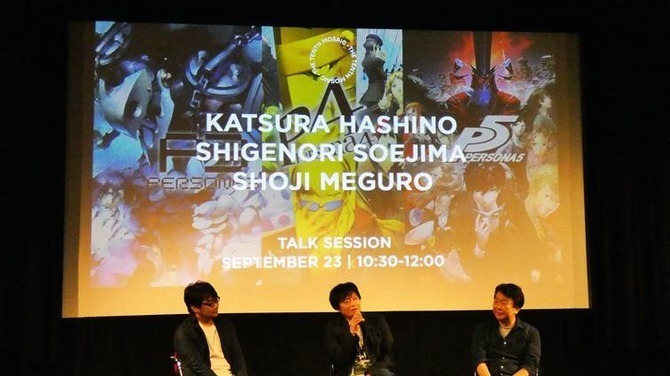
At “The Tenth Mosaic,” a festival celebrating game culture held over two days—Tuesday, September 22, 2026 (a national holiday) and Wednesday, September 23, 2026 (a national holiday)—at the Tokyo Franco-Japanese Institute,key staff members from *Persona 3*, *Persona 4*, and *Persona 5*—Katsura Hashino, Seiki Soejima, and Shoji Meguro—held a roundtable discussion, looking back on the development of those titles.
What were their thoughts at the time, and what was the intention behind the “change in direction”? This article reports on the details of that discussion.
◆Taking on *Persona 3* with Their Backs Against the Wall
The panelists were Director Katsura Hashino, Character Designer Naruki Soejima, and Sound Creator Shoji Meguro.

Mr. Hashino has been involved with the “Persona” series since *Persona 3* and has served as director on every title since then, up to the latest installment, *Persona 5*.
Mr. Soejima joined the series during the final stages of development for *Persona: The Masked Hero*, and after handling concept art and world-building for *Persona 2*, he began working on character design starting with *Persona 3*.
Sound creator Mr. Meguro composed several tracks for *Persona* and *Persona 2*, and has served as the main composer for the series since *Persona 3*.
Although Atlus’s RPGs at the time were by no means underperforming in terms of sales, rising development costs combined with a stagnant fan base led the company to approach Mr. Hashino—who had earned acclaim with the *Devil Summoner* and *Shin Megami Tensei* series—and entrust him with the future of Atlus’s RPGs.
“If we don’t achieve certain results with this, this will be the last RPG Atlas ever makes.” That was the situation surrounding Atlus’s RPGs at the time, as conveyed to Mr. Hashino.

So instead of asking, “How should we develop the series?” Mr. Hashino focused on exploring “What can we do to revitalize Atlus?” He decided to build the project from scratch.
Atlas had already been developing games for the Sega Saturn, and the “Devil Summoner” series team was formed based on the assumption that the Sega Saturn had a large base of core gamers. On the other hand, since the PlayStation (PS1) had a large number of casual users, the “Persona” series team was created to offer a more accessible experience.
So, Mr. Hashino first analyzed the “Persona” series from the perspective of the “Devil Summoner” team and fine-tuned the essence, philosophy, and themes inherited from the “Megami Tensei” series to suit the “Persona” series while adapting them to the spirit of the times.He paid particular attention to the question of what kind of themes would resonate with the players of that time—the younger generation.
Specifically, drawing on interviews with young people of that era, analytical studies, and even post-war surveys of youth, *Persona 3* took the timeless theme of life and death—a subject that never loses its relevance—and framed it within the genre of the “juvenile novel.”
Here, the term “juvenile fiction” refers to “stories about the struggles of young people as they navigate their place in the world and transition into adulthood.” Consequently, we selected character designs and systems that best expressed this “juvenile fiction” concept.
For example, the calendar system was designed to depict the limited time of student life. Within the juvenile genre, how do we make the young characters grow? That was our primary consideration.
So, how were the artwork and music created?

Regarding the artwork, Mr. Soejima prefaced his remarks by saying, “It wasn’t something I was consciously aware of,” but as he reflected on that time, he explained that he valued the concept of “things I found to be good” and may have been aiming for visuals that would make users feel a sense of superiority. That was the approach he took when designing the typography and UI.
He also says he was brimming with joy at being able to design characters at the time and tried his hand at character designs he hadn’t been able to create in his previous work.
Mr. Meguro, who was in charge of the music, noted that since the game’s world was built around a pop and light-hearted image, he created numerous tracks with “future pop” as his keyword to match that vision. Looking back on that time, he also shared—with a laugh—that he had some reservations about introducing stylized characters.
Atlas, which had always valued a dark and stylish image in the *Megami Tensei* series, wondered if it was really okay to introduce stylized characters that might undermine that image. That was their thinking, but *Persona 3* was released during the PS2 era.Partly because it was difficult to create full-body digital characters, they had no choice but to simplify them.

◆*Persona 4*, Inspired by Kosuke Kindaichi
After *Persona 3* was released in 2006, its sequel, *Persona 4*, arrived relatively soon after in 2008.This was because *Persona 3* had become a hot topic through word of mouth and generated enough profit to ensure the series’ survival, leading Mr. Hashino to think, “I want to thoroughly prepare the next title while users are still playing *Persona 3*.”
So, Hashino first explored the game’s direction by focusing on the question: “If the *Persona 3* characters were to face new conflicts, what kinds of obstacles would they encounter?” Of course, this didn’t mean the *Persona 3* characters would simply return as-is.Rather, it was an explanation in the sense that the *Persona 3* characters served as a mirror for the players—that is, what kind of conflicts would the *Persona 3* characters (as represented by the players) need to overcome next?
Back then, just as now, it was an era flooded with information. While making “information literacy”—distinguishing truth from falsehood—the central theme, Mr. Hashino decided to bring Kōsuke Kindaichi, a character he himself was a fan of, into the *Persona* series.Mr. Hashino loves the “Kosuke Kindaichi” series because he finds it fascinating how Kindaichi—an outsider—breaks down the traditions of a closed-off village and opens up new possibilities. What would happen if he combined that with the juvenile genre in *Persona 4*?
When he commissioned Mr. Soejima to create a concept illustration, he immediately received a sketch depicting the crime scene—a female high school student floating in a river, her body in tatters—and felt that he was on the right track.

During a roundtable discussion, Mr. Soejima revealed that the materials Mr. Hashino had given him at the time were all quite grim, and he struggled considerably with how to portray the story in a positive light.Furthermore, having gained some insight from *Persona 3*, he built the game’s world based on that experience—incorporating a tone suited to the countryside and iconic elements like “rural kids always wear tracksuits.” While he reflected that this approach might have been a bit too simplistic, he convinced himself that the final product was the right choice.
On the other hand, when commissioning Mr. Meguro, the request was limited to conveying the game’s worldview—saying, “This is the kind of atmosphere the game has”—rather than specifying, “We want this kind of music.” This approach wasn’t limited to *Persona 4*. Mr. Hashino, who trusts Mr. Meguro’s work, said he makes a point of placing orders with minimal restrictions.
Consequently, a similar approach was taken for *Persona 4*, and Mr. Meguro spent about a year mulling over that concept. The result was a collection of tracks with a pop-rock vibe.

Since production on *Persona 4* began shortly after *Persona 3*, everyone seemed to have a strong sense that they were continuing the work from where they left off.Thanks to this, development reportedly proceeded relatively smoothly, directly incorporating the experience gained from *3*. At the same time, there were also improvements made. One such change was the transition from a strictly compartmentalized division of labor to a production system that emphasized stronger team collaboration.
While *Persona 3* was developed under a strictly compartmentalized system, starting with *Persona 4*, they reportedly switched to a method that involved a certain degree of information sharing between teams.When a scenario plot (synopsis) was submitted, it was shared with each team to gather feedback; when rough character designs were submitted, they were similarly evaluated by everyone. This ultimately enhanced team collaboration and had the powerful effect of fostering a shared vision across the entire team.
◆ *Persona 5*, Which Won Over Overseas Fans
The latest installment in the series to date, *Persona 5*, was released in 2016—eight years after the release of *Persona 4*—following the team’s development of *Catherine*.
Initially, development proceeded under the premise of a “juvenile adventure with just a backpack,” but since that concept didn’t quite fit, a change in direction ultimately led to a delay in the release date.As for the decision to use a phantom thief as the central motif, it stemmed from Mr. Hashino’s long-standing love of mysteries, combined with a chance discovery of a new *Lupin the Third* anime, which reignited his interest in the phantom thief theme.
From there, the game’s world was built around music that incorporated big band sounds reminiscent of the “Lupin the Third” anime, as well as acid jazz—a genre popularized by Jamiroquai.
In terms of art, the team refined the game’s world further based on their experience experimenting with a sexy aesthetic in *Catherine*. Additionally, since *Catherine* served as a sort of trial run for full-body 3D scenes, the insights gained there were put to use in *Persona 5*.
In this way, *Persona 5* not only expanded its recognition among domestic fans but also gained a large following overseas. Regarding this, Mr. Soejima mentioned that even when drawing promotional illustrations after the game’s release, he began checking the reactions of overseas fans.Previously, since the fanbase consisted almost entirely of domestic fans, feedback naturally reached them, but they couldn’t accurately gauge the reactions of overseas fans without actively seeking them out. In this way, gaining new fans had a tangible impact on the development team.

Finally, when the MC asked the panel, “What defines the ‘Persona’ essence?” they all looked pensive but responded as follows.
Mr. Hashino, while preempting his answer by saying he had “never really thought about it,” suggested that the chaotic, messy aspects—such as the hesitation, mistakes, and misunderstandings typical of students—might be what defines “the essence of Persona.” It was something unrefined, accompanied by the energy characteristic of minors.
Mr. Meguro’s view of “what makes a Persona unique” differed slightly; he explained that, in terms of music production, it is precisely the aspect that must not be constrained by preconceived notions.A sound creator’s role is, after all, to follow Mr. Hashino’s instructions. If one were to define “what a Persona should be” in that context, it would actually clash with the instructions and become unworkable. For Mr. Meguro, it’s the finished product that embodies “the essence of a Persona.”
The same applies to Mr. Soejima’s “Persona-like quality.” The finished product, which reflects its era, ultimately becomes what defines “Persona-like quality.”He notes that even within Atlus, there are staff members who worry about “staying true to Persona,” but he argues that if they try to do that, the result will merely be a copy of past titles. He states that if they simply create something enjoyable in the moment, that “authenticity” will naturally follow later.
Although the three offered distinct answers, what they all shared was the idea that “the future and the results lie ahead, built upon the present.” That way of thinking seems to be precisely one manifestation of the “juvenile” sensibility that Mr. Hashino sought to express. That’s the kind of roundtable discussion it turned out to be.




