


It’s precisely because it’s a physical medium that catches your eye that “memories become tied to it.”
Haru Iida: We’ve talked about various aspects we love, but we’re also facing storage space issues, and just as retailers face inventory risks, we have to confront the negative aspects unique to physical copies.
Deterioration and lack of compatible hardware are particularly notable issues. While I do keep all my old titles, the condition of the games from my childhood isn’t exactly ideal, and there are some I don’t even have the hardware to play—so when asked if I’ve truly “preserved” them, it’s a bit of a gray area.

Takaroku: While I think we just have to accept that deterioration is inevitable, it does somewhat diminish the significance and value of owning the cartridges. I’m from the *Pokémon Red and Green* generation and still have my cartridges, but when I tried booting one up after a long time, the data had disappeared. In the end, I have no choice but to rely on my own memory to recall what Pokémon I raised and what kind of journey I went on back then…
Haru Iida: That’s just how it goes with games that can’t be saved to external memory, so the impact is particularly noticeable with handheld games.
Skollfang: In that case, we’ll end up placing greater importance on their value as “triggers for memories.” However, I think physical cartridges will still be central to archiving gaming culture itself moving forward.
I’ve heard there are even cases where “the developers themselves don’t have the data from back then,” so retro games are becoming important from a perspective separate from our personal memories.
Haru Iida: That’s true. These days, I don’t have a monitor at home with an RCA cable—the so-called “three-color connector”—so even if I had the hardware and software, I wouldn’t be able to “dive into those memories.” But their value as retro games is really coming to the fore. We’ve even reached a point where “Game Center CX” is debating whether to play Wii and PS3 games as retro titles.


Another part of the appeal of physical games is watching your “backlog” literally pile up—though that can also be seen as a downside. I’ve set my own rule: “I’ll only stack as many as fit in this box.” How about you all?
Skollfang: Personally, I line them up on a shelf so they’re always in plain sight, and I try to play the ones that catch my eye at a natural break in my schedule. After all, it’s disrespectful to the developers if you don’t play them when you’re actually in the mood to enjoy them.
Haru Iida: I see. For me, stacking them where I can see them is partly a way to push myself—it’s an interesting approach. What about you, Takaroku?
Takaroku: Before I play a game, I find myself wondering, “Which version of me is better—the one who plays this game, or the one who doesn’t?” I’m sure all of you are in this line of work because games changed your lives, but that just goes to show how much games can really change a person.
I feel like I’m choosing while wondering: Will playing this now have a positive impact on my life, or will it have a negative one? Which will it be?
Haru Iida: That’s unique, too. This strays a bit from the topic of the game package itself, but when you finally sit down to play a game you’ve had sitting on the shelf for a while, and it turns out to be genuinely fun, you feel like you’ve hit the jackpot—or at least, you get that extra sense of satisfaction, right?
Takaroku: Absolutely, absolutely. There really is an optimal time to discover a game, and maybe that’s what we’re always searching for.
Skollfang: In that sense, I think having a physical package catch your eye and stay in the back of your mind is what really leads to the best encounters.
Haru Iida: For me, with digital downloads, I sometimes “forget I even bought it” (laughs). For us, the physical presence of the box actually helps us discover great games.
Let’s cherish the physical copies we have now—and the memories they hold!
Takaroku: We touched on overseas topics when discussing bonus content, but I think I’ve come to appreciate the appeal of physical packages even more since learning that their designs differ between Japan and other countries.
One game that really stood out to me was *JUDGE EYES: The Last Will of the Grim Reaper*, starring Takuya Kimura as the protagonist. I played it with a bit of a fan-girl mindset, thinking, “Oh, Kimutaku’s in this!”—and it turned out to be an amazing game. So when I went to the U.S., I went out and bought the local version of *JUDGE EYES*.
In Japan, Takuya Kimura is practically an icon of his generation, and the domestic version’s cover features a huge, bold image of him as the protagonist. But while the protagonist is still the focal point on the international version, the design is completely different. It was interesting to realize, “Oh, so marketing is different overseas too,” and I think there are plenty of other cases where the artwork differs between the Japanese and international versions.
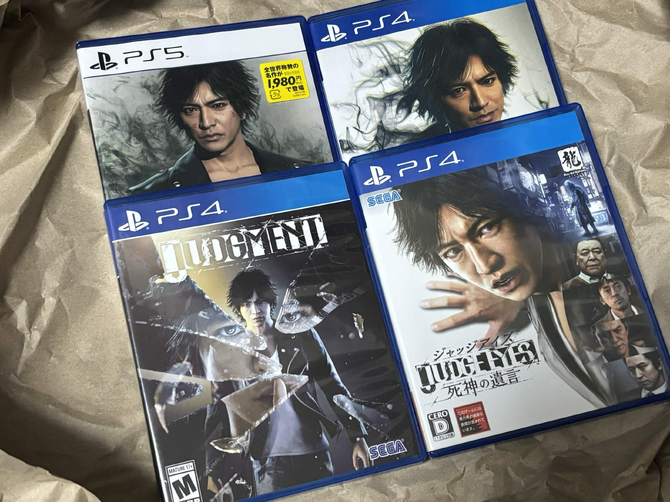
Haru Iida: *Judgment* is one of my favorite games—I bought and played the first edition myself—but since it’s a “version that’s no longer available” featuring Pierre Taki as the model, it’s become a bit of a collector’s item.
Skollfang: While games can still be updated by replacing models or voice actors, video content can sometimes be taken down following such scandals—making it unavailable even on streaming services—so the feeling of “I’m glad I have this” is likely to become even stronger.
Haru Iida: This is a bit of a special case, isn’t it? (laughs) Still, I haven’t really paid much attention to the differences between Japan and overseas markets before, so this has made me want to look into it more.
Takaroku: I get the impression that the reaction to the disappearance of physical copies is stronger overseas. There’s enough passion there that it’s worth changing the visuals just to promote it—and that’s probably why the bonus content is so lavish.
Skollfang: To begin with, there are fewer and fewer stores in Japan where you can actually buy physical copies, aren’t there? I don’t think the sections in electronics stores will disappear anytime soon, but small shops—like those combined with bookstores—are disappearing at a rapid pace.
Takaroku: There used to be so many game stores back in the day… It was fun to pick up a physical copy and imagine, “I wonder what kind of game this is?”
Haru Iida: It’s fun, isn’t it? Of course, browsing digital versions in a store is convenient, but one of the characteristics of that experience is that you can’t help but notice the ratings. While ratings can sometimes be a motivator—so I’m not completely against them—it’s inevitable that they create preconceptions.
Skollfang: When it comes to “discovering a game,” I still think the package—that single door prepared by the developer—is the best way to do it.
Haru Iida: This looks like it’ll be a major turning point for game shops as well, but to wrap things up, let’s discuss the future—specifically, how we writers who love physical copies will approach this going forward.
I find myself thinking, “If they’d just distribute the box art images, I’d print them out, put them in a tall case, and display them,” but if that’s too difficult, I might end up designing my own original packaging to display (laughs).
Skollfang: That’s a great idea. I already switch between physical copies and digital downloads, so I don’t think it’ll be a huge change for me… but if the market share of digital versions—which have frequent sales—continues to grow, the used game market will probably fade away.
Haru Iida: Lending and borrowing won’t be as easy either. Actually, there are some games I borrowed from people back in my college days that have ended up in my collection—I really need to return them properly (laughs).
Skollfang: Keeping something you borrowed isn’t cool, but that was part of the boxed-copy culture, too (laughs). Still, as long as hardcore fans want them, boxed copies will continue to exist as collector’s items.
Haru Iida: Do you think we’ll start seeing cases where “the first-run limited edition includes the physical case!”?
Skollfang: I’m sure we’ll see that. We’re already seeing versions of Nintendo hardware that come with an empty box included.

Takaroku: I think releasing a physical version is a goal for indie game developers, so hardware that supports physical releases might become a bit of a selling point or attraction.
Personally, when (SIE) made the announcement, I was filled with feelings of sadness and disappointment, but this is still just a plan for the year after next or later. I’m trying to stay positive now, thinking that in 10 years, we might even say, “We want physical copies after all, so let’s bring them back.”
Just as people who played *Final Fantasy* when they were young are now the ones making today’s *Final Fantasy*, a generational shift among creators is underway. So, someday, there might even be a movement led by people who love physical copies to bring them back. I don’t want to be too pessimistic; instead, I’ll keep collecting the physical copies I can while looking forward to exciting developments down the road.
Haru Iida: So the conclusion is to start by cherishing the “physical copies we have now,” right?
Takaroku: Exactly! That feeling has only grown stronger for me.
Haru Iida: Talking about these memories and the appeal of the games like this has really put me in a positive frame of mind. More than anything, even the process of checking and organizing the physical copies I own in preparation for this roundtable was a lot of fun, so I really hope our readers will enjoy taking inventory of their own physical game collections at home, too.
Skollfang: Let’s cherish the memories tied to these packages, as well as the connections with the people behind them.





