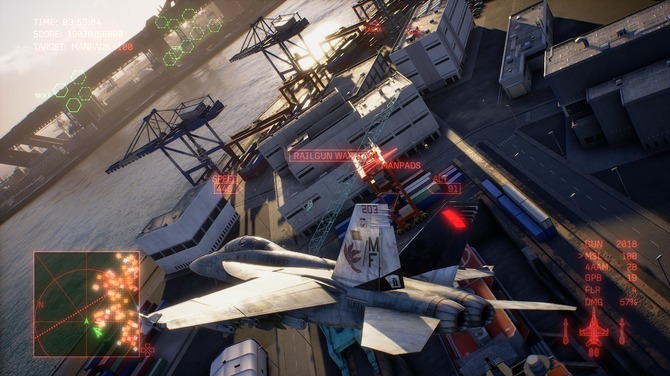
Real-scale visuals that bring the “Strange Real” concept to life—numerous missions that evoke a connection to *ACE7*
As for the campaign missions, perhaps due to lessons learned from the previous title, *ACE7*, there were no tricky missions or ones designed to deceive the player. There are virtually no missions where the objective shifts midway—from ground attack to air-to-air, or from air-to-air to ground attack.
On the other hand, the only truly tricky mission that makes use of the real-scale maps and objects is the one involving the identification of a camouflaged container ship.

The missions do not deviate significantly from the objectives explained in the briefings, and their content remains largely consistent. Additionally, even in multi-role missions involving both ground-attack and air-to-air combat, the ability to carry two types of special weapons—combined with the presence of wingmen—effectively lowers the difficulty, which is another notable change.
One thing that stands out particularly while playing the campaign is how faithfully it follows and builds upon the structure and content of the *ACE7* mission DLC.
For example, the assault on the Sotoa Fleet and the battle against enemy ace units on Newfield Island in Mission 4 are reminiscent of the “Anchorhead Assault.”Furthermore, the battle against the land battleship brings to mind Captain Torres’s fight against the Alicorn in the “Plan to Save 10 Million.” The fact that elements cultivated in these DLC missions have been incorporated and further developed in *ACE8* is highly significant.
Furthermore, elements from the previous title, *ACE7*, were also evident in certain characters and settings. Princess Cosette, the orbital elevator, and Fort Grace Island—the starting point of *ACE7*—make a return. While this location is now an FCU base rather than the former IUN-PKF base, it has been rebuilt to a realistic scale, including the graphics.
While I’d like to discuss this in greater detail, I’ll omit it here to keep this brief. However, considering both the mission content—which depicts the battles on the Euria Continent continuing into the 2020s—and the story itself, I felt that if *ACE7* was the first part, then *ACE8* is the second.


The maps in this game are rendered to real-world scale, so when your aircraft flies close to the ground, you’ll see vast clusters of skyscrapers, houses, and trees stretching out before you.
In particular, the battle in Seave—the capital of the FCU—clearly illustrates this feature; flying at low altitude exposes the player to more visual information than in the previous game, including buildings, roads, and homes. The prominent display of buildings and residences powerfully conveys the desolation of the land ravaged by this war, allowing the player to imagine the lives of the people who once lived there.
On the other hand, the Mega Float battles feature structures that combine an unprecedented sense of realism—with familiar architecture—with a convincing sense of scale, even though they are things we’ve never actually seen. I can’t deny that the moment I saw them, I felt a strangely realistic sensation.
In a sense, I felt that this was the moment when “Strange Real”—the visual concept proposed by Masato Kanno in *Ace Combat 04*—was finally realized, rather than simply being part of this series’ world. This concept, which has been consistently portrayed since *AC04*, has now reached a new pinnacle.