


Six years after its release, *VALORANT* is no longer considered a “new” game. Yet even today, creators continue to play *VALORANT*, discuss it, and create new content. How can they keep their passion alive even after the initial buzz has faded?
Launched in the midst of the 2020 pandemic, the 5v5 competitive FPS *VALORANT* is considered one of the world’s most successful live-service games. At the same time, however, competing titles continue to emerge, and popular creators are increasingly moving on to other games.
At the “Game Industry Conference (GIC)” held in Poznań, Poland, Kristin Banse, who leads *VALORANT* communications for Germany and Eastern Europe at Riot Games, delivered a presentation titled “Six Years Later: Keeping Creators Invested in VALORANT.”
Based on the philosophy of viewing creators not as “promoters” but as “partners in building a culture,” she introduced five pillars for maintaining relationships with creators in a game that has been on the market for six years, along with specific examples.

The Current State of ‘VALORANT’
Mr. Bance serves as the Communications Lead for *VALORANT* in Germany and Eastern Europe at Riot Games. His responsibilities range widely from creator relations and social media to press relations. He has been with Riot for over three years and has more than 10 years of experience in the gaming industry.Prior to joining Riot, he worked at Freaks 4U Gaming, Gamescom, and TikTok.
Let’s start with some basic information about *VALORANT*. It is a free-to-play 5v5 first-person shooter (FPS) that was released in 2020, in the midst of the pandemic.Forced to alter its release plans due to the pandemic, Riot Games reportedly shifted its strategy to distribute access to the beta version using Twitch’s “Drops” feature, which rewards viewers with in-game perks for watching streams.
Currently, in addition to PC, the game has been available on consoles since 2024, while the mobile version is only available in China.
At the time of its release, there was a sense of novelty, discovery, and great anticipation.Riot Games is by no means a small company, and many creators (streamers and video content creators) reportedly jumped at the chance, saying, “The company behind ‘League of Legends’ has released a new game.” There’s no doubt this contributed significantly to its launch. However, it was pointed out that mere novelty doesn’t last long and doesn’t build a lasting audience.
Furthermore, there are titles—such as *Fall Guys* and *Call of Duty: Warzone*—that compete for the time of both players and creators.
This is especially true in markets like Germany, where companies compete fiercely for investment. As five or six years pass since release, players grow tired of older games. In such a situation, she said, “We must continue to reinvent the wheel while constantly proving our right to exist.”
The mission is not just to “get people talking,” but to create “a game that makes people want to keep talking about it.”
Underpinning this is Riot Games’ “Player First” philosophy and its approach to viewing creators as “partners.” The fundamental idea is that “creators aren’t simply promoting *VALORANT*—they’re shaping its culture and community.”
Building on that, “Our mission isn’t to make creators talk about *VALORANT*.It is to make *VALORANT* a game that creators want to keep talking about. My job is to create a cool experience that creators themselves want to talk about—not a relationship where we pay them to play on stream and then lose their interest once it’s over,” Bance explained.
He also noted that while the initiatives he’s about to introduce are geared toward live-service games, they can be applied to other titles and to creators’ own strategies as well. He emphasized that relationships can be built without necessarily incurring massive costs.

The Five Pillars Supporting *VALORANT* Six Years After Launch
The strategy she presented, “HOW TO KEEP WINNING,” consists of five points: identifying core creators, talking with creators, creating regular opportunities for creators to engage, finding ways to connect with new people, and “Own your niche.”

First is “Identifying Core Creators and Understanding the Brand.” While there are many tools for finding new creators, she says the most important thing is to actually browse online. Since there are already many people playing *VALORANT*, they’re easy to find, but she also keeps an eye out for people in related fields.
For example, *Counter-Strike* creators might also be interested in *VALORANT*.
To make these kinds of assessments, you must have a deep understanding of your own brand. She stated that knowing what kind of game it is, what kind of creators you want to attract, and who is a good fit for you “sounds simple but is extremely important.”
The second pillar is “talking with creators.” She regularly holds monthly one-on-one meetings with creators on a dedicated Discord server. She announces the event on Discord every month, recruits participants via Google Forms, and spends an entire day having 30-minute one-on-one conversations with each creator.
The goal is to understand the challenges creators face. Some creators find it difficult to voice their grievances on social media, and from the brand’s perspective, they also want to avoid having internal issues spread on social media. At the same time, she listens to how creators want to develop their content going forward and how the brand can support them.
One example I mentioned was a woman who is a “VALORANT” creator but also has an interest in fashion.Since she had been involved in many fashion-related collaborations in the past, understanding her interests allowed us to propose a suitable project. “At first glance, helping her pursue a career in fashion might not seem like my job,” she said, “but by listening to her and supporting her growth, our relationship has improved significantly.”
The third pillar is “creating regular opportunities for creators to get involved.” In *VALORANT*, two new Agents and a new map are released every year.Riot offers creators the chance to play new content a few days before its public release, encouraging them to create exclusive content. This generates excitement and awareness for the new content and is also intended to bring back players who have drifted away. Although this places a burden on the development team to set up dedicated environments and accounts, she stated, “It’s worth the effort.”
However, they note that six years after launch, creators are beginning to grow tired of this early access program itself. To prevent it from becoming routine, they’re making adjustments—such as reformatting the program to make it more accessible, inviting new creators, and organizing challenges for creators during the early access period.
Another initiative involves opportunities for interviews with developers. Riot’s headquarters are in Los Angeles, and there are very few developers in Europe. With only a few UI specialists based in Dublin, they say “everything feels very far away.”
As a result, for creators in Poland, for example, being able to ask developers in Los Angeles about agent designs is a significant opportunity. At the same time, they say this helps creators feel a closer connection to Riot as a company. This is also one of the reasons they continue to engage in steady community activities in Poland.
The fourth pillar is “finding ways to engage with new people.” Given that *Fortnite* is making significant investments in Europe, some creators are moving on to other games and no longer creating content for *VALORANT*. That’s precisely why it’s important to constantly seek ways to welcome new creators, they say.
The fundamental principle is “creating authentic moments that align with the creator’s brand.” This involves assessing what interests a particular creator and determining whether inviting them to *VALORANT* at this time makes sense. Two examples were shared here.
The first is MokrySuchar, a Polish livestreamer. A former esports journalist, he was interested in *VALORANT* and also played *League of Legends*. He was also known for streaming from real-world locations—such as walking around town—and for organizing events.
Riot approached him with the idea: “Why don’t you host a tournament bringing together creators from all over Poland to promote the new map?”

As a result, he organized a two-day event that brought together 40 creators. The average viewership on Twitch exceeded 33,000, and total watch time reached 300,000 hours. Bansé noted that the biggest success was that Riot was able to engage creators and new audiences it wouldn’t normally reach.
The second is OhnePixel from Germany. Introduced as “one of the world’s largest game creators,” he is deeply involved in the *Counter-Strike* community and represents the “complete opposite” of *VALORANT*.
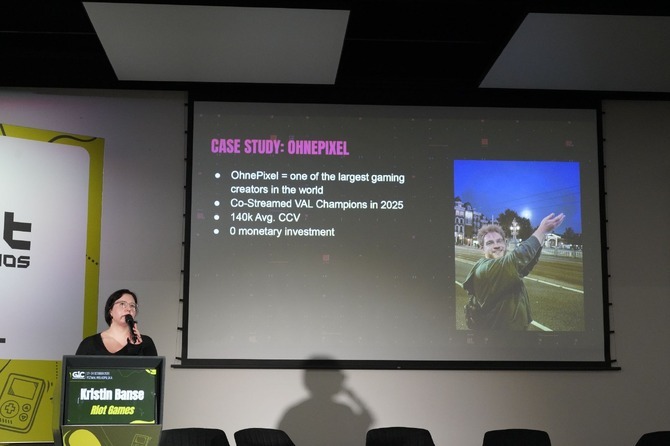
All they did was “literally just send an email and ask.” When they asked OhnePixel if he’d be interested in hosting the official co-stream for last year’s *VALORANT* World Championship (Champions)—that is, simulcasting the tournament on his own channel—he reportedly expressed interest.
With zero financial investment, it became one of the most successful co-streams of the year, attracting an average of 140,000 viewers. He mentioned that OhnePixel joined him again this year to attend the tournament in China, and he was pleased that their relationship continues.
Drawing on this example, he urged everyone to “just ask.” He explained that even if you’re turned down, you have nothing to lose; what’s important is finding creators who fit your brand and figuring out how to welcome them into your community.
The final pillar is “cultivating our own unique space and preparing the next generation.” He spoke about the importance of nurturing creators and expanding both their reach and audience.
Six years after its release, *VALORANT* has many top creators on Twitch and YouTube with large viewerships who generate significant revenue from the game. However, he noted that in many cases, the next tier of creators to support them has not yet developed.
In fact, there have been instances where top creators announced they were moving on to other games. To avoid a situation where creators disappear when that happens, he stated that it’s important to provide opportunities not only to top creators—who bring the greatest reach—but also to smaller creators.
“Relationships with creators cannot always be measured by numbers.”
Examples were also shared illustrating that a creator’s size does not necessarily correlate directly with the number of people they reach.In Germany, there is a female creator with about 10,000 TikTok followers who, when invited to an event, posts around 30 short videos that collectively garner about 8 million views. It was noted that this can sometimes yield better results than a creator with 5 million followers posting just one video.
He explained that the success of such initiatives should not be evaluated solely based on reach or impressions. The reason, he said, is that “relationships with creators cannot always be measured by numbers.” This is because they are “human relationships” that require investment.
There are three metrics. The first is “Depth,” which refers to repeat participation and feedback from creators. We look at how many creators return and continue to participate in events.
The second metric, “Relevance,” refers to organic mentions and audience reactions. They look at how much creators are talking about the game even outside the opportunities provided by Riot.
The third is “Growth,” which refers to a new pool of creators and first-time viewers. He noted that while it’s easy to chase numbers, sometimes long-term investment in relationships is necessary—and that this ultimately pays off for us.
Assessing the Impact on Development Plans and the Risk of Damaging the Brand
During the Q&A session, two questions were raised. The first asked whether there were any examples of collaborations with creators influencing the game’s development plans—such as instances where the game was modified or exclusive skins were created at the request of a major creator.
Mr. Bance replied that *VALORANT* is not currently undertaking such initiatives. He mentioned that in *Call of Duty*, there had been instances where in-game content created in collaboration with creators did not go well and was subsequently removed, and that they wish to avoid such situations.
On the other hand, this is an area they are still exploring. He mentioned that at this year’s *VALORANT* Champions event in China, they launched their first merchandise collaboration with a prominent local creator. While they are considering the possibility of offering creator-curated sets for the in-game shop in the future, he noted that they are “still in the early stages.”
The second question concerned how to assess the risk of damaging the brand. He explained that there are core values and ethical standards that must be upheld, and that in cases involving creators who might pose a risk, they seek a second opinion from the global team.
Additionally, since voices on social media can sometimes appear biased, they reportedly use “Talkwalker,” an analytics tool that allows them to neutrally gauge public sentiment. However, they honestly admitted that, ultimately, intuition—based on a deep understanding of their own brand—plays a significant role.
In the case of MokrySuchar, driven by the goal of “winning in the Polish market and gaining local recognition,” they explained that while the creator’s language might sometimes be inappropriate, he embodies their values, leading them to conclude that “he is worth working with.”
