


Laptops equipped with NVIDIA’s new “RTX Spark” went on sale on October 16, 2026. While NVIDIA is best known for its GeForce series, the RTX Spark is a product that’s a bit different from previous new GPUs.
The announcement heavily highlighted features such as up to 128GB of memory, AI computing performance of up to 1 petaflop (FP4 precision), and AI agents that run locally. However, gamers might be wondering, “So, can I actually play games on it?” or “Isn’t a regular gaming PC good enough?”
In fact, the RTX Spark isn’t just capable of running the latest AAA titles—it’s also a platform that opens up new ways to enjoy games, such as AI-powered NPCs and mod creation.
In this article, based on the content of a media briefing held by NVIDIA, we’ll break down what RTX Spark is and how it relates to us as gamers.
RTX Spark Is Not a New Graphics Card! It’s a Slightly Unconventional PC Where Both the CPU and GPU Are Made by NVIDIA
First, it’s important to note that RTX Spark isn’t a standalone graphics card like the GeForce RTX 50 series.
Typical gaming PCs combine a CPU from Intel or AMD with a GPU from NVIDIA or another manufacturer. In contrast, the RTX Spark is a product known as a “SoC (System on a Chip)” that integrates NVIDIA’s Blackwell-generation GPU and the Grace CPU—developed in collaboration with MediaTek—onto a single chip.
The GPU features up to 6,144 CUDA cores, while the CPU features up to 20 cores. Another distinctive feature is the “unified memory” architecture, in which the CPU and GPU share memory.
In traditional gaming PCs, system memory and GPU VRAM are generally separate. However, with the RTX Spark, up to 128GB of memory can be shared between the two.
Of course, this does not mean it is a “gaming GPU with 128GB of VRAM.” Rather, it means that a total of up to 128GB of memory can be allocated for use by both the GPU and the CPU.

This architecture demonstrates particular strength with AI models and 3D CG, which consume large amounts of memory. For example, it opens up the possibility of running large-scale AI models—which previously couldn’t be run on conventional gaming GPUs due to insufficient memory capacity—in a local environment.
In addition, power efficiency is a major selling point of the RTX Spark. NVIDIA emphasizes that it can maintain performance levels close to those achieved when plugged in, even while running on battery power.
Laptops equipped with RTX Spark are now available from manufacturers such as ASUS, Dell, HP, Lenovo, Microsoft, and MSI, with prices in the U.S. starting at $2,599. A compact desktop PC is also scheduled for release in November.
In short, RTX Spark is a new PC platform designed not just to prioritize gaming performance like traditional gaming PCs, but to handle gaming, creative work, and local AI all in one device.
You can play both *Gears of War: E-Day* and *ARC Raiders*! However, there are some caveats regarding “1440p at over 100 fps.”
That said, what readers are likely most curious about is gaming performance. According to NVIDIA, the RTX Spark will support hundreds of PC game titles at launch.
Not only will major titles like *Gears of War: E-Day*, *CONTROL Resonant*, and *NBA 2K27* run, but so will demanding titles such as *Cyberpunk 2077* and *Black Myth: Wukong*.
Technologies familiar from GeForce RTX—such as ray tracing, DLSS, NVIDIA Reflex, and G-SYNC—are also available. NVIDIA explains that the card can achieve gameplay exceeding 100 fps at 1440p resolution.

However, you shouldn’t take this number at face value as a measure of standard graphics performance.
In the example NVIDIA provided showing over 100 fps, the graphics settings were set to medium, and the system utilized DLSS upscaling, DLSS 4.5’s “Balanced” setting, and 3x frame generation.
Frame generation is a technology that uses AI to create intermediate frames, thereby enhancing visual smoothness. A 100 fps frame rate that includes generated frames is not the same as the game engine actually rendering at 100 fps. This distinction is particularly important in competitive games, where responsiveness to player input is paramount.
Additionally, in a review of the ASUS ProArt P16 by the international media outlet PC Gamer, the laptop achieved an average of 42 fps in *Baldur’s Gate 3* at 1080p with Ultra settings.The RTX 5070-equipped laptop used for comparison averaged 69 fps, and depending on the game, traditional gaming laptops can significantly outperform it.
In other words, while the RTX Spark can certainly run AAA games, it does not always outperform gaming PCs in the same price range.
Arm-based Windows compatibility is actually a key factor. Support for titles like *VALORANT* and *CoD* is still pending.
There’s another feature of the RTX Spark that gamers should be aware of: its CPU uses the Arm architecture rather than the x86 architecture commonly found in Intel and AMD CPUs.
This is a difference you don’t usually need to worry about in everyday PC use, but the situation is a bit different when it comes to PC gaming. Since many Windows games are designed with x86 CPUs in mind, they must run on Arm-based Windows via a conversion feature called “Prism.”
This raises the issue of compatibility on a game-by-game basis. With online games in particular, even if the game itself runs, you may not be able to play if the anti-cheat software—used to prevent cheating—does not support the Arm environment.
NVIDIA is working with Microsoft, various game developers, and anti-cheat software companies to address this issue, and at launch, titles such as *Fortnite*, *ARC Raiders*, *THE FINALS*, *Marvel Rivals*, and *Counter-Strike 2* will be playable.
On the other hand, *PUBG: BATTLEGROUNDS* is scheduled for support in the first half of 2027, and the *Call of Duty* series is slated for support in 2027. Riot Games has also expressed its intention to support *League of Legends* and *VALORANT*, but as of now, these titles will not be playable from the launch date.

This is likely a very important consideration for gamers who regularly play specific online titles.
While it’s reassuring that NVIDIA is working with many manufacturers to ensure compatibility, it’s risky to purchase a system based on the assumption that “since it’s a Windows game, everything will work.” You’ll need to check the compatibility status of each specific title you want to play individually.
DLSS 5 Gets Even Faster! This Is Relevant for Existing GeForce Users, Too
Along with the announcement of RTX Spark, NVIDIA also unveiled several updates to its AI technologies for gaming. One of these is a performance boost for “DLSS 5,” which debuted in September.
DLSS is known as a technology that uses AI for upscaling and frame generation to make games run more smoothly. However, “3D-Guided Neural Rendering,” introduced with DLSS 5, is different from simple resolution enhancement.
It uses AI to enhance lighting and material textures based on the visuals rendered by the game engine.
For example, in *Hogwarts Legacy*, which is scheduled to support DLSS 5 on November 5, details such as the shading of flowers and buildings, as well as the texture of moss growing on roofs, will be rendered with greater precision. The feature is also scheduled to be introduced in *Where Winds Meet* in late November.

Furthermore, on October 16, an update was released to speed up the DLSS 5 AI model itself. According to NVIDIA, the model’s processing performance has doubled, and *NBA 2K27* is expected to see a roughly 30% frame rate increase when running on RTX Spark.
Regarding frame generation, “Performance Mode”—which reduces processing load at the cost of a slight trade-off in image quality—is now available in beta.
It’s important to note that these technologies aren’t exclusive to RTX Spark. The DLSS 5 update will also be available for the GeForce RTX 50 series, and the Performance Mode for frame generation will be supported on the RTX 40 series as well.
In other words, this announcement is relevant even for existing GeForce users who do not plan to purchase an RTX Spark.
That said, DLSS 5—which involves AI significantly intervening in a game’s visual presentation—leaves room for debate regarding issues such as consistency with the visuals intended by developers. We’ll need to watch closely not only for simple improvements in image quality but also to see how the visual presentation of games changes.
Will in-game companions truly start to “listen”? NVIDIA’s AI NPCs
This brings us to another key feature of RTX Spark. NVIDIA is developing a technology called “NVIDIA ACE” that uses AI to animate in-game characters.
For example, in *PUBG: BATTLEGROUNDS*, an open beta test was conducted featuring AI teammates that understand and act on the player’s commands.
Additionally, in the creature-raising game *Aniimo*, technology was showcased that allows players to give pets instructions using natural language to have them gather resources and manage bases. This feature is scheduled for implementation in early 2027.
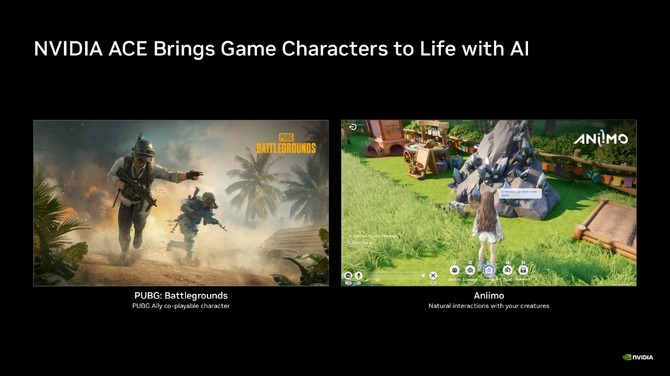
While players have been able to give instructions to NPC companions in previous games, in most cases this involved selecting commands predefined by the developers.
In contrast, NVIDIA is aiming to create AI characters that understand the player’s words and the game situation and act more flexibly.
To that end, NVIDIA also announced a new small-scale language model called “Nemotron 3.5 Bolt E4B.” NVIDIA explains that, compared to previous models, the model’s accuracy in conversation-related processing has improved by 1.5 times based on NVIDIA’s internal composite evaluation, and it is scheduled for release on October 23.
Of course, just because the model has become more powerful doesn’t mean that NPCs in every game will suddenly become smarter. Integrating it into the actual gaming experience requires implementation and game design by developers.
Still, if games become more common where characters don’t just select dialogue from a set of options but instead consult with teammates or give instructions in their own words depending on the situation, the gaming experience itself might change.
While this AI NPC technology isn’t exclusive to RTX Spark, its adoption is likely to increase as environments capable of running large-scale AI processing locally become more widespread.
Minecraft Java Edition Supports RTX Remix! Is the Era of AI-Generated Mods Upon Us?
Hardcore gamers might find this news particularly intriguing.
NVIDIA also announced expanded support for “RTX Remix,” a mod creation platform that can modernize the graphics of older games.
On October 23, the “RTX Remix Mod Kit” for *Minecraft Java Edition* is scheduled to be released in beta.
Using this tool, users can implement ray tracing and DLSS into existing Java Edition maps, as well as enhance particle and lighting effects. High-resolution texture packs and sample maps will also be provided.

Furthermore, on the same day, RTX Remix itself will gain support for DLSS 5.
During the briefing, an example was shown of DLSS 5 applied to an RTX Remix mod currently in development for *Fallout 4*, demonstrating improvements in equipment reflections and lighting effects.
NVIDIA also emphasized AI-powered mod creation assistance.
Thanks to AI-powered coding assistance, the barrier to entry for mod creation—which previously required advanced programming knowledge—is gradually lowering.
In fact, NVIDIA highlighted community initiatives such as an AI dialogue mod for *RimWorld* and a mod that introduces AI to *Mount & Blade II*.

With AI assisting in mod creation, efforts to alter a game’s visuals and gameplay may become accessible to a wider range of players.
However, this doesn’t mean you have to purchase an RTX Spark to use it. It’s a technology that can be enjoyed on any compatible system, including existing PCs equipped with GeForce RTX graphics cards.
RTX Spark’s True Potential May Lie in “Time Outside of Gaming”
While we’ve covered gaming-related features so far, what NVIDIA actually emphasized most in this announcement was the existence of AI agents.
AI agents are artificial intelligence systems that understand user instructions, interact with applications and files on a PC, and perform tasks autonomously.
For example, they are designed to combine multiple tools to perform tasks based on instructions such as “Create a short clip from this gameplay video” or “Modify this 3D model.”
NVIDIA is focusing on running these AI agents on the PC rather than in the cloud.
While cloud-based AI services are convenient, they may incur usage-based fees or require an internet connection. With local AI, processing can continue without relying on external services, as long as hardware performance and power allow.
Furthermore, using software called “NVIDIA PAIR,” AI processing can be distributed across multiple PCs connected to a home LAN.
For example, the company demonstrated a use case where, when launching a game, the processing of an AI agent that had been running is transferred to another PC to free up processing power for the gaming PC.

Users don’t just play games on their PCs—they also create videos related to those games, develop mods, and perform various tasks using AI. This may be the type of user NVIDIA has in mind for the RTX Spark.
So, should gamers buy the RTX Spark?
Now that we’ve covered all this, let’s return to the key question: “Do gamers really need the RTX Spark?”
At this point, if your sole purpose is to play games, there doesn’t seem to be a need to go out of your way to choose the RTX Spark.
While the RTX Spark offers attractive features like excellent power efficiency and local AI processing capabilities, its starting price of $2,599 in the U.S. is by no means cheap.
In the same price range, a gaming laptop combining a traditional Intel or AMD CPU with a GeForce RTX GPU is also a viable option. Depending on the game, you might achieve higher frame rates with that setup, and you won’t have to worry about compatibility issues specific to the Arm version of Windows.
On the other hand, for users who want to play games while also getting seriously involved in mod creation, 3D CG, video editing, and local AI, this looks like an intriguing option.
It can run large-scale AI models by leveraging up to 128GB of unified memory, while also being capable of playing AAA titles. The ability to pack these capabilities into a slim laptop is a unique appeal of the RTX Spark.
What made this announcement particularly interesting, however, was not so much the performance of the new chip itself, but rather NVIDIA’s vision for “the PC of the future.”
Until now, gaming PCs have evolved toward rendering more beautiful graphics at higher resolutions and higher frame rates.
RTX Spark aims to add a new role to this equation: local AI.
It’s not just about playing games—it’s about interacting with in-game characters using natural language, customizing games yourself, and having AI assist with the creation process. The fact that this announcement presented such possibilities is what makes it so significant.
Of course, whether such a future will lead to a truly engaging gaming experience is another matter entirely. Simply equipping a game with AI doesn’t automatically make it more fun, and many of these features are still in the conceptual stage at this point.
RTX Spark isn’t the definitive replacement for today’s gaming PCs. However, it’s a very intriguing product when considering what the future of gaming PCs might look like.
What kinds of games and ways of playing will NVIDIA’s vision of a “PC that runs both games and AI” give rise to in the future? Perhaps the future of PC gaming is beginning to take shape in a realm slightly different from the traditional race for hardware performance.

