Bill Van Zyll, Vice President and General Manager of Nintendo Latin America, stated in an interview with the Brazilian YouTube channel “Coelho no Japão” that “there are no plans to phase out physical media.”
No Plans to Discontinue Physical Media
The interview was recorded during “Brazil Game Show 2026 (BGS 2026),” one of Brazil’s largest gaming events, and was conducted by YouTuber Rodrigo Coelho (Coelho no Japão), who has approximately 520,000 subscribers.
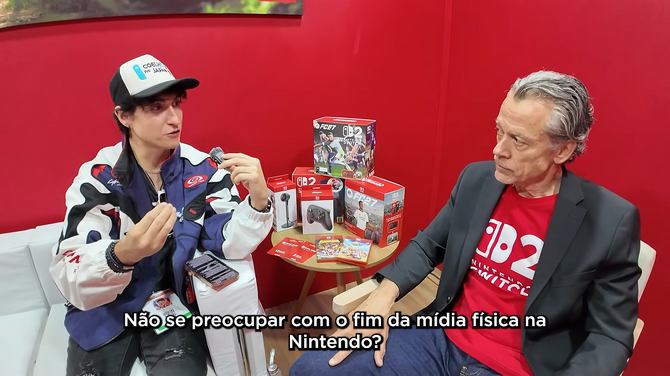
When asked whether Nintendo would continue to support physical media as the industry as a whole shifts toward digital, Bill Van Zyll responded as follows:
“Nintendo has historically taken a neutral stance and prioritizes consumer preferences above all else. The Nintendo Switch 2 will support both physical and digital formats, and we have no plans to discontinue physical media. We also fully understand the attachment fans have to it.”
In response to another question, he noted that boxed versions tend to be preferred throughout Latin America, including Brazil, citing collectibility, as well as the ability to lend, borrow, and resell them, as reasons for this preference.
When asked about the price difference between physical and digital versions, Bill Van Zyll explained that physical versions incur many physical costs, such as the cost of cartridges and chips, as well as packaging, assembly, shipping, and inventory storage. He stated that it is natural for a price difference to exist between physical and digital versions, as the latter do not incur these costs.

The interview also touched on the Nintendo booth at an event in Brazil, sales trends for the Nintendo Switch and Switch 2 in Brazil, price adjustments, and requests for a Brazilian Portuguese version of Nintendo Direct.
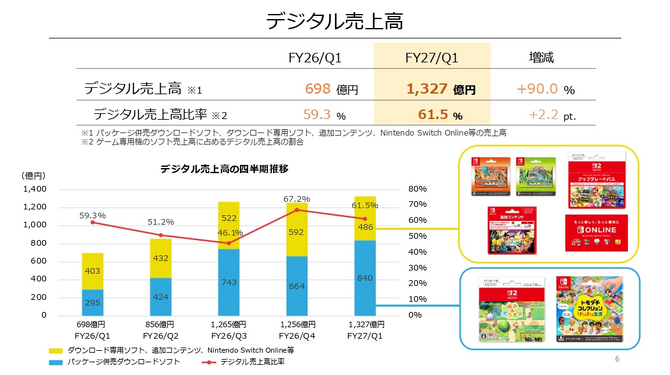
Nintendo announced in its August financial results that digital sales accounted for approximately 60% of total revenue
Let’s take a look back at industry trends based on financial reports from Nintendo and Sony.
According to the financial results presentation materials (PDF) for the first quarter of the fiscal year ending March 2027 (April–June 2026), released in August 2026, digital sales for that quarter totaled 132.7 billion yen.Digital sales accounted for 61.5% of total dedicated game console software sales, up from 59.3% in the same period of the previous year.
Meanwhile, according to financial results released by the Sony Group for the first quarter of fiscal year 2026 (April–June 2026), digital versions accounted for 82% of full-price game sales for the PS4 and PS5.Since Nintendo’s figures are based on revenue and Sony’s on unit sales—differing in their calculation methods—a direct comparison isn’t possible; however, it appears that Nintendo’s platforms have a higher proportion of physical copies compared to the PlayStation.
International influencer Stealth has also pointed out that Nintendo’s physical sales account for a higher proportion of total revenue.

However, all figures in these financial reports are global. Bill Van Zyll’s remarks pertain solely to the Latin American market, including Brazil, and Nintendo’s financial presentation materials released in August did not show digital sales ratios by region.
The Evolving Nature of Physical Media
Turning to the reality of physical editions, whether they use cards or discs, it’s fair to say that the mechanisms for both the Nintendo Switch 2 and the PlayStation are changing. For the Nintendo Switch 2, games are also sold as key cards that do not contain the game data itself; players must download the data to play (this key card system is primarily used for third-party software).


Sony has already announced that disc production for PlayStation consoles will end in January 2028. During the Sony Group’s financial results briefing for the first quarter of fiscal year 2026, Tao Lin, who answered questions on behalf of the gaming business, explained that a sales model—in which packages include a code instead of a disc—has already begun in North America.
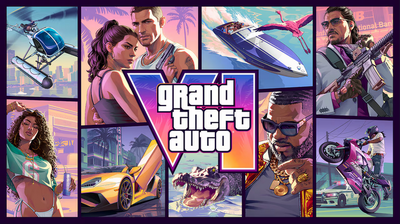
This is believed to refer to *Grand Theft Auto VI*, which will be sold as a “code-in-box” version.

Furthermore, physical media also faces capacity issues.
For example, the PS5 boxed version of *Final Fantasy VII: Revelations* is sold on a single disc, and playing the game requires downloading additional data (the Xbox Series X|S boxed version is the same overseas).The Nintendo Switch 2 physical edition is also sold with a key card, and Director Naoki Hamaguchi explained that each platform has capacity limitations for physical media, and he felt it would be undesirable to compromise on quality just to fit everything onto a single disc.

With storage capacity constraints, rising production costs, and the end of PS disc manufacturing, the landscape surrounding physical media is changing.
Nevertheless, based on Bill Van Zyll’s recent remarks, it’s clear that there remains strong demand for physical editions in certain regions. The format of media is evolving—from discs to codes, and in some cases, even to key cards. Even so, the culture of physical editions may continue to endure in a different form.