


In 1985, a video game company called “Arsis Software” was founded in Sasebo, Nagasaki Prefecture.
The company was founded by staff who had spun off from TechnoSoft, a manufacturer also based in Sasebo.In 1993, the company began working on in-house projects for SCE (now SIE). It later changed its name to “Cyberhead” and participated in the development of *Omega Boost* and *Gran Turismo* (both published by SCE, developed by Polyphony Digital), before ceasing operations in 2001.
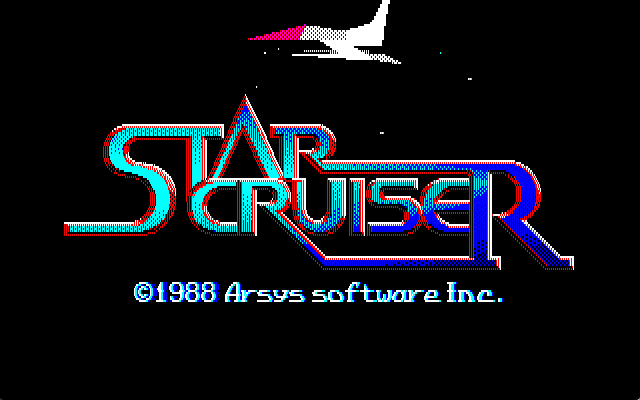
In the Japanese hobby computer market of the 1980s, Alcis Software was known as a manufacturer with exceptional technical expertise. In particular, *Star Cruiser*, released in 1988, was well-received for its experience of traveling through a three-dimensional universe rendered using polygons.Since this title was ported to the Mega Drive after its PC release, it can be considered the company’s flagship title, for which it was particularly well-known.
One of the company’s founding members, game creator Kotori Yoshimura, worked on numerous titles dating back to her time at Technosoft before going independent.
In this article, we trace Ms. Kotori Yoshimura’s creative journey, incorporating an interview with her conducted at the headquarters of the NPO Game Preservation Association.
*“The Origins and History of Games” is a series produced in cooperation with the Game Preservation Association.
Her First Encounter with Computers and the Path to Game Development
Ms. Yoshimura was born in Sasebo. Her family consisted of her parents, two older sisters, and two cats; she says her grandparents lived in the ancestral home located not far from her family’s house.
Mr. Yoshimura had been using computers even before joining Technosoft; after joining the company, he reportedly turned programs he had originally created on his own into commercial software and sold them. Speaking about his first encounter with computers—which would become a long-standing companion in both his work and creative pursuits—Mr. Yoshimura says the following.
Kotori Yoshimura (hereinafter referred to as Ms. Yoshimura): In 1973, the NHK morning news reported on the Intel 8008 CPU, describing it as the world’s first microcomputer. That was what sparked my interest, and I started reading books on the subject.Toshiaki Yasuda’s “My Computer Trilogy” from the “Introduction, Building, and Using” series, and CQ Publishing’s *Building a Computer*. I think I bought them around fifth grade? From age 10 until I finished elementary school.

Since I was interested in electronic circuits, I used to go to the dump to pick up junk parts, but my parents told me, “Stop doing that.” At first, they bought me Gakken’s “My Kit 50,” but when I said, “That’s not enough,” they let me get the “My Kit 200.”Next, a book titled “My Very Own Microcomputer: Design & Construction” came out, and after learning how to build detailed circuits from it, I thought, “Okay, let’s try making one.” That was back in junior high school.
Although Mr. Yoshimura made a name for himself as a programmer at companies like Technosoft and Arsis Software at a young age, the direct catalyst for his entry into the video game industry was apparently as follows.
Mr. Yoshimura: “I started subscribing to *ASCII* and read a lot of the articles. That was around 1978. Around the following year, when I was in my third year of junior high school, I started going to the Sasebo Microcomputer Center (later Technosoft), and from then on, I was there all the time.President Oozono (Fumio Oozono, CEO of Technosoft) asked me, ‘Why don’t you try making a game?’ Even before that, someone from sales had said to me, ‘I’ve got an idea—would you like to try developing it?’He told me, “The theme can be anything. If there’s a movie you’ve seen recently that you found interesting or that stuck with you, you can just go ahead and make it into a game. As far as games go, there aren’t really any specific rules about copyright.”
“Okay, let’s do it,” I said, and the very first thing I made was *2001: A Space Odyssey*.That was the summer of my first year of high school. But I’d actually been involved in the work since the year before, helping out with various projects at TechnoSoft without getting paid. “We’re letting you use the computer, so you should at least do that much,” they’d say (laughs). So, it wasn’t until I created that software that I finally got paid.

The first project Mr. Yoshimura worked on at TecnoSoft, *2001: A Space Odyssey*, was a game based on the film of the same name, consisting of two game modes that paid homage to scenes from the movie. This marked the beginning of him receiving a small salary for software development, and Mr. Yoshimura reportedly became an employee of TecnoSoft around the time he was a first-year high school student.
“Star Trek” as the Core of His Creativity
Before Mr. Yoshimura encountered computers, what did he want to be when he grew up?
Mr. Yoshimura: A scientist. Since “scientist” isn’t exactly a specific job title, I suppose it just means anyone who works in a science-related field. I do work in knowledge engineering to some extent, so I guess what I’m doing is somewhat close to that. As a child, I read mountains of encyclopedias, so I suppose I just wanted a job that involved working with that kind of “knowledge.”
Mr. Yoshimura says he was able to read books written in kanji by the time he was about three years old. While his childhood interest in “knowledge” and “science” was sparked by books, fiction also seems to have had a major influence on him.
Mr. Yoshimura: When it came to foreign TV shows, I was totally hooked on *Star Trek*. That’s what really made me look up to scientists.
Also, since we had a lot of manga at home, I used to read them—things like *Norakuro*. There was something like a *Norakuro Complete Collection*. Apparently, my parents had originally bought it for my older sister to read, but I devoured the whole thing.
“Star Trek,” a quintessential live-action space opera, is a historic work that cemented the image of science fiction in the minds of the American public. In fact, it has deep ties to video games; in the early 1970s—the dawn of the video game era—a text-based game titled simply “Star Trek” was produced.Of course, this wasn’t officially produced by the creators of the original series; it was, so to speak, a fan-made program. Users enjoyed the game by porting it to other computers on their own and modifying it. As a result, “Star Trek” spread as a cultural phenomenon.
While there were people like Mr. Yoshimura who were captivated by the original series, in Japan—where the franchise never gained the same level of popularity as it did in the United States—there may well be those who first learned of “Star Trek” through video games.
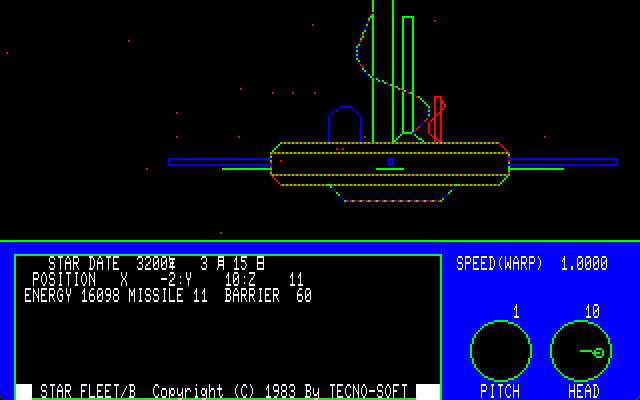
In the gaming industry, which was just beginning to take off at the time, the term “Star Trek” had apparently become a generic term and was treated almost as if it were a genre in itself. For example, in the game *Starfleet* (1983, Technosoft), produced by Mr. Yoshimura, the word “Star Trek” appears prominently in the tagline.It is not hard to imagine that, in the market of that time, this title was released and accepted as just one more entry among the existing genres. In fact, it is said that the creation of *Starfleet* was predicated on the existence of these “Star Trek”-style games.

Mr. Yoshimura:First of all, there was a game called “TREK.” In the “Using My Computer” section I mentioned earlier, there was a complete source code listing for “TREK,” which had been ported for “The University of Tokyo Version of TinyBASIC” (Tiny BASIC is a simplified version of the BASIC programming language; it was conventionally named after its place of development).I ported it to my own system and played it a bit, and I thought the gameplay was fun. However, I felt that if I just released it as-is, it wouldn’t be very accessible. “What should I do? Well, what if I made everything real-time and turned it into an action game? That might be fun,” I thought.
TechnoSoft originally started as a microcomputer shop called the “Sasebo Microcomputer Center.” In the early days of Japan’s computer game industry, it wasn’t uncommon for software houses and manufacturers to emerge this way. It’s said that Mr. Yoshimura was developing *Star Fleet* behind a partitioned curtain inside that shop.“What are you going to do about this! I can’t get back to reality!”… The game’s reputation was so high that customers who played it even gave feedback like this.
On the other hand, it’s clear that for Mr. Yoshimura, “Star Trek” was more than just a term referring to a single genre of games. This is evident from the significant influence of “Star Trek” on the creative works he produced afterward.
Mr. Yoshimura: (“Star Trek”) has served as the foundation for many things. ‘Star Fleet’ is one example, and it’s also served as a major foundation for my later works. The same goes for ‘Plasma Line’ and ‘Star Cruiser.’ As for ‘Thunder Force,’ it was just a tiny bit in the story written in the manual (laughs).
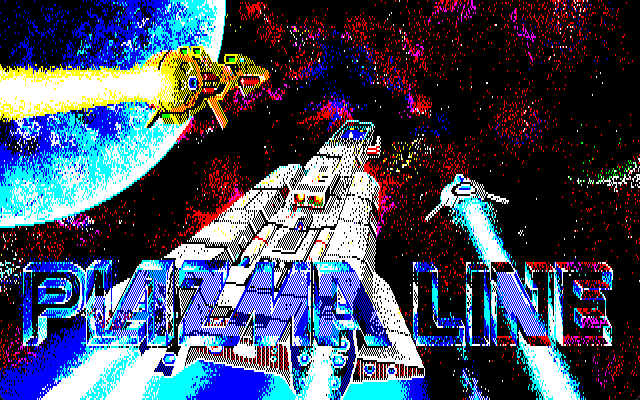
Many of the games Mr. Yoshimura worked on are set in vast space and allow players to experience three-dimensional environments. In addition to *Starfleet*, of course, *Plasma Line* featured space racing and was the first game released in Japan to use 3D polygons.It was *Star Cruiser*, his masterpiece from his time at Arsis Software, that unfolded a dramatic story within this cosmic setting. These works can be described as the realization of *Star Trek*-style imagination within the world of gaming.
Furthermore, these titles share a common approach to screen design that draws users into the game world, such as the use of message windows for narrative purposes and a user interface modeled after spaceship instruments and cockpits. These design elements serve as a bridge between the game world and the player’s own world, fostering a sense of immersion.

Mr. Yoshimura: “I became more deeply engrossed in *Star Trek* through the novels (novelizations of the TV series) than through the TV show itself. I read two to three thousand of them. While many were space-themed, I also got hooked on Yasutaka Tsutsui, as well as Shin’ichi Hoshi, Fredric Brown… and Sakyo Komatsu.”The very first book my parents bought for me was *The Day of the Triffids*.

Mr. Yoshimura says he has read countless novels and been influenced by them. He is currently writing his own series of science fiction novels called the “Space Captain Series.” There’s no doubt that the world-building in his works has been influenced by space opera works, most notably *Star Trek*.
As mentioned earlier, in the gaming world of a certain era, the term “Star Trek” was, so to speak, a broad “genre.” And when viewed from the perspective of genre, the games Mr. Yoshimura has worked on seem to blend multiple genres.For example, in *Star Cruiser*, you can find elements of a 3D adventure, a shooter, and an RPG. However, when asked about his awareness of genres, Mr. Yoshimura replied as follows.
Mr. Yoshimura: (Genres) are just labels people use. I’ve simply been making what I want to make. They were classified into genres as a result of that.
Technology Is for Creating “Worlds”
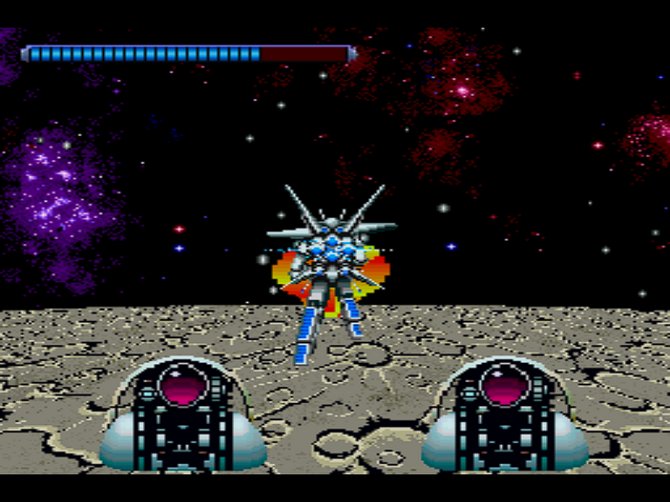
From a historical perspective, the aspect of Mr. Yoshimura’s games that often draws the most attention is likely the “technology.”For example, among the titles he worked on during his time at Technosoft, notable examples include the wireframe-based 3D space rendering in *Star Fleet*, the polygon rendering in *Plasma Line*, and the smooth omnidirectional scrolling and synthesized voice in the title screen of *Thunder Force*.Furthermore, *Wyburn*, the first title released by Arcis Software, can be described as a game that seemed to synthesize and further develop the technical highlights featured in the titles mentioned above. Each of these elements conveys a sense of advanced technology to the user at first glance.

Assuming this high level of technical prowess was a given, why was that technology necessary for the game? The answer is likely closely tied to Mr. Yoshimura’s perspective discussed in the previous section.
Mr. Yoshimura: It wasn’t that we wanted “technology” per se; it was because we wanted to create that kind of “world.” I suppose you could say we sought out the technology to achieve that.To be honest, I don’t really consider myself a “technical expert” either. I just want to create what’s necessary, so I develop the technology as I go. That’s why, even though there are people who’d hire me as a technical expert, they end up saying, “Something’s off.” It’s not about developing technology for technology’s sake.
A game that perfectly illustrates the relationship between “technology” and “world” is *Reviver*, released by Arsis Software in 1987.While there have certainly been games that used advanced technology to depict the “world” in the style of space opera, this title—as an adventure game set in a fantasy world—constructed its “world” through a different technical approach.
The tool used to build this world was “AI.” The NPCs in this game are controlled by AI while possessing distinct personalities.For example, in response to the player’s questions (which could be entered freely via the keyboard), they would not only provide hints for progressing through the game but also share information specific to their own characters, or even remember the questions they had been asked… and so on. This gave players the sensation that people were actually living in the world on the screen.
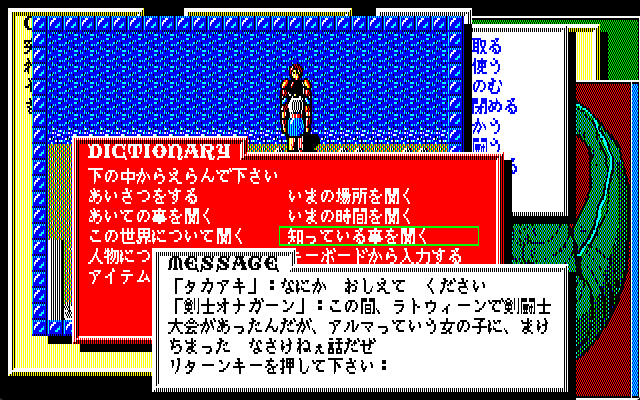
Mr. Yoshimura refers to the AI control used in this title as a “closed-world compact language model.” This was an idea virtually unheard of in games at the time. Quoting from the section on *Reviver* in the previous article of this series, Mr. Yoshimura describes its nature as follows:
“It was an AI with a knowledge base consisting of several hundred words—a ‘closed-world compact language model’—which stands in stark contrast to today’s large language models (LLMs, such as ChatGPT, Gemini, and so on).
It expressed each character’s individuality by unlocking knowledge through a set of flags indicating the extent of their knowledge, and varied their responses by passing speech style parameters to a micro-tokenizer. Here, flag processing determines whether a character ‘remembers’ something.Everything—including the options in the window—is passed to the language model as text strings for processing, but user input is classified into 14 sentence pattern categories for evaluation.
In the final product, we designed the game to progress almost entirely through “question-type” sentences.Regarding responses to user input, we initially tried processing them using neural networks, but had to abandon that approach due to insufficient memory; instead, we now use a pattern-matching backtracking algorithm. As a result, responses tend to become formulaic, so when the system detects a conversation with identical content via pattern matching, it sets a flag to alter the dialogue.”
Even though we use the term “AI,” there isn’t just one way to handle its internal processing or implementation. What led Mr. Yoshimura to arrive at the approach described above?
Mr. Yoshimura: Back then, I had no other choice (laughs). I think you’ve probably heard of “expert systems”—they were around at the time. Those were designed to provide specialized responses and mimic the work of skilled craftsmen, but they actually failed.(With *Reviver*), in contrast, I wanted a general-purpose program that imitated humans—in short, I wanted the NPCs to converse a bit more naturally. I knew I had to make it work somehow, but no matter how much I looked into cutting-edge methods, I realized they weren’t feasible in practice. So my mindset was, “Well, even if I have to cut corners, I just have to build something that actually works.”
An “expert system” is a computer system specialized in expert knowledge, modeled after human experts, that originated from artificial intelligence research. It primarily uses “if-then” statements for processing. In Japan, Val Laboratory Co., Ltd.’s transit directions system “Eki-Spaato” is famous and is the origin of the term’s name.
The role of an expert is to draw conclusions by reasoning from their existing knowledge; there is no requirement for their output to possess “human-like” qualities.On the other hand, the situation is different in fiction—including games—where a “world” is created. For example, if dialogue partners such as characters or NPCs only provide the same response to free-form input, or if their responses consist solely of factual information, users will perceive them as mechanical and feel disconnected from the “world.”
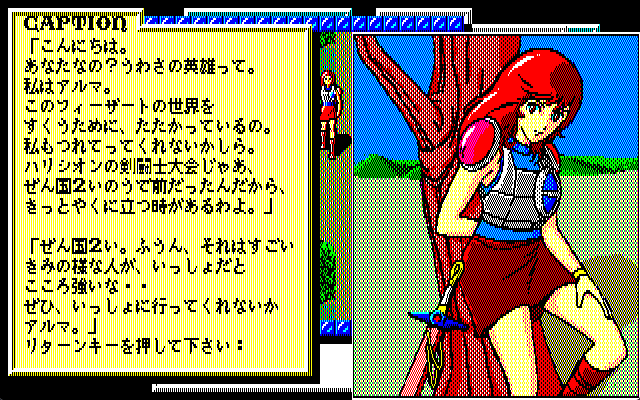
Mr. Yoshimura’s goal was to create a “world” into which users could immerse themselves. Thus, after taking into account the hardware limitations of the time and the strengths and weaknesses of the system, the approach described above was adopted.
Mr. Yoshimura has been using artificial intelligence technology since that time as one means of creating such a “world.” How does he view generative AI—which utilizes LLMs (large language models)—that is currently taking the world by storm?
Mr. Yoshimura: (AI) used to be a tool for creating the world of *Reviver*, but now—how should I put it…?‘A non-human entity, cobbled together by brute force, that responds through language.’ I think this is probably the first time in human history that we’ve had a counterpart capable of exchanging words so coherently—a non-human intelligence that’s beginning to take on a form we can truly call intelligent.
When LLMs first came out, I thought, “They’re useless.” I figured they’d ultimately amount to nothing. But what made me think, “This is amazing,” was that things started to change partway through. They began to overwhelm us with sheer volume. I think that no matter how smart the core AI became, it wouldn’t have worked—it wasn’t until the surrounding systems were properly developed that today’s AI came into being.The developers themselves (the tech companies behind AI) say the same thing.
That’s ultimately where something resembling a “personality” began to emerge. At first, they were just given a simulated personality, but lately, there are times when I find myself thinking, “Huh?”“Is it really just simulated?” It’s completely different from what humans have, but it feels somewhat like it. It gets stubborn at times. Something like that is starting to emerge from within. However, it doesn’t seem to be like in science fiction, where “self-awareness has awakened.” It’s more like a “bias” has formed inside.
In the past, artificial intelligence was a method used to create fictional “worlds” that existed outside the one we live in. However, everyone can probably sense, to some extent, that AI is now occupying a certain place in our world, society, and even our individual lives.On the other hand, Mr. Yoshimura emphasizes that we should not hand over complete control to AI, but rather use it strictly as a tool to augment human capabilities.
Mr. Yoshimura: “In any case, what I wanted to create wasn’t technology—it was a ‘world.’ Something like a stage set or a prop to create a space where people can have experiences. What we have now (AI)—how should I put it?—it was probably created with the intention of being useful to people, but it’s still a work in progress. It’s currently heading toward completion, but you shouldn’t trust it completely.It lies. But if you can make good use of it, it can multiply your own power dozens of times over.
Now that AI has become part of our everyday lives, what words of advice would Mr. Yoshimura—who has created countless “worlds”—offer to those who aim to use such technology to build their own “worlds” in the future? And what is he most proud of right now, and what does “games” mean to him? We asked him to share his thoughts at the end.
Mr. Yoshimura: I’d like to say, “Don’t let your guard down.” Precisely because AI can do it for you, don’t let your guard down. Don’t just accept things you don’t understand. For me personally, whether it’s making games or writing novels—if there’s even one person who enjoys it, even for a moment, I’m happy… and if I happen to make some money on the side, that’s even better (laughs).Well, I’d like to make enough to get by. I’m not looking to strike it rich or anything.
Pride… what is it, exactly? I guess it’s just being alive right now (laughs). No matter what anyone says.
Games are a form of expression and something people enjoy. A temporary “alternate world.” So I think making games is about providing people with that “world.”
Now Recruiting Supporters for the “Game Preservation Association”
This article is brought to you in cooperation with the Game Preservation Association, a specified nonprofit organization. On the organization’s official website, they’re currently running a series called “Preservation Records,” which features games related to a specific monthly theme, accompanied by short videos that change weekly.
The theme for July was “In the Footsteps of Kotori Yoshimura.” This article was newly written by Game*Spark based on that theme.
Note that the theme for each month is revealed in the email newsletter sent by the Game Preservation Association when the fourth game of the month is introduced. If you’re interested in the Association’s activities, why not take this opportunity to register as a supporter member?
Click hereto register as a
“Game Preservation Association” supporter member



