


While the live-action “Resident Evil” series starring Milla Jovovich did capture the sense of terror in a confined space from the video game in its first installment, *Resident Evil* (2002), it increasingly took on the characteristics of an action movie with each subsequent installment.Alice’s abilities continued to escalate, and ultimately, the series transformed into a “cheat character movie” where the focus shifted from the zombies and creatures themselves to watching Alice defeat her enemies.
Paul W. S. Anderson, who consistently led the series from the planning and screenwriting stages, and Milla began dating during the production of the series and married in 2009.Of course, that alone cannot explain the series’ direction, but considering how Alice became increasingly superhuman with each installment and how the story itself came to revolve around her, it ultimately feels as though the focus shifted more toward showcasing their favorite star, Milla, in the most compelling and powerful light—rather than simply being a film adaptation of “Resident Evil.”
In contrast, *Resident Evil: Welcome to Raccoon City* (2021, hereinafter “WTR”) was the film that championed a return to the original games.This film is a reboot that reconstructs elements from the early days of the series—primarily the video games *Resident Evil* (1996) and *Resident Evil 2* (1998)—into a single movie. With many aspects—such as the recreation of the famous scene where the zombies turn to face the camera—clearly inspired by the games, not only in the story but also in the visual style, the approach itself was by no means bad.
On the other hand, bold changes were made to the character designs. In recent years, there has been a tendency for works to face immediate criticism for “political correctness” when a character’s race is altered from the source material. However, the act of changing a character’s race, age, or background depending on the work is by no means a new endeavor.
For example, in the “X-Men” movie series, there were initially voices pointing out that the casting of Professor X and Magneto differed from the source material, arguing that the actors were too old.Nevertheless, today the images of Patrick Stewart and Ian McKellen are strongly associated with their characters, and there is no shortage of excitement surrounding their appearances in “Avengers: Doomsday,” set for release in December 2026.In other words, new interpretations are often met with skepticism at first.
Therefore, the fact that Black actress Hannah John-Kamen played Jill Valentine in *WTR* or that Lance Reddick portrayed Albert Wesker in the Netflix adaptation of *Resident Evil* (2022) is not the issue in and of itself. What matters is how those changes function within the work.
The Netflix version, too, while making bold changes to Wesker’s backstory, did not completely abandon elements from the video games. It featured a sister born from Wesker’s DNA as the protagonist, introduced game-derived creatures such as the Licker, and incorporated plot elements reminiscent of *Resident Evil 5* (2009) and other titles.
Featuring “nameless ordinary citizens” rather than existing characters
Such alterations to existing characters inevitably attract both praise and criticism. One way to reconstruct the world itself while avoiding that criticism is to cast an original character as the protagonist.

This time, Zack Kreger chose precisely that approach. Unlike *WTR*, which features series icons like Leon and Chris as protagonists, this story thoroughly avoids even hinting at their existence.The film focuses on what would happen if an anonymous ordinary citizen—neither a hero nor possessing the combat skills of a special forces operative—were caught up in a biohazard outbreak “behind the scenes” of the stories where those iconic characters take center stage.
While Paul W. S. Anderson and Johannes Roberts of “WTR” are both fans of the *Resident Evil* series, Zack chose to go all out on “horror.”
While Johannes also cited *CODE: Veronica* and *Resident Evil 4* as specific candidates for a sequel, he also expressed interest in the darker, more terrifying worlds seen in *Resident Evil 7* and *Resident Evil: Village*. Had the series continued, it’s possible we would have seen films that delved even deeper into horror.
If I had to compare it to a game, the structure would be closer to *Resident Evil: Outbreak* (2003) and *Resident Evil: Outbreak FILE 2* (2004). However, this is not a direct film adaptation of *Outbreak*.Rather, it utilizes the universe established by the series starting with *Resident Evil 4* (2005) to offer a glimpse into the “backstory” of the events—a perspective that had not been fully explored in the films until now.
To begin with, while the opening scenes depict the early stages of the pandemic, smartphones appear as a matter of course, so the setting is not the 1990s—the era of the video game series from *Resident Evil* (1996) to *Resident Evil 3: Last Escape* (1999).Although it is positioned as a story running parallel to *Resident Evil 2*, it does not directly recreate the world of the main game series; it is better to consider it as a separate timeline.
Crucially, the film consistently portrays the horror from the perspective of ordinary citizens. Even when considering all live-action films, TV dramas, and CG animations to date, there have been surprisingly few “Resident Evil” adaptations that center their stories on ordinary people—not combat professionals—as they face the unknown terror.On the other hand, in the video games, starting with *Resident Evil 7* (2017), at least in the story’s opening segments, there has been an increased emphasis on the sensation of characters—who are not superhuman agents—being thrown into the midst of unknown horrors.
*Resident Evil 6* was both a culmination of the series’ pursuit of the action-shooter genre and a work that revealed the limitations of that approach. Consequently, *Resident Evil 7* boldly broke away from that direction and introduced a first-person perspective.By returning to the survival horror of the series’ early days—exploring confined spaces while being pursued by an unknown entity—it created a different kind of fear than anything that had come before.

It is also symbolic that the international title, *RESIDENT EVIL 7 biohazard*, and the Japanese title, *BIOHAZARD 7 resident evil*, are structured in a way that intertwines the two series names. This was a game that sought to redefine “fear” itself while taking a fresh look at the series’ legacy.
And a major element that defined the horror of *7* was the Baker family.The Baker family evokes the lineage of “crazy families” in American horror, such as the Sawyer family from *The Texas Chain Saw Massacre* (1974). The protagonist, having strayed into a remote area, becomes entangled in the abnormal rules and values that exist only in that place.
Works that transform such “places where urban norms don’t apply” into sources of horror are not uncommon.Numerous works have been created that utilize the alien nature of rural areas and closed-off communities as a source of horror—such as the *The Texas Chain Saw Massacre* series, the *Climori* series, and, in Japan, the so-called “village” series that began with *Inunaki Village* (2020).
However, what made *7* particularly interesting was that it didn’t simply rely on the trope of “people in the countryside are scary.” The Baker family wasn’t inherently insane to begin with. The strange behavior and remarks the player first encounters from them begin to take on a different meaning as the story progresses. Jack Baker and the rest of the family are, in a sense, both perpetrators and victims.
And it is precisely this kind of fear—the sense that “these people seem normal at first glance, but something is off”—that pairs so well with Zack Kreger.
The Kreger-Style Horror That Continues from “Barbarian” and “Weapons”
Ever since his feature directorial debut, *The Barbarian* (2022), Kreger has been transforming the unique sense of strangeness exuded by the elderly and seemingly harmless individuals into horror.Changes that can happen to anyone—such as aging and cognitive decline—are themes in horror that easily translate into anxiety stemming from “not knowing what the other person is thinking” or “our common sense not applying here.”
Of course, the horror doesn’t stem from old age or dementia itself; what’s crucial is the “misalignment”—the sense that communication seems to be happening but isn’t. A person who was having a normal conversation suddenly behaves in a completely different way. You don’t understand why. That unpredictability is what generates the horror.
This sensation was also effectively utilized in *Weapons* (2025). Furthermore, that film powerfully depicted the terror of people—controlled by some force—charging straight toward the viewer in an unstoppable, relentless manner.Come to think of it, this fear—of “an entity whose thoughts are unknown, mindlessly charging toward you”—is well-suited for visualizing the unpredictable behavior of the infected in the *Resident Evil* series.
Not “re-creating” the game, but translating the player’s experience into film
While Kreger is a fan of the games themselves, he is also a director whose expressive power and visual sensibility are a perfect match for *Resident Evil*. This film, too, stays true to the sense of “helpless humans facing an overwhelming threat”—a theme that the game series has emphasized since *Resident Evil 7*.
This approach is evident in the visuals themselves. From the very beginning, the direction consistently employs a “player’s perspective,” making it feel as though you’re actually playing the game. However, unlike the climaxes of *Hardcore* (2015) or the Indian violence film *Marco* (2024), the camera isn’t fixed in a strictly first-person perspective.While maintaining an objective, cinematic camera perspective, the film occasionally subtly incorporates the sensation of controlling a game. It moves exquisitely back and forth between the realms of film and video games.
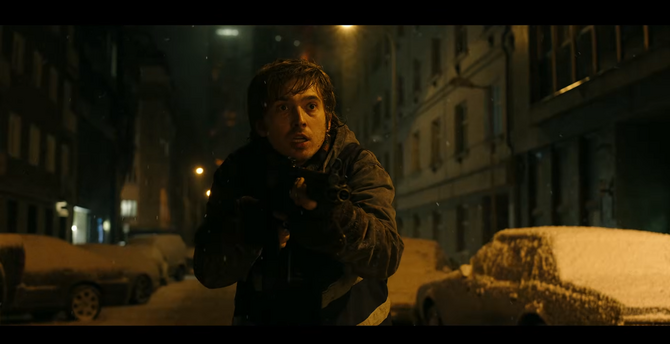
What’s particularly interesting is how weapons are acquired. You start with a handgun, then discover a shotgun inside a house you visit early on. As the story progresses, you obtain even more powerful machine gun-type weapons. The very structure—where weapons are gradually upgraded in line with the increasing level of danger—clearly draws on the progression of a video game.
In particular, the placement of the shotgun strongly evokes the influence of *Resident Evil 4*. Furthermore, while familiar items from the series—such as typewriters and green herbs—make an appearance, the film skillfully integrates them as natural elements of the world rather than forcing them onto the screen as “easter eggs” that only fans would recognize.
There are also jokes that play on a classic video game trope: while you can destroy small keys with a gun, you can’t break larger ones. Yet this never feels like blatant fan service; instead, it blends seamlessly into the flow of the story.

It’s also significant that the protagonist is practically a complete novice when it comes to firearms. Acquiring a weapon doesn’t instantly make him invincible; he starts out not even knowing how to handle it. In other words, the equation “getting a gun = being safe” doesn’t hold true. Even though he’s armed, a sense of tension—that he could be killed at any moment—persists right up to the very end.
Here, too, the “fear of an alien presence closing in on you”—a theme Kreger has explored throughout his work—proves highly effective.
A New “Resident Evil” That Blends the Creatures of “4” with the Horror of “7”
It’s clear from numerous details throughout the game that Zack Kreger is a fan of *Resident Evil 4* and is also drawing inspiration from the titles released since *7*.
This is particularly evident in the design of the infected and the creatures. Rather than focusing on standard zombies like those in the game versions of *Resident Evil 1* through *3*, the film emphasizes biological mutations reminiscent of the Plaga-type creatures from *Resident Evil 4* onward and the Ouroboros-type creatures from *Resident Evil 5* onward.Furthermore, a creature reminiscent of the Fat Moulded from *Resident Evil 7* appears midway through the game. Rather than recreating a specific title, the film draws broadly from the creature designs developed throughout the series since *Resident Evil 4*.
The Plaga-type creatures themselves have also appeared in the live-action series starring Milla Jovovich. However, in a world where giant creatures and superhuman characters appear one after another, they ended up blending into the background, merely coming across as one of many monster subspecies.
In contrast, this film thoroughly weakens the human characters to highlight the strangeness and menace of each individual creature. In other words, this film does not draw its legacy from any single *Resident Evil* title.
It draws on the organic, grotesque creature designs from *Resident Evil 4* onward; the primal fear of humans being hunted by unknown entities that *Resident Evil 7* brought back to the series; and the perspective of ordinary citizens on the sidelines—rather than at the center of the incident—as seen in *Resident Evil: Outbreak*.

Added to this are the sense of dissonance—that “something is off about these humans”—and the terror of beings that defy logic suddenly closing in on you, elements that Kreger himself has honed in *Barbarian* and *Weapons*.
That’s precisely why this film differs slightly from a “faithful adaptation” that simply recreates the game’s setting and characters.Rather, it attempts to translate into film the very sensations players experience when playing the *Resident Evil* games—the uncertainty of “not knowing what lies ahead,” the unease of “not feeling safe even with a weapon,” and the dilemma of “not knowing whether to flee or fight.”
While incorporating the creature designs from *Resident Evil 4* onward, the film’s approach to creating horror is closer to a return to the survival horror style seen in *Resident Evil 7* and beyond. Isn’t the greatest appeal of this film precisely how Kreger’s own artistic vision seamlessly weaves these two elements together?
It stands perfectly well as a standalone conclusion, yet it also left me wanting to see the continuation of this world—perhaps in one more installment.
Game*Spark Review: “Resident Evil” Movie, Released October 9, 2026
Moving Beyond Character-Driven Films: Aiming for Simple “Horror” Told from the Perspective of a Nobody
-
GOOD
- Precisely because it’s told from the perspective of ordinary citizens, there’s a sense of tension—where even having a weapon offers no sense of security—that was absent from previous film adaptations
- Even without explicitly referencing the game characters, it genuinely makes you feel like you’re in the “Resident Evil” universe
- An old woman running at full speed is simply terrifying
BAD
- If you haven’t played many video games and are expecting the action and star power of the Milla Jovovich-led *Resident Evil* films, you’ll get the feeling that “this isn’t it.”
- There’s an unusually high amount of gore with body parts flying everywhere (which, in a way, is a plus).
- The agent-like character who appears partway through is way too weak.
