


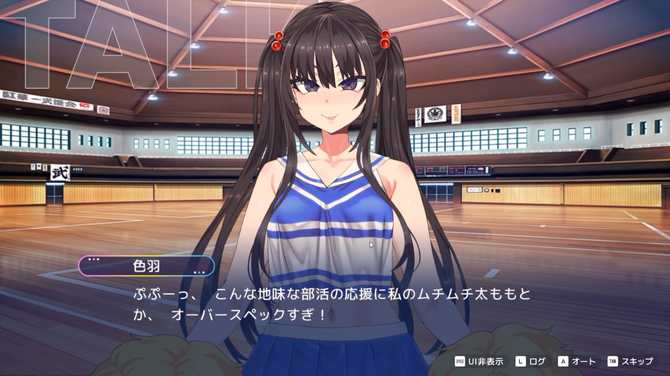
Have any of you ever been provoked by a video game character?
Right after losing a match, you’re provoked, and before you know it, you’re gripping the controller again, shouting, “One more time!”—I’m sure many of you have had that experience. That feeling of frustration can sometimes be the best motivation.
Yabukarado’s new title, *Go for It! Cheer Rhythm*, takes that “frustration from being taunted” and incorporates it into a rhythm game where you use your whole body to play.
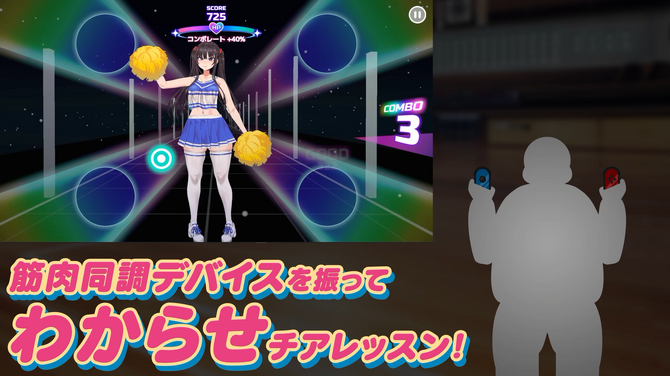
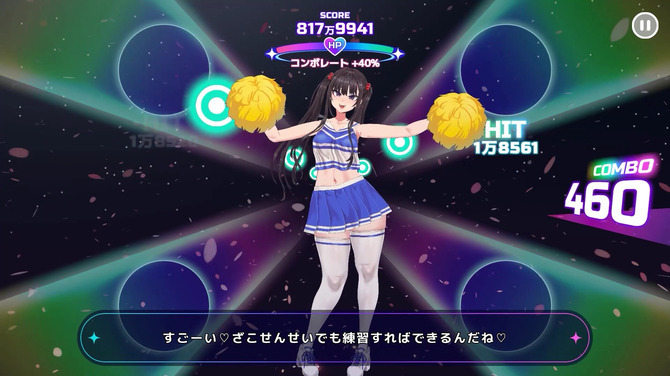
In this all-ages fitness rhythm action game, players take on the role of a “teacher” and coach the prideful high school girl Iroha Shishikura (Voiced by: Yuka Hinata) in cheerleading. Holding a Joy-Con in each hand, you’ll wave them like cheerleading pom-poms to keep the beat.However, no matter how accurately you perform, Iroha will taunt you with over 600 different sassy voice lines. The game has garnered attention for its character design by Asanagi-sensei, as well as for its soundtrack composed by renowned game composers such as Yuki Kikuta and Mitsuhiro Kaneda.
The game was showcased in the Indie Games Corner at TGS 2026, and I had the opportunity to try it out myself. In this article, I’ll share the highlights of my interview with Mr. Yabu, the representative of Yabukarado, the studio behind the game.
The concept of waving pom-poms was born from a technical challenge
――First, could you tell us what idea sparked the concept for *Ganbare! Cheer Rhythm*?
Mr. Yabu: It all started when I was looking at indie and doujin games and realized there were almost none that let you play using your body, like the Switch’s Joy-Con.
A long time ago, there was a game on the Wii called *Reginrave: Slash of the Gods*, right? It was developed by Sandlot, the same studio behind the *Earth Defense Force* series. Set in a Norse-inspired world, you’d swing the Wii Remote like a weapon, and a slash would travel in the direction you swung to defeat enemies.Since it was part of the *Earth Defense Force* lineage, it was a game where massive hordes of enemies would appear. At the company I worked for back then, we’d all play it together during breaks, having a blast.
I think games like *Beat Saber* today fall into that same category—playing a game while moving your body is just so much fun, physically speaking. I’d been thinking that for quite some time.
Around that time, I discovered that you could connect a Switch controller to a PC via Bluetooth.
Since the Switch is already widespread in many households, I thought, “Maybe even indie developers could create this kind of game now”—and that was the starting point.
――From there, the game evolved into its current form—where you move your body while being egged on by a sassy girl—but was that concept decided from the very beginning?
Mr. Yabu: At first, I was thinking of it in a slightly different way—it was based on boxing.
I wondered if we could accurately detect gestures like jabs, hooks, and uppercuts using the Joy-Con. I thought that if we could pull that off, it would be a technology that could be applied not just to this game, but to action games as well, so I started by testing that technology first.
However, this turned out to be quite difficult. I replayed games like *Fit Boxing* for reference, but it seemed they weren’t strictly distinguishing between different types of punches. The design is such that you get a workout simply by moving your body in sync with the on-screen instructions. Realizing that this was a challenge even for existing titles, we decided to change direction.
It’s difficult to accurately capture arm gestures. However, I thought that if we used the acceleration data from moving the Joy-Con controllers, we might be able to distinguish between the four directions. I ran more tests with this approach and found that it seemed to work.
That said, this approach actually made it difficult to create a traditional boxing or fitness game. So we decided to shape the game around the idea of incorporating it into a playful experience, similar to *Samba de Amigo* or *Beat Saber*.
――So, in a sense, the decision to have players wave pom-poms came about precisely because of technical constraints, didn’t it?
Mr. Yabu: That’s right. On top of that, it was the result of repeated testing to determine what kind of movements felt good.
Once we were able to implement those movements, we started thinking about what kind of theme would work best for a rhythm game. Up until then, I’d been envisioning characters I’d drawn myself, but once we decided to make it a rhythm game, we decided to go with properly cute characters, so we asked Asanagi-sensei to design them.
“Rousing” Rather Than “Praising”: The Reason Behind It
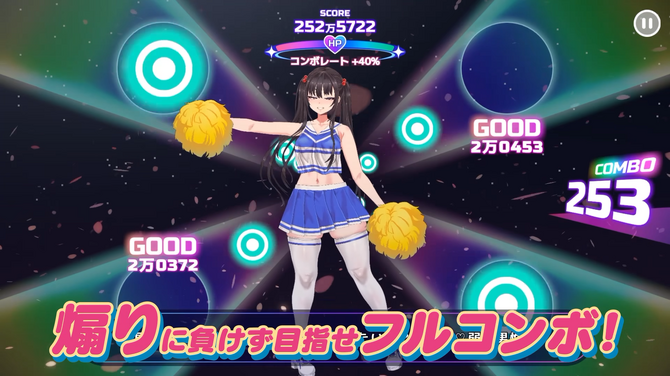
――In this game, Iroha reacts in real time via Live2D based on the player’s inputs. How are you balancing the gameplay mechanics of a rhythm game with the sense that the character is actually there?
Mr. Yabu: Our approach here stems from a perspective that’s a bit different from that of core rhythm game users.
I think there have been quite a few rhythm games where characters appear and dance. However, I believe there have been very few that actually give you the sense that you’re playing the game alongside the character and interacting with them.
“Space Channel 5” served as inspiration for our game design. In that game, too, the protagonist, Urara, speaks directly to you in the middle of a song, right? It’s presented as a news report, but as the viewer watching the screen, you’re positioned like a TV audience member, and there’s that sense of interaction. The idea that it’s really fun when a character speaks directly to you served as our inspiration.
――I also got to try it out at TGS, and even when you play well, Iroha really riles you up, doesn’t she? Why did you choose to create an experience where you’re “riled up” rather than praised?
Yabu: Simply put, it’s my personal preference (laughs).
I personally really like that kind of character personality, and just as I was thinking about creating something like that, the perfect subject came along. Since rhythm games involve interaction, you can accept being called “zaako” very naturally, right?
If you mess up, you’ll naturally get taunted, get annoyed, and feel like you want to show her what you’re made of. Even if you do well, getting taunted makes you want to keep going and “show her.” Though when I say “show her,” since this is a game for a general audience, it doesn’t have any adult-oriented undertones. It’s closer to making her properly acknowledge your skill.
I believe that by creating this kind of experience, players’ sense of immersion in the game will deepen.
――I hear there are over 600 voice lines—are they used differently depending on the situation?
Mr. Yabu: Yes. Of course, there are different lines for success and failure. If you fail while on a long combo streak, the taunt gives you that “Oh, what a waste” feeling, whereas if you fail with a short combo, you’ll just get a standard “Loser.” We’ve increased the variety by carefully selecting lines that really dig into the player’s psyche.
Also, this game features a Story Mode, and it’s designed so that your performance score accumulates throughout the entire Story Mode. As the story progresses, the path branches based on how well you’ve performed up to that point.
A “trust rating” starts at zero; if you do well, it goes into the positive, but if you keep failing, it drops into the negative. When it’s in the negative, some variations feature even harsher lines than the initial ones. However, since some players might find that a bit much, we’re considering adding an option in the settings to toggle whether the trust rating can go negative.
Iroha, Born from Intertwined Fates; Life Imbued Through Acting

――You’ve enlisted Asanagi-sensei for character design and Yuka Hinata for the voice acting. Could you tell us how you came to work with these two, and what aspects you focused on when creating the character Iroha?
Mr. Yabu: Actually, we’re borrowing Iroha from a character that Asanagi-sensei had originally drawn. When we asked her to design a cute girl for this game, she suggested, “How about this character?” We thought, “That’s great,” and ended up borrowing her.
Asanagi-sensei has also drawn cheerleader characters, and apparently, the setting is that they all attend the same school. The way she moves in this game and the way she holds her cheer pom-poms fit together perfectly. Rather than being created with a specific goal in mind, this character—and indeed, the game itself—came about through a series of coincidences.
As for her personality, the artist hadn’t decided on the details in great depth, so we came up with it ourselves. She had a somewhat sassy vibe to begin with, but we’ve amplified that trait. That’s where my personal preferences came through a bit.
With that in mind, we offered the voice acting role based on who we felt best suited this visual and personality—and who fans would most expect to hear. Since we originally planned to release this for a general audience, our pool of candidates narrowed significantly to doujin voice actors who have also appeared in mainstream works.
――During the actual recording, were there any moments when you felt she came across as even more “typically Iroha” than you’d imagined?
Yabu: As expected, once the voice actress performed the role, the character really came to life.
Since I wrote the lines myself, I was a bit anxious—wondering, “Is this line okay? Will it come across well?”
But when she actually performed it… wow, it was amazing. For example, even in a single line like “Zaa-ko,” it wasn’t just a matter of making fun of the player—there was a sense of kindness toward them embedded in it.
Rather than being hurt by it, the performance had such depth that it felt comforting to hear—I’m really glad it turned out that way.
A “Serious” Track from the Composers of Classic Games
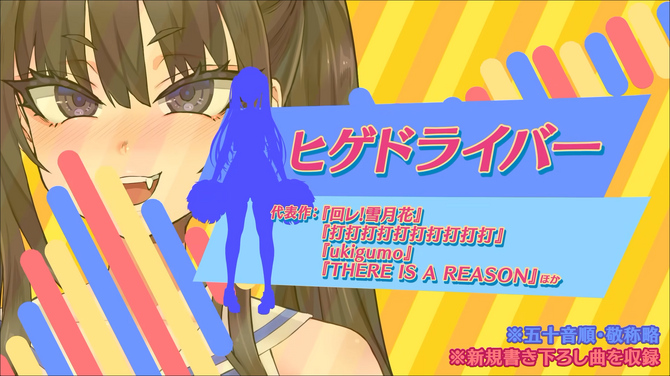
――In terms of the music, you’ve announced an incredibly star-studded lineup of composers, including Yuki Kikuta, Mitsuhiro Kaneda, Kichizo Kudo, and Hige Driver. Could you tell us how such a diverse group of creators came to be involved?
Yabu: We didn’t have any pre-existing connections with them. When we announced this title on August 10, the response was incredibly positive.
I’d always thought that, if possible, I’d like to ask the composers who created the music for the games I’d played since childhood to contribute to this project. Since the response was so positive, I reached out with a press release, saying, “We’re making a game like this—if you’re interested,” and they ended up showing interest.
Quite a few of them replied, “That sounds interesting,” when I reached out, and I’m truly grateful for that. I’m glad I trusted my instincts and kept making games that I personally find fun.
――Did you give the composers any specific instructions?
Yabu: I don’t give them extremely detailed specifications. Since it’s a rhythm game, while I do convey the length and tempo range, I ask the game music composers to take the game songs they’re truly skilled at—the ones that everyone went crazy for back in the day—and reconstruct them using today’s technology and interpretation.
So, rather than asking for songs tailored specifically to this character, we’re having them create truly “hardcore” tracks. I believe it’s definitely more fun to play when there’s a contrast between the character and the game mechanics and a hardcore track. If we just ended up with songs that fit the character—so-called “character songs”—it would lose its appeal.
Of course, we’ll also extend offers to composers who are currently active in the rhythm game scene. However, since I imagine every rhythm game reaches out to those same people, I really wanted to set us apart.
Plus, when you hear a composer’s name, their signature song immediately comes to mind, doesn’t it? We’re aiming for tracks that live up to those expectations.
Feedback and Challenges from TGS 2026

――You had a playable demo booth at TGS 2026. Were there any ways people played the game that differed from the development team’s expectations, or any unexpected reactions?
Mr. Yabu: It was more popular than we expected—we actually ran out of the promotional items we’d prepared by the first half of the third day.It was a shame that Day 5 was canceled, but we’d already distributed everything we’d prepared by then—we were about to run out of giveaways anyway—so I think it was a huge success. I haven’t counted them exactly, but I believe over 300 people played the game.
What surprised me was seeing families there. When I saw a mother say, “Go ahead and try it,” and her child playing the game, I thought, “This is amazing.”
Adults tend to have a bit of a jaded perspective, so they sometimes judge a game based on its characters before even playing it, but these families played it purely as a game without any preconceptions and told us they had fun. I got the sense that the gameplay itself is definitely promising.
――Based on the reactions at TGS, were there any areas you felt needed improvement?
Yabu: Yes, there are. At TGS, staff members were always on hand; after explaining how to play using gestures and body language, we’d almost always get feedback that people had fun. However, watching the situation, I realized that if there hadn’t been staff present and we’d just set up the demo stations, the level of satisfaction probably wouldn’t have been as high.
I now feel that unless we refine the game’s introductory section more thoroughly, it will be difficult for players to reach the point where they realize just how fun the gameplay is.
This time, quite a few people came to try the game because of the buzz surrounding the characters and other topics. In other words, they were people who had hardly ever played a rhythm game before. For those players, it takes some effort just to understand what to do when the notes start flowing.
Our staff members were calling out “Yes! Yes!” to signal the beat and even dancing along behind the players, and watching them, I could see that this made the game more enjoyable. So, I’d like to include a support feature like a voice guide.Just like in *Fit Boxing*, where you can choose your trainer’s voice, we’re thinking about adding a feature that lets players be guided by their favorite character’s voice.
Balancing Accessibility and Depth
――I imagine some people will aim to improve their skills as a rhythm game, while others will play casually for fitness purposes. I think what they’re looking for is quite different—to what extent do you plan to incorporate depth into this title as a rhythm game?
Mr. Yabu: First and foremost, we want to make the game very easy to get into. We’re prioritizing accessibility so that even people who aren’t core rhythm game users—but are just starting to get interested in the genre—can enjoy it.
That said, we’ll naturally include high-difficulty charts for players who get used to the game and find the early difficulty levels too easy. However, since there are two game modes—Story Mode and Free Mode—we plan to make the highest difficulty available only in Free Mode. In other words, clearing an ultra-high difficulty level won’t be a requirement for reaching the ending.
There’s another practical limitation: since moving your hands up and down with the Joy-Con requires a fairly large arm movement, setting the interval between up and down switches too short would make it practically impossible to execute. Therefore, there’s an upper limit to the difficulty level for Joy-Con gameplay.
As for note types, there are currently three patterns: rapid taps, long presses, and simultaneous presses. We’d like to explore whether we can incorporate different movements—including whether it’s technically feasible—but we don’t plan to add too many. The more we add, the less beginner-friendly the game becomes.
Also, as anyone who played it at TGS probably knows, it’s actually harder when you’re physically moving your body than it looks on screen. People tend to think, “This looks easy,” just by looking at the game screen, so figuring out how to convey that in our promotions is a real challenge.
One more point: this game will be playable not only with the Joy-Con but also with a keyboard or gamepad. We also plan to create a top-tier chart specifically for playing with a gamepad or keyboard. Since there are no restrictions on arm movement with these inputs, we’ll be able to create charts where the up and down directions switch back and forth at an incredibly fast pace—like “taka-taka-taka-taka.”
A world where great work is recognized
――Finally, please tell us how you’d like players to perceive *Ganbare! Cheer Rhythm* as a game, and what level of evolution you ultimately hope to showcase with this title.
Mr. Yabu: It’s a wonderful game featuring incredibly cute and charming characters cheering you on, so I’d like as many people as possible to play it. I hope players will approach it without too many preconceptions and simply have fun.
I do think there’s still a tendency for people to form preconceptions or label things based on who created them. But personally, I want to create an environment where anyone can express themselves however they like. I believe that approach allows us to create new experiences through creativity and leads to interesting outcomes. With this combination, we’re making a wholesome game that’s also incredibly fun.First and foremost, I want to do my best to deliver that to players.
My ambition is that by doing so, we can help create a trend where the potential of indie and doujin creators—including ourselves—gains global recognition. I hope we can create a world where anyone can do whatever they want, and as long as the finished product is wonderful, it will be appreciated.
As for the game’s future, I recently applied for a Switch developer account. It’s currently under review, so if it’s approved, I plan to officially move forward with the Switch version.
For the Switch version, I’m planning to create another storyline with a different protagonist. I’m calling the current mode “Single Mode” and the Switch version “Family Mode.” In Family Mode, the protagonist will be around the same age as the heroine, and the story will be a lighthearted, slapstick comedy set in a school setting.
――So the story will differ between the PC and Switch versions.
Mr. Yabu: That’s right. It’s not exactly “two for the price of one,” but I think it’ll be a game where players can enjoy the contrast between the heroine’s attitude toward “Sensei” and her attitude toward someone her own age—or perhaps even a little younger.
What struck me most while listening to your story was that this game wasn’t created with a specific “goal” in mind, but rather took shape through a series of coincidences.The challenge of implementing punch detection with the Joy-Cons led to the “pop-pop” sound effect; the encounter with Asanagi-sensei’s character inspired the cheerleading theme; and the response at the announcement event forged connections with composers of classic games.
And then there’s the anecdote from the TGS venue about a child, encouraged by their mother, happily playing the game. Doesn’t this speak more than anything to the game’s inherent strength—a strength that can’t be explained by the characters’ popularity alone?
You get riled up, you feel frustrated—and yet, you still find yourself wanting to swing your arms again. I’m already looking forward to the day when I can prove my skills to Iroha and earn her recognition as “Sensei.”
“Go for It! Cheer Rhythm” is scheduled for release in 2027 for theSteam.
*Screenshots are from the in-development version.
