


On September 24, 2026, Konami Digital Entertainment and Annapurna Interactive released the latest installment in the series, *SILENT HILL: Townfall*.
The *SILENT HILL* series underwent a full-scale revival beginning with the 2024 remake of *SILENT HILL 2*,and in 2025, *SILENT HILL f*—the first title in the series set in Japan—generated significant buzz. It remains a landmark psychological horror game that continues to take on new challenges.

Now, the studio behind this title, *SILENT HILL: Townfall*, is Screen Burn (formerly No Code), known for titles such as *Observation*. A key feature is its use of a “first-person perspective throughout,” marking the first time this has been attempted in a major title in the series.
As a die-hard Silent Hill fan, I was thoroughly satisfied—I felt the same level of “tension” and “fear” as in the traditional top-down perspective.
Furthermore, while the first-person perspective offers the advantage of increased immersion compared to the top-down view, it also has the limitation of restricted visual information. This is compensated for by the various “sounds” of the surroundings; as a result, the terror derived from auditory cues—such as the footsteps of enemies and sound effects—may rank among the best in the entire series.

The setting for this game is “St. Amelia,” a remote Scottish island shrouded in thick fog. In 1996, the protagonist, Simon Odell, was washed ashore on this island and, while wandering through a town that had lost its vitality, gradually uncovers the past hidden within himself and the land.

One of the places said to have provided significant inspiration for the creation of St. Amelia is the real-life fishing village of “St. Monans” in the East Neuk of Fife, in eastern Scotland.
St. Monans is known as a scenic tourist destination featuring traditional fishermen’s cottages from the 17th to 19th centuries and a beautiful stone-built streetscape.
The development team reportedly conducted meticulous location scouting in the area and realistically recreated the distinctive low coastal walls, streetlights, and buildings—as well as the unique sense of confinement and desolate atmosphere—within the game, making it an undisputed pilgrimage site for fans.

In this article, I’ll introduce the charm of their unique culture and original landscapes by comparing the “misty town of ‘St. Amelia’” with the real-life inspiration, “St. Monanz.”
Personally, I would have loved to visit the location in person and report on the beautiful scenery of St. Monanz, but since the total travel costs would have been over 350,000 yen (!), I reluctantly had to give up on the idea.
This article was written with reference to “geograph,” a UK-based geographic information sharing site. Thank you for your understanding.

◆A port town featuring colorful cottages and a beautiful coastal promenade

Early in the game, players explore the port town of “St. Amelia,” a fictional isolated island modeled after St. Monan’s.

This small port town once flourished as a key hub for maritime trade, and fishing was also a thriving industry in the surrounding waters.Then, in 1902, the construction of a dockhouse at the harbor further spurred industrial development. Today, it remains a historic location blessed with abundant fish catches and serves as a hub for yacht enthusiasts.
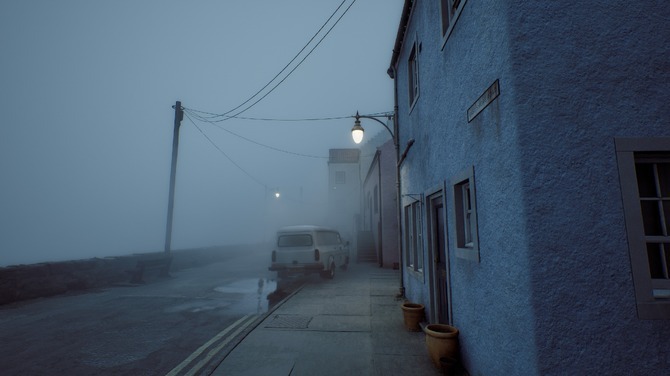
First, one of the landscapes that symbolizes St. Amelia, the game’s setting, is the “Coastal District.” Characterized by stone seawalls and stone-walled houses lining the coast almost seamlessly, it creates a very beautiful and mysterious impression.

The real-life “St. Monans Harbor” is also a picturesque, historic fishing port, as seen in the photo, featuring a cove protected by “three breakwaters.”

The central breakwater was built as far back as 1596, while the eastern breakwater was designed in 1865 by David & Thomas Stevenson, renowned Scottish lighthouse engineers. The very history of the village’s fishing and shipbuilding industries is etched into the harbor’s structure.
Additionally, part of the breakwater features a unique stonework structure (commonly known as “The Blocks”) designed to absorb the impact of rough waves, creating a distinctive landscape that makes it a very popular spot among photographers and tourists.

Meanwhile, the “harbor” in the game is the first place where the protagonist, Simon, was washed ashore, and it serves as a particularly important landmark within the story.
Around St. Amelia Harbor, visibility is so poor due to the thick fog (har) rolling in from the sea that it’s difficult to see even a few meters ahead, creating an irresistibly eerie and chilling atmosphere that is quintessentially *SILENT HILL*.

In contrast, the real-life sea at St. Monanz stretches out before you as a stunningly beautiful blue ocean, as shown in the image.
Furthermore, standing at the tip of the harbor or the breakwater (pier) offers a captivating panoramic view of the islands, including the “Isle of May” floating far out at sea and the volcanic rock outcrop “Bass Rock.”

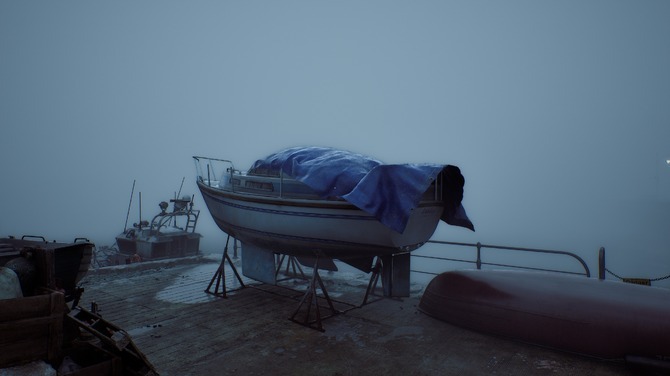
At the docks within St. Amelia Harbor, you can see various fishing gear such as “buoys” and “fish pens (lobster pots),” but these are placed as decorative elements to heighten the game’s sense of a gloomy harbor town and instill a sense of psychological dread in the player.
In addition, while several small boats and yachts are moored with ropes, there is not a single person in sight, and the area is shrouded in a silence that makes it seem as if the residents have suddenly vanished—a scene that is both beautiful and eerie.

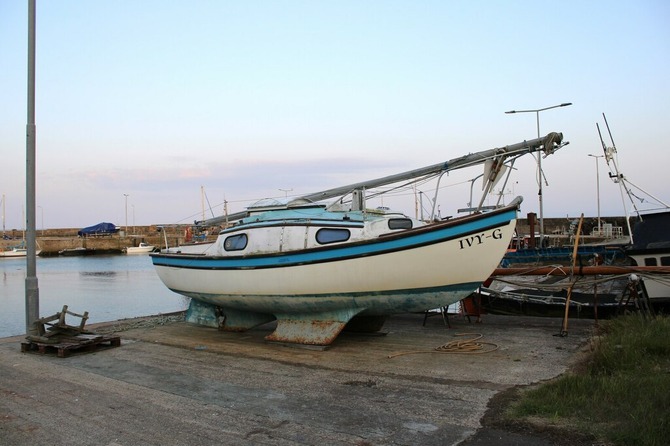
In contrast, at the real-life Port of St. Monans, fishing for the area’s famous lobsters and crabs is thriving, and the harbor is filled with stacks of net-lined cages (ike-su), just like in the game.
Looking around the dock, small, active lobster fishing boats and pleasure boats (yachts) are leisurely moored there. In keeping with its real-life history—that it “once flourished with many fishermen and boats before later falling into decline”—it has transformed into a peaceful tourist harbor.

Furthermore, the most eye-catching feature in St. Monans is, without a doubt, the colorful “cottages.” Lined up along “Shore Street” and “West Shore” by the harbor, they add warmth to the North Sea scenery and are the village’s best vantage point.

The houses are characterized by pale walls in shades of pastel blue, pink, cream, and white, topped with vivid red pan-tile roofs that reflect the village’s history of trade with the Netherlands—making the scene look just like a painting.


In contrast, the houses in St. Amelia are shrouded in thick sea fog (haar) and darkness, their vibrant colors transformed into dull grays and dark tones. It overwhelms the player as a row of lifeless, deserted ruins—a stark contrast to the bustling past that now seems like a lie.

All the windows are tightly shut from the inside, leaving behind eerie traces of daily life—such as abandoned furniture—as if the residents had suddenly vanished. The atmosphere, where only the cold sea breeze rattles the windows, could be described as a symbol of suffocating confinement.
This creates a striking contrast between St. Monanz’s charm as a “quiet tourist destination” and the horror atmosphere of the game.
◆ Labyrinthine Narrow Alleys and the Town Center

Head north past St. Amelia’s East Coast Road and climb the narrow staircase to reach the town center.
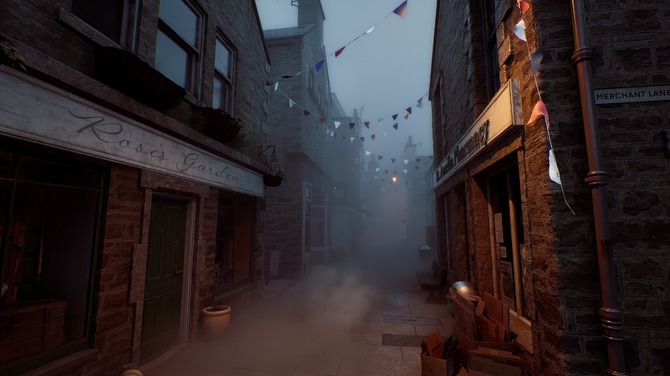


When you reach Main Street, you’ll find “Merchant Lane,” lined with a post office, a video rental shop, and a variety store—though it’s now deserted and has a ruin-like atmosphere. You can still glimpse traces of the lives once lived by the residents of St. Amelia.

Incidentally, the bulletin board at the “Tourist Center” features real photographs of the scenery in St. Monanz—a lovely touch that conveys the developers’ respect and affection for the place. Be sure to look for them.
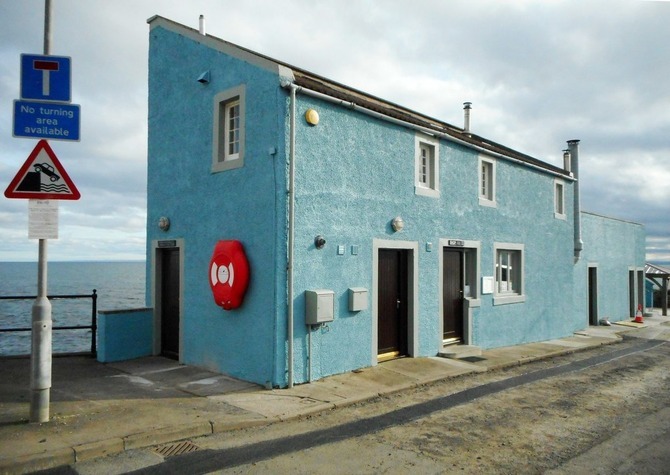

Now, when compared to the scenery of St. Monanz, you’ll notice many areas clearly inspired by the real St. Monanz—such as the “Post Office” with its vivid, pastel-blue, fancy appearance and streets packed with houses—and you’ll be amazed by the high level of detail in the recreation.

Another distinctive feature is the intricate network of narrow, cobblestone alleys—called “closes”—that crisscross between the buildings.
In the game’s St. Amelia, the alleys wind their way between buildings, with a continuous series of right-angle turns, so players are constantly haunted by the fear of blind spots—never knowing what lies around the next bend.

As you can see, the alleys of St. Monanz are “picturesque paths where you can feel history just by walking through them,” which is thrilling—but the contrast with the game is striking.

And let’s not forget the striking monument known as the “Heart of St. Amelia,” located in the town’s central square.

In *SILENT HILL: Townfall*, this location holds two very important meanings: it serves as a physical landmark and represents the core (theme) of the story.
Additionally, since several key exploration areas—such as the “Holden Hotel” and the “Coastal District Clinic”—are scattered throughout the surrounding area, you’ll find yourself visiting this spot frequently.

It is clear that the “Heart of St. Amelia” monument was inspired by the real-life “St. Monans War Memorial.”
Although the size differs, it closely resembles the distinctive Celtic cross monument, and you can see the influence of St. Monans here as well.
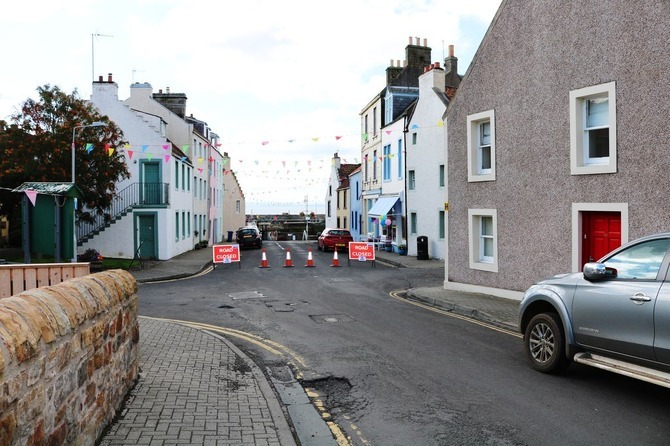

There are also other similar no-entry areas…


In the real-life town of St. Monans, there is a handmade garden created by locals called the “Wellie Boot Garden,” featuring over 200 pairs of colorful rubber boots; however, in the game, it has been reimagined as the “St. Amelia Community Garden.”


The icing on the cake is that an exact replica of a “public phone booth” also exists in St. Monanz and is frequently used by locals. Incidentally, in the game, this phone booth serves as a save point, making it quite important. You’ll breathe a sigh of relief whenever you discover one while exploring.
◆Churches, Windmills, and Saltwater Pools—The Charm of Historic Structures “Not Found in the Game”

Although they do not appear directly in the game, St. Monans is home to many buildings that bear witness to the village’s long history.
The Old Kirk (St. Monans Auld Kirk) is one such structure—a historic church said to be the closest to the sea in Scotland, rebuilt by King David II in the 14th century (the 1360s).

It features a T-shaped structure with a “spire” (a flying-fish-shaped roof)—a rarity among Scotland’s old churches—and its location near the coast makes for a truly beautiful sight.

Next is the “St. Monans Windmill,” the only surviving historic windmill in Fife, built in the late 18th century (around 1771) and standing solitary on a small hill overlooking the coastline.

With its beautiful stonework and a silhouette that stands out against the green hills and blue sea, it serves as a wonderful landmark for hikers on the Fife Coastal Path.
It is also known for its breathtaking beauty at sunrise and sunset, when it stands against the gradations of the sky, and for the mysterious atmosphere it takes on when shrouded in sea fog (har), transforming into a scene straight out of the world of *Silent Hill*.

Last but not least is the “St. Monans Tidal Pool,” a historic outdoor seawater pool built on the rocky coastline that utilizes the ebb and flow of the tides.
Located on the coastline east of the village, right next to the windmill, it has recently gained immense popularity as a hidden gem—a mecca—for “wild swimming” enthusiasts.

Right behind the pool stands the St. Monans Windmill mentioned earlier, and at dusk, the silhouette of the windmill and the gradations of the sky create a breathtakingly beautiful scene that bathes the tranquil pool in a reddish glow. It really makes you want to jump right in.
Learning about the local historical sites will surely provide clues to understanding the depth of the town and the context that gives rise to the horror in this film.
◆The “Town of Mist” Born from a Beautiful Fishing Village

Looking at St. Amelia in *SILENT HILL: Townfall* in this way, it becomes clear that the beautiful, tranquil town of St. Monan’s lies at the heart of its landscape.
Narrow streets lined with stone houses, the town’s proximity to the sea, stairs leading down to the shore, and a landscape dotted with old buildings. While incorporating the characteristics of this real-world location, the game transforms it into the uniquely unstable space of *SILENT HILL*—distinct from reality—by layering elements such as fog, light, sound, and the absence of people.

On the other hand, the real St. Monanz is a peaceful seaside town where people still live today. The townscape, shaped over a long history, and traces of fishing and industry coexist naturally with the present-day landscape, and this in itself is part of the area’s unique charm.
That is precisely why, even when incorporated as the setting for this game, it feels not merely like a fictional horror setting, but rather a “place where people once truly lived”—a sense of authenticity that lends it such conviction.

Beyond the scenery seen in the game lies a town where people actually live. That’s why I believe interest extends not only to the game’s location design but also to the landscape and culture that this town has developed over a long period of time.

If you ever have the chance to visit St. Monans, walking through the scenery not just as a backdrop but as a way to discover where this game was born might be one way to enjoy it.
The latest installment in the series, *SILENT HILL: Townfall*, is now available forPS5and PC (Steamand the Epic Games Store).



