


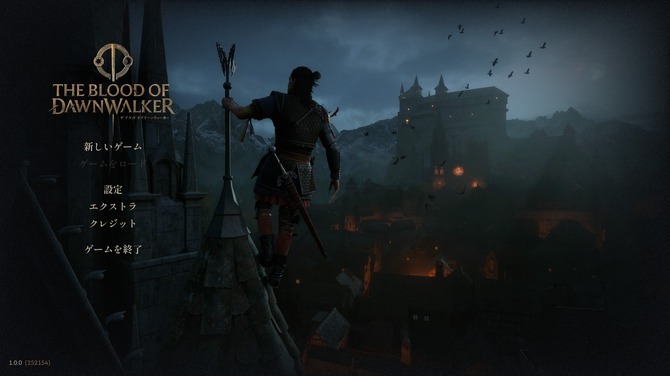
"The Blood of Dawnwalker," a brand-new dark fantasy RPG released on September 3 as the debut title from "Rebel Wolves"—a new studio founded by a team of veteran creators who worked on titles such as *The Witcher 3: Wild Hunt*—has already garnered significant attention.
The game garnered widespread acclaim almost immediately upon release. Plans for a series expansion were revealed even before launch, and recruitment for the “next chapter” began shortly after release, making it a fairly popular title already.On the other hand, however, the Japanese version has faced backlash from users due to content restrictions (though the developers have explicitly stated they are working to lift restrictions on depictions of bloodshed), and I believe this may be one reason why its popularity has yet to fully take off.
I’ve been playing this game primarily through the main story, completing a fair number of side quests along the way, and have just reached the standard ending. In a previous preview article, I shared my early impressions, but in this piece, I’ll offer a review from the perspective of a player who has completed the full game, having played through the final version from start to finish.

1: Graphics and World-Building

The first thing you notice when playing this game is how the atmosphere of the somber yet beautiful graphics, as well as the presentation of the text and UI, closely resemble *The Witcher 3*.There are also many similarities in areas such as quest structure and the variety of progression options, so I think fans of that series will be able to sense that “The Witcher 3” feel down to the finest details when they play this game. Since the development teams overlap, many elements within the game have a feel that can safely be described as “The Witcher 3-like.”
Of course, it isn’t exactly the same as *The Witcher 3*. While there are various differences, particularly in the systems, one of the biggest differences I noticed as a player is the game’s overall “sense of scale.”
If you’re just following the main story, you can complete this game in about 20 hours, which makes it quite “compact” compared to recent AAA open-world RPG blockbusters.To give a clear comparison, it’s perhaps similar to the relationship between *The Outer Worlds* and the *Fallout* series. Just like *The Outer Worlds*, this game can be seen as a spiritual successor that’s neatly packaged on a smaller scale—in a good way.

The setting, “Sangora Valley,” features a map that’s sufficiently large when viewed as a standalone game. However, when compared to the massive AAA titles of recent years—which can take 100 hours to complete—it’s undeniably compact, and the variety of scenery isn’t particularly extensive.There’s only one large city like “Svaltrau,” and since the overall color palette of the map doesn’t change dramatically, some players might find it feels a bit monotonous if they play nonstop.
However, thanks to this compact scale, the game offers a highly immersive experience, and I felt that a high percentage of the playtime was genuinely “fun.” The fact that you can stay engrossed from start to finish without experiencing the “slump” in movement and exploration often found in overly vast maps is undoubtedly one of this game’s greatest strengths.

Unlike existing fantasy RPGs, while the game is set in the fictional “Sangora Valley” region of the Carpathian Mountains, the world is built upon the foundation of actual 14th-century Europe—a fact that is one of the major appeals of its world-building.Thanks to this, the game offers a level of intrigue more akin to a historical title than a mere fantasy RPG, and the entire work exudes a mature, substantial, and composed atmosphere.
Furthermore, much of the vast amount of in-game lore (text content) is grounded in actual historical knowledge, so simply reading through it as a source of general knowledge and trivia is a pure pleasure in itself. Overall, while the game’s world and fields are somewhat compact and perhaps lack variety, I felt they were more than compensated for by the game’s abundant charm.
2: Action and Combat Elements

The combat system for controlling the protagonist, Cohen, is intricately designed; not only does it incorporate the concept of “direction” for attacks and defenses, but it also features a modern “just defense” system where you must time your actions to block enemy attacks.While traveling through the fields, you’ll constantly be accosted by wild animals like boars and wolves, and most of the available quests involve some form of combat.
Since tense battles unfold constantly along the way, this aspect might be one where player preferences diverge somewhat. Personally, I felt that combat carried such a heavy weight in the overall game that it felt like a “combat-focused ARPG.”
On the other hand, despite the frequent battles, the variety of enemy types isn’t particularly rich. Furthermore, there are moments where the difficulty spikes dramatically the instant you transition from a regular battle to a boss fight, leaving me with the impression that the combat difficulty balance is somewhat unstable and rough around the edges.

Furthermore, in the vampire form at night—which is one of the game’s highlights—your freedom of movement increases dramatically. It’s a truly enjoyable experience to explore the maps freely and in three dimensions, such as reaching high places that are inaccessible in human form.However, perhaps due to this high degree of freedom, there were occasional instances where the character got stuck on terrain or entered spaces they shouldn’t have been able to access, resulting in bugs such as getting “stuck” (unable to proceed). I hope to see these issues addressed through ongoing refinements in future updates.
3: Story and Lore

The story progression in this game is quite engaging, keeping you hooked until the very end. As I mentioned in the preview article, the core narrative revolves around a “revenge plot” against the vampires, while simultaneously being driven by a time limit to “rescue your captive family.”As a result, the player’s objective is very clear, and it’s easy to empathize with the protagonist—which is a real strength. You’ll rarely encounter the situation common in major Western RPGs where “there’s so much jargon and backstory that you’re not quite sure what you’re fighting for.”
Of course, a simple story doesn’t mean the content is trite. Combined with solid, excellent direction, it results in a highly engaging narrative. Personally, I really enjoyed a storyline this straightforward and easy to follow.
Additionally, the game’s design—where the outcome of the final quest changes significantly depending on which faction the player has sided with—is a mechanic reminiscent of *Cyberpunk 2077*, a title the studio’s development team previously worked on.There are plenty of choices and branching paths in both main and side quests, and with romance options available (though the sexual content has been toned down), players who enjoy visual novels should find plenty to enjoy.

The sheer richness of the text that reinforces the game’s world and story is truly impressive. From the glossary to the books you can pick up in various locations throughout the game, the volume of reading material is absolutely massive—a feature that players who love delving into lore will find irresistible. The translation also felt natural and easy to read.
The variety of items—such as consumables and equipment—is also quite extensive. However, that doesn’t mean the overall game system is complex or difficult to understand; quite the opposite, in fact. You don’t need to master every single one of these vast item categories or the finer details of the system perfectly; as long as you have a solid grasp of the basic actions, you can easily complete the game.I felt that the game’s accessibility stems from the fact that, while the text delves deeply into the world with great passion, the gameplay itself is balanced so that the difficulty never becomes too high.
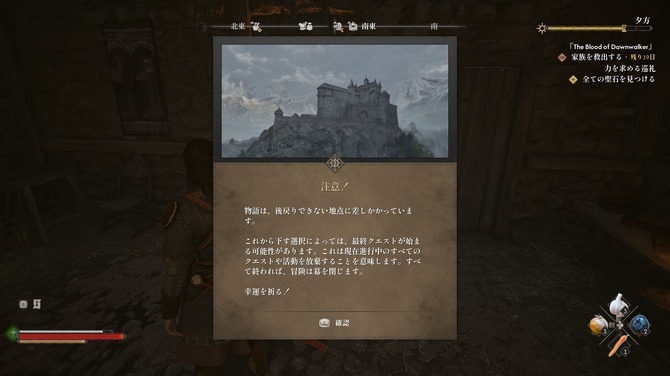
In addition to these elements, the “30-day” time limit—which is also the game’s defining feature—adds an exquisite sense of tension to the story. The game employs an innovative system where time clearly progresses based on specific quest progress and skill acquisition.While the early stages strongly emphasize the need to “use your time wisely,” once you actually start playing, you’ll find it’s balanced so that if you proceed at a steady pace, you can reach the ending in around 20 days.Of course, if you try to complete every single side quest, you’ll run out of time, but the game is designed so that you can simply accept that those alternate routes are best enjoyed during subsequent playthroughs. As a result, I personally didn’t feel any sense of constraint or excessive pressure from this 30-day limit.Rather, I feel it’s an interesting system that adds weight to the decision of “which quests to choose within the limited time,” bringing diversity to the player’s progression.
As for the mechanic where quests and actions change depending on whether it’s day or night, while there were moments when it felt a bit cumbersome, it was hardly noticeable when viewed over the course of the entire playthrough. The passage-of-time system is the most surprising aspect at first, but by the latter half of the game—once you’ve completed a faction’s story and are in a position to reach the ending at any time—it becomes almost unnoticeable.In that sense, you could say it’s a system whose presence gradually fades as the game progresses, but fundamentally, I think it’s an interesting mechanic that adds tension to the early stages of the game, and it’s a system worth having. (Incidentally, even if 30 days pass without you saving your family, the game doesn’t end immediately; this, too, seems to be respected as one of the diverse choices available to the player.)
4: Overall Impression

When evaluating this title, there is one disappointing aspect I simply must address: the content restrictions applied to the Japanese version. This game is a dark fantasy centered on vampires, and graphic depictions of bloodshed and cruelty are essential elements in building its world.
However, the Japanese version imposes restrictions on such depictions, which undoubtedly diminishes the original version’s inherent intensity.While this doesn’t detract from the fun of the gameplay itself, as a player, I simply have to deduct points because it prevents you from fully experiencing the game’s full potential. Since it has been explicitly stated that a fix for this issue is coming, those who plan to play this title in the future might want to wait for it.
Nevertheless, *The Blood of Dawnwalker*—which condenses intense combat, exploration, and a rich, immersive world into a compact package—is a compelling title. I feel that this game is especially worth picking up for those who have grown a bit tired of overly massive open-world RPGs.
Game*Spark Review: *The Blood of Dawnwalker* (PC / PlayStation 5 / Xbox Series X|S) Released September 3, 2026
Censorship Is an Issue, but It’s an Impressive Debut for a New Studio
-
GOOD
- Vast amounts of text and lore
- Action-packed combat with a high degree of freedom
- Just the right amount of content to play through in one sitting
BAD
- Censorship in the Japanese version
- Combat and maps might lack a bit of variety


