


No matter how vast the universe may be, a street racer’s focus is likely on the split second leading up to the next corner.
It doesn’t matter how many stars lie beyond or whether a war is raging somewhere. They delay braking until the very last moment, then force their car into the brief opening that appears. And they open the throttle even a tenth of a second earlier. What they need isn’t the galaxy stretching far into the distance. It’s just that tiny bit of space needed to make it through the corner.
They are neither Jedi guided by the Force nor Rebel Alliance fighters burning with a noble cause. What drives them is a much simpler, much more selfish desire: to pass the guy right in front of them. To race faster than anyone else. Even as their machines screech and sparks fly at the edge of their vision, that thirst never wanes.
*Star Wars: Galactic Racer* depicts a *Star Wars* universe for these speed freaks.
Breaking more than two decades of silence, the engines roar once more
This racing game comes from Fuse Games, a studio founded by developers from Criterion Games—the team behind the *Burnout* and *Need for Speed* series.It marks the first dedicated *Star Wars* racing title since 2002’s *Star Wars Racer Revenge*, and the engine that has lain dormant for over twenty years is finally roaring to life once more.

That said, this title is not a sequel to the previous *Racer* series. While those earlier games were all set during the Prequel era, this one moves the clock forward significantly.The setting takes place after *Star Wars: Episode VI – Return of the Jedi*, during the New Republic era—the same time period as *The Mandalorian*. As Imperial rule crumbled and the fledgling government scrambled to rebuild, an underground world of gambling and entertainment was flourishing in the lawless Outer Rim.
Born out of this chaos is the unofficial racing circuit known as the “Galactic League.” It’s a world where criminal organizations sponsor racers, and massive wagers are placed on every race.Players take on the role of Shade, a lone wolf racer who plunges into this world, racing in pursuit of glory and revenge.

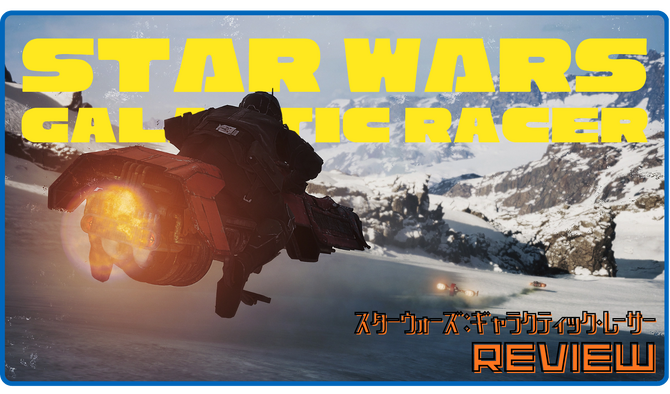
You’ll primarily pilot three types of vehicles with distinct handling characteristics: the Landspeeder, the Speeder Bike, and the Skim Speeder. Of these, the Skim Speeder was my personal favorite.While its acceleration is the slowest of all the machines, once you’ve built up speed, its top speed is unmatched. The tracks in this game generally feature many sharp corners, but by using the “knife-edge” maneuver—where you tilt the machine sideways—you can cut into them without losing speed.
Although you’ll have the chance to ride a Podracer as well, it’s positioned as a special machine that only experts can master.The Podracing that thrilled the crowds on Tatooine in *Star Wars: Episode I—The Phantom Menace* has faded with the times and is now a thing of the distant past. It’s interesting how these former stars have become figures spoken of almost as legends, much like the Jedi.

Bet it all on a one-time race in a league with no rules
There is only one goal in the race: to be the first to cross the finish line. However, the means to achieve it are irrelevant.
Slam your machine into the side of a rival lined up next to you, forcing them into walls, rocks, or the ground.In the next instant, your opponent’s machine shatters with a deafening roar. The “takedown,” familiar from *Burnout*, is alive and well in this lawless league. The opponent you’ve knocked down drops back, and you move up one spot in the rankings. Just like winning a battle for position in a corner, takedowns are a crucial weapon.

Of course, the hunter can easily become the hunted. If you show even the slightest opening, you might be the one on the receiving end of a ram—and end up as nothing more than a smear on the wall. Even simply failing to make a corner or hitting an obstacle can cause your car to be destroyed in an instant.
Of course, you can return to the race even after a crash, but the cost is high. If you exceed a certain number of crashes, you’ll be forced to retire on the spot. You can’t survive just by rushing forward blindly. That’s why you must identify the right opponent to attack and maintain your distance to avoid getting caught up in the fray.Skill in maneuvering is just as crucial as speed.

And in this game, being eliminated isn’t just a simple loss. This is where the roguelike structure of the central “Galactic Tour” campaign comes into play.
To take on the Tour, you’ll need tokens that grant you entry into the league. Once you’ve entered, you’ll choose your next event from a branching route map, much like in *Slay the Spire*. In addition to standard races, you’ll face a variety of challenges, including “Eliminators,” where the bottom-ranked racers are eliminated at regular intervals, and “Field Tests,” where you aim to complete specific objectives such as beating a certain time.As you advance, you’ll earn funds and parts, allowing you to upgrade your machine between races.

However, if you crash repeatedly and retire, or fail to reach the required ranking, your token will be revoked. If that happens, the tour ends there, and you’ll have to start over from the first race. Naturally, since the route and event placements change with each attempt, you can’t simply retrace your steps from the previous run.Still, some of your progress carries over to the next challenge, so a defeat isn’t a complete waste.

While you’ll feel a sense of progress with each attempt, building your setup each time can be a bit tricky. Although you can determine the direction of your upgrades by selecting a “Race Style” before the race, the credits available for purchasing upgrades are limited, making it quite challenging for beginners to achieve the desired synergies.
Furthermore, the battery powering your abilities is shared across all of them, and the number of uses is limited. If you rely too heavily on a single ability, the remaining three equipped abilities will go unused and become nothing more than window dressing.On the other hand, if you combine and use multiple abilities, the battery drains that much faster, and you risk running out of power at a crucial moment. You could call it a balancing act, but whichever path you choose, a sense of constraint lingers, and I found the difficulty of managing your abilities to be a bit of a concern.


A Raging Planet and a Rampaging Machine
Unlike *Burnout Paradise*, which lets you roam a single, continuous open world,
this game takes you from planet to planet, racing on courses set up in various locations. There’s a well-established trope in *Star Wars* that “each planet has its own distinct character,” and this game stays true to that.
On the sandy planet Jakku, you’ll weave your way through the wreckage of a decaying Star Destroyer. On the tropical planet Lantana, an active volcano looms overhead; the heat of the lava pushes your machine to the brink of overheating, but you can cool it down by driving through the water.On the ice-bound planet Andor Prime, the cold freezes the vehicle solid, while on the toxic planet Sentinel I, streams of acid block your path—you can’t cross them without shields. The planets’ environments themselves are another enemy to contend with alongside your rivals.


However, enemies can also become weapons, depending on how you use them. On cold planets, the chill helps dissipate the heat from the “ramjet” boost system, allowing you to keep it running longer than usual.Conversely, on lava planets, you can deliberately absorb the heat to enhance your boost, gaining even greater acceleration and power-ups. Combining these environmental benefits with upgrades and abilities earned during the tour creates new synergies. Reading the planet’s characteristics and tailoring your machine accordingly is also essential when building your setup.
Furthermore, even on the same planet, you don’t always race the same route. Whether it’s day or night, or whether you’re racing clockwise or counterclockwise, the course changes its character with every race. The layout isn’t a single, straight path; instead, it’s a “wide-linear” design crisscrossed with branches and shortcuts throughout, meaning the line you choose directly determines the outcome of the race.
However—and this is likely intentional—there are many instances where it’s difficult to grasp the course’s layout and overall structure until you actually start driving. It’s not uncommon to crash after getting lost, which was a bit frustrating.

Above all, what really stands out is the game’s focus on delivering a tangible sense of “controlling” the machine.Before the race, you fire up the engine in the cockpit and input several commands in sequence to activate each system. If you pull this off successfully, you can start the race with your afterburner and shields fully charged, and if you time your throttle just right, you can even pull off a rocket start.
Once the race begins, things get even more hectic. While keeping your foot on the accelerator, use R3 to switch between afterburner and ramjet, and use L1 to select abilities and activate them at the right moment. The ramjet provides intense acceleration but builds up heat in exchange—if you push it too hard, your craft could explode.If your craft is damaged by collisions or harsh conditions, you’ll also need to time your throttle inputs just right to perform quick repairs.

Since you have to juggle all of this while racing at top speed through a course filled with tight, consecutive corners, the controls are quite complex. If you make even a single mistake or sustain too much damage, your abilities and various systems will start failing one after another, making it difficult to even drive properly.Even so, it’s simply fun to race while experiencing that chaotic sensation—much like Anakin, who was at the mercy of the gauges and levers during that Podrace. That said, you can adjust the accessibility settings to lighten the control load, so even those who aren’t confident in their skills don’t need to worry.
Given the developers’ background, you might imagine this is just a rehash of *Burnout*, but at the very least, the feel of the controls is something entirely different.While the game’s DNA is clearly evident in the back-and-forth takedowns and spectacular crashes, the sensation of racing while managing heat and soothing a battered craft is actually closer to the 1999 *Star Wars Episode I: Racer*.It combines the racing philosophy of *Burnout* with the sensation of wrestling with the game’s machines. That’s the best way to describe the driving experience in this game.


Dreams and rivalries discussed in the paddock, and the revival of pod racing
The campaign isn’t limited to the track. As you travel from planet to planet, you’ll find hubs called “paddocks” in each location, where you can directly control Shade and explore on foot between races.It’s essentially the campsite for a racing caravan touring from planet to planet. Here, you can spend credits to learn new abilities or repair damaged machines, as well as exchange words with rivals competing on the same tour.
Some boast about their grand dreams for the future, while others confide in you about their conflicts with siblings. It’s truly heartwarming to see strangers gradually become familiar faces as you exchange words with them.While the main storyline itself isn’t particularly memorable, it’s the accumulation of these casual interactions that creates the atmosphere of a journey—much like a bivouac at the Dakar Rally—where competitors spend the night together at the same campsite.


Furthermore, before the race, you can participate in side bets among racers on the outcome. If you win, your credits increase—but, believe it or not, you can even bet on another racer to finish first. It almost feels like a fixed race, but this lawless spirit is quintessentially Star Wars.
As the journey progresses, some unexpected faces join the tour. It’s none other than Sebulba, the villain who relentlessly sabotaged Anakin Skywalker in *The Phantom Menace*.As you listen to his tales from the past—even in his old age, he’s still active—you can actually race through those memories in a mission titled “Tales of Podracing.” You get to experience podracing at its peak during the Prequel era firsthand.


You’ll climb into a bare-bones podracer—nothing more than a cockpit connected to two massive engines. While it reaches speeds that far surpass those of a speeder, it’s a fragile machine that could be destroyed by even the slightest collision.As you race at top speed through a canyon with towering rock walls closing in, even the slightest misjudgment can end it all in an instant. Still, the exhilaration of tearing through the desert amid the ear-splitting roar of the engines is something you simply can’t experience with any other vehicle. Anyone whose heart raced during that scene in the movie is sure to let out a shout of excitement.
The attention to detail is also a delight. Not only can you race on the Mos Espa circuit—a refined version of the track from *Episode I: Racer*—but the UI for controlling the podracer is also packed with homages to that film. It’s a clever touch that will make longtime fans grin.As a side note, the fact that Andor Prime—which appears as a track—is an original planet created specifically for that film also speaks to the developers’ love for the series.

On the other hand, the game primarily draws from the prequels and sequels, with elements from the original trilogy largely limited to creatures and props that add color to the background. Since the story is set immediately after *Return of the Jedi*, opinions will likely be divided among those expecting the atmosphere of Luke Skywalker’s era or the Imperial era.

Solo Mode to Test Your Skills and Multiplayer for True Competition
In addition to the campaign,
this game offers several other modes. If you just want a quick race, the Arcade Mode is a good choice—you can take on events like Time Trials and compete for the top spot on the leaderboard.If you want to hone your skills and enjoy challenging races, try Scenario Mode. You’ll take control of rivals you encountered in the campaign and complete objectives under predetermined conditions. The difficulty is higher than in the campaign, making this a mode geared toward advanced players. Of course, you can also go head-to-head with racers from around the world in Multiplayer Mode.
The centerpiece of multiplayer is the “Multiplayer Tour,” where up to 12 players compete. It consists of six races; you use the rewards earned from the first five races to upgrade your car as you aim for the top spot in the final race.It’s designed as if the campaign’s roguelike elements were directly ported into PvP. Since it’s structured so that players can fight until the very end regardless of their ranking, you won’t be eliminated and left behind midway through. However, each session lasts about 30 minutes, so you’ll need to set aside a block of time to play.
Although single-race “Quick Matches” are available, the “Tour” is where you can truly experience the game’s unique strategic elements—such as collecting parts and placing bets—so you’ll likely find yourself wanting to set aside a block of time for it.


Before each race in the Tour, you predict your final ranking and place a bet. If your prediction is correct, you’ll receive additional rewards, so you can either play it safe by betting on a modest ranking to earn a guaranteed payout, or take a risk by betting on a top finish. That said, the latter is by far the more lucrative option.That’s because while betting on a high finish can net you Legendary-tier parts, playing it safe and accumulating low-rarity parts will only widen the gap between you and the leading pack.
In other words, in this game, the faster players get stronger parts and become even faster. In the *Mario Kart* series, the lower you rank, the more likely you are to get powerful items; in *Kirby Air Rider*’s City Trials and *Forza Horizon*’s Eliminator mode, sudden events and randomly appearing cars give players who’ve fallen behind a chance to make a comeback.In other words, there’s intentionally room for luck to play a role in the outcome.
In contrast, this game has almost no such safety net mechanisms, so races tend to boil down to a simple test of skill. Looking at it another way, you could say that because of the cumulative results over six races, it’s pure skill—not luck—that’s put to the test. However, since a single mistake can haunt you until the very end, there’s a strong sense of tension—you simply “can’t afford to fail”—and I found it difficult to make up for any lost ground.

*Star Wars: Galactic Racer* is more than just a fan item bearing the Star Wars name—it’s a solid, meaty racing game. The visceral sensation of mastering your machine while being hounded by overheating and damage.The thrill of slamming rivals into the wall. And the nerve-wracking tension of losing everything with a single retirement. There’s a driving experience here that you simply can’t find anywhere else.
It’s not for everyone. That’s precisely why I recommend this title not to those who just want a casual few minutes of racing, but to die-hard racers who’ll pick up the controller again no matter how many times they stumble.
Game*Spark Review: “Star Wars: Galactic Racer” PC/PS5/Xbox Series X|S Release Date: October 6, 2026
It’s not for everyone, but it offers a racing experience you won’t find anywhere else
-
GOOD
- A challenging, satisfying sense of control as you tame your unruly machine
- The tension unique to roguelikes, where a single crash can be fatal
- Detailed design that appeals to fans, including recreations of Podraces and movie-like locations
BAD
- Strict resource constraints make it difficult to build the synergies you envision
- The course layout is hard to grasp, making it easy to get lost and crash
- Multiplayer offers little room for comebacks, and sessions are too long



