


When people hear “Minecraft,” I imagine there are still quite a few who picture a laid-back game where you stack square blocks to build houses. Of course, there’s no doubt that it’s a quintessential casual game enjoyed by everyone from children to adults all over the world.
However, once you actually spawn in that world, zombies and skeletons attack when night falls, and creepers sneak up on you from behind.It’s not just about building; there’s also an action side where you aim to defeat the Ender Dragon while upgrading your gear, and PvP is played at a high intensity. With its grind-heavy progression and action elements where character control is key—if you let your guard down, death comes without mercy—it’s a challenging game.
Released on September 29, 2026, *Minecraft Dungeons II* is the sequel to *Minecraft Dungeons*, a hack-and-slash game set in the *Minecraft* universe.
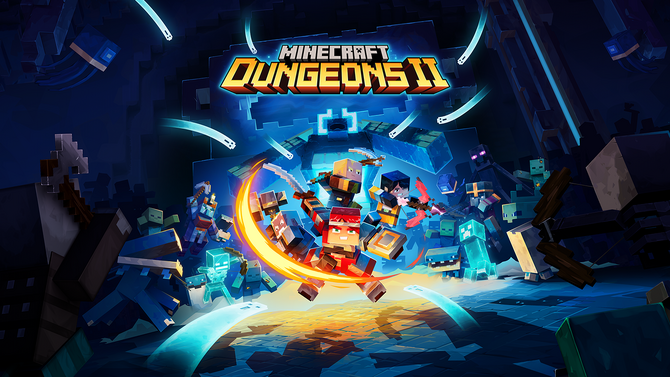
The development team emphasizes that they aimed to make this game accessible enough that even those unfamiliar with hack-and-slash games can pick up a controller and start playing right away. So, after playing it thoroughly, just how long does that “ease of play” last? And what awaits beyond the ending?
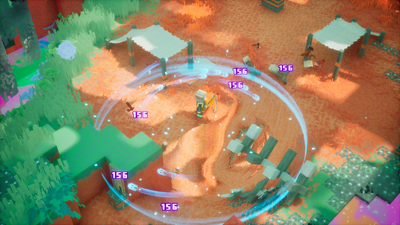
For this article, I was provided with a review code prior to release. After playing through to the ending, I also delved into the post-game content. To put it simply, the game’s systems are casual and straightforward. At the same time, it’s a title that lets you fully savor the “hack-and-slash” fun of defeating enemies, collecting gear, and building your own unique character build.
And above all, the difficulty is by no means easy. It was precisely in that challenge that I felt the true “Minecraft-ness” of the game.
What exactly is a “hack-and-slash” game?
Before getting into the main topic, let’s briefly touch on the genre. “Hack-and-slash” is short for “hack and slash”—it refers to games where you enjoy the cycle of defeating hordes of enemies to obtain gear, growing stronger, and then taking on even tougher foes. A prime example of this genre is the *Diablo* series.
The real thrill of this genre lies in crafting your own unique combat style—or “build”—by combining the gear you’ve acquired. However, the variety of gear and its stats can be complex, so some people might find it intimidating at first.In fact, I’m a hack-and-slash beginner who’s never played the *Diablo* series before. This game makes the entry point surprisingly simple.
The controls are simple, but if you don’t “think strategically,” you’ll be defeated in no time
I played this game with a keyboard and mouse, though it can also be played with a controller. My first impression upon playing was just how clear and intuitive the UI and controls are. There are few buttons to use, and basic actions like moving, attacking, and dodging feel natural right away.
I never got lost in the field either. There’s a feature called “Guiding Light” where pressing the mouse wheel activates a glowing path to your destination—it’s incredibly handy. It’s not that the field layout is hard to follow to begin with, but thanks to this feature, I was able to progress through my adventure without getting lost almost at all.
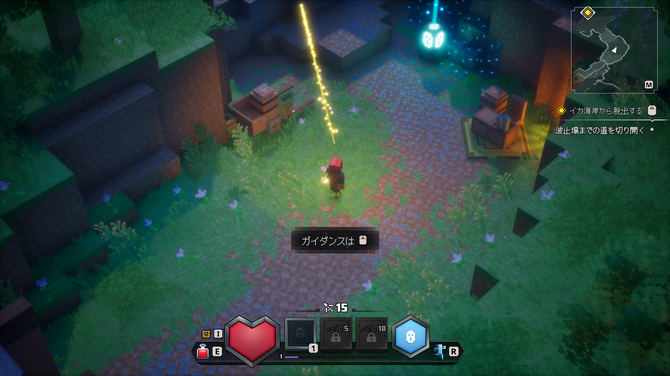
Also, this game doesn’t have any difficulty settings. To be honest, early on I thought, “Is this a little too easy?” But that complacency was my downfall. I got overconfident and charged into a group of enemies, only to get hit by a Creeper’s explosion and pecked at by arrows from a skeleton in the distance—and I was taken down in a flash.
What I realized then was that the enemies in this game basically attack in packs. The difficulty is set so that if you get surrounded, you’ll be taken down immediately—and despite the visuals that might seem geared toward children, the game is anything but easy. That’s why it’s crucial to identify the most threatening enemy within the group.
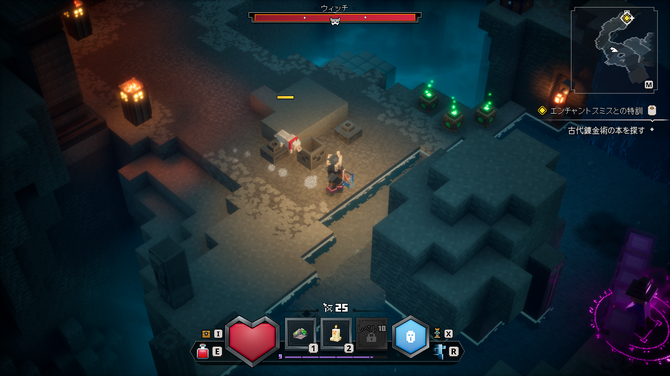
You should prioritize taking out the Creeper, which deals massive damage with its explosion, and enemies with troublesome ranged attacks. The sense of satisfaction when this strategy pays off is unparalleled. Even with a limited number of buttons, the game really tests your character positioning and control skills.
Another straightforward aspect of this game is that familiar enemies use familiar attacks. Creepers approach and explode, while skeletons shoot arrows from a distance. Anyone who has played *Minecraft*—or even those who haven’t played it but are generally familiar with the game—should intuitively know how to handle them.
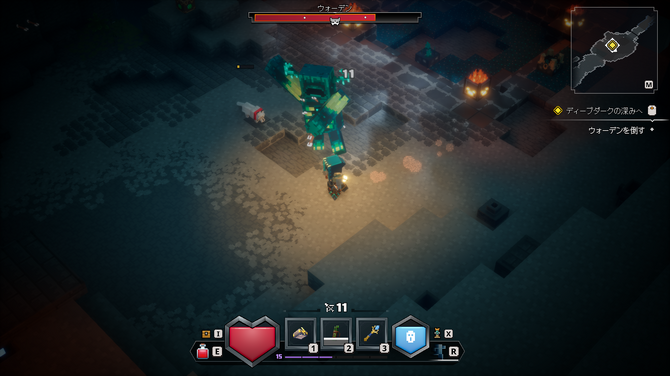
There are three main types of combat: battles against common enemies you encounter while walking through the field; event battles called “ambushes,” where large numbers of enemies attack at specific locations; and boss battles.Ambushes are like raid battles where you have to fend off wave after wave of enemies. In boss battles, your character control becomes even more important; you’ll enjoy challenging fights where you have to carefully dodge attacks while dealing damage.
No permanent loss even if you die! A user-friendly design that thoroughly minimizes stress
One of the game’s strengths is that, while the difficulty isn’t easy, it never feels unfair.
First of all, you don’t lose anything when you’re defeated. If you’re defeated, you’re sent back to your base, but you can upgrade your equipment there and then retry the battle from a location very close by. If you don’t need to upgrade, you can return to the battlefield in about 3 seconds. Since you can easily try again as many times as you like even after failing, the game offers high replayability and is completely stress-free.
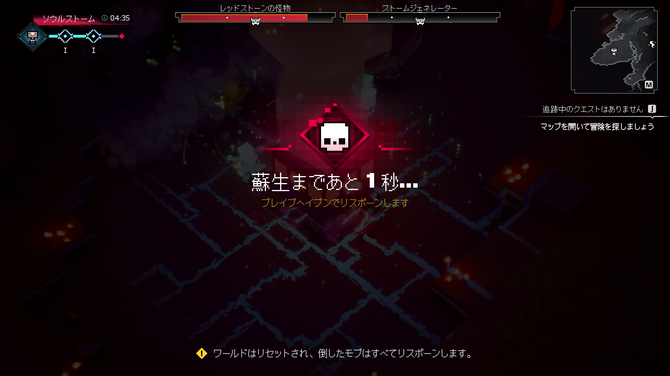
When your health gets very low, visual cues appear on the screen, and you’ll hear an audio alert as well. As a result, I never once found myself “dead before I knew it.” You also won’t be defeated by continuous damage from effects like poison or fire, so there’s no time spent just watching your health slowly drain away until you run out of strength.
Another great feature is that healing potions are “free.” In this game, healing potions aren’t consumables; they’re treated more like a skill that becomes available again over time. This means you don’t have to manage your remaining stock of consumables or agonize over whether you “should use it here…” If you can use them freely, just go ahead and use them.
Through this cumulative design, the game achieves a balance where it’s “challenging, but anyone can beat it if they think it through.” If you diligently upgrade your gear and fight while prioritizing your enemies, you’ll definitely find a way through. It’s not just about mashing buttons—you have to think. The fact that there’s room for strategy in combat directly translates to fun.
The “Three at the Base” Who Hold the Key to Equipment Enhancement
From here on, we’ll discuss equipment—the core of this game’s hack-and-slash experience. As you collect gear and grow stronger, the three characters at your base—the “Town Merchant,” the “Enchanting Smith,” and the “Blacksmith”—are indispensable.
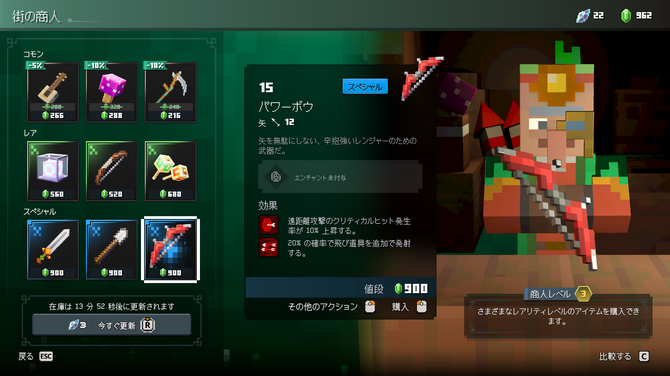
You can purchase items such as weapons and armor from the Town Merchant using emeralds. As you level up the merchant, higher-rarity items will become available. However, since you’ll acquire a considerable number of weapons and armor simply by completing quests and exploring the field, I personally didn’t feel much need to use this merchant.
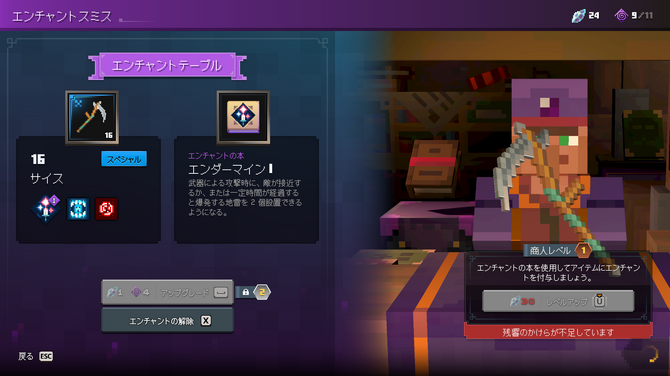
The Enchanting Smith, as the name suggests, is responsible for applying enchantments to your gear.Using “Enchantment Books” collected during your adventures and Enchantment Points, you can apply or enhance enchantments on items. Additionally, by leveling up the shop using a currency-like resource obtained by defeating a special enemy called “Echo Shards,” you’ll be able to further enhance your enchantments.
What’s particularly important here is that when you remove an enchantment from an item, the Enchantment Points used are refunded. Furthermore, a single Enchantment Book can be reused on multiple items. In other words, enchantments aren’t irreversible enhancements—you can revert them at any time.
When playing hack-and-slash or RPG games, do you ever hold back on using enhancement items because you think, “It’d be a waste”? In this game, you don’t have to worry about that. If an enchantment catches your eye, just go ahead and try it. If it doesn’t work out, remove it and apply a different one. I found that the real fun of this game lies in using and experimenting with enchantments as much as possible.
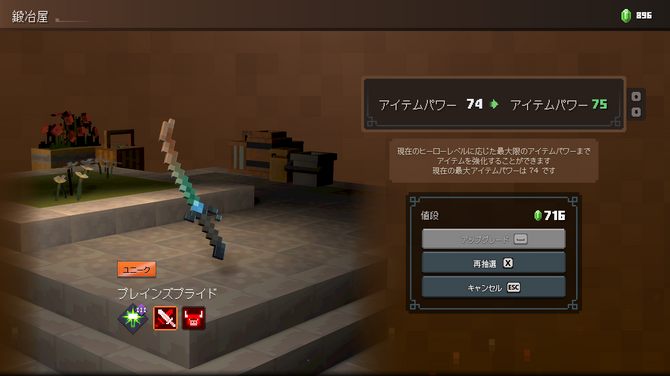
There are two main things you can do at the blacksmith’s. One is to use emeralds to raise the level of your equipment to match your current character level. The other is to use Echo Shards to reroll the “effects” on your equipment.
Effects are like passive skills attached to equipment.Some simply increase attack power or healing, while others boost damage from elements like fire or lightning. At Level 1, the Blacksmith can only reroll effects for low-rarity gear, but as you level it up using Echo Shards, you’ll be able to reroll effects for higher-rarity gear as well.
The system for leveling up equipment was also incredibly helpful. In games of this type, it’s common to end up with gear that’s “high rarity but too low-level to be useful.” In this game, however, since you can raise the item level at the Blacksmith, that situation never occurred. In short, you can keep using the gear you like right up until the very end.
“Artifacts” and the New “Talismans” Expand Build Variety
Among the various pieces of equipment, “Artifacts” and “Talismans” have a major impact on your combat style.
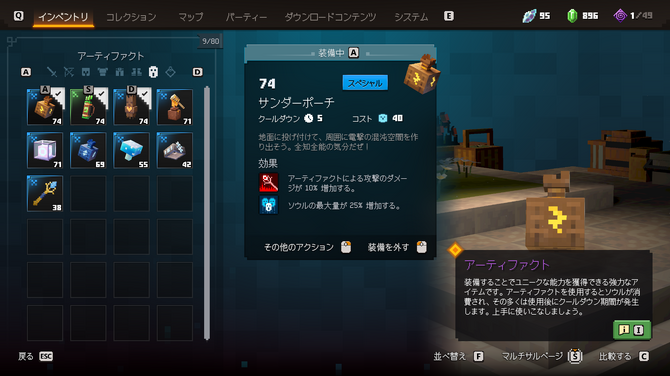
Artifacts are items that grant unique abilities when equipped. You can equip up to three at a time, activating them using the assigned keys. Using them consumes “Souls”—a resource similar to MP—and many artifacts have a cooldown period before they can be used again.
The way they activate varies from artifact to artifact—some trigger instantly, others provide a continuous effect, and some build up power before unleashing a massive burst. Elemental attacks also differ depending on the artifact, ranging from those that imbue normal attacks with elemental effects to those that deal direct elemental damage.
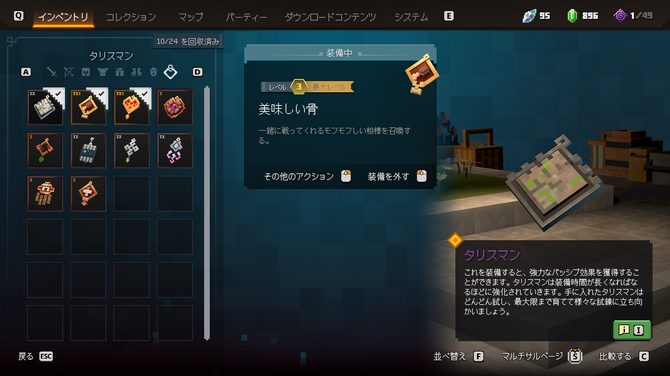
Additionally, talismans—a new feature in this game—are items that grant passive effects when equipped. I felt that these talismans hold the key to building your character in this game.
My Build: A “Thunder × Healing” Tank Strategy
Now, let me introduce the actual build I used to reach the game’s ending.
I built my character around my favorite melee weapons and bows. The cornerstone of my build was the Lightning-element artifact “Thunder Pouch,” which I obtained early on. This artifact generates a shockwave of lightning around me, and it proved incredibly useful in this game where you’re often surrounded by enemies.
To make the most of it, I repeatedly rerolled my equipment effects at the blacksmith, sticking with it until I got an effect that boosted my Lightning-elemental attacks. The time spent rerolling until you get the effect you’re aiming for is truly one of the joys unique to hack-and-slash games, isn’t it?
For talismans, I equipped the “Beeswax Emblem,” which increases maximum health, and the “Delicious Bone,” which summons a fluffy dog to fight alongside me. For my melee weapon, I applied the “Heal Smite” enchantment, which creates a healing zone whenever I defeat an enemy.I chose other enchantments and artifacts with a focus on healing as well, and cleared the dungeon using a tank-style strategy centered on sheer endurance.
Why a tanking strategy? Because having high health and high attack power is simply “the right thing to do.” Even when surrounded by hordes of enemies, I stood my ground without falling, then blasted them all away with a thunder shockwave. The exhilaration I felt when my custom build clicked into place was the very essence of what makes hack-and-slash games so thrilling.
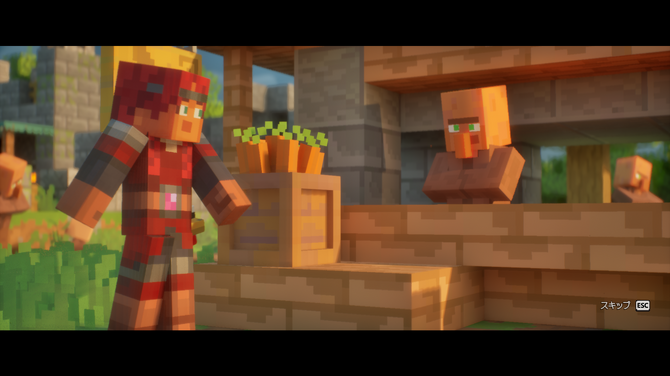
The real fun begins after the ending! What awaited me was an endless “loot hunt.”
The game’s true value shines through after you reach the ending. In fact, you could even say that everything up to the ending was just a long tutorial. After the ending, several end-game activities await.
The first is “Rifts and Dungeons.” You’ll venture into rifts (cracks leading to the Shift) and dungeons scattered throughout the world to search for enchantment tomes.
The second is collecting “Echo Shards.” You’ll battle mobs corrupted by the Soul to gather Echo Shards and upgrade your gear. Since these shards are also used to level up your Enchant Smith and Blacksmith, they’re essential for fine-tuning your build.
After beating the game, I immersed myself in exploring the rifts and dungeons, relentlessly scavenging for enchantment books and gear to strengthen my build. Refining the build I’d put together before the ending—this “rabbit hole” is, in my opinion, where the game’s true appeal lies.
And the third is the high-difficulty content, “Soul Storm.” In the post-ending world, devices that trigger Soul Storms—which unleash devastating energy—are installed throughout the map, and players must destroy these “Storm Generators” while battling against swarming hordes of mobs.
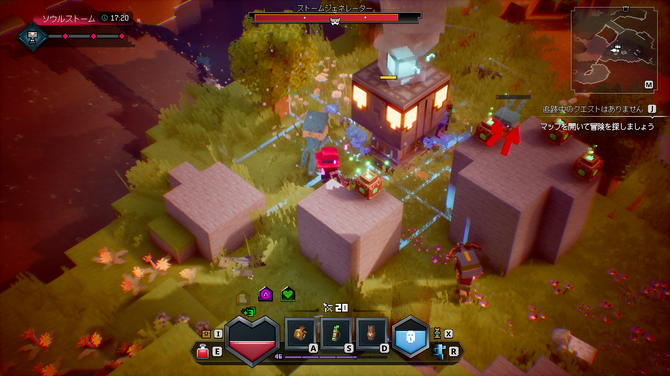
This Soul Storm is quite challenging. Simply put, the enemies are strong and numerous. Furthermore, with bosses spawning on the field and others emerging from the Storm Generators joining the fray, the battlefield becomes absolutely chaotic.
The Endermen were particularly troublesome. They constantly teleport, making them hard to hit, and on top of being tough, their attacks are devastating—you’ll be taken down in the blink of an eye if you take just two or three hits, so you can’t let your guard down.
The Soul Storm has a 15-minute time limit, and I fell just short of clearing it within that time. I plan to further refine my build and keep trying.
Pastel-Colored Shifts and Music That Blends into the World
Finally, I’d like to touch on the graphics and music.
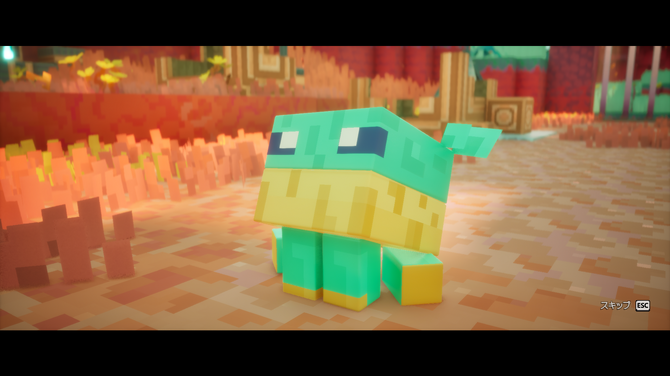
Visually, I was struck by the beauty of “Shift,” the new dimension that lies beyond the rift. It’s a charming, pastel-colored world that feels like a dream—something we haven’t really seen in previous *Minecraft* games.
It has been announced that this “Shift” will also be implemented in the original *Minecraft* in 2027. It’s also great to see that all the characters that appear are so adorable.
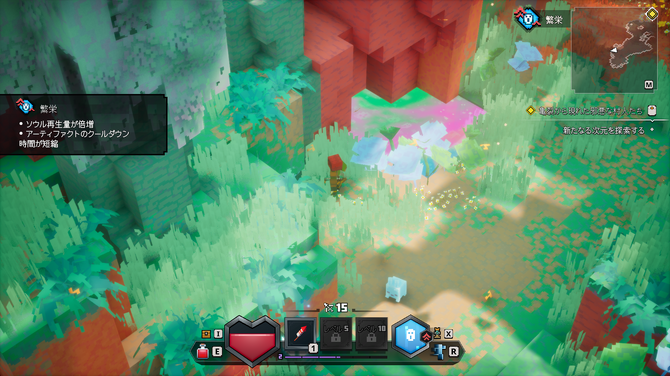
The music consists mainly of laid-back, “Minecraft-esque” tracks that blend perfectly with the natural ambient sounds. On the other hand, epic tracks during boss battles really amp up the excitement. Given that the story revolves around music, the soundtrack has a calm, ambient feel that fits the game’s world perfectly, while still maintaining a strong presence.
Easy to get into, but with depth to explore. And, true to *Minecraft*’s style, it’s a tough challenge.
Can *Minecraft Dungeons II* be enjoyed even by those new to hack-and-slash games? The answer is definitely “YES.”
The controls are simple, and the UI is clear. You lose nothing when you die, and you don’t have to worry about how many healing potions you have left. You can re-enchant items at any time, and you can keep using your favorite gear until the very end. Elements that would otherwise raise the barrier to entry—such as “difficulty getting started” or “feeling like you’re wasting resources”—have been carefully removed.
That said, this is by no means an easy game. Enemies attack in hordes, and if you fight without thinking, you’ll be defeated in the blink of an eye. That’s precisely why the sense of accomplishment you feel when you strategize enemy priorities, upgrade your gear, and carefully craft your build to overcome challenges is truly exceptional.
It may look casual, but once you actually play it, you’ll find it’s quite challenging. That’s precisely the same appeal as the original *Minecraft*. This is a game I especially want people who’ve been interested in hack-and-slash games but haven’t taken the plunge to give a try.
“Minecraft Dungeons II” is now available for PC (Steam/Microsoft Store),PS5,XBOX Series X|S, Nintendo Switch, and Nintendo Switch 2. It’s also available on Game Pass.



