


Muddy water covering the streets, buildings stained with tide marks, and deserted alleys. Beyond them lies a half-submerged 1920s cityscape.
Released by Frogwares on August 18, 2026, *The Sinking City 2* is a third-person survival horror game inspired by the world of H.P. Lovecraft’s works.Set in the fictional American city of “Arkham,” this highly anticipated title shares the same 1920s setting and universe as its predecessor, *The Sinking City*, but features a completely new protagonist, story, and game system.

What is particularly striking about this game is “the city of Arkham” itself. “Arkham,” which also appears in the original Cthulhu Mythos, is depicted in this game as a ruin submerged by a supernatural flood, where monstrous beings roam.

In this article, we’ll explore why this “submerged city of Arkham” feels so eerie and terrifying. Drawing on fragments of stories left behind by Lovecraft—such as “The Shadow over Innsmouth”—we’ll examine the reasons behind this and the game’s appeal.

◆Why Is the Submerged City of Arkham So Scary?

What’s eerie about Arkham in “The Sinking City 2” is that “the city is submerged and no longer functioning.”
The protagonist, Calvin, travels by small boat rather than on foot because the entire city is flooded. Water laps up to the doorsteps of buildings, and intersections have been transformed into waterways.
Eventually, when a floodgate blocks his path, he must get out of the boat and break into a nearby building to restore power. In other words, the flooding isn’t just a backdrop—it’s a mechanism that disrupts the exploration route itself and forces the player into dangerous indoor environments.


Another eerie aspect is that traces of human life remain in Arkham, even though people were living there until very recently: apartments furnished with furniture, a radio shop still stocked with merchandise, posters and household items… Yet the residents themselves are almost nowhere to be found, leaving the city virtually deserted.
In contrast to Oakmont in the previous game, *The Sinking City*, where citizens continued to live even amid the disaster, it’s clear from in-game documents and the diaries of former residents that Arkham has already been largely swallowed up and is a completely abandoned city.

If it were a complete ruin, one could simply dismiss it as a “dead place,” but here, only the forms of daily life remain, with humans entirely absent. Monstrous creatures roam as if to fill that void, and the absence of the “people who were once there” makes the city of Arkham seem all the more eerie.

Furthermore, while moving through the water, you can barely see anything below eye level. You have no idea how deep the former streets are, and building entrances sit right at the water’s surface.
On land, you might simply think, “There might be an enemy around the next corner,” but in a submerged city, the unease and uncertainty of not even knowing what lies directly beneath you is what breeds fear.

A city that once belonged to humans is gradually transforming into the domain of “something not human.” Isn’t the true nature of the horror depicted in this game clearly revealed there?
In submerged Arkham, the monster we should be wary of first may not be a monstrous creature, but rather “the city itself,” which no longer offers any sense of safety.

◆ From “The Shadow over Innsmouth” to “The Dunwich Horror”—Monsters Reconstructed from the Original Works

A defining feature of *The Sinking City 2* is how the monsters and deities from Lovecraft’s works are incorporated into Arkham in a way unique to the game.
A prime example is the “Deep Ones.” In the original story, “The Shadow over Innsmouth” (published in 1936), a terrifying connection is depicted between the dilapidated port town of Innsmouth and a race of monstrous beings dwelling beneath the sea.
The Deep Ones possess heads, gills, and webbed feet reminiscent of fish and amphibians, and are capable of producing offspring with humans. Those who inherit their blood transform into inhuman forms as they grow, eventually returning to the sea.

In this game, such Deep Ones appear as boss enemies known as “Deep One Raiders.” They emerge from the water’s edge and are formidable foes that quickly close the distance.
Although Innsmouth is the land most closely associated with them, their oceanic terror has been transplanted to the submerged city of Arkham. As a result, the very water covering the city feels like a gateway to the “non-human world” that lies beyond the sea.

On the other hand, this game also features monsters that do not appear in the original works. One such creature is the “Slither,” a deep-sea parasitic organism—a sinister entity that parasitizes human corpses, forming colonies to control them.
Furthermore, according to the official lore, they are said to serve “Yog-Sothoth,” a pivotal figure in the Lovecraftian Mythos.

Yog-Sothoth is a central figure in “The Dunwich Horror” (published in 1929). In that story, Wilbur Waitley attempts to gain knowledge of Yog-Sothoth’s power from the “Necronomicon” at Miskatonic University.
In other words, while this work features original monsters like the Deep Ones directly from the source material, it also uses the lore of Yog-Sothoth to create new horrors such as the Slitherer.

Rather than simply recreating Lovecraft’s works, it uses his mythos as raw material to generate new horrors. It is precisely this bold reinterpretation that ensures Arkham in *The Sinking City 2* is not merely a “Cthulhu Mythos theme park.”
◆ Homages to Lovecraft’s Works Scattered Throughout the City

In *The Sinking City 2*, references to Lovecraft’s works are woven into not only the monsters but also the documents you can collect during the game, as well as the names of buildings and signs.
First, in the document “On Masks,” which you obtain early in the game, the name Walter Gilman actually appears.Gilman is the protagonist of “The Dream of the Witch’s House” (published in 1933); he studied mathematics at Miskatonic University and explored the connections between “non-Euclidean geometry,” quantum physics, and magic.The game’s documents also reference Gilman and non-Euclidean mathematics, making this a fairly direct homage.

Miskatonic University itself becomes a key location on the map from the very beginning. The submerged library contains a restricted-access area, and a document titled “Catalog of the Forbidden Books Section” also appears.
In the original works, the university library strictly guards forbidden books, including the *Necronomicon*, and in “The Dream in the Witch’s House,” Gilman drew closer to forbidden knowledge there. In the game, players can actually explore this “university where books you must not know lie dormant.”

There are also some place names that will make you smile.The name “Devil’s Reef Hotel” is taken almost directly from “Devil’s Reef” in “The Shadow over Innsmouth.” In the original story, it was a black reef off the coast of Innsmouth—a dreadful place rumored to be frequented by both residents and “the Deep Ones.”

Furthermore, a poster titled “Whispers from Yuggoth” appears in the print shop. This “Yuggoth” isa planet associated with the Mi-Go (extraterrestrial beings) in “The Whisperer in Darkness” (published in 1931), and the name is also used in the title of Lovecraft’s own series of poems, “Fungi from Yuggoth.”

At the fish market, there’s even a shop named “Pickman’s Fine Fishes.” Hearing the name “Pickman” inevitably brings to mind Richard Upton Pickman, the painter from “The Model for Pickman” (published in 1926).
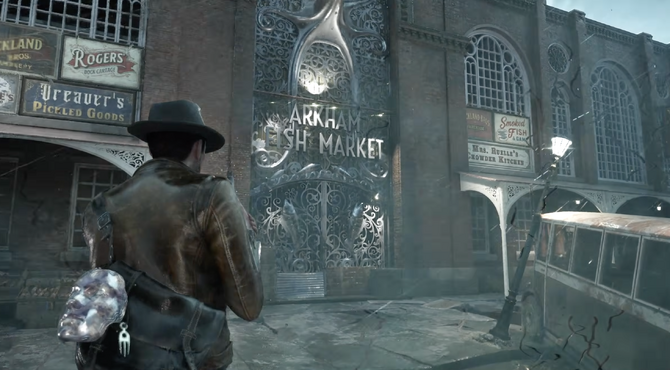
Viewed this way, it becomes clear that Arkham in this work is not merely a “town inspired by the Cthulhu Mythos.”
From a single sign to a single document, right down to the names of buildings, it has become a massive “collection of references” woven together from proper nouns, characters, and events in Lovecraft’s works.
The more familiar you are with the source material, the more your exploration itself turns into a series of new discoveries, and the fear you experience multiplies. I believe this is precisely what makes the sunken Arkham so fascinating, and ultimately, the unique charm of *The Sinking City 2*.

*The Sinking City 2* is now available for PC (Steam, Epic Games Store, GOG.com),PS5, andXbox Series X|S.



