


At indie game events and the like, there are so-called “preachy guys” who, after players have finished a demo, go on and on about their own opinions or unilaterally offer unsolicited suggestions for improvement.
They have frequently been a topic of discussion on social media, including a warning posted by the official Tokyo Game Dungeon account in May 2026. On the other hand, excessive criticism can hinder free and open critique, and there have also been frequent counterarguments against such criticism.

Everyone perceives things differently. Even the same behavior can be seen as “feedback” by some and as a “lecture” by others. So, at actual game events, what kinds of words and actions are perceived as disruptive? And where exactly is the line between welcome “feedback” and a “lecture”?
Game*Spark conducted a survey targeting those with experience exhibiting at gaming events, asking, “Have you ever been subjected to behavior or comments that you felt were disruptive or harassing after a demo session?” Although the term “middle-aged men” is included in the question, we deliberately asked this question regardless of generation or gender in order to investigate the reality more broadly.
Here, we present the responses we received.
* The responses published here are based on the individual experiences and perceptions of the respondents; the editorial staff has not independently verified the facts.
Approximately 70% of respondents answered “Yes” to the question
Of the 33 valid responses, 23 answered “Yes” and 10 answered “No.”
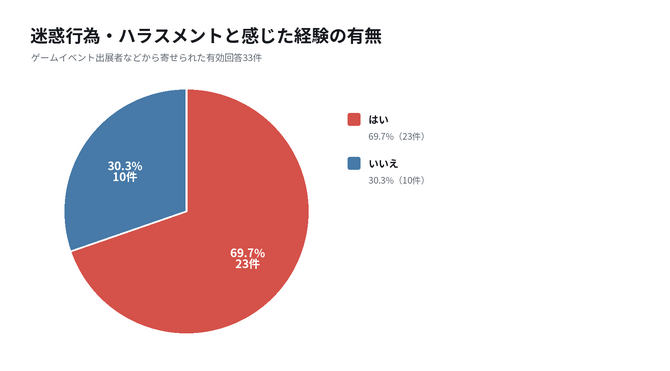
The question asked about “disruptive behavior” and “harassment” collectively, covering a range of severity. Looking at the actual responses, while there were clear-cut issues such as stalking and sexual remarks, the survey also included cases—such as brief suggestions for improvement—that could be interpreted in different ways.
This survey was not conducted among randomly selected exhibitors. Since people with relevant experiences are more likely to respond, it is important to note that these results do not directly reflect the prevalence of such incidents among all game event exhibitors.
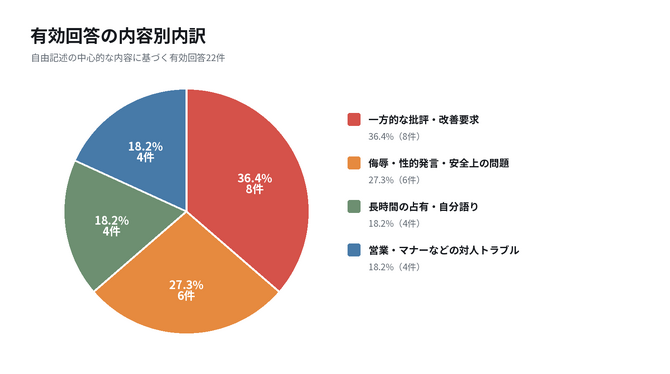
Additionally, among the “Yes” responses, we classified the 22 cases that described specific incidents based on the content of the open-ended comments. The classifications were not chosen by the respondents themselves; for responses containing multiple elements, we selected the single topic that was most prominently discussed.
“If it were me, I’d make it this way”… One-sided criticism and demands for improvement
The most common type of response received this time was statements similar to “one-sided criticism or demands for improvement” (8 cases). This refers to what is commonly known as “lecturing,” and reasons cited for finding it offensive included experiences where their intended development policies or the development process itself were rejected.
Wished to Remain Anonymous
I was told to scrap the winning contest entry and purchase and release someone else’s proposal instead.
Anonymous
I was given opinions on gameplay and design based on the critic’s own production philosophy (such as “If it were me, I’d make it like this”). This included unsolicited, excessive advice.
PUGELLA GAMES teshima
When I exhibited at an indie game event in the past, a player who tried the game commented on the outfit of a female character in the game, saying, “Wearing that outfit will cut off your circulation!” (It was a character wearing a belt around her thighs). At first I thought, “Huh…?” but immediately realized“Ah! Since the game we’re making is a ‘typing game where you send hate comments to VTubers,’ they were either suggesting hate comments or just making a joke!” So I replied, “Thank you, lol. We’ll add that to the game too! lol,” but they looked at me with a straight face and said, “…Huh?”“What do you mean?” It seemed like they were seriously saying “it’ll restrict blood flow,” and that was the end of it.
One particularly memorable instance was a case where I wasn’t actually asked for “business” advice.At indie game events, not all exhibitors are developing their games as a “business”—many are showcasing them as a “hobby.” However, since it’s hard for attendees to distinguish between these different intentions, there were several instances where people ended up giving “advice on how to sell” that wasn’t actually needed, leading to misunderstandings.
Anonymous
While demoing an action-puzzle game with highly customizable control settings, I had the controls set to a relatively beginner-friendly level, but even so, about 5% of players made control errors. One of them lectured me for about three minutes, saying, “If you make this many control errors, it’s not going to sell.”
Pusuke (Overload Games)
This happened quite a while ago. Someone came up to ask me a question about the game we were showcasing. It’s common for people to compare our game to existing, similar titles—discussing the game system, how to play, and so on. Usually, that’s where it ends, but this person, having already understood those points, asked, “Even so, how is this different from similar commercially available games?” I replied that it was likely a difference in concept. Something about this felt off, so when I asked who they were, I found out they worked for a major game publisher.I remember thinking to myself, “Ah, so this is what planning meetings are like.” While I welcome questions like this, I suppose some people might find them a bit of a burden.
"Can't Get Off" in All-Ages Games… Sexual Comments and Stalking
Another issue that appears to be more clearly problematic involves behavior related to “insults, sexual remarks, and safety concerns” (6 cases). Specifically, this includes sexual remarks, stalking, and direct insults that go beyond the scope of mere opinions.
Anonymous
Someone commented that a game rated for all ages featuring a female protagonist was “not arousing” (i.e., not sexual). I reported this to the operators because I felt it constituted sexual harassment, but since I didn’t know the person’s name or identity, no follow-up action was taken.
iDiOSLAB
We are developing a hardcore 2D turn-based roguelike, but at an event, a certain player lectured us, saying, “You should make the game look 3D, with cuter girls, lots of boobs, and curvy figures—that would definitely be better.”
In addition, there were reports of stalking behavior, such as “standing in front of the booth watching the staff until closing time, or even following them around,” suggesting that safety issues involving stalking can occur even at gaming events.
Furthermore, the following examples were cited as direct insults that went beyond the scope of mere feedback.
Anonymous
“I was told, ‘Why don’t you just give it a rest? There’s no point in doing any more of this.’”
Anonymous
There was a pair of visitors; while one was enjoying the demo, the other shouted, “I don’t approve of this, though.” The words “What do you mean by that?” were on the tip of my tongue, but I held back—it was truly frustrating.
Comments that deny the very meaning of continuing development or the intrinsic value of the work itself—rather than addressing specific issues with the game—are not criticism of the game but can easily be perceived as an attack on the developers themselves. Furthermore, even if remarks are intended for companions or close associates, caution is needed when they are made in places where exhibitors can hear them.
40 minutes to an hour… Confusion over “having time stolen”
More than discomfort with the content of the lecture itself, there are notable complaints that “prolonged monopolization of space and self-centered rambling” ultimately hindered booth operations.
Anonymous
Extended advice.
Wishes to remain anonymous
After the trial play, the person lingered for an hour, silently fiddling with the Kamen Rider belt tied around their waist right in front of me, and made a point of showing it off.
Anonymous
There were no verbal outbursts, but other attendees and developer acquaintances came up to talk to me during the session, and even when things got hectic due to bugs, they wouldn’t leave. As a result, I ended up spending nearly 40 minutes assisting one person. As a developer, I want to talk to all kinds of people, but since there are times when I’m busy, I feel it’s best to keep things in moderation.
Kousagi/Rabbit Soft Worker's
Since the exhibit is the kind of thing that strikes a chord with a specific demographic, there’s a certain inevitability to it, but there are often times when people go on and on about their own stories—old tales, war stories, and the like—that have nothing to do with the game’s content, and that drains most of my exhibition time and energy.(Though I do hear some interesting stories every now and then.) It’s a real pain having to constantly worry about not disturbing the neighboring exhibitors. When I say, “We’re showcasing a game here, so please give it a try,” it’s tough when people just play it out of politeness and then abandon it.I’m not here to listen to the visitors’ stories. They could at least give their impressions of the game. I want them to reimburse me for all the expenses I incurred setting up this exhibit.
At many game events, booths adjust the length of each play session so that more attendees can try the games. In this round of responses, we received reports of instances where developers spent an additional 40 minutes to an hour talking with visitors, separate from the actual play sessions. It seems that even the same words can be interpreted differently depending on the duration of the conversation, the tone of voice, how crowded the area is, and whether the developer is actively seeking feedback.
Indie game events are spaces where “business” and “hobby” coexist
Confusing the difference between business and hobby isn’t limited to people unfamiliar with the ins and outs of game events. In addition to misunderstandings with general attendees, we also received reports of miscommunications with industry professionals and individuals claiming to be game producers.
Wishes to remain anonymous
During a demo of a multiplayer sandbox game (where multiple machines were set up, and if there was only one player—because the AI couldn’t keep up—a member of our team would join as an opponent), a person claiming to be a game publisher remarked:“Isn’t the content volume insufficient as it stands? Hasn’t this reached a scale suitable for release?” Even after explaining that it was a demo and that, as a sandbox game designed for multiplayer, it had no predefined scenarios, the person continued to endlessly point out the lack of a single-player story mode.
Intimidating behavior isn’t limited to one-way interactions from attendees toward developers. At times, this kind of negative reaction can also come from developers toward attendees.
Anonymous
This might be a slightly different topic, but I’m a voice actor, and there was a time when I simply loved indie games and would go try them out. Once, when I stopped by to say hello, I was suddenly asked, “Are you here to pitch? If you’re here to pitch, could you please not play?” That terrified me, and I haven’t had the chance to visit since.I had actually been hoping that if the opportunity arose, we might connect, but I was reminded of how deeply traumatized I was by being told that out of the blue during my first-ever greeting upon meeting someone for the first time.
Exhibitors Who Haven’t Experienced the Problem
On the other hand, not all of the responses received constituted behavior that would clearly be considered disruptive even from a third-party perspective. In this survey, 10 out of 33 respondents answered that they had “never” experienced behavior or remarks they perceived as disruptive or harassing.
Eternal Papyrus
I’m fortunate that mostly nice people come here. (Am I just lucky? Or do I give off an aura that makes sketchy people stay away…?)
Wishes to Remain Anonymous
I’ve only participated once so far, but everyone was polite then, and there was no disruptive behavior or harassment.
Anonymous
I’ve been to about 10 events and have never been on the receiving end of any offensive remarks. It might be because we’re often manning the booth as a group, or because the genre is visual novels—I’m not sure.
Omado
Most people who try out the games just share their impressions, so I haven’t encountered any particular issues.
Online, it’s often the rare, intense experiences that get shared, while the many calm conversations that take place tend to go unnoticed. As a result, if you only look at social media posts about “preachy old men,” you might get the impression that game event venues are overflowing with disruptive attendees.
However, from the responses this time, I was able to confirm that there are people who have exhibited multiple times without experiencing any problems, as well as those who feel that most attendees politely share their feedback. At many venues, there is a calm exchange between exhibitors and attendees, suggesting that problematic behavior is not part of the everyday scene.
Concerns that “frank opinions might be lost”
In addition, we received several concerns and comments regarding the debate surrounding “Preachy Uncle” itself, including this survey project.
Anonymous
I’ve exhibited five times so far, but I’ve never experienced behavior that I would consider harassment. Only once was I told that a mini-game was too difficult and that I needed to make it easier so players could keep up, but I considered that to be within the realm of feedback.The tone was a bit sharp, but it wasn’t a baseless comment, so I accepted it as part of the feedback process.Harassment is, of course, unacceptable, but I’m worried that if the narrative that “preachy old men are malicious” spreads too far, we might stop receiving candid feedback. I still believe that playtesting is the best way to improve a game, so I want to welcome honest opinions from test players.
Anonymous
I think using the term “preachy old man” allowed us to discuss the issue without causing too much friction—in a way, it gave us room to talk about it in a style reminiscent of the Showa or Heisei eras. But the moment you use the word “harassment,” any room for discussing it with a touch of humor disappears.Despite various emotional issues, we’ve participated in indie game events in a friendly and harmonious atmosphere, but I feel uneasy that an influential media outlet like yours is attempting to frame the issue in this way.You know how people often say the internet used to be fun back in the day? I worry that the way your company is framing this issue will actually change the atmosphere for the people who are enjoying it right now. I don’t know what kind of article you’re planning to write, but I’d like to ask you to reconsider this once more.
The ongoing reminders from Tokyo Game Dungeon should be viewed not as proof that the event has become chaotic, but rather as efforts to maintain a community where exhibitors can feel safe showcasing their work.The organizers’ efforts to establish rules and issue reminders, the mutual support among exhibitors, and the consideration shown by the vast majority of attendees—it is through this cumulative effort that indie game events continue to be preserved as valuable spaces where developers and players can exchange ideas directly.
The Difference Between “Feedback” and “Lecturing”
In this survey, we were unable to draw a clear, universally applicable line between “feedback” and “lecturing.” Just as gamers are diverse, so are developers. Even when the same words are used, some people welcome them as honest feedback, while others find them burdensome as unsolicited advice.
On the other hand, among the responses indicating discomfort, there were notable instances where the speaker was perceived as having decided on the “correct answer” for the work without first confirming the developer’s circumstances or creative intent.There is a clear difference between sharing one’s own experience—such as “I got stuck here” or “I found it too difficult”—and dictating how a work should be, by stating “It’s not marketable” or “It should be easier.”
One reason such misunderstandings are common is that indie game events are spaces where business and hobby perspectives coexist. At these events, you’ll find developers aiming to sell their games or secure contracts with publishers, as well as those who simply want others to play the games they’ve created as a hobby.There are those who want to gauge market potential, those seeking candid feedback on gameplay, and those who simply want to showcase their finished work and enjoy interacting with attendees. Attendees’ objectives vary as well. The venue is filled not only with people who simply want to play games but also with those evaluating titles from a consumer’s perspective and those searching for promising projects or talent for professional opportunities.
The fact that people with different goals gather in the same place is both the challenge of indie game events and the core of their appeal. Sometimes, a project born out of a hobby leads to commercial success, and other times, it fosters a space for long-term interaction between developers and players. It is precisely because the boundaries between business and hobby are blurred that not only do misunderstandings occur, but unprecedented works and relationships are also born.
Precisely because this is a space where business and hobby, criticism and interaction coexist, it’s important to confirm whether the other person is actually seeking advice before offering it, and to keep conversations brief when the venue is crowded. Isn’t it these small, thoughtful considerations that distinguish a sincere “impression” from a one-sided “lecture”?
Below are the details of the 33 valid responses. Names and circle names are included only when the respondents have given permission for their publication in this article. For readability, some typos, formatting, and line breaks have been adjusted without altering the meaning.Please note that each response is based on the respondent’s personal experience and perception, and the editorial staff has not independently verified all facts.
Those who answered “Yes”
Wishes to remain anonymous
Extensive advice.
Wishes to remain anonymous
After the trial play, they lingered for an hour, silently fiddling with the Kamen Rider belt strapped around their waist right in front of me, forcing me to watch.
PUGELLA GAMES teshima
I’m teshima from PUGELLA GAMES, and I’m developing a game called “A Typing Game Where You Send Troll Comments to VTubers.”
When I exhibited at an indie game event in Tokyo (Tokyo Game Dungeon) in the past, a player who tried the game commented on the outfit of the female character in the game, saying, “Wearing that outfit will cut off your blood circulation!” (It was a character wearing a belt around her thighs.)
At first I thought, “Huh…?” but then I immediately realized, “Ah! Since the game we’re making is ‘A Typing Game Where You Send Troll Comments to VTubers,’ they must have said that as a joke—or rather, as a ‘punchline’!” So I replied, “Thank you (lol).I’ll add that to the game too!” But they replied with a straight face, “……Huh?” and “What do you mean?”—it seemed like they’d actually been serious about the “poor blood circulation” comment, so that was the end of it.
Wish to remain anonymous
About 90% of the trouble was caused by foreigners. It was hell being in an environment where people were flying insults at our work in English, Chinese, and other languages. They’d even bring up cracks (pirated versions) without the slightest hint of guilt, and I really felt the cultural difference.
Anonymous
I think using the term “preachy old man” allowed us to discuss the issue without causing too much friction—in a way that felt reminiscent of the Showa and Heisei eras—but the moment you use the word “harassment,” there’s no longer any room to talk about it with a sense of humor.
Despite various emotional issues, we’ve always participated in indie game events in a friendly and harmonious atmosphere, but I feel uneasy that an influential media outlet like yours is attempting to frame the issue in this way.
You know how people often say the internet used to be fun back in the day? I worry that the way your company is covering this issue will actually change the atmosphere for the people who are enjoying it right now. I don’t know what kind of article you’re planning to write, but I’d like you to reconsider this once more.
Anonymous
While demoing an action-puzzle game with detailed control settings, I had the controls set to a relatively beginner-friendly level, but even so, about 5% of players made control errors. One of them lectured me for about three minutes, saying, “If you make this many control errors, the game won’t be marketable.”
Anonymous
I was given opinions about the gameplay and design based on the person’s own development philosophy (such as “If it were me, I’d make it this way”). This included unsolicited, excessive advice that I didn’t ask for.
Anonymous
During a demo of a multiplayer sandbox game (where multiple machines were set up; if there was only one player because the AI couldn’t keep up, a member of our team would join as an opponent), a person claiming to be a game publisher told me things like, “Isn’t the amount of content insufficient as it is?” and “Hasn’t this reached the scale required for release?”
Even after I explained that it was a demo and that, as a sandbox game designed for multiplayer, it didn’t have a story mode, they continued to endlessly point out the lack of a single-player story mode.
Anonymous
A person claiming to be a game producer told me, “I’m working on a project with a famous influencer, and I’m looking for a programmer to build the game the influencer came up with, so I’d like to hire you.” It was extremely unpleasant. I’m doing indie game development because I want to make my own games—I wish people who just try to offload work on other people’s games wouldn’t come to these events.
Later, I heard from a developer who’d gotten caught up with that person that they were being skimmed off quite heavily, and I was glad I hadn’t gotten involved. Even if someone says they’ll “invest,” I consider it a red flag if they start dropping names like YouTubers, comedians, or esports players.
Anonymous
They played the game in silence for a short time (about a minute), then left after offering only one piece of feedback on the UI: “You should color-code the options.”
Anonymous
There were no verbal outbursts, but other attendees and developer acquaintances kept striking up conversations with me. Even when things got hectic due to bugs, they wouldn’t leave—and in the end, I spent nearly 40 minutes assisting just one person. As a developer, I do want to talk to all kinds of people, but since I also get busy at times, I’d prefer if they kept it to a reasonable extent.
Anonymous
It wasn’t exactly verbal, but someone stood in front of the booth watching the staff the entire time until closing, even going so far as to follow us around—stalker-like behavior. It was both a hindrance to the organizers and terrifying due to the stalking.
Anonymous
I was told, “Why don’t you just give it a rest? It’s pointless to keep going.”
Kousagi / Rabbit Soft Worker's
Since the exhibit is the kind of thing that strikes a chord with a specific audience, there’s a certain inevitability to it, but it often happens that people go on and on about their own stories—like old tales or tales of their past exploits—completely unrelated to the game’s content, which drains most of my energy and takes up the majority of my time at the booth (though I do hear some interesting stories every now and then).It’s a real pain having to constantly worry about not disturbing the neighboring exhibitors.
When I say, “We’re exhibiting a game here, so please give it a try,” it’s tough when people just play it half-heartedly as a formality and then abandon it. I’m not here to listen to the visitors’ stories. At the very least, they could share their thoughts on the game. I want them to reimburse me for all the expenses I incurred for this exhibition.
Anonymous
I was told to scrap the project that won the contest and instead purchase and release someone else’s project (I’m a woman).
GoToSeven
It’s not exactly what they said, but things like leaving their drinks or bags at the booth without even trying the game, or throwing away the flyers we handed out right in front of us? I’m sure everyone’s experienced this before, right?
Anonymous
Someone commented that a game suitable for all ages featuring a female protagonist was “not arousing (not sexual).” I reported it to the organizers because I felt it was sexual harassment, but since I didn’t know the person’s name or other details, no action was taken afterward.
iDiOSLAB
We’re developing a hardcore 2D turn-based roguelike, but at an event, a certain player lectured us, saying, “You should definitely make the game look 3D, with cuter girls, lots of boobs, and a more voluptuous style—that’d be way better.”
Pusuke (overload Games)
This happened quite a while ago. Someone came up to ask a question about the game we were showcasing. It’s common for our game to be compared to existing, similar titles—regarding the game system, how to play, and so on. Usually, that’s where it ends, but this person, having already understood those similarities, asked, “So, what exactly sets your game apart from similar commercial titles?” I replied that it was likely a difference in concept.
I thought something was off, so I asked who they were—turns out they were from a major game publisher. I remember thinking to myself, “Ah, so this is what planning meetings are like.” While I welcome questions like this, I suppose some people might find them a bit of a burden.
Anonymous
It wasn’t directly in response to my comment, but I received a message from the developer of a popular rhythm game saying, “We’d love to say hello on the day of the indie game event.” However, when the day actually arrived, no one from that company showed up, and I haven’t heard a single word from them since.
Anonymous
There was a pair of visitors; while one was enjoying the demo, the other shouted, “I don’t approve of this, though.” The words “What do you mean by that?” were on the tip of my tongue, but I managed to hold them back—though it really stung.
Anonymous
This might be a slightly different topic, but I’m a voice actor, and there was a time when I simply loved indie games and would go try them out. Once, when I stopped by to say hello, I was suddenly asked, “Are you here to pitch? If so, could you please not play?” That was so terrifying that I haven’t had the chance to visit since.
I’d actually been hoping that a connection might develop, but being told that right off the bat during my first greeting left a deeply traumatic impression on me.
Wasshoi Dokkoi Ise Ebi
They kept glancing back and forth between my face and the booth, then said with a straight face, “Why don’t you decorate the booth a bit more?” Promotional items like postcards aren’t cheap for students.Since projects in the prototype stage or jam sessions tend to launch and disband in quick cycles, we don’t work on them for a full year or two. Therefore, we simply didn’t have the budget to spend on promotional items. It was very sad to be criticized like that—as if the person were just a customer—without any consideration for our circumstances.
Those who answered “No”
Wishes to remain anonymous
No.
Eternal Papyrus
I’m fortunate that mostly nice people come here. (Am I just lucky? Or do I give off an aura that makes sketchy people stay away…?)
Prefer to remain anonymous
Nothing really… If I had to come up with something, there was one person who asked for a sketchbook but didn’t even pick up their pamphlet.
Prefer to Remain Anonymous
Nothing in particular.
Omado
I’ve exhibited at game events about six times, but I’ve rarely experienced any behavior or comments after playtests that I’d consider disruptive or harassing. While I do get comments that make me feel a bit uncomfortable, it’s only about one person per day—if that—and I’ve never experienced any harassment that felt malicious. Most players just share their impressions, so I don’t really have any issues.
If I had to name one instance, I once received a suggestion after a playtest saying, “You should add more animations here.” Since I’m an independent developer and the project wasn’t large enough to allocate sufficient resources to animation production, I wasn’t particularly interested in that kind of advice and wasn’t sure how to respond.
So when I told them, “I’m just doing this as a hobby, so I don’t need any advice,” they seemed to take offense. While it wasn’t enough to call it harassment, I remember it as an instance where I felt a bit uncomfortable because, rather than receiving feedback after the demo, I was given a one-sided suggestion for improvement.
Anonymous
I’ve only participated once so far, but everyone was polite then, and there was no disruptive behavior or harassment.
Anonymous
I’ve attended about 10 events, but I’ve never been on the receiving end of any offensive remarks. It might be because we often have multiple people manning the booth, or because the genre is visual novels—I’m not sure.
Anonymous
I’ve held exhibitions five times so far, and I’ve never experienced anything I would consider harassment.
There was one instance where someone complained that a mini-game was too difficult and that I needed to make it easier or players wouldn’t be able to keep up, but I considered that to be within the realm of personal feedback. The way it was phrased was a bit sharp, but it wasn’t baseless, so I accepted it as part of the feedback process.
Harassment is, of course, unacceptable, but I’m worried that if we overemphasize the idea that “preachy old men are the worst,” we might end up losing out on candid feedback. I still believe that playtesting is the best way to improve a game, so I want to welcome honest opinions from test players.
Tensei Factory LLC
None.
Rokushou
I’ve heard advice meant to improve the game before, and I don’t think it was harassment.
