


First, take a look at our cats. The orange tabby is Soy-kun, and the calico is Fuku-chan.

Soi-kun was originally a tiny, newborn kitten found lying on the ground near Aoto Station—smaller even than the oversized rats in Kabukicho. He has big, round eyes and a fluffy, wriggly body. He’s also quite timid—he never shows himself at all when anyone other than family members comes to the house.
However, when it’s just family around, his attitude completely changes—he immediately rolls over to show his belly and lets us pet him. Plus, whenever I walk around the house, he follows me everywhere, constantly bumping his forehead against my shin—he really acts like a “Bumper Man” (he’s 10 years old, which is about 56 in human years).Anyway, he’s just a cute little cat who loves my shins and his food more than anything.
Before coming to our home, Fuku-chan bounced around from one human household to another and was in poor condition—he had periodontal disease and his coat wasn’t in great shape. Now he’s completely healthy, and unlike Soy-kun, he’s a total sweetheart who wags his tail and purrs at everyone. His most charming feature is the patch of fur on his chest that looks like Zangief’s chest hair.
If I sit on the sofa and tap my stomach twice, he’ll appear out of nowhere and jump right onto my lap. However, he absolutely hates being held—if I pick him up, he’ll meow “Moo-moo” in protest.

Cats have long been dogged by stereotypes: “capricious,” “unaffectionate,” “loners,” and “acting like they own the house.” There’s even a famous quip that says dogs have “owners,” while cats only have “servants.”
But once you actually own one, as I explained earlier, that image is completely dispelled. Just when you think they’re capricious and unpredictable, you can actually predict their every move; they don’t prefer solitude and stick close to you whether you’re awake or asleep. Since they come to greet me at the front door 100% of the time when I get home, I don’t think they actually see themselves as the “master” of the house.
Haha, cats are actually pretty easy to control, aren’t they? Though, of course, that might just be because I “want to believe” that.
Finally Available in Japanese! The Cat-Shattering SRPG “Mewgenics”
Well, that was quite a long introduction. This article introduces the cat SRPG *Mewgenics*, which has officially been localized into Japanese and is now available on overseas consoles.

The game was developed by Edmund McMillen and Tyler Glaiel.Edmund McMillen is known as the creator of *The Binding of Isaac: Rebirth* and *Super Meat Boy*. Previously, I wrote an introductory article about *The Binding of Isaac: Rebirth* that explored Edmund McMillen’s background and philosophy.Of course, the philosophy I explored in that article is heavily reflected in *Mewgenics* as well, so reading that piece alongside this one should help you understand the game’s appeal in greater detail.

The setting is Boon County, a desolate rural town in the United States. Players take on the role of the “Cat Lady,” brought back to life by Thomas A. Beenees—a mad scientist possessed by cats (?)—and must collect, raise, and pit large numbers of cats against each other for his experiments.
Above all, the incredibly blasphemous opening sequence leaves a lasting impression. Thomas A. Beanies first asks the player to choose two out of three cats.I’m not quite sure why, but I just picked the two with the weirdest faces that caught my eye. Then, immediately after the line, “What’s wrong with ○○?!” the remaining cat is disposed of somewhere to the sound of a chainsaw. All while accompanied by the baffling follow-up remark that “we can at least collect blood and sweat before incinerating it…”
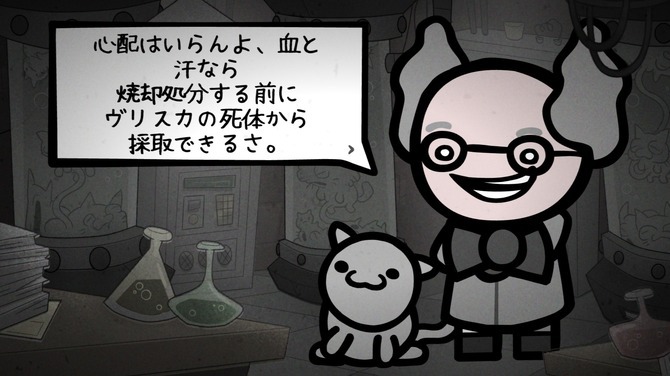
Anyway, once that opening is over, you move right into the tutorial. Guided by Butch—a rough-around-the-edges guy with relatively sound judgment—you set out to exterminate the rats, who serve as the main grunt enemies.The controls are extremely simple, and the game never demands complex maneuvers. You simply move around a standard SRPG grid, fighting each turn by using basic attacks and mana-consuming skills.
However, this game offers a level of freedom that ensures it never gets monotonous. After all, there are over 10 character classes, each with 75 unique abilities. Plus, with over 900 types of items, every playthrough delivers a completely different experience, with new tactics and synergies emerging each time.

What’s most exciting is the game’s depth—the fact that whenever you think, “Couldn’t I cheat by doing this?” there’s a high probability you’ll actually be able to pull it off.For example, you can build a cat character in the Tank class around skills that effectively utilize stones and rocks scattered across the field. This can be incredibly effective not only against ordinary, lifeless stones but also against “stones” that are actually enemy characters with their own will.
Oh, I bet you’re wondering what happens if a cat’s HP drops to 0 and it gets defeated in battle, right? Don’t worry—its lifeless body remains on the field, and it’ll return for the next battle unless it takes another hit that shatters its body. However, it will sustain injuries that permanently lower some of its stats.

I’m not particularly skilled at this genre of game myself, but I managed to play for 200 hours—sort of just reading the English text as I went—and defeat every boss. I’m sure those of you living in a world where the game has been localized into Japanese won’t have much trouble with the complexity of the controls.
Control and Create the Strongest Cat
Now that I’ve briefly explained the game’s overview, let’s dive deeper into its greatest appeals: randomness and control. The basic flow consists of a repetition of the “Breeding and Preparation Phase at Home” and the “Adventure Phase as You Progress Through the Map.” Essentially, you’ll keep repeating this cycle right up until the very end. And, at first, you’ll definitely find yourself flustered by the random elements.
First, let’s explain the “Breeding and Preparation Phase at Home.”
During the home phase, if you place cats together in the same room and select “End Day,” the results for that day are processed all at once. Cats come in various genders, but generally, if you pair cats of the same gender, there’s a chance they’ll fight; if you pair cats of opposite genders, there’s a chance they’ll mate. If mating is successful, a new kitten is born that will join your team.

In addition, exactly one stray cat will show up in front of your house every day. Since these cats—like Soy, who suddenly appeared near your house one day—come on their own, you can’t choose them, and their stats are random. However, the higher your house’s “Charm” stat is, the greater the chance of attracting high-quality cats.
Naturally, in the beginning, even breeding won’t go exactly as the player intends. After all, cats don’t take “orders” when it comes to mating. While kittens may inherit their parents’ skills and stats, this inheritance is limited and random. What’s more, they may also inherit their parents’ negative stats—which can be a real headache.
Sometimes they’ll inherit stats that have dropped due to injury, and other times they’ll inherit skills that seem like passive “disabilities”—skills that appear to have negative effects at first glance (more on this later).
However, the charm of this game lies in mastering these challenges and gaining complete control over these capricious cats. Just as Fuku-chan comes running the moment you pat her belly twice, this game teaches us that a cat’s behavior can be shaped by its environment and the habits you build over time.
You can control these elements by arranging the room’s environment. At first, only one room is available, but by giving away (unwanted) cats to Frank—an old man who lives in the sewers—the number of rooms gradually increases.

In addition to “Charm,” rooms have stats like “Comfort” and “Stimulation,” which you can manage by placing furniture obtained throughout the game.In rooms with high Comfort, cats live peacefully and are more likely to breed; conversely, in rooms with low Comfort, they start fighting. While fighting has drawbacks—the losing cat may get injured or even die—the winning cat’s stats increase.
Taking advantage of this mechanic, you can create “Fight Club”-style rooms by intentionally worsening the environment to provoke fights. Gather cats with mediocre stats in a single room to boost their overall stats, and once a cat is injured and becomes unusable (for combat or breeding), give it away or abandon it.
Note that even if a cat you sent on an adventure returns safely, you cannot send it on the same adventure again.However, if you bring them back home, you can use them normally for breeding. In other words, cats that have learned powerful skills during an adventure can no longer be used as combatants, but you have the option to use them in the breeding area as “seed” to pass those traits on to the next generation.
Even more important is the element of “mutation.” Mutations are physical changes (essentially deformities) that cats can acquire through various means, and they are passed down from generation to generation through breeding.It’s a slightly complicated mechanic, but essentially, if a piece of furniture has a high mutation stat, the cat will mutate, granting stat bonuses to specific body parts.

Believe it or not, there are said to be nearly 700 different types of mutations in total. Every single day, unknown mutations occur and cats with unfamiliar forms are born, which is absolutely mind-blowing. If you master this system, you’ll be able to consistently create cats with high stats, so your progress in the game is sure to get on track.
Congenital Disabilities Aren’t Just a Drawback
Once you’ve thoroughly understood stats, skills, and item mechanics, the next step is to create powerful cats by effectively utilizing the “disabilities”—the negative effects.
In this game’s breeding system, deliberately mating closely related cats—so-called “inbreeding”—is explicitly provided as an option and is treated as a high-risk, high-reward strategy. With each successive generation, this inbreeding increases the likelihood of “congenital disorders” occurring.
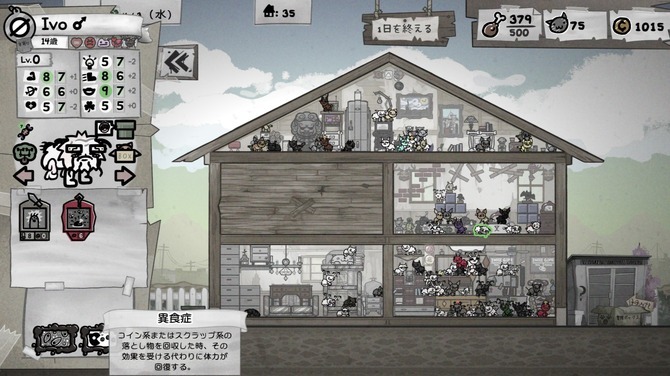
Congenital disorders generally function as disadvantages. For example, a cat suffering from “narcolepsy” is forced to fall asleep at the end of each turn and can only act every other turn.“Primitive Dwarfism,” on the other hand, features an extreme set of stats: while Strength, Dexterity, Endurance, Intelligence, Speed, and Charisma all decrease, Luck increases significantly.
However, in rare cases, these weaknesses can be turned into strengths. If a cat with narcolepsy is equipped with the “Dream Catcher” accessory, falling asleep triggers effects that boost all stats, fully restore mana, and heal injuries.
Similarly, with “Primitive Dwarfism,” if you incorporate the increased Luck into a build that relies on evasion or critical hit rates (which is particularly easy to achieve with the Thief class), it can be turned into a powerful niche.In other words, inbreeding isn’t just a gamble that piles on risks; it’s a mechanism that simultaneously opens up a deeper layer of build possibilities—one where you “master the character despite their flaws.”Furthermore, since this is a game crafted with incredible attention to detail, taking inbreeding to its absolute limit can sometimes grant staggering stat bonuses—so it might be worth aiming for.
A cat’s personality and behavior are by no means uncontrollable mysteries; they can be shaped to a significant degree by the environment and accumulated experiences. It can be said that *Mewgenics* has successfully transformed this stark reality into a game system in a rather cynical manner.

The Scathing Game System and Characters Come Back to Haunt the Player
The cynicism of *Mewgenics* doesn’t end with that opening scene or the game system alone. If you look closely, the human characters in this game are positioned so that each one embodies a selfish attitude toward the cats.
Beanie, the mad scientist, treats cats as experimental subjects in the name of “science”; Butch, the local cat-fighting promoter, treats them as betting tools in the name of “strength”; and Tink, who gives off a slight pedophilic vibe, treats them as commodities in a beauty pageant in the name of “beauty.”Although their justifications differ, their actions all share a single common thread: “exploiting cats for their own desires.”

And what’s most cynically ironic is that this dynamic mirrors the player’s own actions exactly. You select and keep cats with good stats, while giving away or disposing of those with poor stats. To optimize bloodlines, you sometimes resort to inbreeding, even knowing the risks. Cats that get injured and become useless are removed from your squad.The act of skillfully exploiting a “disability” (in terms of in-game stats) to make a cat usable in battle…
How is this any different from the selfish pursuit of “science” by Beanie or “strength” by Butch?
We cannot
communicate with cats
Although I boldly claimed at the beginning that I can control my own cat, since humans cannot actually converse with (real-life) cats, I don’t really know how true that is.
This game might seem like a blasphemous, sensationalist work that takes pleasure in one-sided violence against cats. No, there’s no doubt it’s sensationalist. But think about it. It’s more likely that we humans also treat the cats we keep as pets in a one-sided manner in our daily lives, isn’t it?
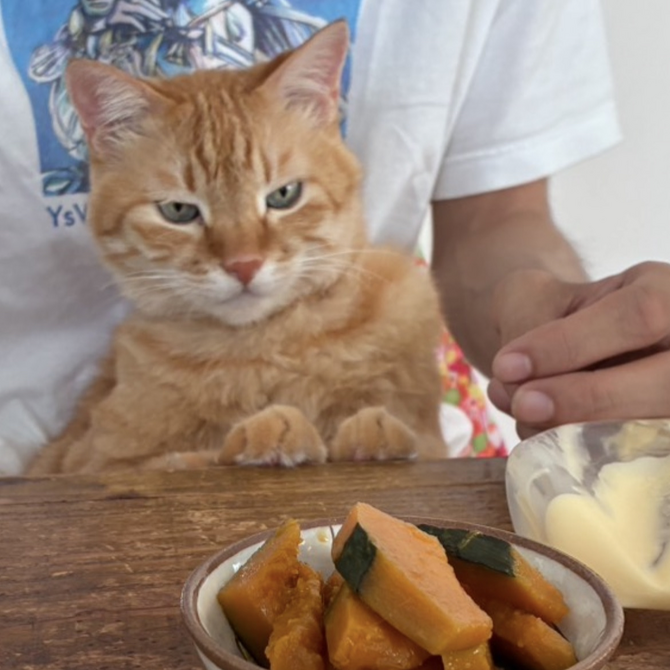
Do they really want to play right now? Are they really sleepy right now? Are they really bumping into us of their own free will? Do they actually enjoy being petted? Do they really like CIAO Churu?
This work is laced with satire throughout—targeting animal testing, euthanasia, and unscrupulous breeders. At first, you might be able to laugh at that satire. But perhaps even those of us who love cats are interacting with them based on one-sided assumptions, just like the targets of this mockery.
At the very least, I find the futility of such one-sidedness—and the cruelty that stems from it—the very act of “clearing the game” by manipulating the environment and breeding—to be wonderfully intriguing.
This ironic gaze may be directed not only at blatant villains but also at cat lovers who act like “good people.” *Mewgenics* isn’t just a highly addictive SRPG; it’s a game that delves deep into these very issues.

*Mewgenics* is now available on PC (Steam) and international consoles. It costs 3,400 yen—you’d be better off buying this than going to a cat café.



