


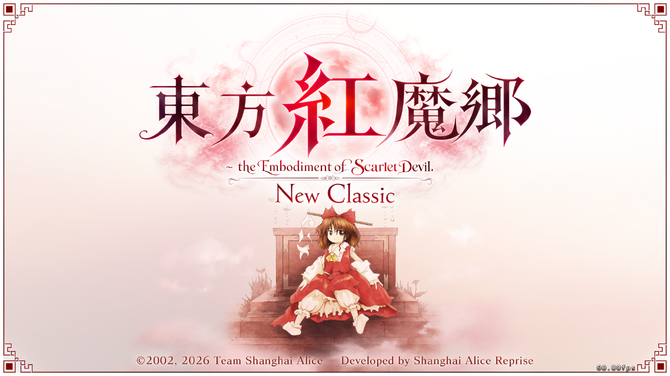
*Touhou Koumakyou ~ the Embodiment of Scarlet Devil* (hereinafter referred to as *Koumakyou*) was released at “Comic Market 62” in 2002. It features adorable, doll-like girls, captivating character designs, and elegant, dramatic music.The popularity of the “Touhou Project” exploded, primarily through the internet, captivating everyone from adults to children—and even those who don’t play video games. “Koumakyou” in particular enjoys enduring popularity, and even today, fan art, music arrangements, and other derivative works based on it are actively being created.
However, *Red Magic Village* is PC-exclusive and has never been ported to other platforms. As a result, you couldn’t play it without obtaining the disc. Furthermore, it doesn’t run properly on current operating systems, requiring unofficial tools or patches—creating a significant barrier to entry.I imagine there were many people who were interested in the characters and music but were left on the sidelines because they didn’t have the right setup. There might even be some who have never played a bullet-hell shooter to begin with. I, too, experienced that frustration back when I was in middle school.
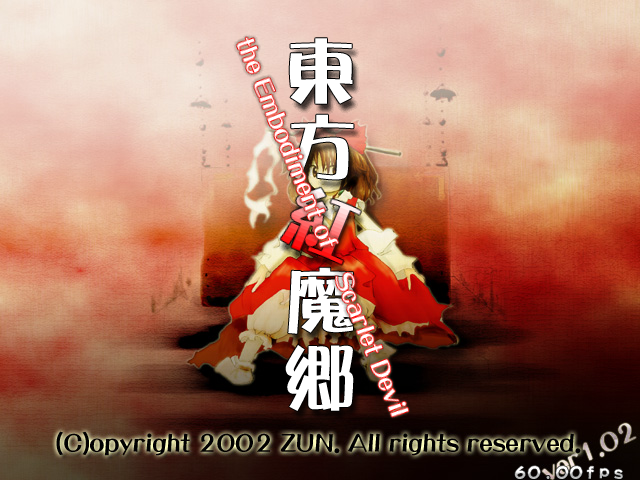
For a long time, *Koumakyou* was a game that was difficult to play, but after 24 years, it has been revived for the modern era as *Touhou Koumakyou: New Classic* (hereinafter *Koumakyou NC*).*Koumakyou NC* includes two versions: the New Classic version, with graphics and music reworked by developers who have “grown” (according to the developers themselves), and the Classic version, which recreates the original 2002 game as faithfully as possible. As a result, it has truly become a title that anyone can easily pick up and play.
In this article, we’ll bring you a review of *Touhou Koumakyou: New Classic ~ the Embodiment of Scarlet Devil.*, the remake of *Koumakyou*.
Even More Accessible with “Challenge Mode”
*Koumakyou* is a vertical bullet-hell shooter consisting of six regular stages and one EX stage. The EASY difficulty features a total of five stages, and the EX stage is unlocked by clearing the game without continues on NORMAL difficulty or higher.
You can choose between two playable characters: Reimu Hakurei, a shrine maiden with a wide attack range, and Marisa Kirisame, a witch with high movement speed. Each character has two shot types, allowing you to enjoy a total of four different combinations.Each shot type has distinct strengths and weaknesses: for example, the “Spirit Amulet” has low attack power at long range but features convenient homing and a long bomb duration, while the “Love Amulet” boasts immense power and a wide range but fires a bomb that slows your movement speed.
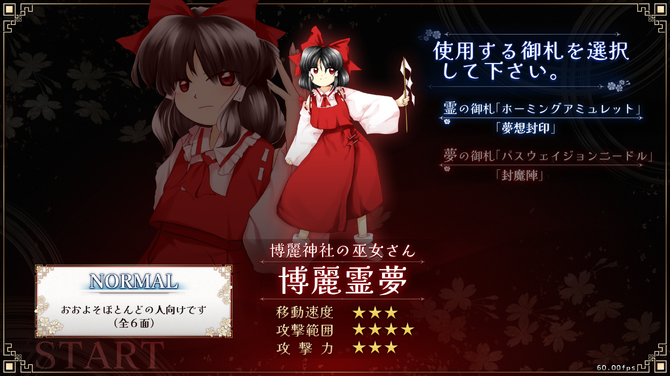
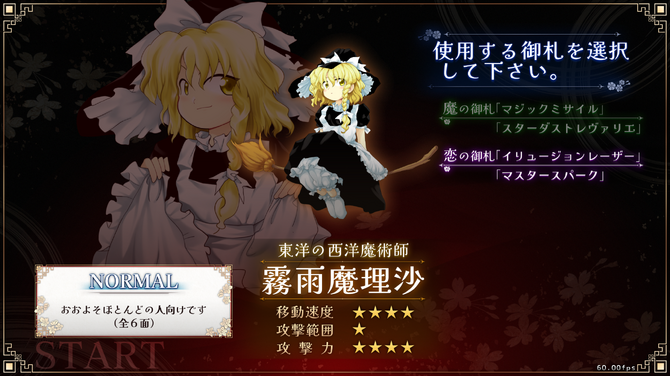
While the original game only featured a life-loss system, the New Classic version adds a “Challenge Mode” with no game overs, allowing even first-time shoot ’em up players to reach the final stage in a single playthrough.
Furthermore, features adopted in later titles—such as a hitbox indicator for the player ship during slow movement and red enemy markers at the bottom of the screen—have been added, improving playability and making enemies easier to defeat.Since the original version lacked these assist features, players had to rely on instinct to gauge their ship’s hitbox, and they couldn’t determine the boss’s position without looking up.

The game has also been updated so that items can be collected by moving to the top of the screen even without being at full power, making it easier to rack up points and earn Extends (*1).
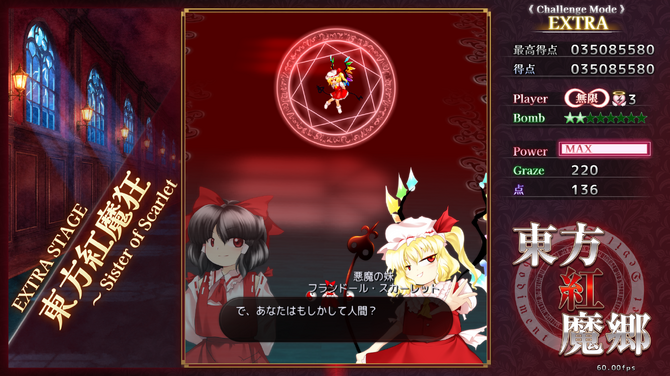
I, too, was unable to clear the original *Scaredy Scarlet* on NORMAL without continuing, but thanks to these new features, I was able to meet the requirements in *Scaredy Scarlet NC* and finally see the EX boss, “Flandre Scarlet.”
*1 A system where you gain one extra life for every 10 million, 20 million, 40 million, and 60 million points scored.
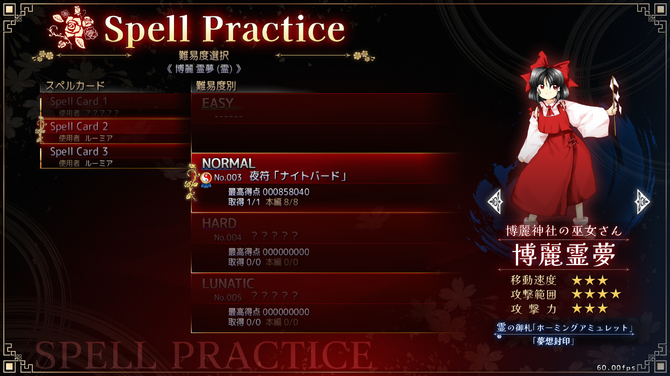
It also features “Spell Practice,” a mode where you can practice the spell cards of bosses you’ve already defeated—a feature absent from the original *Koumakyou*—making this a remake that truly scratches where it itches, reflecting the wishes of many players who likely thought, “If only this were here, it would be so much easier…”
So, do these added features and “Challenge Mode” make *Red Magic Village NC* an easy game that anyone can clear right away? Of course not. The spirit of “taking on challenges and improving your skills” that runs through the *Touhou* series is firmly present in this title as well.
The “Bullet Hell” Takes Center Stage—Mastery and a Spirit of Perseverance Are Required
The system in *Koumakyou* is extremely simple. Based on the three elements of “shoot, dodge, and defeat,” you fire shots while dodging the barrage of bullets that are fired one after another.While moving around freely with normal movement, you can press a button to switch to “Slow Motion Mode,” allowing for more precise dodging that weaves through the gaps in the bullet patterns.
You can also use “Spell Cards”—essentially “bombs”—as your trump card to clear bullets, protect your ship, and land high-damage attacks. There are only two ways to obtain Spell Cards: by defeating mid-bosses that appear along the way to get one, or by gaining an extra life.

There are also features like “Glaze,” which grants a score bonus when you dodge enemy bullets at the very edge of their hitbox, but these are essentially the main actions the player will perform.
Players who are likely experiencing a bullet-hell shooter for the first time will probably start by selecting the “EASY” difficulty—labeled as “for those who struggle with shooters”—only to be left scratching their heads at the intensity of the bullet patterns and the “for those who struggle” tagline.Just when you think you’ve somehow cleared EASY, you’ll be mercilessly sent back by the Stage 5 boss, the maid “Sakuya Izayoi,” and end up with a bad ending. And if you dive into NORMAL—which is “for just about everyone”—in pursuit of the good ending, you’ll likely find yourself wondering, “Is it really possible to clear this without using any continues?”

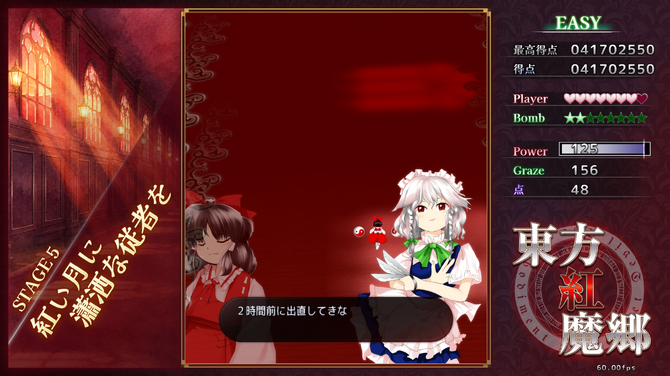
In many titles of the *Touhou* series, a “no-continue clear” is required to unlock the Good Ending.Depending on the title, this may be possible even on EASY, or it may be restricted to NORMAL or higher difficulty levels. However, in *Koumakyou*, since EASY only goes up to Stage 5, you must clear NORMAL without using continues to see the good ending.
You might think, “Well, then, shouldn’t it be possible to see the Good Ending in the ‘Challenge Mode’—which was added to this game and has no Game Over—no matter how many times you make a mistake?”… but it’s not that simple.To reach the Good Ending in Challenge Mode, you must clear the game with no more than 5 misses (each Extend reduces the miss count by 1), so the requirements are virtually the same as in “Standard Mode,” which uses the traditional life system with an initial count of 5 lives.Ultimately, regardless of which mode you choose, the game is designed so that players cannot see the Good Ending unless they improve their skills.

This design can come across as “no beginners allowed,” raising concerns such as: “Isn’t it unfair that beginners can’t see the Good Ending even though the game includes a mode specifically for them?” or “Shouldn’t the remake allow players to play up to Stage 6 even on EASY?”In fact, starting with *Scaredy Red*, Stage 6 has been included in the EASY mode as well. It could be argued that the only thing that should vary by difficulty level is the game’s challenge itself, and that keeping all other elements equal is what a game designed for all users should aim for.
However, that approach fails to capture the true appeal of this “bullet hell shooter.”If you simply reach the boss and defeat it once, you’ll finish the game before experiencing the tension of dodging and enduring the bullet hell, the sense of improvement you feel each time you play while memorizing patterns and adapting to them, and the beauty of the freely expressed bullet patterns.As stated on the original game’s packaging—“The ultimate aesthetic form, pursuing the true fun of bullet hell shooters” and “A gift from bullet hell enthusiasts, for bullet hell enthusiasts”—this game exists, so to speak, for the sake of the “bullet patterns” themselves.

For example, the Stage 6 boss—the final boss, “Remilia Scarlet”—has a phase where she unleashes bullet patterns from the residents of the Scarlet Devil Mansion. Not only do these look different, but you can also anticipate how to dodge them to some extent based on the bullets themselves.Since Remilia is the head of the Scarlet Devil Mansion, it makes perfect sense that she can utilize bullet patterns from the mansion’s servants. The character design and the bullet pattern choreography mesh perfectly.
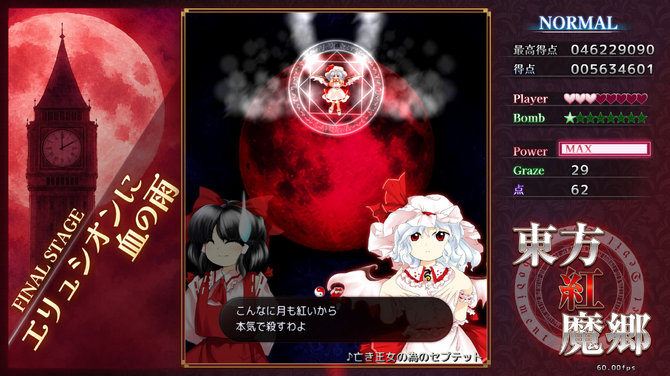
In particular, the beauty of the standard bullet patterns Remilia unleashes using a knife reminiscent of Sakuya is perfectly synchronized—even down to the timing—with the track “Septet for a Dead Princess,” making it one of the most memorable bullet patterns in the game.Although this is a standard bullet pattern rather than a Spell Card, when I first saw it, I was captivated by its beauty—a pattern I had previously thought of as something to simply dodge or use a bomb to get past.

I imagine many people are drawn to this game by the music, but when I listened to the tracks on the soundtrack after playing, I felt something was missing.So, why did I feel that way? It’s because the music is composed with the stage layout and the entire screen in mind—and the bullet patterns are an integral part of the song. While the music is certainly captivating on its own, it’s only when combined with the bullet patterns that it truly reveals its full potential. These characters, enveloped in such bullet patterns and music, are sure to leave a vivid impression on players’ memories.
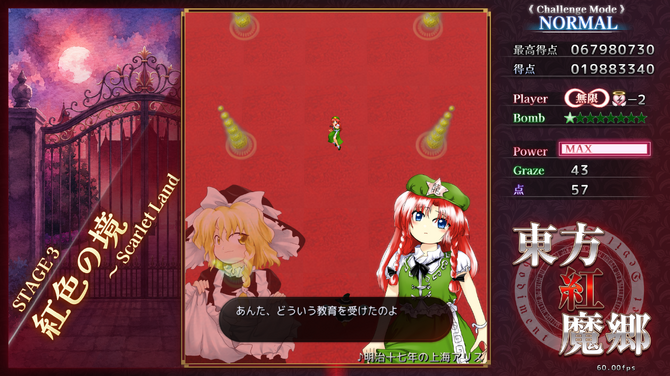
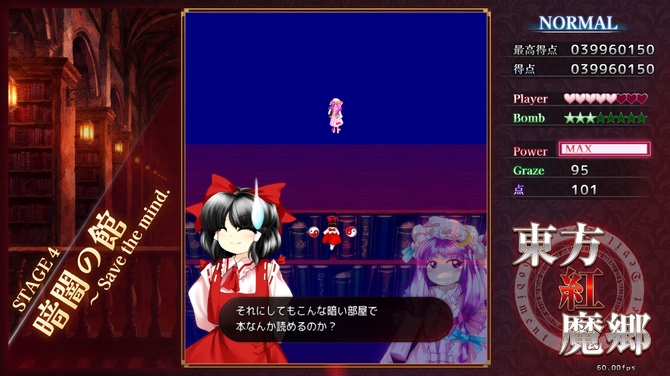
In this way, the characters, backgrounds, and music in this game are designed to bring out the appeal of the bullet patterns. To achieve this, the developers likely ensured that players could discover the fun of “bullet patterns” on their own—even if this means that differences in difficulty levels create disparities in the player experience, making the game less than entirely equitable.
A Revamped *Koumakyou* Awaits
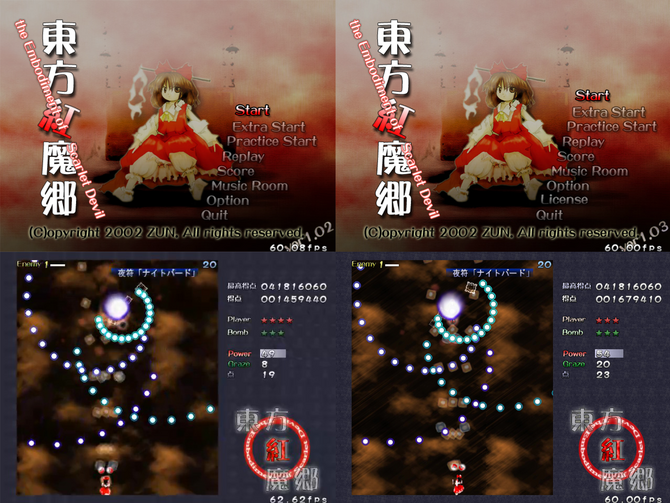
"Koumakyou NC" essentially retains the same stage layout, patterns, and presentation as the original. While there are some differences—such as a slight increase in the number of enemies in certain sections—safe spots like positioning yourself above the stage at the start of Stage 2’s boss fight against “Chirno” to dodge bullets, or the upper-screen evasion in Stage 5, remain intact.

This shows just how polished *Red Magic Village* is—so much so that even today, there’s almost no need to change these elements. While this approach is certainly not wrong for a remake that simply updates the original *Red Magic Village* to make it more accessible to modern players, the fact that the boss entrance animations and on-screen text effects when transitioning to the next stage are almost identical gives the game a somewhat simplistic feel in some areas.Given that titles released after *Red Magic Village* feature even more elaborate presentations, it felt as though there was still room to tweak the visual presentation a bit more.
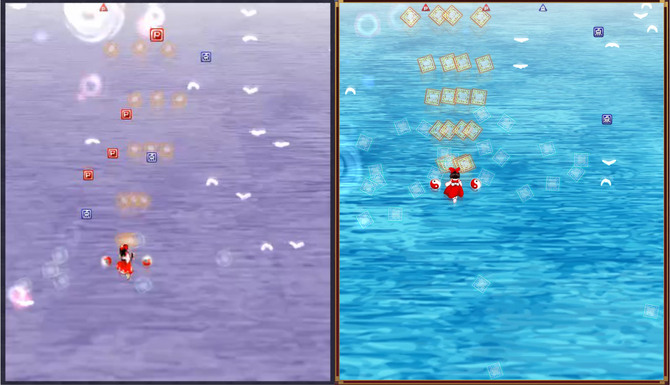
Additionally, because the saturation and brightness of the backgrounds have increased, there are sections in some stages (particularly during Stage 2) where the bullet patterns blend into the background, making them difficult to see. While this isn’t a deal-breaker, I wish a bit more attention had been paid to the visibility of the bullets.
The illustrations have been reproduced to a very high standard without compromising ZUN’s original artistic style, and the distinct character designs remain completely intact. The pixel-art animations are also incredibly cute and lively.While playing, you rarely have the chance to really look at the characters, but nowadays, you can easily take screenshots or record clips on any hardware, and there’s also a replay function. It’s a good idea to use those to take a closer look at their movements.
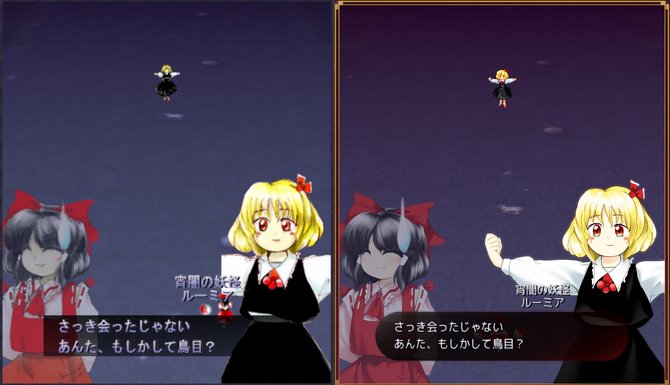

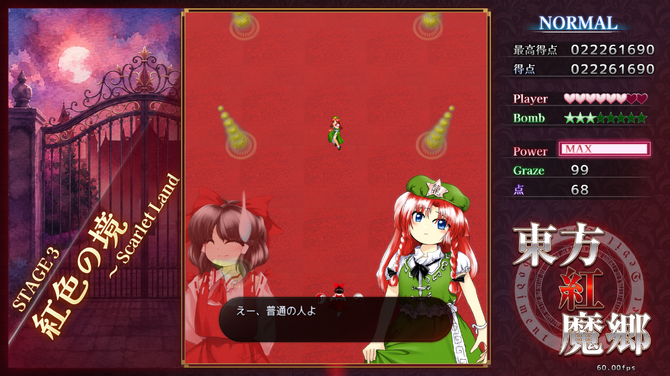
The musical arrangements by ZUN are also rich and reflect the characters’ personalities even more vividly. In particular, “Shanghai Tea House ~ Chinese Tea” from Stage 3 has been given a more Chinese-style flair to match the roots of the stage’s boss, the gatekeeper “Kou Meiling.”Listening through the entire album again, I feel it’s designed so that as you approach the end—moving from the bright, energetic tracks of Stages 1–3 to the serious tone of Stage 4 and the intense rock of Stage 5—the player’s own sense of tension gradually builds.
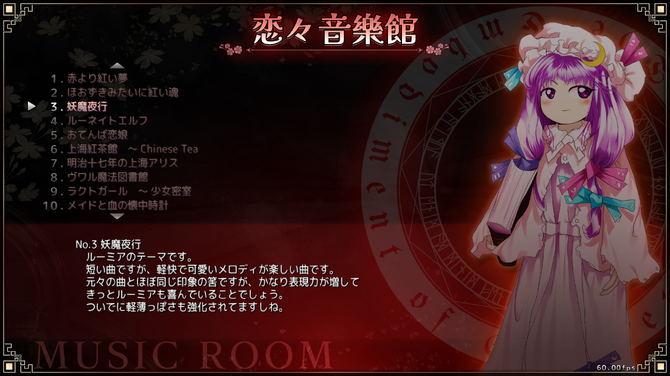
Since you can switch to the original tracks, you can enjoy comparing the two depending on your mood. When you switch over, you can really feel that the arrangements in this game were composed to blend seamlessly with the frame illustrations and backgrounds that adorn the screen.Switching back to the original tracks gives me a sense of calm, likely because I’m so familiar with them, but the arranged versions are still the ones that truly blend seamlessly with this game’s visuals.

By the way, when I played the Classic version, it felt almost identical to the original. Of course, there may be minor differences, but you’ll hardly notice them during normal gameplay.
This title is a remake of the 2002 game *Koumakyou*, featuring minor assist features and adjustments to make it more accessible to everyone. Popular characters have been beautifully redrawn while staying true to ZUN’s original illustrations from that era, and the music has been arranged by ZUN himself to capture elements that the original compositions couldn’t fully express.While there are few additions in terms of visual effects and other elements—leaving it feeling a bit lacking as a remake—it possesses a charm that makes you want to play it over and over again as a simple, stoic bullet-hell shooter, and it can certainly be considered a suitable entry point into the *Touhou* series.
*Koumakyou* is a difficult game (though according to ZUN’s bonus text in the original, the difficulty has been toned down a bit…).That’s precisely why the sense of accomplishment you feel when you reach Remilia with three or fewer continues, or when you manage a no-continue clear by dodging every shot from the “Red Magic” spell card, is truly irreplaceable.

For Flandre, the EX boss who becomes available in Challenge Mode once you’ve fought your way to the end, you can unlock new bullet patterns and music tracks by meeting certain conditions. To do so, you’ll need to improve your skills enough to defeat her, which provides a new sense of purpose and a fresh goal for growth. This doesn’t mean the challenge has simply been made easier, either.That said, to be honest, I have absolutely no confidence that my skills are good enough to reach that point…

By the time you’ve repeated these challenges over and over, you’ll surely have grown to love the characters from *Kouma-kyou* even more and come to appreciate the inherent fun of bullet hell gameplay itself.Since it’s exceptionally well-made as both a remake and a port, I’d be absolutely thrilled if, as a further “Reprise,” we could someday play *Touhou Youyoumu* and *Eiyashou* as well.
Game*Spark Review: *Touhou Koumakyou: New Classic ~ the Embodiment of Scarlet Devil.* PC/PS5/Switch/Switch 2 September 10, 2026
A timeless masterpiece brimming with the beauty of bullet hell—a simple and stoic bullet hell shooter
-
GOOD
- A remake that preserves the charm of the original while adding subtle assist features to make it more accessible
- With the addition of “Challenge Mode,” even beginners can now play all the way through to the final stage
- Although the stages and patterns remain unchanged, the beauty of the bullet patterns has not faded even today
- Designed with a focus on helping players improve their skills
- EX bosses now feature additional bullet patterns and music tracks that can be unlocked under certain conditions, providing new goals to aim for
BAD
- On some stages, the contrast between the background and the bullet patterns is too low, making the bullets hard to see
- Since the port is included, it feels like there was room to make the visuals more flashy as a remake
- Although the design prioritizes skill development, the fact that the Good Ending is inaccessible may be too challenging for some players



