


July, 2026. As of this writing, the world is filled with a sense of helpless despair and resignation. Amid a reality that makes one want to give up on everything, however, there were two indie games that offered a glimmer of hope: *The Shoelace Story* and *PAIC: The Moon Rider Story*.
Developer KITTYPOOL released the visual novel *The Shoelace Story* on March 6 and its spin-off, *PAIC: The Moon Rider Story*, on April 1.Even within the indie game genre—which is known for embracing a chaotic mix of styles—both titles stand out as some of the most “mishmash-like” slapstick sci-fi. At the same time, they are strange masterpieces that remind us of the anger we feel toward the structural discrimination, exploitation, and violence that bind us so tightly in reality.
Both titles contain depictions of trauma stemming from war and massacres, sexual violence, femicide (the murder of women based on gender discrimination), and institutional discrimination against transgender people.If you plan to play these games, we strongly recommend doing so in a safe environment after carefully considering your mental state (please note that this article refrains from detailed references to these depictions).
To be honest, there were many moments when even I, the author, found myself instinctively wanting to look away from the gut-wrenching anger and sorrow in both games, which hit like body blows. But that is precisely why my emotions were so deeply stirred—I felt compelled to think, “Things this terrible must never be allowed to happen again; we must never pretend this anger and sorrow don’t exist.”
And isn’t that very “refusal to give up” exactly what we need now, more than four months after their release? In this article, I’d like to revisit and highlight the chaotic charm of these two works.

Both *The Shoelace Story* and *PAIC: The Moon Rider Story* are science fiction fantasy works—what might be called “virtual war chronicles”—that share the same setting and time period.The setting is Earth. The stories depict characters tenaciously surviving the aftermath of a 900-year war between humanity—whose science and technology have reached their peak—and the mysterious hostile creatures known as “Mamono.”
The protagonist of *The Shoelace Story*, “Love Catch,” is a woman who became an orphan of war due to a “massacre—one that would likely not even merit a single line in a textbook”—during that war against the Mamono. She works as a freelance reporter and, though unable to speak due to past trauma, communicates through her own unique and peculiar body language.In her private life, however, she drowns her sorrows in alcohol and drugs every day.
She seems to barely scrape by thanks to being “trained” by her obsequiously rude butler dog, “Buddy,” and her free-spirited feminist cat, “Diva.”

By a twist of fate, this good-for-nothing, Love Catch, is ordered by the nation’s president to become the “Hero”—the hope of humanity. She is forced to persuade the “Demon King,” who commands the monsters, to end a war that has raged for 900 years.But even though he’s called the Hero, all he’s been given is a single toy sword. To make matters worse, he doesn’t even have a single clue as to the Demon King’s whereabouts.
To somehow gather information on the Demon King, Love Catch and his companions will put his skills as a writer to use, interacting with a wide variety of people and helping them along the way.

This game is a point-and-click visual novel. Players simply explore the field and look for events occurring in various locations. While there are a few puzzle minigames included, gameplay is essentially handled entirely with mouse clicks.

Rediscovering Anger in a Chaotic World
The characters who form bonds with Love Catch are chaos incarnate. A mechanical lifeform that has lived for 3,000 years; a carefree, corrupt mayor who shows no shame in his misdeeds;A newspaper editor-in-chief who collapsed from withdrawal symptoms after becoming addicted to spice curry, and a manager of an armed shopping mall that has grown so massive it’s become its own autonomous region… These are just a few examples, but they should give you a good sense of just how outlandish the game’s world is.

Despite their outlandish and bizarre nature, these characters occasionally display a reality so stark it takes your breath away. This is likely because the problems they face always serve as a mirror to our own reality.
The “problems” they bring to Love Catch always carry a certain sense of urgency. For example, right at the beginning, Love Catch is commissioned to carry out espionage in order to invalidate an abortion ban ordinance that was enacted with virtually no prior notice.

Whether or not sexual intercourse occurs is not necessarily linked to consent, and of course, it’s impossible to decide the outcome of a pregnancy based solely on one’s “own will.” If the timing is right, an “unwanted pregnancy” can happen all too easily. You might think, “That can’t possibly happen.” But what if you were suddenly faced with such a situation?
Can you imagine the horror of “new rules”—ones that so easily trample on your rights and dignity—being decided behind your back, without your knowledge, before you even realize it? As of July 2026, many people likely feel this situation is particularly close to home.
*The Shoelace Story* reminds us how to channel our anger toward such pressing issues through the chaotic banter between its characters.
“Dark Potpourri Sci-Fi” for Omnivorous Subculture Nerds
A style common to both *The Shoelace Story* and *PAIC: The Moon Rider Story* is a storm of vast, genre-agnostic homages, parodies, and references.
Starting with graphics that seem to pay homage to Love Derrick—familiar from *moon*—and extending to the unique translation style and wordplay of sci-fi classics, BUDDHA BRAND’s “Green Five-Toe,”*The Bachelorette*, audio reports on the Chernobyl nuclear disaster, and even the Basset Hounds beloved by Mamoru Oshii… Even just the references I managed to spot are too numerous to list.

There are even scenes where proper nouns—such as real-world companies, existing game titles, and other works—are shoved in there forcefully.The moment I saw the monologue describing “eyes like Vivi from *FF9*” or the scene where a resident of the Underworld muses to himself, “I wonder if they managed to buy me that AKAI sampler…,” I couldn’t help but clap my hands and laugh—while simultaneously feeling an indescribable sense of wonder.

While these twisted, over-the-top parodies do shake the story’s consistent worldview to its core, they also serve as a gateway to deeper immersion in the story’s world.
There Are Ghosts, and There Are Heroes
Both works share common motifs. Among these, the most notable are “ghosts” and “heroes.”
As mentioned earlier, *PAIC: The Moon Rider Story* is a spin-off of *The Shoelace Story*. The protagonist is “Maniera,” a trans man. The story begins when “Pike,” the ghost of a mysterious pregnant woman, appears before him as he rushes home on his motorcycle.
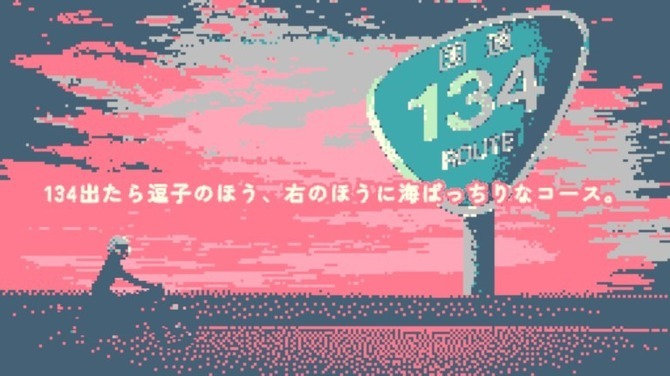
As one might expect, the ghosts appearing in both works met untimely deaths during their lifetimes. They are treated by the living as the subject of unverified rumors—and, worse still, they don’t even know who they are themselves. Yet they lived their lives to the fullest, somewhere, at some point, and they still exist in this world. Who, exactly, could deny that?
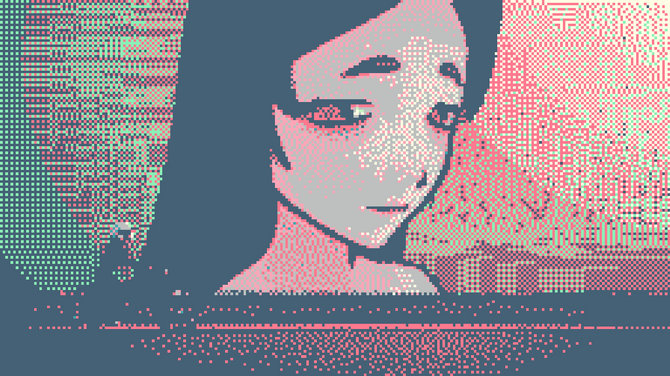
In various works, ghosts have been portrayed as a motif representing queer people*. To give a familiar example from video games, the ghosts in *UNDERTALE* are also explicitly depicted as queer.
* “Queer” is a broad term referring to diverse sexual minorities, including those identified by the “Q” in the LGBTQ spectrum.Although the term once carried a strongly derogatory connotation—similar to what is known as “okama” in the Japanese-speaking world—there is a history of those who identify as queer reclaiming the term and transforming its connotation into a positive one.
Queer people have always been subjected to either the curious stares of the majority or complete disregard. They are often treated as outliers within the legal system and frequently ignored. They are people who, even though they clearly exist, are treated as if they do not.
Amidst this, the heroes—Love Catch and Maniera—listen to the voices of these “ghosts.” Neither of them is a morally exemplary person. Furthermore, they certainly don’t have the luxury of time to help anyone.Yet they engage in conversation with the ghosts. For now, they simply chat face-to-face as neighbors. The portrayal of heroes in both works struck a deep chord with me, at least.

The two works presented by KITTYPOOL stand right beside us as we navigate an unjust reality, serving as a source of support. They share our anger in the face of discrimination and inequality, offer comfort in the face of tragedy, sometimes inspire us, and even fill our hearts with joy.Especially in times like these, isn’t spending hours glued to your PC playing a complex visual novel a rather clever way to cope?
“The Shoelace Story” and “PAIC: The Moon Rider Story” are now available on PC (Steam).



