


In the 1990s, a wave of action games featuring a host of unique characters emerged, primarily on platforms like the Super Famicom and Mega Drive. It was during this era that the British game studio System 3 created “Putty,” a mysterious character with a body resembling blue putty.
First introduced in 1992, Putty was known for his versatile actions, such as freely stretching and inflating his body, and even absorbing enemies. In Japan, he was released in 1993 as *Putty Moon* for the Super Famicom.
And in 2027, the series will celebrate its 35th anniversary. To mark this milestone, development is underway on a new 2D platformer for the Nintendo Switch 2 titled *Putty World 35th Anniversary*.

This title unifies the worlds of not only “Putty”—the series’ origin—but also its sequels, “Super Putty” and “Putty Squad.” It’s not just a simple remaster; it’s an ambitious project in which the original development team itself is reconstructing the game design and visual style of that era using modern technology.
The development concept is: “If the Nintendo Switch 2 hardware had existed in the mid-1990s, what would the developers of that era have created?”
To coincide with the “Tokyo Game Show 2026 (TGS2026),” Game*Spark conducted an interview with Mark Cale, founder and CEO of System 3.We spoke at length with him about the background behind the series’ revival, the reasons for deliberately carrying on the production methods of that era, and even the story behind the creation of the Japan-exclusive title “Patty Moon.”
What if modern hardware had existed in the 1990s? A new retro game created by developers from that era
――First, on the occasion of the 35th anniversary of Putty’s debut, could you tell us why you decided to revive the series?
Mark Cale (hereinafter Cale): It all started with a single question: “If the Nintendo Switch 2 hardware had existed in the mid-1990s, what would we have created using that technology, while maintaining the imagination and techniques of that era?” *Putty World* is the answer to that question.
The original *Putty* was released in 1992, so its 35th anniversary will be next year, in 2027. Of course, this is a perfect opportunity to bring it back to the world, but what’s even more important are the production-related reasons.
Now, we can give Putty far richer expressions and smoother movements, and we can bring together ideas from each title in the series into a single new adventure. We want people who aren’t familiar with Putty to enjoy it just as much as those who remember the Amiga or Super Famicom.
――This project isn’t just a simple remaster; it’s a large-scale reimagining that brings the worlds of *Putty*, *Super Putty*, and *Putty Squad* together into one cohesive whole. What led you to take this approach?
Cale: The global resurgence in retro gaming popularity gave us the confidence to invest in a reconstruction of this scale.
Although *Putty*, *Super Putty*, and *Putty Squad* were developed as separate titles, they each contain characters and gameplay ideas that inherently belong to a single world. We felt that bringing them together was the natural next step for Putty.
Our goal is to create a game that has the breadth of a compilation while still standing as a single, complete title. To achieve this, we’re developing new content while improving every aspect—from controls and animations to level design, pacing, and presentation.Taking our ideas further than what was possible with the hardware of that era and imbuing everything with a consistent sense of identity—that is the philosophy behind *Putty World*.
――Rather than simply “remaking old games for a modern audience,” your approach of asking, “What if the original developers had access to modern hardware?” is very unique. Why did you choose this concept?
Cale: The “What If?” series was born out of the global resurgence in retro gaming.
Since we are the original developers, we can ask ourselves this question directly. If we’d had access to today’s technology back then, how far could we have taken that game? What could we have created if we’d had far greater memory, processing power, and graphical detail? We want to explore that while preserving the gameplay style of the era.

While we’ve modernized the controls and gameplay mechanics, the most important thing is not to compromise the essence of the experience. If we were to change everything to suit modern tastes, we might lose the very charm that’s bringing people back.We aim to make the game even more enjoyable—with better animations, more expressive characters, and responsive controls—while preserving the unique character of the retro experience.
――This title is positioned as the first installment in System 3’s “What If?” series. Are there plans to revive other titles using the same concept?
Cale: Yes. We see “What If?” as an approach that extends beyond *Putty World*. System 3 has a considerable number of titles, and there are other worlds we’d like to revisit using this philosophy.
However, just because it worked well with *Putty World* doesn’t mean we intend to apply the same visual treatment to every title. We’ll start by asking: What made each title unique? And what would the original creators have done if they’d had today’s technology at their disposal? We’ll share details about specific future projects once they’re ready.
Rendering 3D Models One by One! Why We’re Deliberately Carrying On the Production Methods of the 1990s
――In the mid-1990s, games like *Super Donkey Kong* emerged, featuring 2D graphics created by rendering 3D models. System 3 is taking a fresh look at the visual style of this era—could you tell us why?
Cale: I don’t want people to think that the era of pixel art is over; rather, I hope you’ll see this as an opportunity to broaden the scope of the discussion surrounding retro games.
The rendered 2D visuals of the mid-1990s had a unique character—with rounded forms, exaggerated lighting, and a toy-like texture.During that period, the gaming industry transitioned very quickly to polygonal 3D. However, I think there’s still room to explore what would happen if that rendered style were given far richer animation and detail. For those who remember that era, it evokes a sense of nostalgia, and for younger players, it can become a distinctive visual style in its own right.
――While the technical limitations of that era are gone, I think those very limitations were partly what gave the game its unique character. As you remade it for modern hardware, were there any elements you deliberately chose not to change?
Cale: Putty has to move like Putty, feel like Putty, and look like Putty. That was our starting point.
His ability to change his movements and shape, and the joy of testing what he can do, are essential elements. We also wanted to preserve the characters and backgrounds with their unique charm, as well as the rendered 2D style.

Games like *Super Donkey Kong* demonstrated just how wonderful the combination of rendered artwork and 2D gameplay could be.In *Putty World*, while we’ve added detail, expression, and much smoother animations thanks to modern hardware, we’ve preserved the 2D gameplay and visual identity that lie at the heart of the experience.
――You mentioned that the graphics have been completely rebuilt. How are the original production assets and code being utilized in the current development?
Cale: Since the original team is developing *Putty World*, we have firsthand knowledge of how the original game was made and what gave it its unique character. We still have the original source code for the series, which serves as a valuable reference for gameplay, movement, and timing.
However, all the models have been rebuilt from scratch to take full advantage of today’s technology. We’ve deliberately chosen a traditional production method: we create models in 3ds Max, animate them, and render them as individual 2D frames. Those frames become sprites in the game, and the artwork is assembled one frame at a time.
While preserving the traditional techniques and hands-on approach used back then, we’re achieving far greater detail and smoothness with modern tools.
――Putty has a unique body that can stretch and expand. How are you evolving these characteristics using modern technology?
Cale: Putty is an important character in the history of System 3. From the very beginning, he was created around the concept of a hero who can constantly change the shape of his body.
Stretching, expanding, turning into a gel to engulf enemies, transforming into other characters—his body itself is the foundation of the gameplay, and we can create abilities and scenarios based on the idea of what he can become.
In *Putty World*, we’ve taken that uniqueness even further. He now has over 50 different facial expressions and displays a wide range of reactions to what’s happening around him. We’ve also created a playful, unique language just for Putty—similar to the Minions’—that’s entirely his own.
With 600 phrases and over 3,000 words, Putty responds verbally to specific actions, commenting on the player’s behavior or teasing them cheekily. These reactions occur randomly, so you’re sure to be caught off guard and laugh.Combined with his facial expressions and transformations, he comes across as a much more lively character.
Stretch freely with the right stick! 75 stages and over 45 new enemies also make their debut
――What was the most challenging aspect of adapting Putty’s stretching and expanding actions to a modern control scheme?
Cale: The central challenge was making it possible to control this unconventional body naturally. With a typical character, players understand what happens when they run or jump. But with Putty, since the body itself changes shape, the relationship between input, animation, and outcome needs to be extremely clear.
We want the actions of stretching and expanding to feel intuitive right away. At the same time, we want to leave room for players to improve their skills. The animations must convey a sense of elasticity, but the movements must not feel laggy. We’re still fine-tuning the balance between expressive movement and direct responsiveness.
――Compared to the original version, what specifically has changed in the new control system?
Cale: The biggest change is the degree to which you can directly control Putty’s “stretching.” In the previous system, you had to press the X button and then input the direction you wanted to stretch in. Now, you can stretch directly in any direction—left, right, up, or down—using the right stick. With the left stick, you can walk left or right while stretching up or down.
Another important feature is the mechanism that allows Putty to automatically extend up and down to traverse stepped platforms. Simply hold the left or right direction while approaching a series of stair-like platforms, and Putty will extend from platform to platform as you move.
Furthermore, even if you’re off by a few pixels from your intended platform, the system recognizes the intended platform and helps Putty grab onto it. We want players to focus on “where they want to go and what they want to do.” The control scheme should simply be there to help them execute those actions.
Running at a stable 60 fps also makes a huge difference in how the game feels. Since the original ran at around 20–25 fps, you’ll clearly feel the difference when you play it again.
Looking back, the original version gave Putty a lot of actions, but I don’t think they flowed as naturally as they should have. That complexity was one of the points of criticism, and it’s something we want to address. It’s Putty’s diverse abilities that make him special. Our goal is to make those abilities easier to use and more fun.
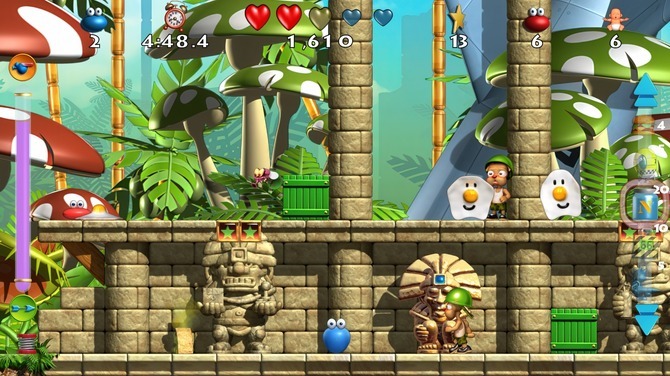
――In addition to 75 stages, this game is set to feature over 45 new enemies and boss battles. How will you balance the elements carried over from the original with the new content?
Cale: We view *Putty World* as a new title built upon the foundation of the original series. While the 75 planned stages are remakes, they are based on the original levels and their layouts. Those designs are an important part of Putty’s history, and we want to preserve that connection in a way that’s recognizable.
At the same time, we’re adding over 45 new enemies, whose behavior and abilities will present players with different challenges. We’re also introducing end-of-level bosses that players must defeat before reaching the exit.
Players who have played the game before will recognize the stages that inspired them. At the same time, the new enemies, boss battles, control scheme, and animations will give the game a fresh feel. We aim to create a richer and more diverse game while preserving the unique character of the original series.
――Please tell us why you chose the Nintendo Switch 2 as the platform for this game.
Cale: I feel that Nintendo hardware is a natural home for colorful, character-driven platformers, and Putty already has a history there. The Nintendo Switch 2 gives us the flexibility to pursue all the animations, expressions, and visual details we want, whether playing on the TV or in handheld mode.
Our development goals are a steady 60 fps, 1080p in Handheld Mode, and up to 4K when outputted to a TV. For me, a key challenge is how much vitality we can breathe into Putty and his surroundings while maintaining the responsiveness of the action.Facial expressions and the transitions when shapes change are just as important as resolution. Please note that these figures are targets we’re working toward as we continue development and optimization.
How Was the Name for the Japanese Version of “Patty Moon” Decided? Reflecting on Memories from the Super Famicom Era
――In Japan, the game was released for the Super Famicom in 1993 under the title “Putty Moon.” What memories do you have of its release in Japan at that time?
Cale: The release of Putty in Japan was a significant milestone for both me and System 3. A character born from home computer development in the UK had finally reached Japanese players on the Super Famicom.
Japan has always been very important to me. That’s because developers in this country have created so many wonderful titles, particularly in the realm of character-driven action games.
“Patty Moon” is part of Putty’s history. It makes me happy to think that people who first encountered him under that name might now discover “Putty World.” At the same time, we can’t assume that today’s players are familiar with the older titles. This game needs to be both a “return” and an accessible entry point.
――In Japan, it was given its own unique title, “Patty Moon,” rather than “Super Putty.” How was this name decided?
Cale: Since “Patty Moon” was originally part of the original Putty’s story, the name comes directly from the game’s world itself. Our publishing partner suggested, “Since that’s where the adventure takes place, wouldn’t ‘Patty Moon’ be a good title for the Japanese market?”
We liked the idea and agreed. It was a very straightforward decision. In Europe and other markets, we wanted to focus on Putty himself. His abilities—stretching, expanding, absorbing, and changing shape—made him a truly quirky character, so we wanted players to remember that name and personality.
Regarding the Japanese title, our role was to respect our partner’s insights into Japanese players while discussing and approving the choice.
――At that time in Japan, character-driven action games—led by Mario—had an overwhelming presence. How was System 3 influenced by Japanese games?
Cale: I’ve always had the utmost respect for Japanese games. Nintendo and Sega showed us just how much can be conveyed through color, movement, and character behavior. Mario is a clear example of how, through crisp visual concepts and precise interactions, a game can be understood almost instantly.
However, that doesn’t mean we wanted to turn Putty into someone else’s character; rather, it was an influence in terms of craftsmanship and approach.We were looking for our own sense of humor and our own way of playing. Putty’s elastic body made that possible. *Putty World* features not only the quirky charm unique to System 3 but also a loving homage to the legacy of Nintendo’s platformer genre.
*Putty Squad*: The Story Behind Its Free Release Nearly 19 Years After Completion
――*Putty Squad* has a curious history: the Amiga version was nearly complete, yet it wasn’t released to the public for many years. What was happening back then?
Cale: Looking back, I think it was a prime example of just how quickly the market surrounding a game can change. The Amiga version of *Putty Squad* was completed in 1994, and reviews had even been published. However, by the time it was ready for release, the Amiga retail market had effectively collapsed.We simply couldn’t get retail stores to stock new Amiga software.
Although it received a 90% rating and a Format Gold Award in *Amiga Format* magazine, the decision to shelve the release was purely a business one. While excellent reviews could prove the game’s quality, they couldn’t persuade retailers to support a platform they had already abandoned.
The Amiga version was ultimately released completely free of charge on December 24, 2013—Christmas Eve—as a gift to the Amiga community. This was approximately 19 years after the initial review. The fact that people still wanted to play it after all that time speaks to the enduring interest in Putty.
In *Putty World*, we want to give the characters, levels, and gameplay ideas from *Putty Squad* a place alongside *Putty* and *Super Putty*.
――System 3 has been developing and publishing games for over 40 years since its founding in 1982. Throughout that time, what has remained unchanged as the essence of game development?
Cale: It’s the need to make someone want to keep playing. It sounds simple, but that’s the true litmus test. No matter how technically advanced a game is, if the feel of the controls is off or if the player isn’t interested in what happens next, the game will fail.
Since founding System 3 in 1982, our tools and equipment have changed countless times. However, the need for a strong idea has remained constant. When it comes to Putty, I always return to the same practical question: Is it fun to move him and use his abilities? If that holds true, then there’s something valuable to build upon.
Feedback from TGS is being incorporated into development. We’re continuing to refine the game ahead of its Q2 2027 release.
――I understand that what’s being showcased at TGS 2026 is a very early-stage technical and graphics demo. Looking ahead to the Q2 2027 release, what aspects are likely to undergo the most significant changes?
Cale: The TGS build is a very early-stage, playable technical and graphical demonstration. While it shows the direction we’re heading, it’s neither the final game nor the full scope of the content. It also includes placeholder assets, so please keep that in mind when viewing what’s on display now.
As we look toward the planned release in the second quarter of 2027, the control scheme and the process by which players learn Putty’s abilities are key areas for refinement. We also still have work to do on developing stages, enemies, and bosses, as well as on animations, visual clarity, balance adjustments, and performance optimization.Our goal is to bring all of these elements together so that the final version is a cohesive and accessible experience.
――What kind of feedback are you hoping to receive from players and the media who try the demo at TGS?
Cale: We want to know where people intuitively understand the game and where they get confused. Can they discover for themselves what they can do with “stretch”? When the screen gets busy, can they figure out what’s happening? Is the control scheme helpful, or does it make simple actions unnecessarily difficult?
I’m heartened to see that previous hands-on articles have highlighted the game’s unique character and its quirky, ’90s-style humor. At the same time, the difficulty of mastering the controls has also been pointed out. At this stage, that’s useful feedback.
Of course, this feedback can influence our development—especially when it comes to the controls, explanations, and the clarity of actions. That’s precisely why we’re asking you to play these early builds.
――Finally, could you share a message for Japanese players experiencing Putty for the first time?
Cale: Putty has a history in Japan through *Putty Moon*. I’m really looking forward to introducing him to a new generation of Japanese players.
You don’t need to know anything about the previous games. The charm of Putty begins with discovering what this strange little blue creature is capable of. Try stretching him between platforms, inflating him, or turning him into a gel-like substance to engulf enemies. Experiment with his various abilities and see how he reacts.
In *Putty World*, his expressions and personality have expanded significantly, so getting to know him should be just as much fun as clearing the stages. Above all, we hope you’ll experience the retro feel unique to the Super Famicom era.
For those who remember *Putty Moon*, we hope you’ll feel like you’re reuniting with an old friend. And for those encountering him for the first time, we hope you’ll enjoy discovering why he’s remained so special to us for so long.
――Thank you very much!
*Putty World* is scheduled for release on Nintendo Switch 2 in the second quarter of 2027.
