


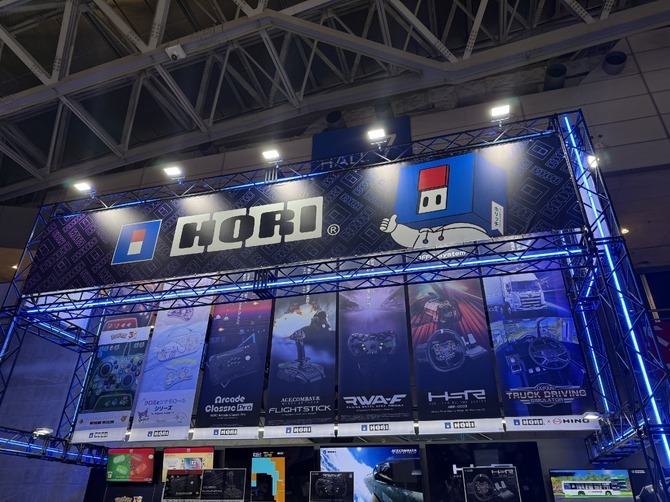
At the “Tokyo Game Show 2026” venue, there was one exhibit that stood out from the rest: the Hori booth.
Hori, well-known as a manufacturer of gaming peripherals, was showcasing something completely out of the ordinary alongside its controllers and arcade sticks: a full-scale driving simulator designed as professional equipment for driving schools and transportation companies.
I had the opportunity to try out this unique exhibit myself, so here’s my report on the experience.
“Games” to Address Labor Shortages

First, let me explain the background behind the development of this simulator. This is the most important part for understanding this product.
This simulator was planned and developed in response to the expansion of the acceptance of foreign workers with “Specific Skilled Worker” status into the motor transport sector. In the logistics industry, where labor shortages are a major concern, the question was: How can we train drivers from overseas? This “game” was created as one solution to that challenge.
There are two versions of the product: the “JAPAN DRIVER TRAINING SIMULATOR” for standard passenger vehicles, and the “JAPAN TRUCK DRIVING SIMULATOR” for heavy-duty vehicles, which we experienced this time. The vehicles you can drive range from standard passenger cars to medium-duty 4-metric-ton trucks, heavy-duty 10-metric-ton trucks, tractor-trailers, and even buses.
Furthermore, the development team is truly committed to this project. Hino Motors collaborated on the development to faithfully recreate the training vehicles using 3DCG. They provided comprehensive support—not only supplying vehicle data but also sampling engine sounds.
Furthermore, for the supervision of the embedded driving instruction, “Hanyu Motor School”—a designated driving school in Saitama Prefecture with expertise in logistics driver training—and “Tetra Shift,” a startup specializing in the development of driving education content for foreign nationals, have partnered. Together, they have fully recreated training exercises in accordance with the Japanese driving instruction curriculum.
Panels displayed at the booth showcased vehicles that fully replicate the practical training curriculum. It was also clearly stated that the system supports five languages: Japanese, English, Vietnamese, Chinese, and Indonesian.
Furthermore, the course for a practical skills competition—where the nation’s top professional truck drivers compete—has been faithfully recreated, allowing users to practice their skills without having to secure a training location or vehicles.
In other words, this is a genuine educational infrastructure created using technology from a gaming manufacturer.
Full-scale controls. This is truly “driving.”
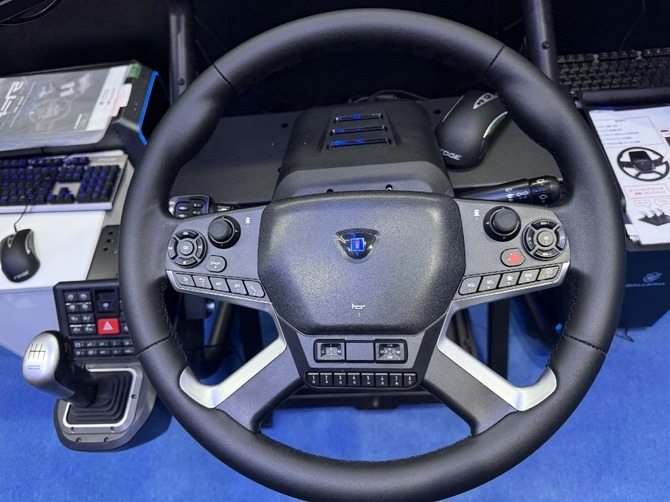
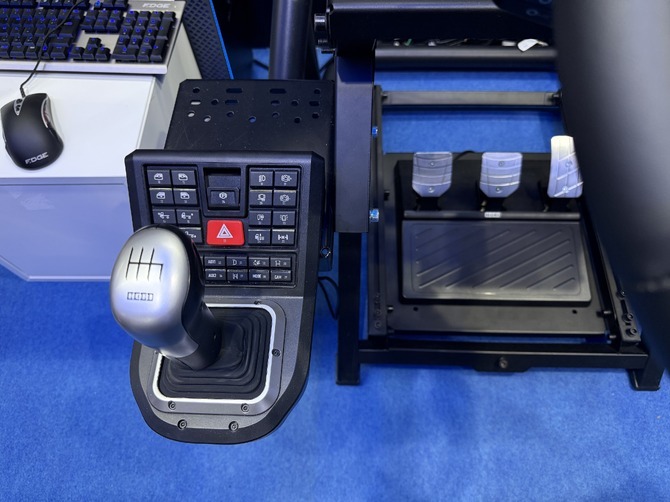
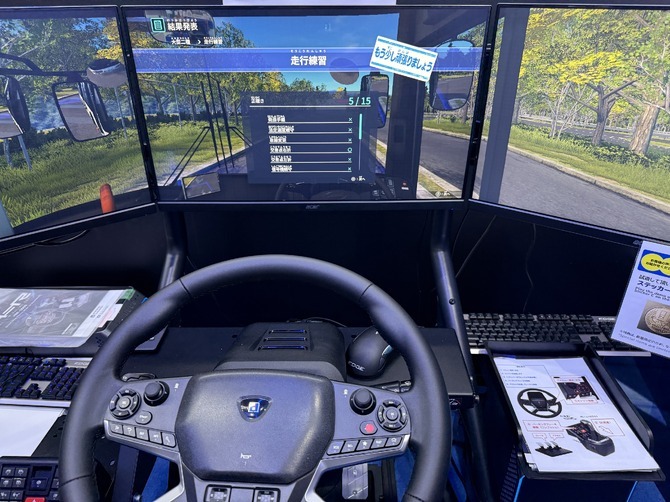
Let’s take a look at the cabinet. When you sit in the three-screen cabinet—which realistically replicates the driver’s seat (a laptop version with compact, condensed functionality is also available)—what appears before your eyes is a complete heavy-duty truck driving environment.
The steering wheel has a diameter of approximately 40 cm and a rotation angle of 1,800°, or two and a half turns to the left and right. It features force feedback.What’s particularly noteworthy is that this size is full-scale. When you actually grip it, the sensation is as close as possible to driving a real heavy-duty truck. Therefore, it differs fundamentally from racing game steering wheel controllers—starting with the way you move your arms.
The steering wheel’s spokes are lined with numerous buttons, and there are levers on both sides. You can operate the windshield wipers, turn signals, and even the retarder with the same feel as in a real vehicle. On the right-hand side is an H-pattern shifter and a switch panel featuring controls for hazard lights, the parking brake, and lighting. At your feet are three metal pedals.
HORI also offers a steering controller for truck simulators called the “HORI Force Feedback Truck Control System” (84,980 yen) for home users, which also features a 40 cm wheel, 1,800° rotation, and force feedback.It’s fascinating to see how the technology cultivated for the consumer market has evolved into a commercial-grade solution.

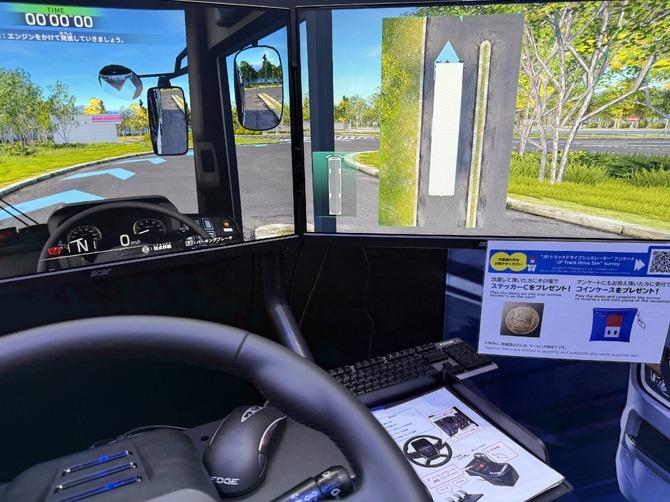
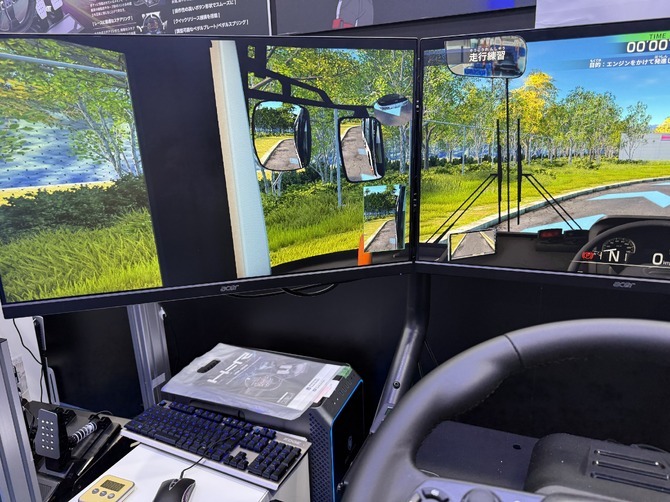
The display area is also meticulously designed: the three screens reproduce side mirrors and under-view mirrors, and an around-view window showing the vehicle from directly above is also displayed.
Furthermore, it includes a replay function so you can review your driving after a lesson, as well as a ranking feature based on accuracy assessments and time measurements for each training task.
Forgetting to signal, running a red light, or speeding—all of these result in a failure.
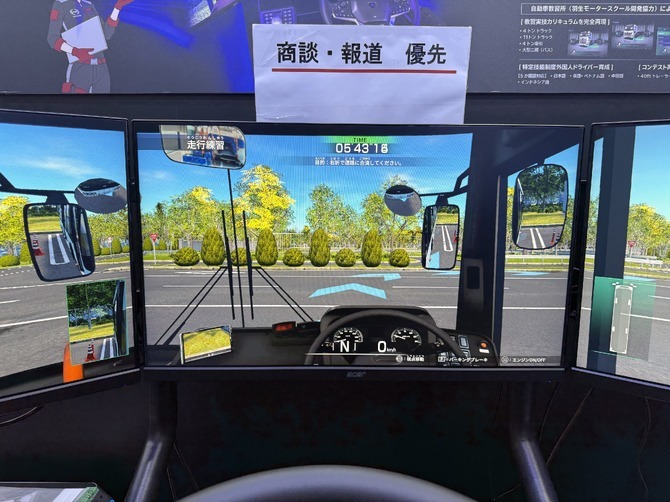
This time, I experienced driving a Toei Bus.
The screen displayed the words “Driving Practice” and the instruction: “Objective: Start the engine and begin driving.” …It was a driving lesson right off the bat. I started the engine, released the parking brake, shifted into gear, and gently pressed the accelerator. And the moment I started moving, the unforgiving reality began.
This simulator requires you to drive according to actual traffic rules. Forgetting to use your turn signal is a no-go. Running a red light is a no-go. Exceeding the speed limit is a no-go.
I know all this. I know it, but when my attention is focused on other things, it slips my mind surprisingly easily. By the time I realize, “Oh, I need to turn right next,” I’m already at the intersection—and I haven’t signaled. If I try to turn just for the sake of it, as if it were a game, I get called out on it immediately.
And then there’s the size of the vehicle. This was really tricky. Unlike a standard car, it’s large, so if you don’t pay attention when turning, you’ll easily run up onto the curb.Even if you understand the concept of the inner wheel difference in your head, unless the timing of turning the wheel and the way you widen your turn are second nature, the rear wheels will mercilessly scrape along the curb. You look in the mirror, assess the vehicle’s position, and only then realize, “Oh, I got too close just now.”
On top of that, there’s shifting. While actually shifting up with the controller, you have to look ahead, to the side, in the mirrors, at the speedometer… it’s just nonstop. One hand on the shifter, your eyes constantly darting between multiple points. I learned firsthand just how much information bus drivers process as a matter of course.
I can’t even count how many times I was told I was “breaking the rules” just by driving normally around the driving school course.
But that’s exactly why it’s meaningful.
What struck me most after the experience was this: “If I can do this smoothly, I won’t be flustered when I actually drive a large vehicle.”
Even if I drove up onto the curb, no one gets hurt and the vehicle doesn’t get damaged in the simulator. No matter how many times I’m told I forgot to signal, the only thing that gets hurt is my pride.
Conversely, this “environment where you can fail safely” is likely the very essence of driving simulators. Moreover, they require no practice space or actual vehicles, and allow users to repeat Japanese-style training exercises exactly as they are in five different languages.
The labor shortage in the logistics industry and the training of drivers coming from overseas—game peripheral manufacturers are tackling these challenges head-on with their own technology. Being able to experience this at an event like TGS was a truly rare opportunity.
At a gaming festival, I drove something that wasn’t a game and racked up a whole slew of traffic violations.
But once I tried it, it all made sense. The full-scale steering wheel—the same size as those in large commercial vehicles—the H-pattern shifter, the metal pedals, and the force feedback that conveys the road surface—all of these are the very technologies Hori has honed over many years for gamers. Now, they’ve become tools for training professional drivers.
“Is this how the technology of a company dedicated to ‘making games more fun’ connects with society?” As I walked away from the booth, I found myself thinking about that for a while.
Note that since “JAPAN DRIVER TRAINING SIMULATOR” and “JAPAN TRUCK DRIVING SIMULATOR” are titles intended for corporate use, there are currently no plans to sell them to individual consumers.However, I was told that if user buzz grows strong enough, there might be a possibility of releasing them as home console titles, so if you’d like to play them yourself, let’s keep the conversation going.

