


"Taro-kun Has Arrived" is a meta-horror game centered around a video left behind by "Taro," a missing streamer.
What players see are videos of Taro left on an underground video site. However, simply watching the videos won’t allow you to play them all the way through. You’ll need to look up any information that catches your eye in the videos online, then use the clues you find to watch the videos again… By moving back and forth between the videos and your web searches, you’ll uncover what happened to the missing Taro.
The game is developed by BeforeHomeWorks. Publishing is handled by “YAMI GAMES,” a game label launched by Yami Co., Ltd., which has developed various projects in the horror genre.
For this article, after playing the demo version of *Taro-kun Came In*, we interviewed Mr. Matsutake and Mr. T from BeforeHomeWorks, as well as Tsubasa Fujita from YAMI GAMES. We asked them about the origins of the game, their goals for the “meta-horror” genre, and the major redesigns that took place during development.
Furthermore, in the latter half of the article, we asked about the label’s future, including why Yami Co., Ltd. decided to venture into the gaming business and how YAMI GAMES approaches the creative vision of its developers.
――First, could you tell us how the game *Taro-kun Came In* came to be?
Mr. Matsutake: It originally started as a game we were making in our spare time, and we began development about three or four years ago.
Even back then, we had the core concept of “a small-time streamer trying to escape a cave” and the idea of “playing through videos uploaded to a video-sharing site,” and we built a prototype based on that.
After working on it for a while, we saw that Yami Co., Ltd. was holding an open call for game proposals, so we submitted our entry. That led to an opportunity to discuss the project with Yami, and we worked together to refine and develop the concept.
――In this game, there’s not only the first-person horror game portion but also segments where you investigate information scattered across the web. Could you explain the reasoning behind this dual-track game system?
Matsutake: There’s a “payoff” I wanted to save for the very end, but I felt that if I revealed that payoff right away, it would feel a bit abrupt to players who were just playing it as a standard first-person horror game. As a player myself, I didn’t think it would feel very satisfying.
So, I first established a structure where “the player is watching a video,” and incorporated a system where the player searches the web during breaks in the video.
By doing this, I wanted players to accept the final twist naturally and without feeling any dissonance, which is why I combined these two elements.
――This game is officially categorized as “meta-horror.” What does “meta-horror” mean to the development team?
Mr. Fujita: I was the one who decided on “meta-horror,” but it’s really about the metafictional aspects. It’s not just about the events happening within the game—there are also directorial choices and mechanics designed to threaten the players themselves as they play.
Being scared by what you see Taro doing is, so to speak, just one stage of the experience. As you progress through the game, the gameplay is designed to make you fear yourself even more.
So, this time, we deliberately categorized it as “Meta-Horror” to convey the sense of “metafiction horror.”
――In that sense, the official website also feels like it’s interfering with the player—it’s designed to resemble the video site Taro was using. Did you design it—including the website that exists outside the main game—as part of a single horror experience?
Mr. Fujita: As we were developing the game, once we had a fairly clear idea of the concept—that “Taro-kun Came In” was this kind of game—I decided to set up the website.
I thought it would be nice if players could easily have an experience similar to the main game through the website. I created a setup where players would go from a page modeled after a video-sharing site like YouTube to the actual website, and from there, their PC would gradually start acting strangely.
――So, does that mean the website outside the main game isn’t actually tied to the game’s mysteries themselves, but was created purely for promotional purposes?
Mr. Fujita: That’s right. It’s positioned as a tool to convey the concept of this title.
――I felt that the nature of the fear was quite different between the time spent actually watching the footage and playing the game in first-person perspective, and the time spent searching for information on the web. Is there anything you’re conscious of when switching back and forth between these two experiences?
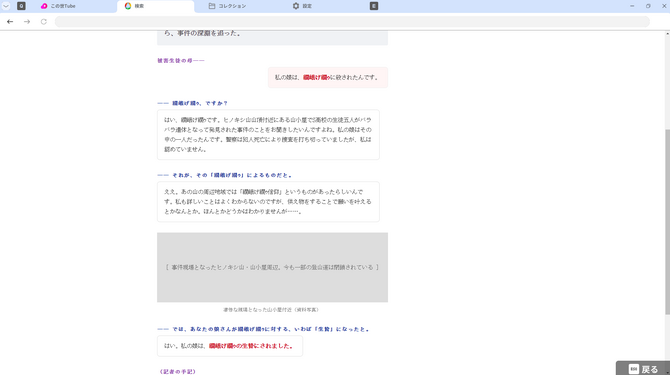
Matsutake: When players are watching the footage, we focus on creating a visual sense of fear. On the other hand, with the web pages, we aim for a sense of fear that comes from “realizing the meaning” or “thinking it through.”
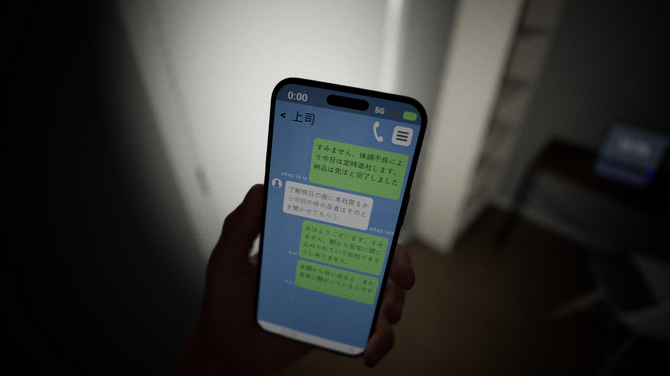
However, rather than treating the two parts as completely separate, we’ve incorporated interactions where information seen in the video becomes clear during the search segment, and conversely, information found in the search segment is explained within the video.
By emphasizing the connection between the two—so that viewers don’t perceive the video and search sections as independent—I strive to maintain a constant sense of tension.
Mr. T: In the search section, the player isn’t playing as Taro from the video; instead, the viewer in front of the screen is the one conducting the search. Therefore, we’ve recreated the look and feel of a real-world search engine to provide a more realistic search experience, with the aim of blurring the line between reality and the game.

――After the demo was released, were there any particularly memorable reactions from players, or any reactions the development team hadn’t anticipated?
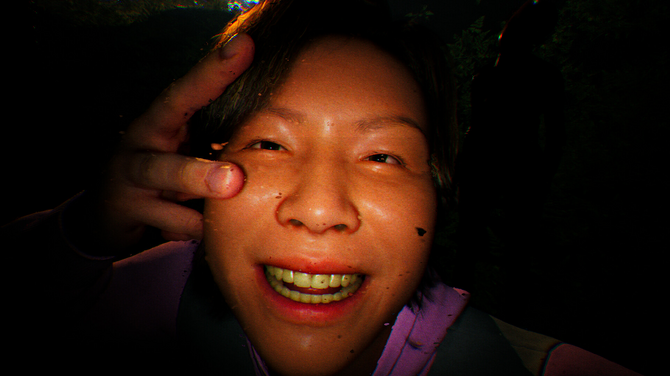
Matsutake: The fact that Taro-kun was surprisingly well-received.
We had envisioned a character who would be seen as more “annoying,” so we thought players might push back a bit (laughs). But he was surprisingly well-received, which really surprised us.
Also, a lot of people actually read the in-game text carefully. It made me realize, “People actually read this much,” so I felt we really needed to put more effort into crafting those details.
――You mentioned that Taro was accepted more than you expected—was that something the development team was happy about? Or did you actually want to make him a character who drew a bit more hate?
Matsutake: Originally, I really wanted him to go through some rough times (laughs). So, when players started to grow attached to him, I did find myself thinking, “Maybe I shouldn’t put him through too much.”
Still, I was happy that players accepted him—flaws and all—and I think that makes the moments when something bad happens even more shocking for them. So, in the end, I think it turned out for the best.
――Were there any particularly major obstacles or difficult aspects during the development of this game?
Matsutake: Compared to the prototype, the game design has changed quite a bit. Since we were essentially rebuilding it from scratch, it was quite challenging both in terms of the sheer volume of work and keeping to the schedule.
Mr. T: That’s right. I think the part about deciding “what kind of systems to build” for the reworks and newly added elements was definitely tough.
――Could you tell us a little more about how it changed from the prototype?
Matsutake: Pretty much everything. Conceptually, the core idea—"watch a video, play the game, and help the protagonist, Taro, escape from the cave"—remains the same.
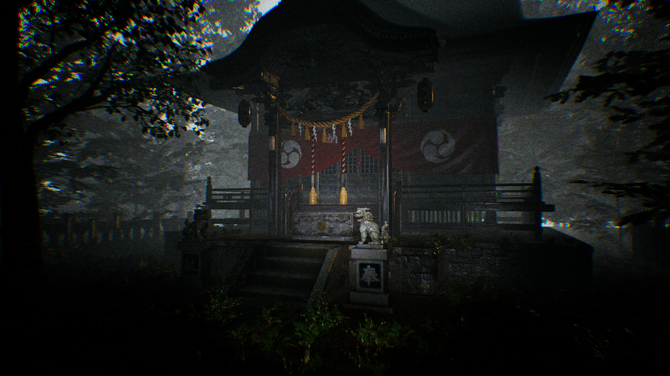
However, the “search segment” that’s in the current version didn’t exist at all in the prototype. We also completely redesigned the cave itself. We ended up reworking something we’d spent about half a year creating in just about 10 days, so it’s turned out to be quite different.
――Was that because you focused on the “punchline” you mentioned at the beginning and refined the game so it would flow naturally into it?
Matsutake: That’s right. Since the punchline itself came about after we’d already built the prototype, we thought, “How can we lead the story to that point without it feeling jarring?” As a result, we ended up making significant changes.
――While playing the demo version, there were some scenes where it felt like the visuals changed depending on the viewer. Is this a system where the route changes for each player?
Matsutake: As a game, the content doesn’t change significantly from player to player.
It’s purely a narrative device used to support the system—where players “search for and resolve issues they’re stuck on in the cutscenes.” However, as a minor stylistic touch, there may be slight differences from player to player, such as “something being there or not.” That’s about it.
Why Did YAMI Co., Ltd. Move into Gaming? “We Need to Properly Develop Our Own IP”
――Next, I’d like to ask about YAMI GAMES. YAMI Co., Ltd. has been involved in horror content in various forms, such as the web, video, and events. Given that, could you tell us why you decided to launch “YAMI GAMES,” a label dedicated specifically to games?
Mr. Fujita: As projects like the “Exhibition of Fear” and the “Exhibition of the Missing” gained a certain level of popularity, a sentiment emerged across the entire company that “we really need to start properly creating our own IP.”
When we talk about horror, it’s not limited to real-world experiences like events or haunted houses. There’s a solid market for horror movies, and of course, there’s a market for games as well.
There was a discussion about properly expanding into that area and building it into a business. Since I myself have a background in the gaming industry, I thought, “Maybe I can start by doing something on a small scale, like an indie project,” and that’s how it all began.
――When you joined the MBS Group in 2018, expanding into games and movies was already outlined as part of the company’s vision. Had the gaming business been in the works for some time?
Mr. Fujita: In that regard, since the founder himself champions “Horror Tech,” he’s long had a strong interest in the gaming business. In fact, we’ve previously worked on writing scenarios for mobile games and creating horror effects for console games, so we’ve always wanted to tackle this kind of digital horror content as well.
Gradually, the environment has come together to allow us to take on these challenges. At our company, this isn’t limited to games—it also includes horror movies and the AI business led by the founder himself. YAMI Co., Ltd. is now entering a phase where we aim to continuously sow various “seeds” in this way.
――“Taro-kun Came In” was developed by BeforeHomeWorks, and “Reporting, Communication, and Bereavement Syndrome” by Wizard Tortoise Games; all of the currently announced titles were produced by external development companies. Does YAMI GAMES place more emphasis on partnering with creators to release titles rather than developing them in-house?
Mr. Fujita: Rather than saying we “prioritize partnering with external studios,” we aim to determine the optimal structure based on the specific circumstances and the project at hand, so we can create and release games in the most appropriate way.
After all, we aren’t a production company specializing in games. Besides, I think the indie game scene is an environment where people tend to find works that reflect an individual creator’s vision “more interesting” than those that are highly polished from a commercial standpoint.
So rather than spending an enormous budget, I think we can create more interesting games by partnering with creators and artists who have compelling ideas. We decided to try this approach first, and that’s how we’re proceeding right now.

――In *Taro-kun Came In*, what specific roles do BeforeHomeWorks and YAMI GAMES each play?
Mr. Fujita: I primarily act as the publisher, handling publishing operations such as sales and marketing, as well as various related tasks. In addition, I provide advice on horror elements and offer guidance to ensure the game stays on the right track when viewed as a commercial product.
――I imagine YAMI Co., Ltd. has a wealth of expertise in horror presentation cultivated through events, the web, and video content. Is that kind of insight being incorporated into game development as well?
Mr. Fujita: I think I share whatever I can regarding “how to create something scary.”
However, what’s possible in events naturally differs from what’s possible in games. So, my approach is to offer advice aimed at improving the ideas the development team has—such as “We want to do this” or “We want to scare people this way.”
I’m not forcing them to do things by saying, “Please do this because it’s part of the YAMI style.” Rather, my approach is to prioritize what the creators want to do while offering guidance on how to make it even scarier or more unsettling.
――In other words, rather than pushing “the YAMI GAMES style” to the forefront, are you prioritizing the creators’ artistic vision?
Mr. Fujita: Basically, yes, and the “YAMI GAMES style” is something that will naturally emerge as our catalog of titles grows. That said, when we look at the game as a product, there are inevitably areas where we think, “We need to tweak this part a bit more.”
We communicate those points honestly to the two of them, and I believe the development team breaks them down and ultimately brings the game’s quality up to the required standard by the time it’s completed.
――Currently, titles are being announced for Steam, but do you plan to expand to platforms other than Steam, such as consoles or smartphones, in the future?
Mr. Fujita: I think that will be difficult unless we have a hit. However, since we’re now in an era where Steam allows us to deliver games worldwide, I believe we’ll focus on sales through Steam first.
――Finally, for Yami Co., Ltd., what do you consider to be the “kind of horror that can only be created through games,” as opposed to movies or exhibitions?
Mr. Fujita: I think it really comes down to “interactivity.” The fact that the game’s progression changes based on your own actions is something unique to games that you don’t see in horror movies.
The question is how to make that interactivity scary. I think that’s something we’ll need to be mindful of when creating horror games.
YAMI Co., Ltd. has ventured into the gaming business as a new frontier for creating its own IP. At the same time, YAMI GAMES takes a stance of respecting the individual philosophies and artistic visions of each creator, rather than unilaterally imposing the “YAMI style” on their works.
“Taro-kun Came In” seems like an intriguing title for understanding the direction YAMI GAMES is taking. I’m eager to see what kind of horror they’ll create next by utilizing the interactivity unique to games. I look forward to seeing how YAMI GAMES develops in the future.
“Taro-kun Has Arrived”
Steam: https://store.steampowered.com/app/4595220/
Official Website: https://gotaroukun.games.yami.net/
YAMI GAMES
Official X: https://x.com/YAMI_GamesDeath
© YAMI GAMES Co., Ltd.
