


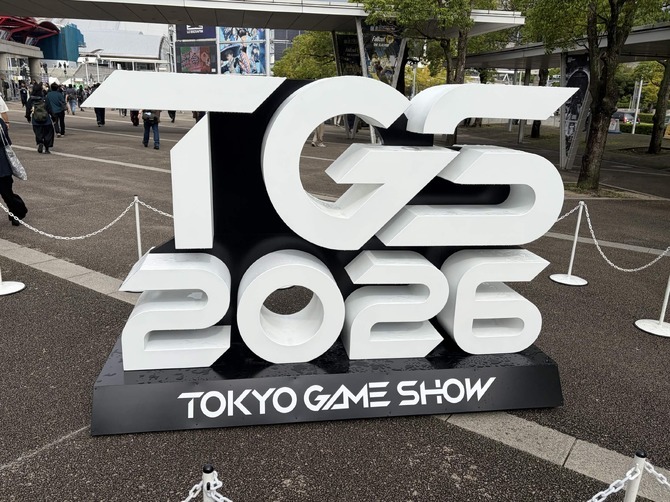
The “Tokyo Game Show 2026” was held at Makuhari Messe in Chiba Prefecture for five days, from September 17 to 21, 2026 (on the 21st, the on-site event was canceled, and only a livestreamed event took place). This year’s game show was once again a huge success, featuring a variety of exhibits and events.
At the D3 Publisher booth, a creator talk featuring Takaya Iijima was held on September 18.
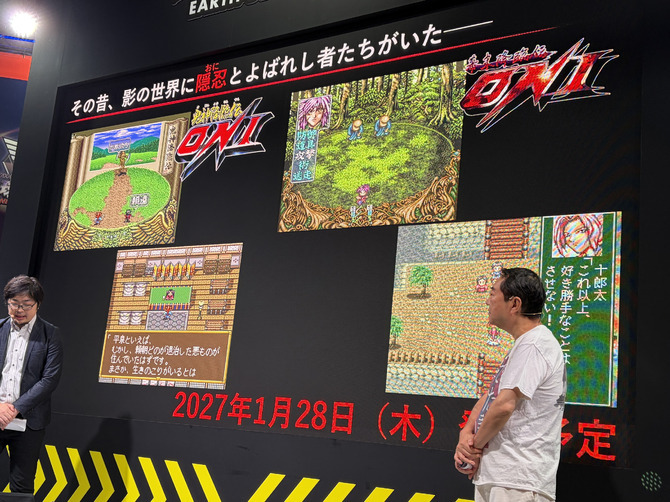
*Scary Stories from School*, released for the Nintendo Switch on September 10, 2026,*Tsukikomori*, and the announcement that seven titles—from *Oni Shinobi Kōmaroku ONI* to *Bakumatsu Kōrinden ONI*—will be re-released on January 28, 2027, Mr. Iijima shared his memories from that time and behind-the-scenes stories about the production. In this article, we’ll bring you a report on the talk show event!

Has CERO Changed With the Times?
The event began with Minami Shinohara serving as moderator, followed by a discussion between Takiya Iijima and Shunsuke Fujita, a producer at D3 Publisher. The talk kicked off with *Scary Stories from School* and *Tsukikomori*.
Regarding *Scary Stories from School*, Mr. Iijima noted that while the scenario hasn’t changed since its original release, by today’s standards it would be reclassified from “CERO B” to “CERO D.” He kicked off the discussion with a candid remark, suggesting that due to shifting compliance standards, the scenario might have even been rated “CERO Z” or shelved altogether.
Regarding production, since social media didn’t exist at the time of development, they apparently had to conduct all their research on foot. Reflecting on this, he remarked that in today’s era of readily available information, “the same scenario might never have been completed,” and emphasized that certain possibilities could only have emerged because of the circumstances back then.
He explained that aiming for “entertainment” is crucial in game development; it’s not enough to simply delve deeply into genres like horror or romance—it’s necessary to incorporate a variety of elements. The result of this approach was “Nozomi Kazama” from *Scary Stories from School*, and it seems that, as a game, scenarios spanning a diverse range of genres were created for each narrator.
The Meaning Behind *Scary Stories from School*
Regarding the meaning behind the “scary” in *Scary Stories from School*, he explained that the title does not refer to a collection of “the seven mysteries of the school” or “ghost stories associated with the school,” but rather to “scary stories you experience at ‘school.’” The concept behind the game’s signature system—featuring six narrators—appears to have been heavily influenced by Mr. Iijima’s own experiences as a student.
During his school days, Mr. Iijima often found himself sitting in a circle with friends—during school trips or training camps—telling stories in the style of the “Hyakumonogatari” (Hundred Tales). However, since it was an all-boys school, there were no love stories; the conversations usually turned to scary tales. He explained that if you could scare someone during these sessions, you became the hero of the moment. It seems this experience sparked his initial idea: “Wouldn’t it be fun to gather people who are good at telling scary stories?”
Mr. Iijima shared an anecdote about how he used to set up “staged moments” during ghost story sessions back in his student days. He would tell a story like, “I’m going to summon a spirit now,” and ask a friend in advance to react with “It’s here!” once someone noticed—a tactic he used to build excitement. However, at one point, even a completely different friend reacted with “It’s here!”—and he ended up experiencing a truly terrifying moment…
When asked about his favorite stories, Mr. Iijima cited three scenarios he’d wanted to write—“Murder Club,” “The Doll,” and “Hanako-san in the Restroom”—and shared his memories of each. Regarding “The Doll,” he also recounted a personal scary experience: ever since he was a child, whenever he was tired, he would sometimes see a doll out of the corner of his eye.
Regarding “Hanako-san in the Restroom,” he also explained that the story’s theme is “You never know when or where people are hurting others.”

Scenarios Not Included in the Original Release Now Featured as Limited-Edition Bonuses
As for the “Murder Club” scenario, the limited edition of the Nintendo Switch version includes a novel written specifically for this release by Mr. Iijima titled “Goodbye, Murder Club.”
Although this scenario had been in development since that time, he revealed that while the original publisher had no issue with “someone else killing the protagonist,” they deemed it unacceptable for “the protagonist to attempt to kill someone else.” As a result, although the two scenarios were originally intended to be released as a set, they could not be included in the game at the time; it seems this has now been realized in the form of a newly written novel.
Reflecting on the challenges during development, he recalled that debugging was particularly difficult due to the game’s sheer volume. There were even instances where a hidden scenario simply wouldn’t trigger no matter what they tried, forcing them to check every single flag. The strict storage limitations of the Super Famicom era—which led to the removal of elements like graphical shadows—actually ended up contributing to the game’s atmospheric appeal.
When asked if they had any actual scary experiences during development, Mr. Iijima commented, “Nothing happened back then.” However, it seems they did undergo a purification ritual. On the other hand, Mr. Fujita, who was involved in the port, reportedly experienced a frightening incident where the paper turned completely black when he printed out materials related to the game.
Furthermore, during the work on this port, various incidents occurred, such as Mr. Iijima suddenly losing his hearing the very moment he finished drawing the newly created “Goodbye, Murder Club,” and the producer suffering a heart attack.
“ONI,” a Japanese-Style RPG That Was Rare at the Time
The discussion then turned to the *ONI* series. The series began with the 1990 Game Boy title *Onin Shinobu Kōmaroku ONI*, and it was announced that the latest installment, *ONI Zero X (Cross)*, is scheduled for release in 2027.
In the past, Mr. Iijima served as the supervising editor for the book *Japanesque: RPG Fantasy Encyclopedia—Japan Edition*, which featured Japanese yokai and ninjas. Building on that, Banpresto approached him with the idea of creating a “Japan-themed RPG,” and it seems the *ONI* series was produced as a result.
The prototype was titled “Zanchi-hari,” with a plot in which the protagonist’s hometown, “Chi-hari,” was attacked, and he—the sole survivor (“Zan”)—sought revenge. However, since the character for “Zan” (meaning “remaining”) in the title was considered bad luck, it was changed to the current title, “ONI.”

Additionally, since he wanted to sell the game to children, he incorporated “transformation” mechanics and added elements from *Yōkai Ningen Bemu*, a series Mr. Iijima loves, which seems to have helped solidify the story’s direction.The resulting game, *Oni: Kōmaroku*, reportedly had “so-so” sales according to Mr. Iijima, but the enthusiasm expressed in the survey postcards was incredible.
The series also received high praise in game magazines published around the same time, but Mr. Iijima said he didn’t feel it was a major hit at the time. He seemed surprised by the huge response to this re-release and expressed his delight, saying once again, “I was able to create a game that stuck in everyone’s memory.”
The bonus is a never-before-seen, original novel titled *Zanchi-hari*!
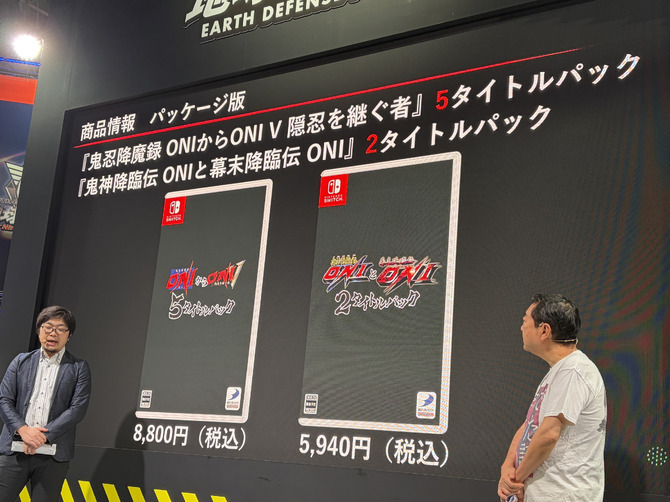
For this re-release, you can choose to purchase each title in the series individually, opt for a bundle containing the five Game Boy titles and two Super Famicom titles, or select a limited edition that includes all seven titles. The limited edition not only includes the original soundtrack but also a novel written specifically for this release by Mr. Iijima—and it was revealed that “Zanchi-cho” will be the bonus feature included in this set.
According to Mr. Iijima, this newly written “Zanchi-cho” is darker and more somber, and serves as the source material for the *ONI* series. Since it tells a story that no one has heard before, it looks set to be a bonus that series fans won’t want to miss.
Regarding development, Mr. Iijima—who had no choice but to conduct on-site research at the time—said he gathered materials by visiting bookstores in various regions. The most challenging part was his research at “Akame 48 Waterfalls,” a Shugendo pilgrimage site in Nabari City, Mie Prefecture.He shared a surprising anecdote about how he actually got lost while exploring the gorge lined with numerous waterfalls. It’s said that the harshness of that experience is reflected in the difficulty of the game’s maps…
Mr. Iijima also played *ONI II: The Legend of the Hidden Ninja* back then, and because it was so difficult, he proposed making it “easier.” However, the staff reportedly told him, “The president (Mr. Iijima) gave the order,” so the original difficulty was kept as is.Mr. Fujita mentioned that thanks to the new “save anywhere” feature and 3x speed option, even those challenging maps are now much easier to play.
He also shared anecdotes about how ideas—such as gimmicks involving the initial weapons—were born out of the struggle with storage limitations and graphical constraints during the Game Boy era. It was a talk show packed with content that delighted fans of the series!

When asked what he’d like to do now, Mr. Iijima commented that he’s thinking of issuing a kind of challenge—something that would make YouTubers and influencers scratch their heads and exclaim, “If they pull this off, we’re in big trouble!”
Finally, Mr. Fujita asked, “If you told your 30-year-old self that a game from 30 years ago is still being played today, what do you think he would say?” Mr. Iijima replied that he has always looked up to Doraemon as his role model, and just like Doraemon—who has been loved for so long—he would likely think, “Well, what about 50 years from now? What about 100 years from now?”
The talk show concluded with a message to the fans: “If you’re playing a game from over 30 years ago now and have thoughts on it—or if you say you want to play more—I think a sequel is possible, so please let us know what you think!”
