


I secured a press slot at gamescom after hearing that I’d get to see an “unannounced title” from Team17, the indie publisher known for *Overcooked* and *WARDOGS*—but when I found out that the title was *Worms: Galactic Tactics*, I have to admit, I was honestly a little stumped.
Even though the *Worms* series has been around for over 30 years, it’s by no means a major franchise in Japan. Add “Tactics” to the mix, and it seems like it would appeal to an even more niche audience. I’m not particularly familiar with the series myself, so I sat down at the demo station wondering, “Well, what kind of article should I write about this…?”
However, once I started playing while listening to the developer’s presentation, my impression completely changed. It turned out to be incredibly fun.
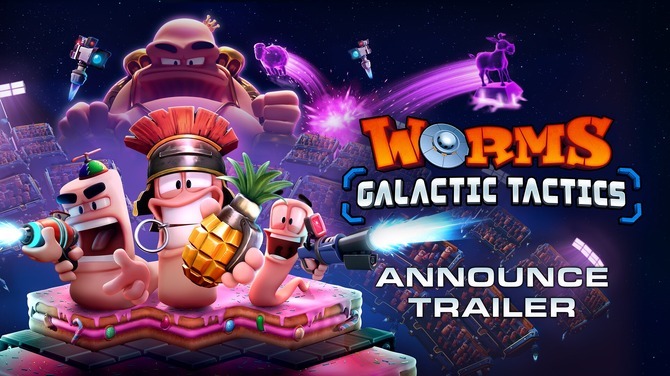
This title is a turn-based tactical roguelite developed by Absolutely Games. You assemble a team of three worms and strengthen your weapons and abilities as you clear stages.While the main focus is single-player, local and online 1-on-1 multiplayer is also planned. The developer is the studio behind the World War II-themed *Classified: France '44*, and reportedly, this project began when they pitched the idea of “combining their strategy expertise with *Worms*” to Team17 after finishing that game.
When people hear the word “tactics,” some might imagine a game where you have to level up units, gear them up, and spend a lot of time preparing before battle. However, based on what I’ve played so far, there’s almost none of that heaviness. Once you enter the battlefield, you can immediately assess the situation, think on your feet, and act right away. This “speed at getting to the heart of the action” left a very positive impression on me.
Strategy emerges *after* you destroy the terrain—and the battlefield never stands still
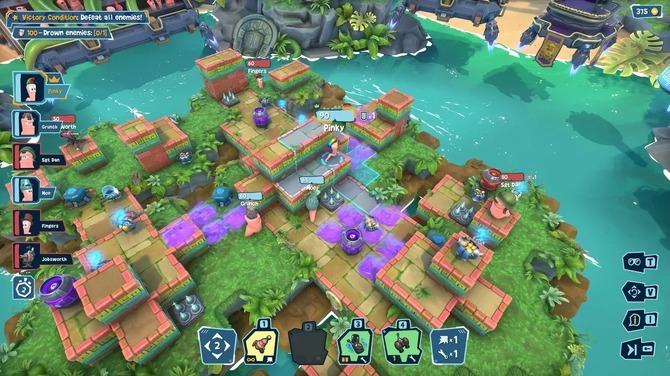
What felt particularly satisfying in this game was being able to use terrain destruction as a strategic tool in and of itself. You can cause extensive destruction to the map, and the state of the battle constantly shifts—including changes in elevation, the placement of explosives, and the positioning of footing.
During the demo, there was an enemy holding high ground. Just by looking at the screen, you can intuitively tell that the high ground offers an advantage, and it’s easy to spot areas that look like they could be collapsed with an explosion. So, I used a bomb to blow the enemy away, and as they fell from the high ground, they took additional damage.
So far, everything went according to plan. But what was really fun happened next.

Looking at where the enemy had landed, I realized, “Wait, I can take them down one more level.” So I used an ability to pull the enemy toward me, sent them falling even further, and dealt damage once more. I hadn’t planned this as a combo from the start; rather, after seeing how the battlefield changed with my first attack, I came up with the next move on the spot.
I think this is exactly where the game’s appeal lies. Rather than planning out the optimal solution from the start, your attacks change the terrain and enemy positions, creating new opportunities.Blowing enemies away with explosions, pulling them in, dropping them into danger zones, moving them near explosives—since you can strategize “after” the battlefield has shifted, combat never feels like simply checking off the answers to a puzzle.
And it’s not just the player who changes the battlefield. In the stage I played, water rose from below with each passing turn. Low-lying areas that were initially safe gradually became unusable, and the battlefield itself slowly shrank.
In other words, taking high ground doesn’t guarantee safety. You’re constantly faced with the reality that “even if it’s safe now, you might not be able to stay here in a few turns.”The development team also mentioned that when positioning your units, you need to consider not only the “current terrain” but also how the surrounding environment will change several turns down the line. While you actively destroy terrain to reshape the battlefield, you’re simultaneously being driven out by the battlefield itself as time passes. This dual layer of change makes combat quite dynamic.

Moreover, despite the complexity of the mechanics, the situation is surprisingly easy to grasp. You intuitively understand things like “high ground is strong,” “this area looks like it’s about to collapse,” or “I can knock this enemy off here.” While it does require a bit of thought, the enemies’ actions proceed smoothly, so I hardly ever felt stressed during the demo.
◆ Instead of “X% Hit Rate,” you land the hits yourself
The attack mechanics are a bit different, too. Rather than waiting for the result based on a “X% hit rate” like in typical tactical games, each weapon requires simple actions like timing your attack or charging. According to the development team, this is intended to preserve the feeling from previous *Worms* games where “the success or failure of an attack depends on the player’s own skill.”This adds a touch of action-oriented excitement to the strategy gameplay, which served as a nice spice.
What’s even more interesting is that even if you miss an attack, it doesn’t simply end as a “failure.” An off-target attack might hit another enemy or object, potentially triggering an unexpected chain reaction.
In fact, during my hands-on session, when I missed an attack aimed at a barrel, the stray shot hit another enemy. In an interview after the demo, the development team themselves cited this scene as an example, explaining that what makes *Worms* unique isn’t just the big successes, but also the unexpected failures and chains of coincidences.
I’m not an expert on the *Worms* series. Even so, I found the sheer chaos—with terrain crumbling, enemies flying through the air, and missed shots hitting something else, which in turn changes the situation—to be genuinely fun.
On the other hand, since using a weapon involves mini-game-style controls every time, I’m curious whether the repetition might feel a bit tedious during extended play sessions. It served as just the right amount of excitement during the short hands-on session, but I’d like to verify this point again in the full release.
◆ You’ll Grow Stronger by Leaps and Bounds Because It’s a Roguelite
The progression as a roguelike also had a good pace. You can use gold earned in combat to attach MODs to weapons and utilities, with a total of about 200 types available. Different upgrades are available for each weapon and utility.
Furthermore, there are other ways to use gold. While the run ends if your entire team is wiped out, if you’ve only lost one or two Worms, you can pay gold at the medical bay between stages to revive and heal them. This means you’ll have to decide whether to spend the funds you’ve earned on MOD upgrades or on rebuilding your team.
Since this was just a single playthrough, I can’t say how deep the build-customization system goes. However, it was great that there were frequent opportunities to upgrade, and even in a short time, I could really feel that “I’ve clearly gotten stronger than before.”You don’t have to spend a long time leveling up your units—you get noticeably stronger right in the middle of a run. Since this is a roguelike with resets, I found it really satisfying to be able to upgrade so aggressively.
The stages themselves aren’t completely fixed either. At this stage of development, there are about 60 to 70 types of handcrafted maps, and the order in which they appear, enemy spawn locations, and enemy compositions all change with each run. Rather than repeating the same strategy over and over, it looks like this will be a game where you devise your battle plan on the fly, based on the board and hand you’re dealt in that particular run.

◆ Easy to Get Into. But Definitely Not Shallow
My initial impression before playing—that “Worms Tactics might be pretty hardcore”—has changed significantly. The situation is easy to grasp, the basic advantages and disadvantages are intuitive, and enemy turns are fast. It’s quite accessible, and even people unfamiliar with tactics games should be able to enjoy it.
In fact, the development team has stated that while they want this game to be a lighthearted tactics title that’s accessible to anyone, they also aim to provide enough depth to entertain everyone from beginners to seasoned players.
But just because it’s easy doesn’t mean it’s shallow. How do you destroy terrain? How do you use the board after it’s been destroyed? Where should you move your enemies? How far will the magma rise in a few turns, and where should you be at that point? Even from this brief hands-on session, I got the sense that once you start thinking about it, there are endless possibilities for strategy.
And best of all, it’s not a game where only perfectly calculated moves are fun. Enemies might get blown away unexpectedly, or a missed attack might hit something else—and seeing those results makes you think, “Okay, let’s try this next.” Both planning and improvisation become part of your tactics. This feeling was quite refreshing.

In the end, partly due to time constraints but mostly because I was so excited for the full release, I cut the demo short. I figured I’d save the rest to play at my own pace after the game launches.
Before the interview, I’d been worrying about how to structure the article, but by the time it was over, I found myself thinking, “I’ll save the rest for the full release.”
In Japan, there are probably quite a few people who aren’t very familiar with *Worms* itself. But I think it would be a real shame to pass this game up just because you’re not familiar with the series. Whether it’s because tactics seem too difficult or because you’ve never played *Worms* before—before you rule it out for reasons like that, I hope you’ll at least keep this title in mind.
*Worms: Galactic Tactics* is scheduled for release in 2027 on PC (Steam), PS5, Xbox Series X|S, and Nintendo Switch 2.
