


From Friday, May 22, to Sunday, May 24, 2026, “BitSummit PUNCH,” one of Japan’s largest indie game events, was held at Miyako Messe in Kyoto.
In this article, we bring you a hands-on report and developer interview for *Replica Club √D*, selected from among the many distinctive titles on display.
A “playable movie” experience woven from a darkly beautiful world and TRPG-inspired card battles

“Replica Club √D” is a cinematic adventure game that captivates players with its unique world, brought to life through stunning illustrations.
The protagonist, Suzuno Kuretsuki, was living a peaceful life as the manager of Kane, a major Hollywood actor. However, from the night she stumbled into a nightmarish world known as the “Underworld,” her daily life began to gradually unravel.

As she moves between the glamorous theater district by day and the ominous “Dark Street” by night, Ryono encounters Dysphoria, a painter who bears a striking resemblance to Kane. And as the boundaries between worlds begin to blur, she finds herself drawn deeper into her own past and the hidden truths that lie within—.

One of the game’s key features is that the very way the story unfolds changes depending on how many times you play through it. According to the developers, the dialogue, cinematics, and choices within the game are designed to carry dual meanings; relationships you believed in during your first playthrough and words you took at face value will take on entirely different meanings during your second playthrough, once you’ve learned the truth.
During this hands-on demo, I was able to experience the opening of the story—where the worlds of day and night intersect—as well as a combat scene.

After meeting in the underworld, Suzuno and Dysphoria arrive at a dilapidated church. Waiting for them there are a macabre corpse adorned with flowers and a girl named Rose, who seems to know Dysphoria well.

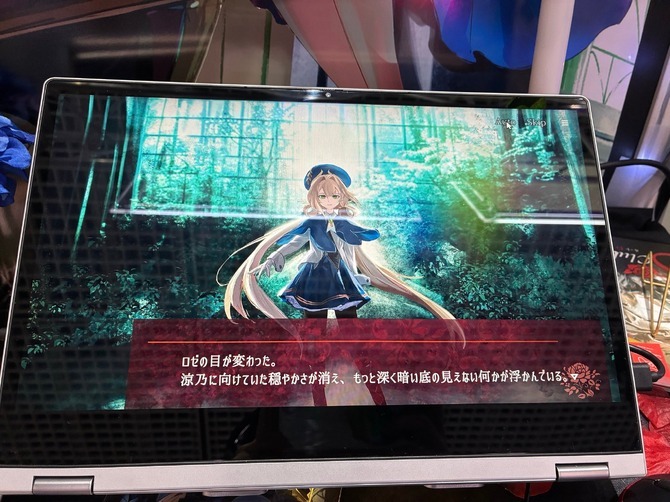
It seems there is a deep, unbreakable bond between Dysphoria and Rose. Here, the combat sequence begins against Rose, who harbors unusual feelings toward Dysphoria.

Rather than the typical command-selection system, this game’s combat employs a card-battle mechanic where players select cards to determine their actions. Another key feature is resource management based on two metrics: HP and SANITY (sanity).
Additionally, highlights include paint-themed elements that reflect Dysphoria’s identity as a painter, as well as striking cut-in animations. The game’s unique worldview is expressed not only in the story but also in the combat scenes, allowing players to enjoy battles that blend strategy with dramatic presentation.


Although the demo only allowed me to experience a portion of the story and a tutorial-style combat segment, I was told that the game incorporates a variety of elements, such as map exploration and psychological negotiations based on choices.
Although I only experienced a small part of the story this time, the game is packed with meticulously detailed character portraits, backgrounds, and beautiful still images, making it well worth seeing. The combat segments also feature cut-in animations, so even during this brief trial, I was able to enjoy a very immersive experience.The text also conveys the story’s atmosphere in every single line, making this a title you’ll want to sit down and enjoy at your own pace.
While playing the demo at the event, I suddenly found myself thinking, “I’d love to grab some snacks and juice and relax in my room while playing this.” Then I realized that feeling was very similar to the mood I get when watching a movie, and I couldn’t help but agree with the concept of a “playable movie.”
“Catharsis unique to games,” depicted beyond the boundaries of the visual novel genre
Next, we present an interview with the developer, mnts.
――Please introduce yourself and tell us what role you play in this project.
mnts: My name is mnts, and I’m the developer of *Replica Club √D*. While I occasionally receive advice from my mentor regarding the UI and programming, I’m essentially developing this game on my own.
――What are the roots of this game’s characters and world? Also, could you tell us why you chose to adopt such a unique game system?
mnts: I’ve been creating content since before I started making games, and the protagonist, Dysphoria, is a character I’ve been developing since that time. We’ve been together for many years now, so I’m personally very attached to her. However, judging by the reactions at events and such, it seems the enemy characters are actually more popular (laughs).
I’m also a fan of tabletop role-playing games (TRPGs), and I’ve been thinking about how to incorporate elements from the Cthulhu Mythos—such as negotiation, combat, and exploration—into an adventure game in a way that would be engaging. As a result, this game features a unique system.
――This game is based on the concept of a “playable movie.” Could you tell us about some films that have influenced you?
mnts: My favorite movie is *Dancer in the Dark*. It might be a film that divides opinion, but even though it’s a sad story, it really leaves a lasting impression.
I want players to experience that same sense of catharsis through the game’s story, so I think fans of that kind of film will enjoy this title as well.
――I hear there are multiple endings to the story in this game. Could you tell us what points you’d like players to pay attention to?
mnts: We’ve definitely prepared both a “true ending” and a “bad ending.” However, whether it’s a true ending or a bad ending is entirely up to the players.
Also, regarding the title *Replica Club √D*, I imagine many people are wondering, “What does the ‘D’ stand for?” If you play the game all the way through, you’ll definitely understand the meaning of the title, so I really hope you’ll see it through to the end!
――This game was selected for the 6th round of the “iGi.” What inspired you to submit it? Also, could you share how you felt when it was selected?
mnts: To be honest, I didn’t expect to be selected.It wasn’t so much that I applied with the goal of being selected, but rather, as I was developing the game, I began to feel the limitations of continuing to work on it alone. I thought that if there was an opportunity to receive support, I’d like to continue development with that help. Also, raising the game’s profile and finding a publisher were among my reasons for applying. With those hopes in mind, I submitted my application.
――Finally, please share a message for users who are interested in this title!
mnts: This title is often introduced as a visual novel, but personally, I’d be happy if people didn’t limit themselves to that category and instead viewed it as a work of art in its own right. I’ve also poured those sentiments into the concept of a “playable movie.”
I didn’t simply want to make a game; I chose the medium of games as a means to convey the catharsis I wish to express.I believe there are experiences that can only be created through a game—where elements like visuals, text, music, and direction intertwine—and I’m creating this with the hope of delivering a catharsis that can only be experienced through a game. I hope you’ll play it as a game, and I’d be delighted if you could also enjoy it as a work of art.
――Thank you very much!
“Replica Club √D” is scheduled for release on PC (Steam). Development is currently in full swing with the goal of releasing a demo before the end of the year. Add it to your wishlist and stay tuned for updates!


