


On September 22 and 23, 2026, “The Tenth Mosaic” was held at the Tokyo Franco-Japanese Institute.
This event, centered on the theme of video games—which have come to be known as the “tenth art” in Europe and the United States—features a variety of creators presenting their work.
At the event, Tetsuya Mizuguchi delivered a lecture titled “A 25-Year Journey and a Future That Continues,” in which he discussed the creation of *Rez*, and a panel discussion featuring various creators took place. Here is our report on the event.
*Photography was permitted at this event.


Tetsuya Mizuguchi on the 25-Year Journey of “Rez” — The Trajectory of a Challenge That Has Linked Games, Music, and Physical Sensations
At the start of his talk, Mr. Mizuguchi sighed thoughtfully, saying, “25 years, huh? That’s been a long time,” before recounting the story behind the release of *Rez*.

It all began with an experience in Zurich in 1997
Mr. Mizuguchi cited a street parade he experienced in Zurich, Switzerland, in 1997 as the origin of *Rez*.
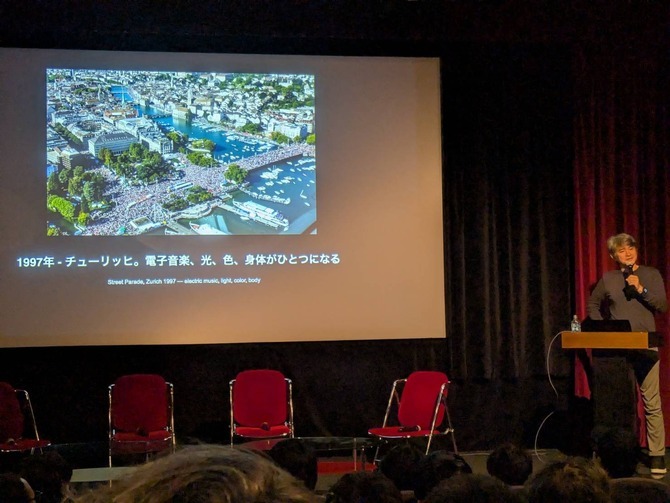
At the time, as many as 400,000 young people gathered in Zurich—a city with a population of about 300,000—and at night, approximately 150,000 people converged on the stadium. Witnessing a spectacle where electronic music, light, color, and people’s bodies became one, Mizuguchi said he was deeply moved by electronic music, a genre he had previously shown little interest in.
That experience reminded him of the painter Wassily Kandinsky.
Kandinsky was an artist who drew inspiration from music and expressed it through his paintings. Reflecting on this, Mizuguchi noted, “Even painters of the past visualized inspiration drawn from sound,” and revealed that he began to wonder, “Couldn’t we do something like that in games as well?”
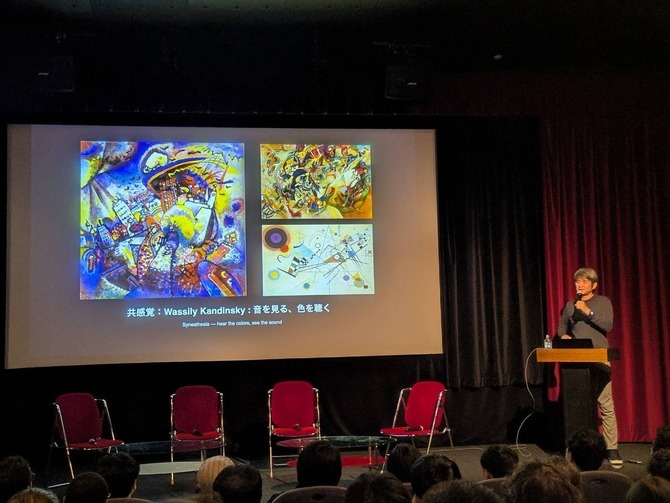
This concept later evolved into “K-Project,” which would eventually become the game *Rez*. The “K” is taken from the first letter of Kandinsky’s name.
“Where exactly does groove come from?”
He met Jun Kobayashi—who would later be appointed director of *Rez*—and the two conducted various experiments over the course of about a year and a half. They reportedly explored what kind of game this might ultimately become by projecting a demo onto a CRT television in which objects changed in sync with the sound.
Furthermore, he observed how people reacted to music by attending live taiko drum performances on Sado Island and visiting clubs in Shibuya at night.
As he watched people’s behavior—such as “when everyone raises their hands while listening to music”—Mizuguchi began to wonder, “Where exactly does groove come from?”
In his search for an answer, he came across footage shot in Kenya by Nobuhiko “ebizo” Tanuma, the sound director of *Rez*.

Upon witnessing the call-and-response structure found in African music—where sounds gradually build up until the performers eventually enter a trance-like state—Mizuguchi says he sensed a parallel with the process of constructing sound on a computer.
“Out of nothing, the first sound rings out, loops, multiplies, and begins to move. I wondered if I could apply this call-and-response structure to the game’s interactions.”
Turning “Shooting” into an Experience of Playing Music
This gave rise to the idea of transforming the act of “shooting” into the experience of playing music.
Mizuguchi viewed the act of shooting as a “primitive, percussive experience” and set out to link game input with musical rhythm.
Quantization played a key role in this.

By synchronizing the player’s sporadic inputs with the musical beat, he established “shooting” as the “call” and the sound that plays when an enemy disappears as the “response.”
Furthermore, rather than playing a sound the instant a button was pressed, he deliberately shifted the timing slightly to create a sense of musical pleasure.
However, we were concerned that players might get bored quickly if that were the only element.
So, we combined the satisfaction of playing percussion with the satisfaction of a DJ altering the track itself.
The combination of the satisfaction of playing percussion and the satisfaction of a DJ transforming the track itself created a surge of excitement, like riding an updraft.
“Through this experiment, I thought, ‘Ah, this is really going to work.’”
From Primitive Visuals to World-Building
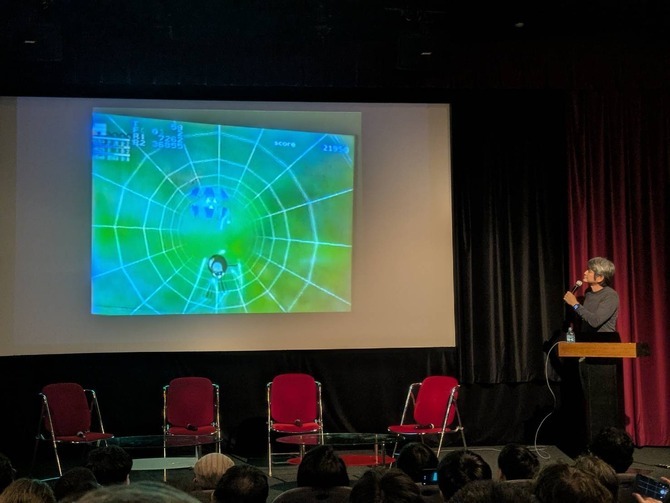
They say the visuals in the early stages of development were intentionally kept primitive.
By using simple shapes like squares and circles, they aimed to identify which elements of the game were influencing the player’s experience.
Mr. Mizuguchi shared an anecdote about how, when he told the art team, “Squares and circles are fine as long as possible,” they pulled a face—which drew laughter from the audience.
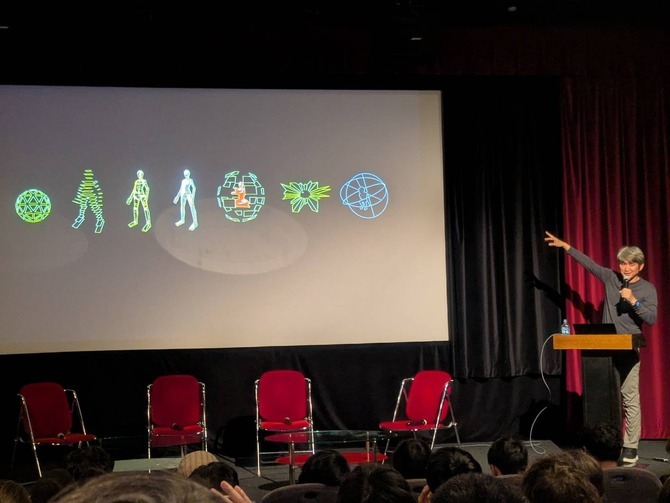
However, as the core of the game system became clearer, the game’s world was gradually fleshed out. Mr. Mizuguchi aimed for a setting that would tap into instinctive memories.
He linked conception to the computer world, where players, as white-hat hackers, would cure a computer world infected by a virus. This gave rise to the concept of the player character starting as an egg, evolving into a human, and then into a baby.
“Turn the hair completely white” in the pre-release live demo
Half a year before the game’s release, a live gameplay demo was showcased at a PS2 party. However, it seems this was an extremely nerve-wracking experience for Mr. Mizuguchi.
“I was so nervous that I dyed my hair completely white the day before, and decided that on the day of the event, I would just play the demo and leave without saying a word,” he recalls.
On the other hand, he recounts that Sony’s chairman told him, “‘Rez’ will change the relationship between games and music going forward.” He says he has never forgotten those words in the 25 years since.
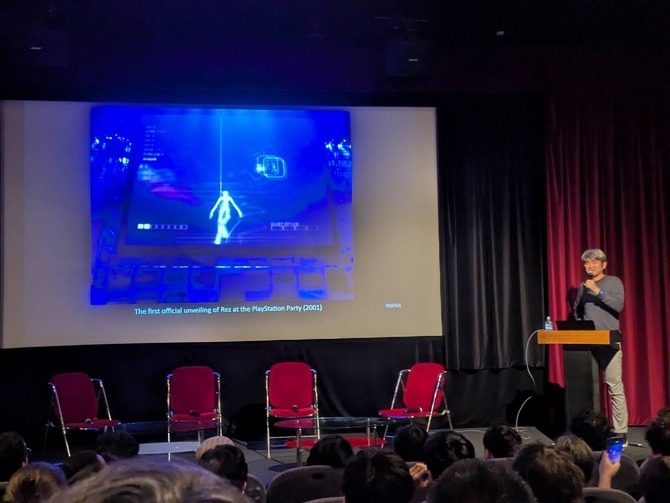
Then, in 2001, “Rez” was finally released.
In addition to the game itself, the “Transvibrator”—a device that allowed players to experience intense vibrations—was also released as a product, expanding *Rez* into a physical experience that went beyond the game screen.

From *Rez HD* to *Rez Infinite*
In 2007, *Rez HD* was released.
As high-resolution graphics became more prevalent, Mr. Mizuguchi, driven by a desire to preserve *Rez* for future generations, approached Sega directly. After securing a licensing agreement, his team handled the publishing themselves and brought the game to Xbox Live Arcade.
He has stated that he felt immense gratitude toward Sega for listening to a former employee and even granting him a license.
Then, in 2016, *Rez Infinite* was released.
Amid new technological environments—4K, 8K, and VR—the additional stage “Area X” was born from the question: “What kind of *Rez* is possible in this day and age?”

In contrast to the line-based visuals that symbolized the original *Rez*, *Area X* utilizes a massive number of particles. Furthermore, unlike the previous rail-shooter-style games, this title introduced a system where players can control their own craft.
The game also finally supports VR. Mr. Mizuguchi says that when he first experienced *Rez* in VR, “I couldn’t stop crying.”
What he felt there was “synesthesia”—a goal he had long pursued.
The game won Best VR at The Game Awards, and Mizuguchi reflects, “I was truly happy. It was very encouraging.”
From the very beginning of *Rez*’s development, Mizuguchi had been pondering the question: “What is an experience that never grows old?” One answer to that question was realized through VR.
The Exploration of Synesthesia Inspired by *Rez*
Mizuguchi also revealed an anecdote from his time at Sega: he once modified a Game Gear to create a VR-like device and played *Puyo Puyo* on it.
He mentioned that he even took this prototype to a board meeting, suggesting that he had been exploring VR and game experiences that engage the body’s senses since a time when the technology was not yet fully mature.
In 2017, he held “Rez Infinite Live with Ken Ishii” at the National Museum of Emerging Science and Innovation (Miraikan).
While Mr. Mizuguchi played *Rez*, Ken Ishii performed music live. It was an event that fused gaming and live performance, with the visuals changing in sync with the music.
Audience members took turns playing the game, presenting a new experience titled “Beyond Synesthesia.”
These experiments with *Rez* have been carried forward into Mizuguchi’s subsequent works.
This philosophy evolved through *Lumines* (2004), *Child of Eden* (2011), *Tetris Effect* (2018), and on to *Lumines Arise* (2025).

Furthermore, he is working on devices designed to let users feel music with their entire bodies, such as the “Synesthesia Suit,” equipped with 26 vibrators, and the “Synesthesia X1,” a chair for listening to music featuring 44 haptic devices.

In particular, the Synesthesia X1 has reportedly elicited intense reactions from those who have actually experienced it, with comments such as “It felt like I had died,” “It felt like I had been reborn,” and “It felt like I had gone to space.”
At the end of the talk, he expressed gratitude not only to Sega and the development staff but also to the game journalists who helped put into words the “sense of pleasure” he had created.
The creators behind *Rez* look back on 25 years—a discussion delving deep into interactive music
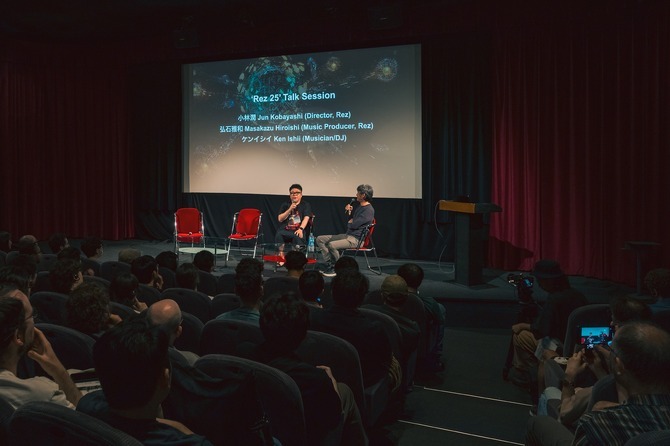
Following the presentation, a panel discussion took place featuring Tetsuya Mizuguchi, Director Jun Kobayashi, Music Producer Masakazu Hiroishi, and artist Ken Ishii, who provided the game’s music.
First, Mr. Mizuguchi called Mr. Kobayashi up to the stage.

Tetsuya Mizuguchi: It’s been a while. You’ve filled out a bit.
Jun Kobayashi: I’ve “rounded out” in more ways than one (laughs).
Tetsuya Mizuguchi: What was your reaction when you first heard about the K-Project concept?
Jun Kobayashi: I thought it sounded interesting.
I think I actually made a video back then. When I looked back at it, it was surprisingly close to the finished *Rez*.
It turns out I already had that idea—building up the music in tandem with the visuals—inside me.
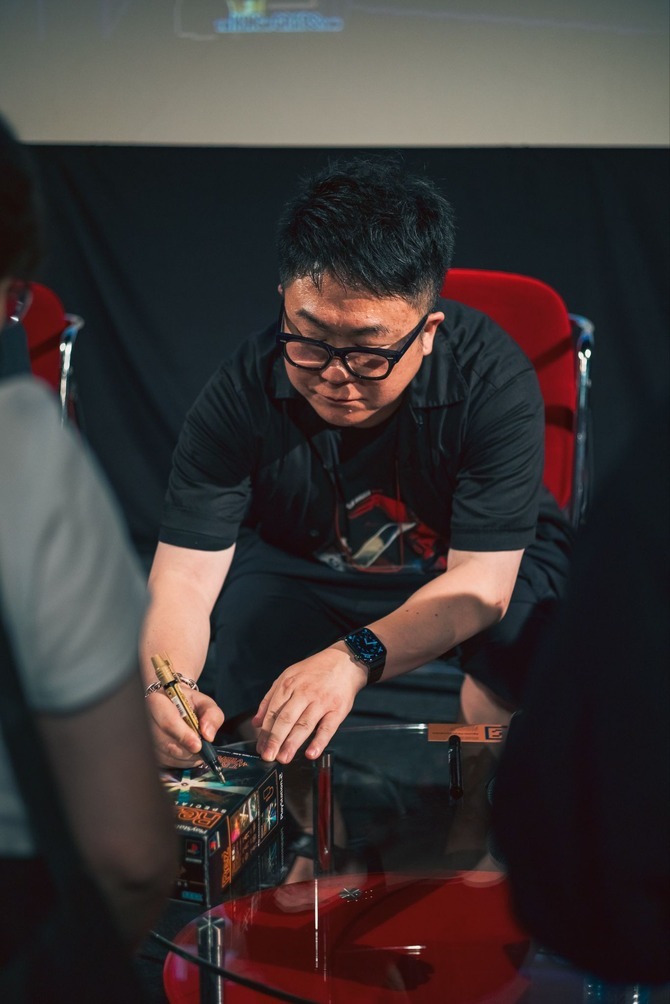
Tetsuya Mikaguchi: When we first started, there were just three or four of us, right? At a certain point, people joined us after finishing other projects, and the team started to grow.
Jun Kobayashi: At first, I was just making videos and showing them to Mr. Mizuguchi. When the programmers joined, it felt like the development stage suddenly leveled up.
Tetsuya Mizuguchi: Anyway, I was just telling everyone to “design something.” I was so busy I don’t even remember it. We were also working on *Space Channel 5* at the time.
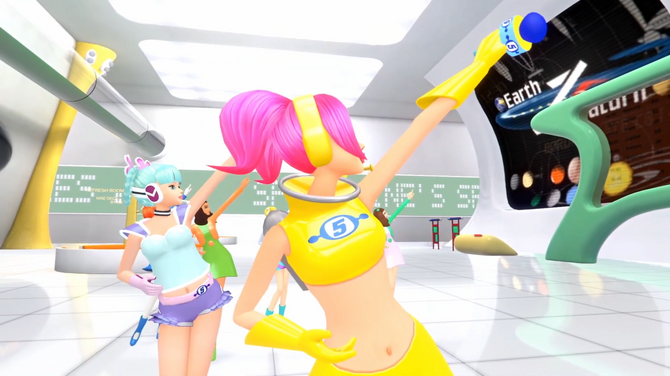
Jun Kobayashi: It was total chaos, wasn’t it? (laughs)
Tetsuya Mizuguchi: There was even a Nippon TV documentary crew on set…
I’ll say this now, but back then I thought, “If we keep going like this, we might not even be able to release the game,” so I wanted to bring in an outside perspective.
When it aired, I was like, “Huh?”—the development team didn’t look like they were having any fun at all (laughs). I was even getting angry for no good reason (laughs). In reality, things were much more laid-back.
But I think it’s because of that experience that we were able to pull it off.
Jun Kobayashi: It might have given us a push in the right direction.
Tetsuya Mizuguchi: Looking back now, my job was basically just waiting all the time. It was an era where even asking for a small favor took a long time.
While I was waiting, my imagination just ran wild…
Jun Kobayashi: Both the PS2 port and the transvibrator were rushed, weren’t they…?
Tetsuya Mizuguchi: I was the one who squeezed the Transvibrator into the game. Sorry about that (laughs).
Negotiations with Legendary Artists
Tetsuya Mikaguchi: Back then, when it came to music in games, everyone produced it in-house. It was rare to use outside artists. Maybe *Wipeout* was the only exception?
But we wouldn’t compromise on the music. So, the first person we consulted was Mr. Hiroishi. Now then, Mr. Hiroishi, please take the stage.
(Masakazu Hiroishi takes the stage)

Masakazu Hiroishi: Hello, I’m Hiroishi. Back then, I was releasing nothing but techno at Sony Music.
It was a turning point in the music industry. I was worried because the company’s structure was changing, but I received this offer at just the right time, so I quit and went independent.
Tetsuya Mizuguchi: I discussed at length with Mr. Hiroishi about what kind of artists would be best for *Rez*. First off, he said he wanted to work with Ken Ishii.
The names that came up at the time were Aphex Twin, Underworld, and Fatboy Slim.
Through Hiroishi’s introduction, I also spoke with Adam Freeland and Coldcut.
When Underworld was here for a live show, I went to their hotel to show them the project, and they said, “That’s interesting!” But they mentioned that the fact it was a shooting game was a bit of a sticking point…
Tetsuya Mizuguchi: As for Fatboy Slim, Area 2 was already finished. Up until three weeks before the release, we were planning to go ahead with that.
But suddenly, Sega’s legal department told us, “Apparently there’s a problem with that song.” It seems we’d sampled someone else’s music… I was almost in tears (laughs).
So I said, “I’ll do it!” and ebizo-san composed the music for Area 2 in just two weeks.
Masakazu Hiroishi: Yeah, that happened, didn’t it? (laughs). I was in charge of Aphex Twin back then.
He came to visit our office in London, so I gave him a presentation.

Jun Kobayashi: I was there too, and I played it for them. But the Dreamcast was so buggy—the hardware was making this screeching noise—so every time it happened, I’d apologize and start over.
But when Aphex Twin heard that glitch sound, he said, “That sound just now was cool…” (laughs). So I asked them to do it, but they didn’t deliver until the very last minute…
When I called on the very day it was due, they told me, “Sorry, we can’t do it.”
Tetsuya Mizuguchi: Ah, I’m starting to remember now. I was really on edge every single day (laughs).
Ken Ishii really is reliable—he works fast and does a solid job.
When I went to Zurich in 1997, there really weren’t any Asians at all. People would even stare at me in stores.
But whenever people struck up a conversation, they’d always ask, “Do you know Ken Ishii?”
I didn’t know anything about electronic music back then, but when I turned on MTV at the hotel, there was Ken Ishii playing. I thought, “This guy is amazing.”
An outrageous proposal: “Break it down to the level of a single note”
. After I got back, I met Mr. Hiroishi, and that’s how I ended up working with Ken Ishii. Now, let’s welcome Ken Ishii to the stage.
(Ken Ishii takes the stage)

Ken Ishii: I’m Ken Ishii, an artist. I’m still hanging in there somehow.
Back then, I was also providing music for other games, but I remember being told, “Break down every single element of the song.” They even asked me to break down the hi-hat and bass down to the individual note level (laughs).
Tetsuya Mizuguchi: Ah, I did say that. “I’m going to break it all down—is that okay?”
Ken Ishii: But if the player plays it well, it ends up sounding like the complete song in the end, doesn’t it?
As an artist, it felt like I was revealing my trade secrets, but when I saw the finished product, I thought, “So that’s what it was all about.”
At first, I did think, “Huh?” but since it was such a revolutionary game, the excitement outweighed that initial confusion.

Tetsuya Mikaguchi: If it had just been us, we probably wouldn’t have been able to explain the game’s concept to the artist.
In that regard, Mr. Hiroishi was a great help.
Masakazu Hiroishi: It was my job to explain it, wasn’t it?
Tetsuya Mikaguchi: We went to Adam Freeland’s house in Brighton, and after Mr. Hiroishi explained it to him, he said, “Okay, I’ll do it.”
Even back when we were working on Coldcut—and he was already a heavyweight in the music industry—he actually mentioned “synesthesia” himself during our conversation. I thought, “This is someone who really gets it.”
Masakazu Hiroishi: Since Coldcut had been doing cut-and-paste in British clubs since the ’80s, when I heard the concept for this project, I immediately thought, “Coldcut would be a perfect fit.” Techno is music that’s built up from individual parts, isn’t it?
Ken Ishii: Right, it’s like putting together a sequence in a video game.
Masakazu Hiroishi: It’s like the player is remixing it.
Interactive Music and Its Influence on Subsequent Music Production
Tetsuya Mizuguchi: I’d like to ask Ken Ishii—after working on *Rez*, did your approach to creating interactive sound change at all?
Ken Ishii: When I’m making music on my own, I try not to listen to other people’s music, but in games, everyone has a different idea of “how I’d shoot if it were me,” don’t they?
So I started to think there might be a certain joy in leaving it up to others… and that’s when I began to enjoy remix contests as well.
Back then, every artist still had that mindset of, “This is my work,” right?
But I reached a point where I thought, “Maybe it’s okay to let others touch it—I might gain new insights.”
Tetsuya Mizuguchi: Things have really changed over the past 25 years, haven’t they?
Ken Ishii: I think with music today, rather than crafting each note individually, what’s required is a sense of how to select parts as a whole.
And then, I have to make sure AI doesn’t take my job away (laughs).
But in the end, it all comes down to taste. That’s the one thing we have to make shine.
Masakazu Hiroishi: My company, UMA (United Music Arts), has also been around for 25 years.
Tetsuya Mizuguchi: Congratulations. How do you view the music scene, Mr. Hiroishi?
Masakazu Hiroishi: I think it’s all part of a continuous flow.
For example, teenagers listen to music online, and they don’t listen to it in chronological order. Their mindset is simply that good music is good.
I feel that the children of the generation that was around when *Rez* was released will be the ones to create new things in both gaming and music.
This was followed by a Q&A session.
――When you’re making games yourself, there are times when the game’s fast response time clashes with the music’s groove. How do you handle that?
Tetsuya Mizuguchi: I know exactly what you mean.
Jun Kobayashi: It basically comes down to quantization, right? In *Rez*, we adjust the timing between locking on and firing.
That said, it might be difficult in action games.
Tetsuya Mizuguchi: When the number of sounds increases, it fills up the space between them. It ends up feeling like you’re pouring ketchup all over it (laughs).
In that sense, leaving that space between the call and response might have been a stroke of genius.

Tetsuya Mizuguchi: We continued to experiment a lot after that. In *Child of Eden*, we incorporated organic sounds and vocals.Also, according to what I heard from the staff, *Tetris Effect* and *Lumines* have different numbers of sounds. *Tetris Effect* has fewer sounds. Basically, when there are a lot of sounds, the design becomes more difficult.
Ken Ishii: Dance music is often played at full volume, but actually, the body moves more naturally to music with fewer notes.
It’s pretty hard to get your body moving to a symphony, isn’t it?
――What do you think is most important for artists moving forward, both in music and in gaming?
Ken Ishii: I think it’s about how well you listen to other people’s music and then blend your own style into it.
I think it’s wonderful when something just pops out of the experiences you’ve had so far.
In short, it’s about whether you can bring out a unique flavor that only you possess.
Masakazu Hiroishi: At my company, we encourage the use of AI. However, I tend to give such specific instructions that my subordinates end up pointing out, “Aren’t you using AI too much?” (laughs).
These days, we’re seeing works that have a distinct “AI-like” quality. That’s precisely why I think we’re entering an era where an artist’s own uniqueness will really shine through.
Jun Kobayashi: Now that we’re in the AI era, I feel like we’ll see more games like *GTA* going forward, and I think it’s becoming harder to produce the kind of edgy, avant-garde works we saw in the 2000s.
Tetsuya Mizuguchi: I can’t predict the future. There are plenty of things that “look the part.” But what comes after that “look” is often lacking.
I think what matters is how you can turn those missing elements into your own signature. We have no choice but to keep doing what AI can’t do.
I still believe AI doesn’t understand things like intuition or experience. In the end, I think the only things that really resonate are the ones that hit you right in the heart.
Though if AI starts creating that too, I might run out of things to do (laughs).

The 25-year journey of *Rez* has also been a history of challenges to connect games, music, and physical sensation.
At its core lies a quest for “pleasure” and “experience” that never fades, no matter how times change.
Even now, as we enter the age of AI, Mizuguchi and his team’s journey continues in search of sensations yet to be discovered.



