



The "Tokyo Game Show 2026" is being held at Makuhari Messe for five days, from September 17 to 21, 2026.
Kodansha Game Lab, the gaming division of Kodansha Creators Lab, has set up a booth at the venue, showcasing a wide range of titles currently on the market and those scheduled for future release.
In this article, I’ll introduce two titles from among them that I actually got to try out and found particularly intriguing.
"High-Priced Theft"
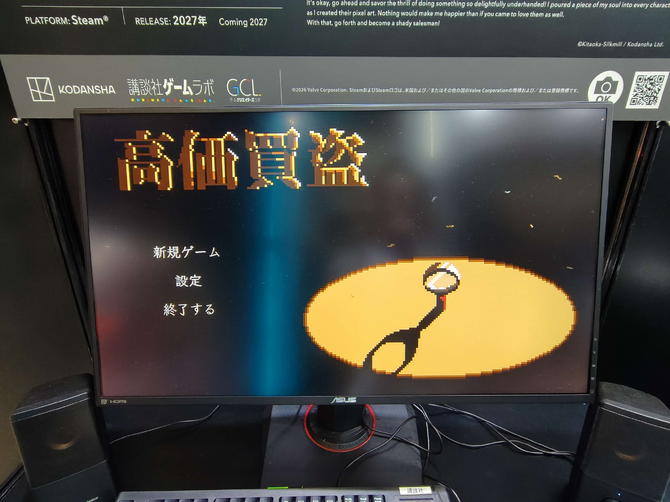
*High-Priced Theft* is an “immoral antique dealer adventure” developed by Shirukumiru Kitaoka. It is scheduled for release on Steam in 2027.
You play as an antique dealer. You appraise and purchase items brought in by customers, then resell them to make a profit—but in this game, simply appraising items correctly won’t lead to significant profits.
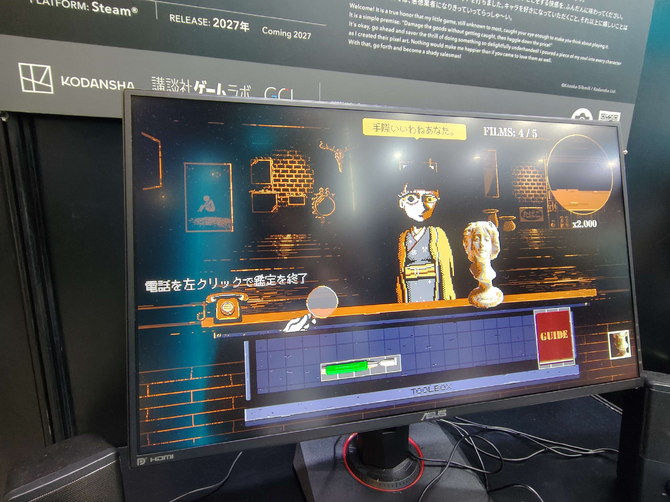
That’s where the game’s signature “fabrication” system comes into play.
You’ll wait for the customer to look away, then use tools like a chisel to deliberately damage the item yourself—and use that damage as an excuse to lower the appraisal value and buy it at a lower price.
Of course, if you damage an item brazenly right in front of the customer, you’ll get caught. It’s similar to the game “Red Light, Green Light”—you need to carefully time your “fabrication” while making sure the other person isn’t looking.
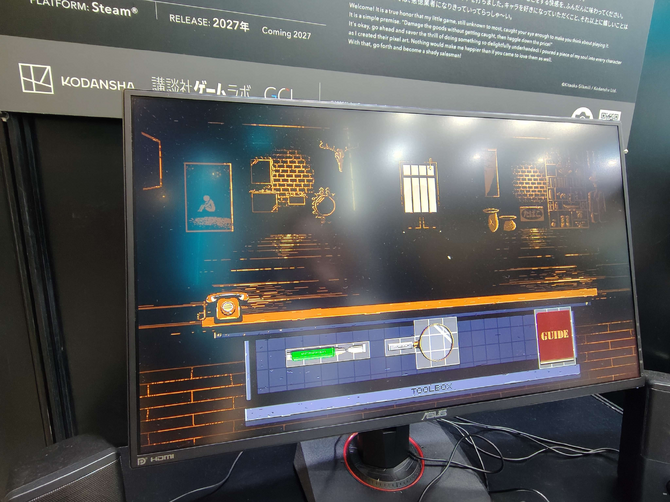
Although I wasn’t able to try this during the demo, if you successfully haggle the price down and make a profit, you can use that money to purchase new tools on the black market. The tools start out as simple as a chisel but eventually escalate to power drills and saws—and the fact that the more money you make, the more extreme your tactics as a unscrupulous antique dealer become is part of the game’s unique appeal.
Hearing this, you might think the protagonist is a complete crook. However, there’s a reason she needs the money.
The story is set in the fictional era of “Taishō.” The protagonist is a young girl whose everyday life was shattered by war and who now lives and works at an antique shop run by her relatives.
She once had to part with the piano she cherished dearly just to survive. But when she learns that the piano is being put up for auction, she thinks, “If I can get the piano back, maybe I can regain the everyday life I lost.”
To that end, she chooses to make money by deceiving customers.
What I found interesting during this demo was that you didn’t necessarily have to damage the items. You could choose not to commit any wrongdoing and simply proceed with the appraisal and transaction as is.
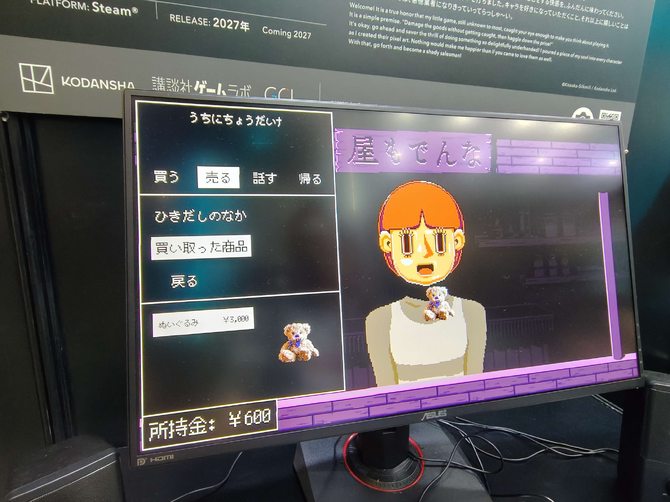
In other words, the extent to which you’re willing to get your hands dirty to achieve your goal is, to a certain degree, left up to the player’s own conscience.
I was also very impressed by the pixel art with its muted color palette and the game’s atmosphere, which somehow evokes a sense of humidity.
Although the gameplay is different, it reminded me of titles like *Papers, Please*—where you’re challenged to consider your own ethics while performing your job—and *Coffee Talk*, which creates a unique atmosphere through pixel art and dialogue.
This isn’t merely a “shady businessman simulator”; it’s a game that confronts players with the question: “How far would you go—how much of a villain would you become—to achieve your goal?”
How far would you be willing to go to get back what’s important to you?
*Legacy Code*

*Legacy Code* is a physics simulation game developed by Room 127. It is scheduled for release on Steam in 2027.
And if I had to describe this game in one word, it’s simply a work that’s utterly free and utterly unpredictable.
Do you remember when you were a kid, forcing together completely different toys to create “the ultimate toy I imagined”?
“Legacy Code” is a game that takes that very form of play and turns it into a fully realized, serious game. Players control a mysterious creature called a “Mechanimal.”
You can freely combine all sorts of things—from body parts like heads, arms, and legs to doll heads, character figurines, electric fans, TVs, dentures, chains, cacti, and everything in between—ranging from organic materials to inorganic objects—to create your very own Mechanimal.
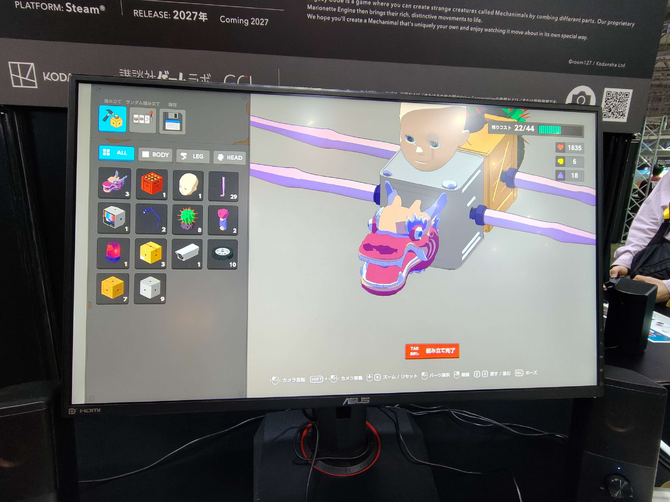
For example, you could attach arms in place of legs to a cardboard-like torso, place a baby doll’s head on top, and even equip a cactus as a weapon—creating combinations that defy common sense.
Since the movements are generated based on the shape and arrangement of the parts, even the creator won’t know how the finished Mechanimal will walk or how it will rampage until they actually set it in motion.
When the Mechanimal I created started moving sideways, a “?” popped up above my head…...
Sometimes you’ll end up with a powerful Mechanimal that turns out exactly as intended, while other times it will start moving in strange ways you could never have imagined just by looking at it. However, it’s precisely this “unpredictability” that makes the game so much fun—and I felt it was the game’s greatest appeal.
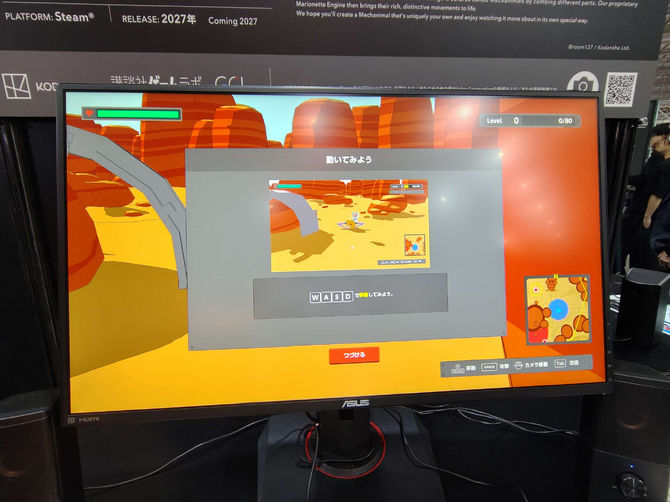
The basic game loop consists of a repetition of “Build,” “Fight,” and “Collect.”
You battle other Mechanimals with the one you’ve built to earn experience points and new parts. You then use those to reconfigure its body, evolving it to become stronger and larger.
While this hands-on demo focused primarily on Mechanimals creation and combat, according to currently available information, the full release will also feature a story in which the player becomes a Mechanimal and sets out on a journey with companions to discover their “true self.”
My impression is that this game combines the *Spore*-like freedom of creating lifeforms with the raw feel of evolution and combat found in *Animal Boss*, all while adding the unpredictability of physics-based simulation.
It has the depth to accommodate not only the idea of “creating something cool” but also the desire to “just make something huge, strange, and somehow powerful.”
Additionally, this title won two awards—the “Best Technological Game Award” and the “Best Arts Award”—at the indie game contest “SENSE OF WONDER NIGHT 2026,” held during the Tokyo Game Show 2026.
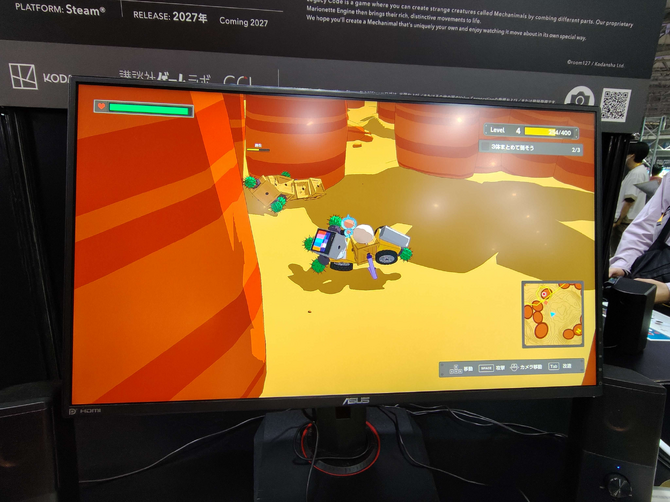
*Legacy Code* lets you fully unleash your free-thinking and, at times, almost terrifying imagination.
If you want to break free from the “proper way to play” found in existing games and create your own bizarre creatures to run wild with, this is a title you definitely won’t want to miss.

