


On Thursday, October 22, 2026, the Nintendo Switch 2 version of *Fatal Fury: City of the Wolves* (hereinafter referred to as *CotW*) will be released.
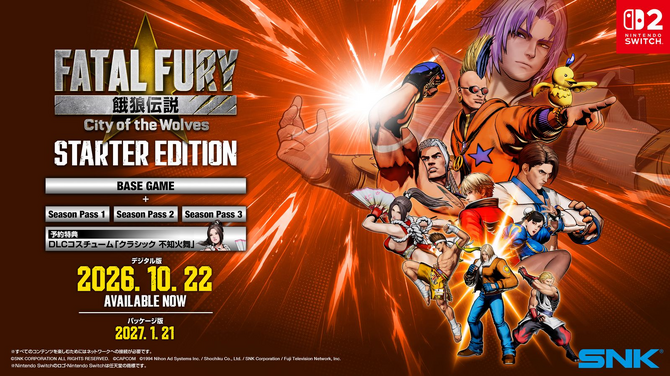
Released in 2025 as the first new entry in the series in 26 years, *Fatal Fury: City of the Wolves* has already gained immense popularity, and the currently ongoing Season 3, “DESTINED FOR REVENGE,” continues its astonishing streak of “new character releases every month.”
In addition to nostalgic characters, the introduction of collaboration characters—including Draken and Mikey from *Tokyo Revengers* in October and Reina from *Tekken 8* in December—has also generated significant buzz.
In this report, we cover the media tour held at SNK’s Osaka headquarters, where *Fatal Fury: CotW* is being developed. In addition to rare glimpses inside the company, we bring you interviews with the developers that revealed one behind-the-scenes detail after another.
Touring SNK Headquarters: From the Latest Motion Capture to Nostalgic Guitars
So, we arrived at SNK’s headquarters in Shin-Osaka. Right at the entrance, there’s a display area featuring posters and figures from past titles, as well as a Neo Geo console—a sight sure to make any fan’s heart race—giving you the full “I’m at a game company!” experience.


Having just relocated in 2023, the office features a striking, brand-new interior that’s full of playful touches, with game packages and arcade cabinets on display everywhere. Even the conference rooms are named after iconic SNK characters like “Haohmaru,” “Iori,” and “Geese,” and their interiors are themed to match—a touch that’s truly unique to SNK.


And during this office tour, we were even able to see the areas where actual development takes place. First, we toured the motion capture studio.
This studio is right in front of the lobby—and believe it or not, this area used to be the entrance. That’s why there’s a massive LED monitor there; it’s used for reviewing footage.

The studio is equipped with 44 high-performance cameras, making it one of the top-tier motion capture studios. It’s actually being used in the development of *Fatal Fury: CotW*, enabling more lifelike, “high-resolution” action.Of course, there are also many scenes that utilize hand-drawn animation for superhuman movements unique to games, and by combining these techniques, a wide range of expressions is made possible.
Since they’ve reportedly begun using this technology not only for *Fatal Fury: CotW* but also for other titles, you might find yourself wondering, “Was this motion captured at the Osaka headquarters?” when watching future SNK titles.

Next, we toured the sound studio. Comprising a debugging room, a recording booth, and a control room, this facility serves as the true hub of SNK’s sound production—handling not only in-studio recordings but also remote sessions with locations in Tokyo and overseas.


In addition to musical instruments and audio equipment, the studio houses a wide variety of props for foley sound production. We were even treated to a surprising behind-the-scenes story: “The sound of Kyo Kusanagi’s jacket rustling has been recorded using the exact same outfit the entire time.”

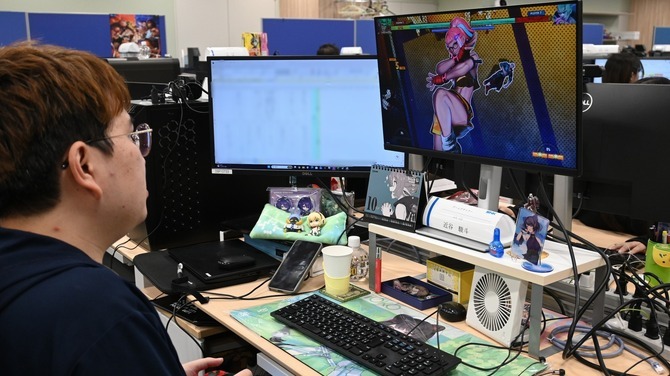
To wrap up the company tour, we were given access to the development area, where members of various teams are working on their respective “islands.” It was a rare opportunity to tour the workspaces of the *Fatal Fury: CotW* creative team in the midst of an intense development environment.
Presenting a Joint Interview with the Entire Development Team
In addition, we conducted a joint interview to commemorate the release of the Switch 2 version. We’re bringing you this special two-part series featuring interviews with SNK’s *Fatal Fury CotW* team and the Hexadrive team responsible for the port.
Staff Participating in the Interview (from Japan Studio Headquarters, Studio 1)
Shunto Chikaya (Director)
Kiyonori Yamada (Lead Programmer)
Tetsuya Yamamoto (Art Director)
Tatsuya Hayashi (Switch 2 Version Director)
Hiroshi Yamazoe (Sound Director)
The Switch 2 version also features Mai Shiranui’s classic costume, which resolves the “heel issue”
――First, could Director Chikaya give us a brief introduction to the Switch 2 version?
Chikaya: *Fatal Fury: CotW* was released last year, and it will now be available on Switch2 on October 22.The number of playable characters is the same as in the versions already released for other platforms, and it runs at a steady 60 fps, making it a *Fatal Fury* game you can take with you on the go and enjoy lively multiplayer matches with friends.
—The Switch 2 version will include the “Classic Mai Shiranui” costume as a pre-order bonus, right?
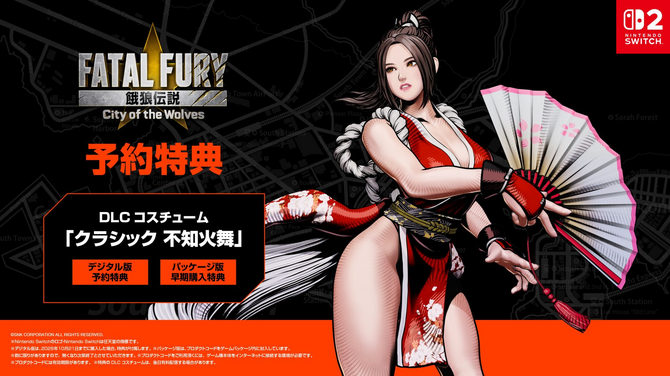
Chikaya: In this game, Mai wears a leather jacket and high heels, so if we had simply reused the model from her Classic Costume—the ninja outfit—her feet would have looked out of place (due to the difference between the tabi socks and the heels). We discussed this extensively with the art team and managed to resolve the issue, allowing us to release it.
Yamamoto: There were many requests for the ninja outfit, and just as we felt Mai’s new image had really taken hold in this game, we decided to release it as an alternate costume.
――Regarding the heel issue, how exactly did you resolve it?
Yamamoto: Since stride length and other factors change depending on whether the character is wearing shoes with raised heels or not, we adjusted the animations so that the character covers the same distance in either case. Since changing the movement values would also alter the character’s performance, we paid very close attention to that detail.
Chikaya: There are easily several hundred motions alone, aren’t there?
Yamamoto: That’s right (wry smile).
Yamazoe: With the alternate costume, not only does the outfit change from a leather jacket to a kimono, but the footstep sounds change as well, so there was quite a bit of work involved in swapping out the sound files.
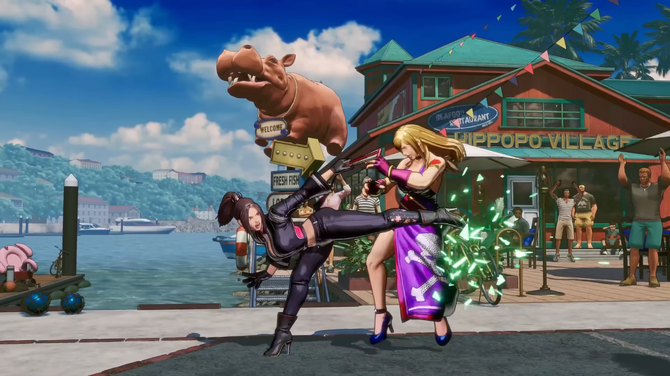
――So it took quite a bit of effort to bring Mai’s costume to life…! Are there any differences between the Switch 2 version and other platforms?
Chikaya: First off, one difference is that the Switch 2 version supports amiibo—a feature unique to the Switch 2—so if you have one, I’d recommend giving it a scan.
On the other hand, regarding the gameplay feel—which I imagine is a major point of interest for everyone—we’ve made various adjustments to ensure there’s no difference from the versions on other platforms, so I think you’ll be able to play with almost the same feel.
What’s the story behind the collaborations with titles like *Tokyo Revengers* and *Tekken 8*…?
――Also, on October 22—coinciding with the Switch 2 version’s release—*Tokyo Revengers* collaboration characters “Manjiro Sano (Mikey)” and “Ken Ryuguji (Draken)” will join the roster.Were there any differences compared to creating regular *Fatal Fury* characters?
Chikaya: With characters from past games like Terry and Rock (Howard), the key to their design is figuring out “how to give them a modern look” compared to the previous game, which came out over 20 years ago. However, for this collaboration, we first had to adjust their appearance to match the new aesthetic, and we also focused on how to establish each character’s fighting style without losing their unique personalities.
For example, with Mikey, his kicks are a core strength, so we made sure players could feel that during combat. As for Draken, he has a tenacious fighting style—he gives off a very powerful and forceful impression—so we worked hard to express that while adapting it to this game’s systems, such as REV Acceleration.
Yamamoto: Since we’re borrowing characters from another IP for collaborations, we create the models with the goal of faithfully recreating the atmosphere of the original manga and anime. For this project, we’ve put particular effort into ensuring that the faces maintain the original’s atmosphere no matter what angle they’re viewed from.

As for movement, since neither Mikey nor Draken—unlike the characters in *Fatal Fury*—possess flashy special moves with effects like “Power Wave,” we explored various ways to translate their individuality into their signature moves.
Ultimately, we decided to differentiate them through visual effects. For Mikey, since his attacks are primarily kicks, we incorporated effects that create clouds of dust. We also gave Mikey red and black effects to give him a slightly Japanese feel, while for Draken, we used slightly flashy pink effects to match the source material’s signature colors. We developed the designs while incorporating these distinctive traits.
――It was also announced in December that “Reina” from *Tekken 8* will be joining the game as part of a collaboration. You’ve been rolling out a wide range of collaborations, including this *East Liberty* one—could you tell us about the background and reasoning behind these collaborations, to the extent possible?
Chikaya: Since the *Fatal Fury* series has been running for so long, it naturally has a large fan base that has supported it for many years.So, as we’ve been thinking about how to get new people interested in *Fatal Fury*, modern manga and anime have come up as candidates, and sometimes we end up deciding, “*Tokyo Revengers* would be a good fit.”
We’ve also already done collaborations with the *Street Fighter* series, and in *Tekken 7*, Geese from SNK made a guest appearance. Based on that kind of synergy and various other factors, we sometimes select characters we think players will enjoy.
――Do you feel like this is actually helping you attract new fans and raise awareness?
Chikaya: I’d say it’s a good thing we’re in the age of social media—if you search online, you can see all kinds of reactions, like “It was fun fighting as this character” or “That move was super cool.”Seeing reactions even from people who don’t usually tweet about SNK makes me feel that collaborations really do help broaden our audience. Plus, there’s a lot we can learn from this experience, so I’m glad we took on the challenge.
――Do you have a message for people who are thinking of trying a fighting game for the first time because of this “Tokyo Revengers” collaboration?
Chikaya: I think there are various hurdles—fighting games inevitably have a reputation for being difficult, and there’s even a mindset that “you’re not a true player until you can pull off difficult moves.” However, I’d like people to set that aside and just focus on “how much fun it is” and “how satisfying it feels” when playing, and to start by trying out the characters for themselves.
This game features “Smart Style” (where you can perform special moves with a single button and execute combos by rapidly tapping buttons), so you’ll be able to defeat enemies just by tapping buttons. From there, I hope you’ll start exploring systems like the REV Gauge.
If you find yourself thinking, “This is fun” or “I think I can handle this game,” then diving into the more challenging elements is another way to enjoy it. So, what would make me happiest is if players simply thought, “A new character’s out—I’ll give it a try,” or “This is fun—I’ll check out the other characters too.”
Yamazoe: From a *Fatal Fury* player’s perspective, this collaboration is about “two biker gang members from *East Lib* showing up,” but for *East Lib* fans, it’s like seeing their favorite characters—Mikey and Draken—joining the fray in a different world.
This time, we’ve implemented songs used in the anime’s soundtrack into the jukebox, so I think players will enjoy seeing these characters battle people from a different world while listening to familiar, “pumping” anime tracks in the background.
――Draken and Mikey are joining the game this time—is the selection of characters for collaborations like this decided by SNK?
Chikaya: We make the initial proposal from SNK’s side, but of course, the other party also has rules like, “This character has this kind of image, so it won’t work.” So, I’d say the process is best described as starting with a proposal, then discussing it, and finally reaching a decision together.
Yamada: So, in that sense, Mikey got the green light, right?
Chikaya: They let us get away with it (laughs). Since we’ve read the original manga ourselves, we’ve made an effort to adapt the presentation in a way that fans of the source material might find somewhat acceptable.
Yamamoto: Given that this is a fighting game, it was difficult to avoid having the characters hit women at all, but we wanted to incorporate that kind of element somewhere, so this time we implemented different special move animations depending on whether the opponent is a male or female character.
――Now that a collaboration with “Higashi Libe” is possible, I imagine fans’ expectations are rising, thinking all kinds of other collaborations might be possible too. Is it safe to look forward to more in the future?
Chikaya: That’s right. It might sound strange to say, but “you’re free to imagine whatever you want,” so please feel free to imagine, “It would be fun if this happened.” If it’s actually implemented, it’ll create a lot of excitement, and even if your predictions don’t come true, it’s not like it’s “absolutely impossible for all eternity.” I think it’ll be a fun way to wait if you play while imagining which characters you’d like to fight.

――So, from SNK’s perspective, you recognize fans’ predictions and imaginings as a positive way to enjoy the game.
Chikaya: That’s right.We’ve had collaborations with *Street Fighter* and *Fist of the North Star* in the past, so when the secret slot for Season 3, “DESTINED FOR REVENGE,” was announced, we saw fans speculating, “It’s this person,” or “No, it’s probably that person.” Some people even took a hint from the keyword “REVENGE” and came up with some really sharp theories.
Yamada: That was fun, wasn’t it? (laughs)
Chikaya: I’m always keeping an eye on which characters fans are hoping for, and I think about whether we can adapt those characters to fit the *Fatal Fury* universe. For example, if a character uses weapons a lot, wouldn’t *Samurai Shodown* be a better fit? We have that kind of perspective when making our selections.
――Unlike collaborations with other companies’ IPs, there have been quite a few characters introduced from SNK’s own catalog. Are there any specific guidelines or criteria for that?
Chikaya: This isn’t about which characters are definitely possible or absolutely out of the question in the future, but there is a sort of unwritten rule in *Fatal Fury* that it’s generally better not to include characters who use weapons.
For example, if we were doing a collaboration with *Moonlight Blade*, I think *Samurai Shodown* would have better synergy, and while we could certainly include Iori Yagami, that would blur the line with *The King of Fighters* (KOF). I think how we approach these kinds of issues is something we’ll need to consider going forward.
“If We Stop, We’ll Burn”—Keeping Up the “Monthly” Character Additions
――In addition to those collaborations, while you’re also working on the Switch 2 version, you’re proceeding this year with the incredibly demanding schedule of “adding a new character every month.” It seems like quite a challenging task—I’d love to hear from everyone in each department about what they found particularly difficult.
Chikaya: There are plenty of things that were tough (laughs).It’s a slightly different angle, but the growing gap between “what’s currently out there” and “what we’re currently making” is really challenging. We have to work backward from what we want to do to set our schedules, and even if there’s a specific request, it takes months to go from decision to implementation, so that time gap gives me pause every time.
――That’s definitely a challenge. How does it look from a programmer’s perspective?
Yamada: It really feels like time is running out day by day, so to speak… (laughs). While we’re constantly thinking about how to build things as quickly as possible, we also can’t afford to make mistakes—so even though this isn’t strictly a technical issue, it gives us a sense of “treasuring every single day.”
Chikaya: It’s not just about adding characters; we also have requests like, “We’d like to implement this new system.”
Yamada: We just do as much as we can, then keep going while managing our time based on what’s left.
Yamamoto: It’s the same with the art. When we’re adding one character per month, the schedule for each version gets incredibly tight, so we ask the project management staff very specifically, “Please finalize the art by this deadline, and we’ll coordinate to implement it here.” This cycle repeats every month, and thanks to the hard work of all the staff, we’re somehow managing to get the updates out (laughs).
Even outside of character releases, we sometimes need new art assets or have to implement new features, so we really have to make the most of every single day.
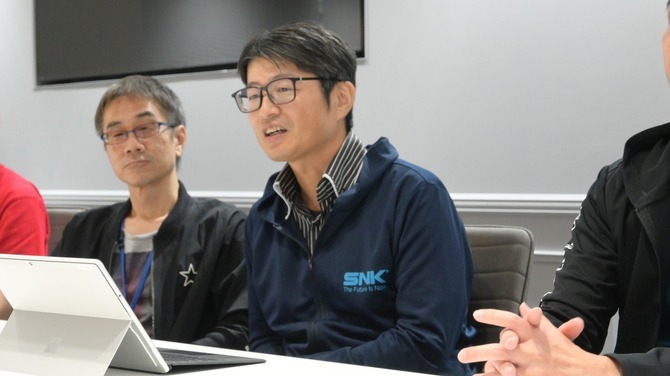
Hayashi: From the perspective of the Switch 2 port, while we’re working with this packed schedule of adding one character per month, there’s also the challenge of setting up a production pipeline compatible with the new platform. Plus, supporting the Switch 2 requires updating the Unreal Engine version, and squeezing that in between everything else was quite tricky.
Since there were also major UI overhauls in addition to the characters, we had to backtrack and address those issues during Switch 2 development… which was quite a challenge.
—Thank you. How about from the sound team’s perspective?
Yamazoe: As you can imagine, adding one character per month was incredibly tough. Since we were developing multiple characters simultaneously, it was difficult to manage the data and ensure there were no discrepancies. However, since the monthly release schedule is already set, that’s the bare minimum—on top of that, we also have to create prototypes for each version…
We’re completely exhausted just keeping up with all this, but even so, I try to keep an open mind and ask myself, “Is there anything else we can do?” For example, around the time Blue Marie was released, the sound team took the initiative and suggested, “Let’s add a song.”While we were working on it, I did catch myself thinking, “This is already insanely hard with the regular releases—why did we even decide to do this?” (laughs), but when I saw how happy users were with the finished product, I felt it was all worth it. I try to always think about whether there’s anything I can contribute, even in a small way, from the sound department’s perspective.
――Sometimes an animation trailer is released when a new character joins the game, right?
Chikaya: We have a dedicated team handling the animations, and they’re tasked with creating trailers that make the biggest possible impact right when we announce, “This character is coming!” Naturally, that makes me want every single character to have one (laughs).
Yamazoe: With one character per month, the sheer volume of text for regular recording alone is massive, so recording sessions take a long time—and when you add in the animation recording on top of that, it really becomes a huge undertaking. The dialogue involves translation as well, so the workload is enormous, but since the animations are something fans really enjoy, I feel it’s worth the effort no matter how much we put into it.

Hayashi: Short videos and the like sometimes get finished right up against the announcement deadline, don’t they? I’m always watching that happen right beside them (laughs).
――I see. I was wondering if maybe SNK had some secret trick that made monthly releases possible, but it’s still just as tough, isn’t it?
Chikaya: We’ve gotten used to it, but it’s still like running while thinking, “There’s a fire chasing me from behind—if I stop, I’ll get burned.” My back’s always on fire (laughs).
――I thought maybe releasing one character a month had become so easy that’s why the “Higashi Libe” collaboration ended up featuring two characters at once.
Chikaya: No, no (laughs). Even with two characters appearing at once, it’s been a process where we’ve been constantly discussing, “What should we do? What should we do?”
――How long do you plan to keep up this update pace?
Chikaya: I’d like to keep it up for as long as possible. I think the biggest factor is that players tell us they want to see a variety of characters, and if we limit it to “X characters per year,” people would end up saying, “How many years is it going to take to get all those different characters out?!”
――I imagine that as the number of characters increases, balancing them becomes more difficult.
Chikaya: There’s really no choice but to “do our best.” There aren’t going to be any tools developed that make this any easier.
When it comes to balancing, we also have to consider the esports scene, so we have to coordinate things so we don’t overlap with major tournaments. It’s like we look at the schedule now and decide on the scope and specifics of the adjustments—saying things like, “Let’s aim for next January,” or “Okay, so August, six months from now… but EVO is happening then.”
――So you hold off on major adjustments during periods when tournaments are packed.
Chikaya: That’s right. If the game mechanics were to change while a player is on a plane heading to a tournament, all the practice they’ve put in up to that point would be for nothing… that’s a possibility. However, in reality, there’s practically no month from January to December without a tournament, so we have to strike a balance.
The balance team constantly monitors tournament information and ranked match data, discussing things like, “Who’s strong right now? Maybe we should tweak it a bit this way,” and then aligning the game’s balance with the bigger picture. I think that’s a pretty accurate picture of how it actually works.
――So far, we’ve focused on collaborations, but Laocoon, who’s being added in November, is from the 1994 theatrical anime *Fatal Fury: The Motion Picture*. He might seem like a “forgotten character” these days—what was the reasoning behind deciding to focus on him specifically?
Chikaya: The catalyst was that Director Masami Oharu took the lead in making it possible to produce Geese’s animations.Since *Fatal Fury: CotW* doesn’t have many boss characters or villainous characters, we thought that bringing in Laocoon from the old anime would be a really great idea. So we approached Director Oohari, and it worked out that we could produce it.
I’m sure people who saw the movie back then would have loved to see Laocoon fight Terry. It took an incredibly long time, but I think they’ll be happy if we can make that childhood dream come true.

――What was the actual response like?
Chikaya: As expected, there were a lot of reactions like, “It’s Laocoon!” and here and there, some people asked, “What are they going to do with him?” Watching the response, I could tell that the more familiar people were with the movie, the more they were anticipating, “How will he fight Laocoon, and how will he win?”
—Looking ahead, do you think there’s potential for characters like Laocoon, who’ve had limited appearances so far?
Chikaya: It’s hard to generalize, but if we were to line up all the *Fatal Fury* characters, the high-priority ones—those who appeared in the launch title or the previous game—would come first, right? From there, we’d prioritize selecting characters making their “first 3D appearance” over those who’ve already appeared in series like *KOF*.And then, even if they’ve appeared in *KOF*, we’ll line up the famous characters that many people are waiting for and re-evaluate them… that’s roughly how the selection process works.
We consider things like what characters the players are hoping for, which characters have never been rendered in 3D before, or which ones have great backstories but haven’t been featured yet—so we want to include them… We receive incredibly passionate feedback about every single character, so the challenge is figuring out how to make those selections from among them.
――Within the scope you’re comfortable discussing, could you touch on some of the candidates?
Chikaya: Well, for example, there are characters related to the Secret Scrolls, like the Hata brothers; since there aren’t many female characters, we have Tsugumi Sendo and Li Xiangfei; and since we’d like a few more villains, there’s Ryuji Yamazaki—there are really all kinds of characters among the candidates, of course.
The tricky part is, for example, if we decide to include Professor Tan (Fu Lu), we’d face issues like, “How old is he now!?”—that kind of chronological problem. We have to take all these various constraints, or rather, considerations, into account.
――And, of course, there’s also the possibility of introducing completely new characters, right?
Chikaya: That’s right. Even at launch, we introduced two characters—Bricha, Joe To’s disciple, and Box Reaper, who was under Cain—and characters like Fang Wang have appeared in the story as well, so I’d like to gradually bring them more into the spotlight.
――Thank you. I’m looking forward to seeing how things unfold.
Geese and Krauser: The Big Hurdles⁉ Behind-the-Scenes Stories of the Switch 2 Port
In the second part of this interview, we were joined by Mr. Matsushita, CEO of HexaDrive—which worked with SNK on the Switch 2 port of *Fatal Fury: CotW*—along with two engineers, to discuss the optimization of the Switch 2 version, a topic of great interest.
Interview Participants (from HexaDrive Co., Ltd.)
Masakazu Matsushita (President and CEO)
Masashi Kuribi (Lead Programmer)
Sora Kanetaka (Programmer)
"Gameplay Feel" and "60 fps"—A Focus on the Player’s Perspective
――Could you tell us again about the background behind the decision to develop and release this Switch 2 version?
Hayashi: Our primary goal is definitely to attract new users. Compared to other platforms where the game has already been released, the Switch 2 has a larger base of younger users, so we decided to develop this version to appeal to that demographic with *Fatal Fury: CotW*.
――I imagine some of this overlaps with the earlier part of the interview, but could you tell us again about any technical challenges you faced during the port to the Switch 2?
Kuribi: The first major challenge we faced was that the version of the game engine used in *Fatal Fury: CotW* wasn’t compatible with the Switch 2, so we had to start by upgrading the engine.
We were updating using the latest version, but various problems arose, and it took quite a while to resolve them. What’s more, just when we thought we’d finished the fixes, the main game (here referring to the versions already released on other platforms) had advanced to a newer version during that time, so having to catch up with those changes was also quite a challenge.
Kanetaka: I felt the same way. Since this is a live-service game, as the version number increases, a gap emerges between it and our in-house development environment. We have to implement updates to catch up, but every time we do, build errors or unexpected behavior occur, so it was a struggle to check everything one by one and fix the bugs.

――So, in terms of preparing for the port—or rather, right from the very beginning—it was quite challenging, wasn’t it?
Kanetaka: That’s right. And once we got it running as the Switch 2 version, since it’s a fighting game, we had to ensure it ran at 60 fps. However, when we first tested it, there were scenes where the frame rate was too low, and even when we tried to implement fixes, some of them didn’t align with our goal of reducing the load on the main game.
So we ended up implementing some fixes specifically for the Switch 2 version, but since we had to do so without affecting the core game’s processing, it required some ingenuity.
――I suppose there were challenges because the hardware environment—such as memory—differs between platforms?
Kuribi: Memory wasn’t a huge issue this time around, but we primarily focused on ensuring a stable frame rate and preventing lag during cross-play. We implemented various measures to ensure the gameplay experience felt the same as on other platforms.
Kanetaka: First and foremost, our main goal was to absolutely guarantee 60 fps. However, we couldn’t just release the game with a blurry, pixelated image, so in addition to the existing graphics processing, we introduced DLSS for the Switch 2 version.This is a technology that enhances visuals by applying AI-powered upscaling to rendered graphics, and we’re fine-tuning the balance between dynamic resolution and DLSS while comparing it to the look of the main game.
――The Switch 2 is a platform with a wide variety of control options. How did you handle that?
Kanetaka: “Two sticks, four buttons on each thumb, and four buttons on the index finger (and middle finger)” is the typical gamepad layout, but in the Switch 2 version, holding the Joy-Con 2 horizontally reduced the number of buttons available for the index finger, which posed a challenge.
*Fatal Fury: CotW* features two control modes: Arcade Style and Smart Style. While the reduced number of buttons wasn’t an issue for Arcade Style, in Smart Style, the reduced button count meant there were controls that couldn’t be assigned.
Considering the user base that plays with Joy-Con 2 held horizontally—such as those using “Share Play”—we determined that the Smart Combo button, which allows players to easily execute combos, was absolutely essential, and that the REV Blow button would likely be desired as well, so we developed a custom key assignment scheme.Of course, players can freely change the button assignments in the configuration menu, so they’re free to experiment and find their own unique control style.

――You mentioned the challenge of keeping up with version updates—so the game will be updated simultaneously after release, right?
Hayashi: That’s right. The main game is already compatible with Switch 2. Getting to that point was a lot of work (laughs).
Matsushita: The development team was playing it nonstop, too.
Kanetaka: That’s right. I’ve been playing *Fatal Fury: CotW* since its release, so when I heard about this port, I got really excited, thinking, “Maybe my experience will come in handy!” (laughs).
Even though it’s a port, as a fighting game enthusiast, I made sure to prioritize the aspects that mattered most to me as a player, discussing them with the development team as we moved forward. For example, if players wanted to “study moves in Training Mode while on the go,” it wouldn’t make sense if the gameplay feel changed. We were very particular about those details so as not to undermine the point of playing on the Switch 2, a portable console.
――From the perspective of maintaining 60 fps and preserving the gameplay feel, were there any characters that posed particular challenges?
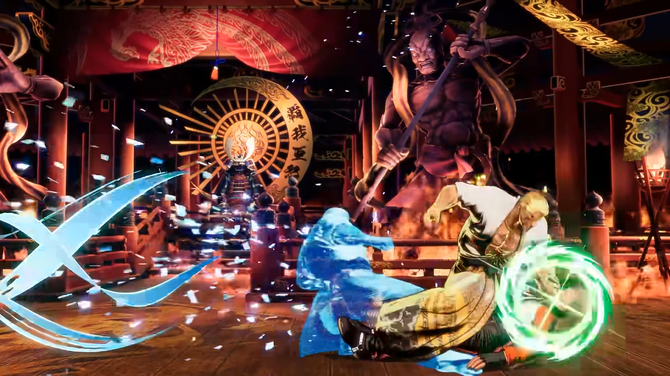
Kanetaka: We struggled a bit with (Nightmare) Geese and (Wolfgang) Krauser. Using the REV Axel causes motion blur, but with these two characters in particular, it inevitably led to performance issues. We worked on addressing this in consultation with Kuribi and SNK.
Hayashi: Since these two characters have models with a high polygon count, we knew in advance that they’d be resource-intensive—and sure enough, that’s exactly what happened.
Kanetaka: We conducted our own performance tests using all characters on all stages, and that’s when we discovered the issue.
Kuribi: Since the Switch 2’s specs are slightly reduced in “Handheld Mode” when played with the console in hand, using REV Acceleration in a Geese vs. Geese match under those conditions prevented us from maintaining 60 fps.To ensure that “you can play at 60 fps even on the go,” we specifically tested Geese and Krauser fighting on various stages.
――So you were successfully able to guarantee 60 fps even in that situation.
Kurihi: As a countermeasure, we made adjustments to reduce the load by streamlining the clone’s model—within the limits of keeping the visual appearance consistent.
Kanetaka: Since the clones look as if they have a blue filter over them, we fortunately discovered that reducing the polygon count didn’t result in any significant visual differences.Of course, we tested REV Acceleration on all other characters as well to confirm there were no visual changes, and since our measurements showed that the game maintained 60 fps with no visual issues even on stages with heavy performance demands, we implemented this optimization.
Hayashi: HexaDrive had extensive experience porting to the Switch, so we felt confident in them and decided to entrust them with the project. Since it’s a later-released platform, our condition was that no asset changes be made so as not to affect the main game, but they worked hard to improve performance through technical optimizations, which was a huge help.
Matsushita: This was our first collaboration with SNK, and while we have many employees who love fighting games, it was our first time tackling this genre, so we were happy to be approached for the project, as we felt it would be a valuable experience for us.
As a general approach in cases like this, variable frame rates are sometimes adopted as long as they don’t affect the gameplay feel. However, as has been mentioned repeatedly, 60 fps is essential for a fighting game, so the development team was very committed to achieving that.
――Thank you. By the way, could you tell us which character you usually play as, Mr. Kanetaka?
Kanetaka: It’s a little awkward to say this while wearing this outfit, but it’s Cristiano Ronaldo.
Everyone: (Laughs).
Kanetaka: The announcement made quite an impact, and when I actually tried him out, the wide range of play options offered by his ball-handling created a truly one-of-a-kind experience. Plus, he’s not too tricky—he’s been crafted with great care—so I got completely hooked. I’ve now ranked up to “Legendary Wolf” as “Smart Ronaldo.” I’m also looking for opponents (laughs).
――Finally, could you share a message for those planning to play *Fatal Fury: CtoW* on Switch 2?
Chikaya: Ever since the game’s initial release, we’ve been hearing requests to “play it on a handheld,” and we’re finally able to release it on Switch 2. Even if this is your first fighting game, I hope you’ll give it a try without worrying that it’s too difficult—whether you’re just testing it out or battling with friends. We really hope you’ll give it a try!

©SNK
©CAPCOM
©Takuro Tsuchiya & Tetsuo Hara / Core Mix, “Fist of the North Star”
Production Committee ©1994 Nihon Ad Systems Inc. / Shochiku Co., Ltd. / SNK Corporation / Fuji Television Network, Inc.
©Ken Wakui & Kodansha / Anime “Tokyo Revengers” Production
Committee TEKKEN™ Series & ©Bandai Namco Entertainment Inc.



