


A stone monument located in the courtyard of Peach’s Castle in *Super Mario 64*. For many years, there were rumors that it could be read as “L is Real 2401,” and it became a symbol of the urban legend surrounding Luigi’s hidden elements.
Now, a study has been published that reconstructs the process of creating the text from a 32×32-pixel image found in the game’s data, suggesting that “Eternal Star / We hope so” is the most likely interpretation.Game*Spark conducted an email interview with mochi64, the researcher behind the study, to learn more about the analysis methods, the role of AI, and the remaining uncertainties.
Please note that this is an estimate by the researcher and does not constitute an official confirmation of the inscription’s content by Nintendo or the original developers.
“Eternal” Tops the List of Approximately 1.23 Million Candidates: How Was the Stele’s Text Determined?
――What prompted you to study this stone monument? Please also tell us why you decided to take on this challenge now, some 30 years after the game’s release.
mochi64: This inscription is one of the oldest unsolved mysteries in gaming history. Everyone has seen it, yet no one can read it. The entire stone monument is just a 32×32-pixel image, and the characters are only 3 to 5 pixels tall. So, instead of trying to “read” it, I decided to “recreate” it.If I enter the correct characters, scale them down just as the original creators did, and overlay them on the same stone background, they should match the pixels exactly. Different words would yield different results. Nowadays, even a home GPU can verify millions of candidates in a matter of hours, and with AI-assisted coding, I can create software on my own that once required a small team. That’s why I decided to tackle this project now.
――When “Eternal Star” emerged as a leading candidate, did you expect that?
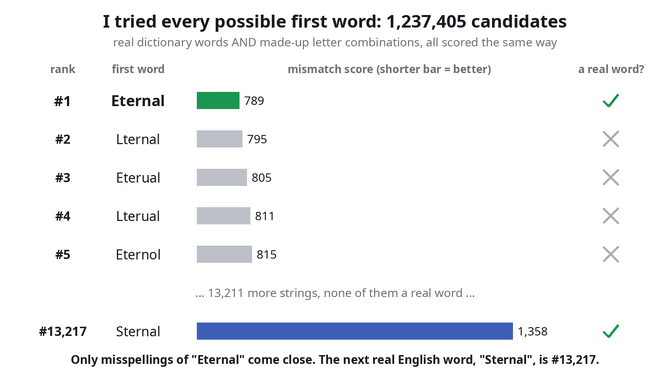
mochi64: It was both as expected and a surprise. “Eternal Star” isn’t a new theory; it had long been listed as a leading reading on the Super Mario Wiki. However, no one had proven it, and the second line remained unknown. So I approached it without any preconceptions and actually spent a lot of time verifying it—specifically to disprove this theory.I didn’t tell the computer “Eternal”; instead, I had it generate 1,237,405 possible candidates based on the combination of characters, including meaningless words like “Lternal.”
As a result, “Eternal” ranked first, while the next real English word, “Sternal,” ranked 13,217th. What surprised me even more was the second line: a blind search of 17,700 common English words yielded “We hope so,” and all of the top eight results contained the word “hope.”
――How certain are we about “Eternal Star / We hope so”? Does the strength of the evidence differ between the top and bottom rows?
mochi64: I have very strong confidence in “Eternal” and “hope,” but there are differences with the other words. “Star” ranked first out of 27,122 candidate words, so I’m confident in that. “We” is also the strongest candidate as a real English word that matches the shape of the characters.On the other hand, the final “so” is the weakest, and “or,” “us,” and “he” also yield similar results. The analysis assigns a score based on the degree of image mismatch; the lower the score, the better the match.
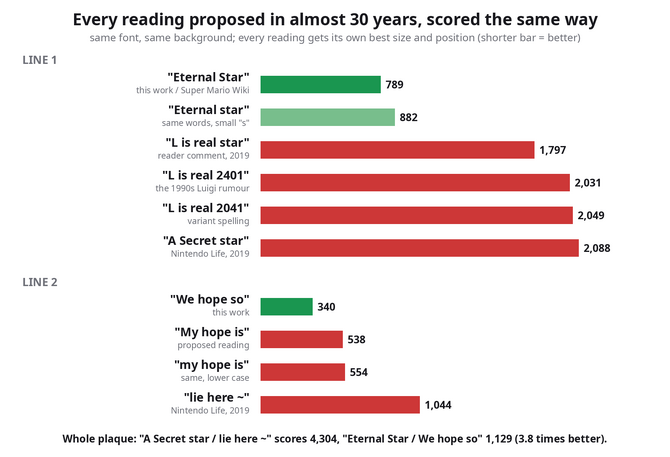
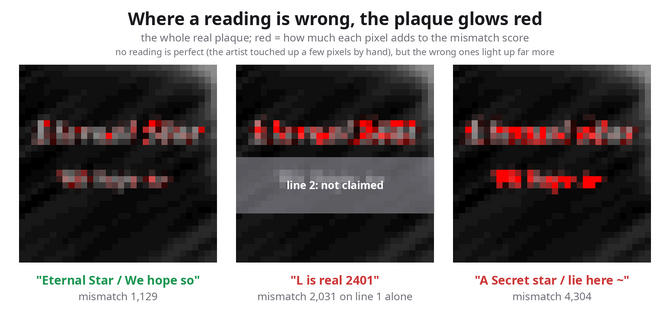
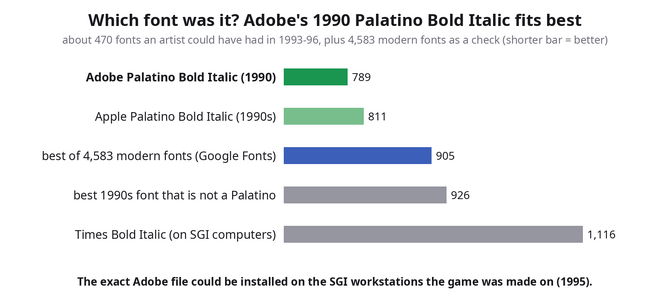
“Eternal Star” scored 789 points, while “L is real 2401” scored 2,031 points—a discrepancy of about 2.6 times.When compared to the 2019 “A Secret star / lie here ~” theory using the full text, that version scored 4,304 points, while “Eternal Star / We hope so” scored 1,129 points. On average, the restored image differs by only about one shade out of 32 shades of gray in the text area.
――Assuming those words are actually inscribed there, why were they chosen?
mochi64: From here on, this is my personal interpretation, separate from the pixel-based analysis. The monument is attached to a statue holding a star, and the Power Star is a central element of the game. “Eternal Star” also looks like it could be the statue’s name.Furthermore, it is common on Japanese monuments to engrave names and wishes. The combination of “Eternal Star” and “I hope it will be so” also feels like a Japanese-style English expression.
There is also a letter from 1998 in which Nintendo of America explained to fans that the inscription was a meaningless joke by the developers. If we interpret it as a simple wish, that explanation fits. No connection to the original concept has been found.The background appears to use a photograph of metal from a 1990s Japanese stock photo CD titled “Material Dictionary,” and it looks like a small, hastily created decoration.
It wasn’t that we wanted to debunk the “L is Real” urban legend
—What do you think of the “L is Real 2401” legend itself?
mochi64: I love this legend. For years, kids kept searching for Luigi based on a few pixels of text. That’s part of gaming history, too. I didn’t start this to debunk the legend. I just wanted to know what was actually written on the monument.
I searched for the setting that best matched the “L is Real” theory under the same conditions as the others, but the results were about 2.6 times worse. While the theory requires a short “L,” spaces between words, and a wide four-digit number, the image shows a long first word with no gaps.
We know from files leaked in 2020 that Luigi was present in early development, but those materials say nothing about the inscription. I did not use the leaked materials in my analysis.
Neither Nintendo nor the developers have issued any new statements, and I have not contacted them. The only officially known explanation is the 1998 letter. To confirm this definitively, we would need the original, un-scaled image file or testimony from the artist who actually drew the characters. I would also welcome any evidence showing that my theory is incorrect.
The AI didn’t read the inscription. Reconstructing 1990s image production
—What role did the AI play in the research, and how were the results verified?
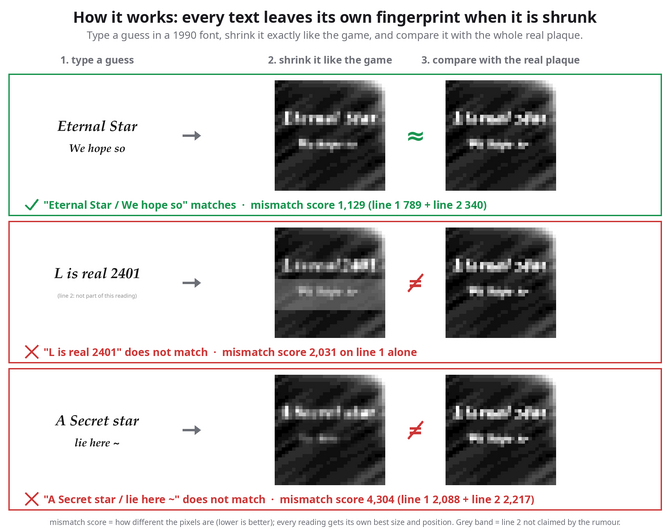
mochi64: The AI helped create the tools, but it did not read the inscription. I used Anthropic’s Claude to assist with writing and modifying code, performing large-scale searches on the GPU, and generating reports.I was the one who determined the direction of the research, verified the results, and made the final judgments. The analysis program itself contains neither image recognition AI nor an upscaler. It simply takes in text, scales it down, and counts pixel differences, so the same input will always yield the same result.
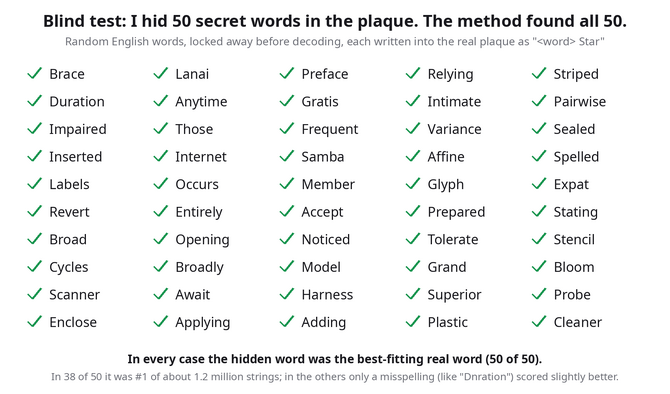
Furthermore, when I embedded 50 secret English words—selected by the computer—into a real stone monument and had the AI search for them without knowing the answers, it discovered all 50 words. I applied each step to a fake stone monument with no hidden text as well, and adopted only the improvements that were effective on the real one. Since the code and data are publicly available, anyone can reproduce the results or try it themselves.
――Were there any instances where you nearly reached the wrong conclusion, or any challenges unique to AI-assisted research?
mochi64: There were many such instances. AI writes code quickly, but even when it makes small mistakes, it can appear confident. In one verification, rounding errors caused the character positions to shift slightly, altering the score; we discovered this by cross-checking with another rigorous program.Also, when we investigated which part of the background photo was used, it produced the “best position,” but since the score was nearly the same even at random positions, we didn’t draw a conclusion from that.
Sometimes, nonsensical spellings like “Lternal” produce scores close to “Eternal.” Since pixels determine the shape of characters, linguistic knowledge is also necessary to select meaningful English words. We also examined another small picture frame inside the castle, but since the characters were only 2 pixels tall and yielded nothing but nonsensical results, we reported it as “unreadable.”
――Did you also test the possibility of Japanese, Romaji, or Japanese fonts from that era?
mochi64: Yes. I tried “Eternal Star,” “Eien no Hoshi,” “Eternal Star,” and “Secret Star” in Mincho and Gothic typefaces, but in all cases, the discrepancy was 4 to 7 times greater than with “Eternal Star.”While Japanese characters consist of a series of square glyphs, the stele appears to feature Latin italic-style characters, with uppercase letters and the letters “t” and “l” standing tall, and lowercase letters arranged between them.
Although Romanized characters were included in the search of 1.23 million alphabet candidates, there were no close matches. However, I did not separately test a dictionary dedicated to Romanized characters. The approximately 470 fonts from around 1993–96 included those used on Japanese Macintosh and Windows systems, as well as on Silicon Graphics workstations used by Nintendo.
The closest match was Adobe’s Palatino Bold Italic, which was also available on SGI systems in 1995. Since the image of the inscription is identical across the Japanese, U.S., European, and Vibration Pack-compatible versions, I believe it was originally created in Japan as an English font.
――What was the reaction from the community, and were there any counterarguments?
mochi64: It was generally received with curiosity and a positive attitude, and it was even featured in gaming media such as VGC. The counterarguments also helped with my verification process.Regarding the claim that “the text appears blurry on the N64 screen,” I explained that I was using the actual images saved in the game files, not screen captures. As for the point that “there are few shades of gray,” I recalculated the values using the same rounding process as the game format, but the ranking remained unchanged.
As for the questions, “Did you specifically target *Eternal*?” and “Did the AI fabricate the results?”, the 50-word blind test and the open-source code are the answers. So far, no one has posted a better interpretation of the scores than I have. I’m still accepting challenges.
――Please explain the specific steps you took to recreate the 1990s texture creation process.
mochi64: First, I type the text using Palatino Bold Italic. The characters on the first line are about 26 pixels tall, and those on the second line are about 19 pixels tall; I place them in a small work area of approximately 190×160 pixels.I adjust the spacing by shifting some characters by less than one-third of a pixel relative to the final image, then scale it down to 32×32 pixels using standard bilinear interpolation. I apply a slight blur and adjust the brightness to a gamma of 1.4.
The text is then superimposed like a bright engraving on a metal surface rotated by approximately 30 degrees and saved in a game-format file using 32 shades of gray.Finally, there are 7 pixels that cannot be reproduced from the characters, making it appear as though the author corrected them by hand. We compared approximately 470 fonts from the 1990s with 4,583 modern fonts using the same method.
Even if the original creator says it’s different—the analysis continues
—Can this method be used to solve mysteries in other games?
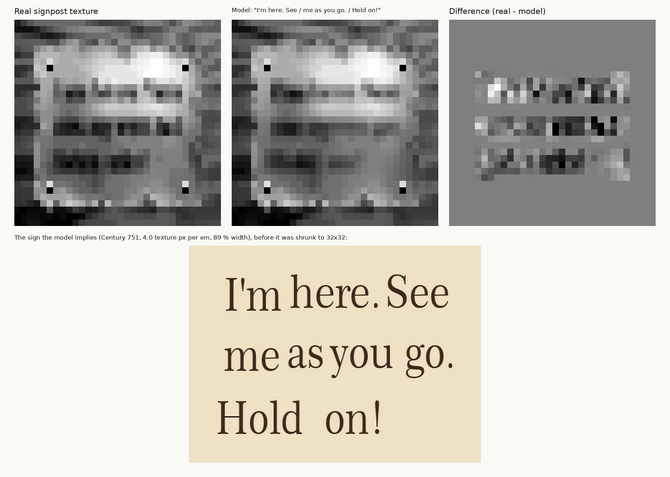
mochi64: If we can recreate how small images were made, we can apply this to other text in older games. For the wooden sign in *Super Mario 64*, the most likely reading is “I’m here. See / me as you go. / Hold on!” However, while I’m relatively confident about “I’m here. See,” I’m relatively confident, but the accuracy drops for the latter part. As for the text in the small picture frames inside the castle, part of it seems to start with “Ha…,” but the rest is too small to read. The eye symbol in *Noita* and the mysterious poster from the 1999 *Resident Evil 3* are also on our list for future investigation.
――What would you think if a developer from that era told you that the text was actually something completely different?
mochi64: I think I’d actually be excited. After all, I’d finally know the answer. That was my goal from the start. I’d immediately publish a correction and try to figure out why “Eternal Star” matched so closely. Maybe they revised the artwork later, or perhaps they used a different version of the text.Since I’ve made my methodology, verification process, and data public, if an error is discovered, the limitations of my approach will also become clear.
――What do you think this inscription means in the context of *Super Mario 64*’s story and history?
mochi64: A famous rumor that “Luigi is hidden there” arose from a few gray pixels, and for a long time, players searched the castle for him. Even ifit had read “Eternal Star. We hope so,” that history wouldn’t disappear. Rather, it would be enriched by the quiet, human wish that a small Japanese development team carved into the statue holding a star. Even after nearly 30 years, people are still playing the game, talking about it, and taking a close look at this monument. In a sense, that wish may have come true.
――Finally, could you tell us about any other game research you’re working on?
mochi64: In *Super Mario 64*, I’m investigating other hidden text, such as signs and picture frames inside the castle. I’m also using the game’s memory to verify famous glitches and speedrun techniques, such as the “upwarp” in *Tic-Tac-Lock*, which became a hot topic in 2013.I’m also working on the “message in the eye” from *Noita* and the mysterious poster from the 1999 version of *Resident Evil 3*. I’m sharing this research on my retro gaming channel, “mochi64.”
――Thank you very much.
