


This series features interviews with the developers behind intriguing new indie games. In this installment, we bring you a mini-interview with the developer of *Tukoni: Guardian of the Forest*, a point-and-click puzzle adventure developed by Dream Operator and released for PC on August 17.
This point-and-click puzzle adventure has the warm, picture-book-like charm of a children’s story. Players take on the role of Tukoni, a forest spirit, and embark on an adventure through a beautiful forest bathed in autumn breezes, filling their backpack with acorns along the way. The game’s key feature is helping the animals living in the forest prepare for winter by solving a variety of mini-games. It also supports Japanese.
“Tukoni: Guardian of the Forest” is available for 1,050 yen.
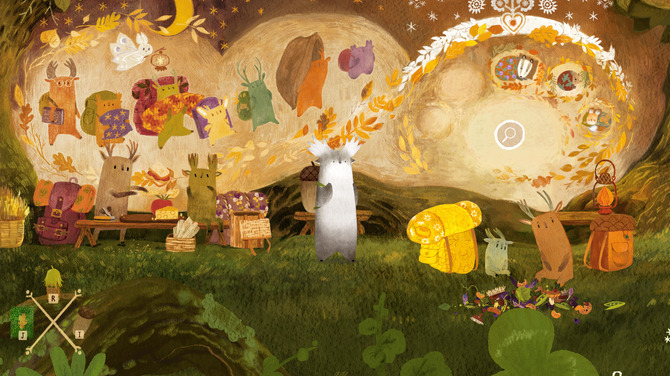

――First, please introduce yourself. What’s your favorite game?
Oleksii: I’m Oleksii Furman, the Creative Director of *Tukoni: Guardian of the Forest*.
That’s a very tough question right off the bat! If I had to name just one favorite game, it would be *The Legend of Zelda: Breath of the Wild*. I’ve never had an experience where I was so captivated by the act of “playing” itself as I was when playing that game.It’s also wonderful that you can share the experience with your family—and that’s exactly what we aimed for with *Tukoni: Guardian of the Forest*.
――Could you tell us about the game’s key features? Also, how did you come up with the idea?
Oleksii: As a storyteller, I’ve used various media—including photography, video, VR, and games—to weave stories. Among these, I’m most drawn to projects that cross different disciplines and blend multiple media to create something truly unique.
*Tukoni: Guardian of the Forest* is one such work. It incorporates the beautiful world and style of children’s picture books, transforming the journey into an interactive experience and breathing life into every page—thereby elevating the experience of reading a picture book to a whole new level.
While I have primarily worked on documentaries up until now, in 2019 I felt a strong desire to create “something” different from what I had done before—a work that could offer people, caught up in their hectic daily lives, a moment of peace and a brief, yet soothing, escape.
Around the time we began developing *Tukoni: Prologue*, the COVID-19 pandemic began, and the world descended into even greater chaos. During that year when everyone was confined to their homes, taking a quiet stroll through a hand-drawn forest felt like a “lifeline.”
After releasing *Tukoni: Prologue*, the development team went back to their respective jobs, and at the time, it wasn’t even certain whether we would develop a full version of the game. Then, reviews from players began to pour in.People all over the world played our small, free game—which had an average playtime of 25 minutes—and told us just how much they enjoyed it.
They shared the joy of the adventure with their loved ones and their own children, and asked questions like, “What happens next? Where is the protagonist headed?” At that moment, we became convinced that “someday, we will definitely create a full version.” That is precisely what continues to drive us forward to this day.
――Were there any games that influenced you while developing this title?
Oleksii: Yes, of course! While developing *Tukoni: Prologue*, we were influenced by numerous games from Amanita Design. I believe their works serve as an excellent benchmark—in terms of both quality and the passion they pour into their games—for anyone striving to create heartfelt adventure games.
However, we chose an approach that wasn’t confined to the “fixed-screen” format. I believe this was a key design decision for us.For *Tukoni: The Guardian of the Forest*, we wanted to incorporate richer gameplay and puzzle elements, so we drew inspiration from 1990s adventure games as well as modern reinterpretations like *Lost in Play* and *Röki*.
From an artistic perspective, Studio Ghibli’s works have had an immense influence on us, especially our artists. We believe that the worlds we create and the stories we tell share a common thread with Ghibli’s works in that they are crafted with great care, and in today’s world overflowing with content generated by AI, we believe this concept of “care” holds profound significance.We also made a conscious effort to create simple yet profound moments—moments that, even if not crucial to the main story’s progression, will linger in players’ hearts for a long time.

――Please share one episode that left the deepest impression on you during the development of this game.
Oleksii: I believe we’ve always maintained a modest and humble attitude toward our work and its results. That’s precisely why every time players show us their warm support, we’re filled with heartfelt gratitude, and each of those moments leaves a deep impression on us.
For *Tukoni: Prologue*, the most memorable moment was when our perception shifted completely—from the assumption that “we’d made a small game that no one would notice” to the realization that “people all over the world are actually playing our game and genuinely loving it.”
And for *Tukoni: Guardian of the Forest*, the day that stands out the most was when the number of wishlist additions exceeded 3,000 on the very day we announced the game. I still remember calling Nikita Bohdanov, the game director for this title, and shouting out loud in sheer joy.
Another unforgettable moment for me personally was the night I sat down at my desk to write the Steam release announcement. It gave me the opportunity to reflect on the journey we’d taken so far—from the release of the prologue version, through the game’s announcement, all the way to the release of the full version—and to appreciate just how much our wonderful players had stood by us and supported us along the way.I really can’t say this enough: without the incredible support of our players, this game would never have existed.
――What kind of user feedback have you received since the release? Please share any particularly memorable comments.
Oleksii: The feedback has been fantastic, and (as of the time of this interview) the game has received an extremely high “Overwhelmingly Positive” rating of 99% on Steam.In the days immediately following its release, *Tukoni: Guardian of the Forest* became an indispensable game among Ukrainian players, and my social media feed was flooded with posts from people playing it—including those who don’t usually play games.
(*Since the rest of the answer contains major spoilers, it will be included at the very bottom of this article.)
――Taking user feedback into account, could you tell us about your plans for future updates?
Oleksii: We just released a small update patch a few days ago that focused on fixing bugs in the tutorial and in-game hints. Furthermore, we’re planning a larger “New Game+” update for next month, which will improve the overall experience and add some cool new cosmetic items.
――Please tell us about the Japanese localization status for this game.
Oleksii: For our expansion into the Asian market, we’ve partnered with our publisher, Gamersky Games, and entrusted them with the translation work. They’ve provided us with several highly professional suggestions regarding the game’s localization, and we’re implementing them.
――Is it okay to distribute and monetize this game?
Oleksii: Yes, of course!
――Finally, please share a message for our Japanese readers.
Oleksii: I’d like to express my heartfelt gratitude to everyone in Japan who has played *Tukoni: Guardian of the Forest* and warmly supported us on our journey so far! Personally, I’ve been greatly influenced by Japanese games, especially those from the PS2 era. Japanese art and culture have also been a huge source of inspiration for the development of this game.
Now, I’d like to pass the baton to Kateryna Ustymenko, who served as the lead artist on this game.
Kateryna: A while back, I developed a strong interest in Japanese culture, and I’m still completely captivated by its charm. Above all, what resonated most deeply with me was the respect for nature.It’s the belief that even a single leaf or a single blade of grass is imbued with life and weaves its own story. Just as depicted in Studio Ghibli’s works, the tiny forest spirits truly exist—they’re right there, waiting for us to notice them.
In the world of *Tukoni*, nothing happens by chance. Even the “single ginkgo leaf” that travels with us didn’t end up in my backpack by accident. The ginkgo tree symbolizes “eternal life” precisely because it has endured through the ages. And yet, it is nothing more than a single leaf!A single leaf from a Japanese snowbell tree, the grass leaves woven by Tukoni the tea-maker, the thickets of ferns in the forest… Each and every tiny plant tells its own story. The same is true for the characters—even a single pillow holds a story within it.
And tea time is truly something special! It’s unique to each forest dweller, featuring different ingredients, and even the steam rising from the tea symbolizes each individual plant, as if the scents were performing a dance!And yet, there remains an “unchanging essence”—the time to prepare slowly and without haste, and the joy of savoring the moment. Above all, the most important thing is to pause, relax, and take notice of the “beauty” all around you.
Finally, to my dear readers in Japan… please try to unravel the many mysteries that appear in this work. There are so many of them, and every single detail is imbued with meaning!And please host a tea party with your favorite warm drink to recharge your energy. It’s important to relax sometimes. Doing so will allow you to see things in a new light. (You might even unlock a new achievement!)
――Thank you very much.


◆ About “Spotlight on Indie Mini-Q&A”
This series features email interviews with indie developers shortly after their games are released. To ensure regular updates, we’ve standardized the questions, with the goal of sharing the voices of as many developers as possible. Please also enjoy our archive of over 1,000 other interview articles.
(Major spoilers ahead)
Continuation of the question: “What kind of user feedback have you received since release? Please share any particularly memorable comments.”
Oleksii: The game concludes with a scene where the forest animals and nature spirits share tea and pie under an apple tree. Given the current situation in Ukraine, where the war continues and many people are forced to live far from their hometowns and loved ones, this final scene proved to be deeply moving for many players.
We witnessed this reaction firsthand in the numerous game streams we watched. We are truly delighted that this game has transcended the framework of a mere “heartwarming adventure game” to become a work that reminds players of the warmth of “home” and the preciousness of feeling safe and happy.
