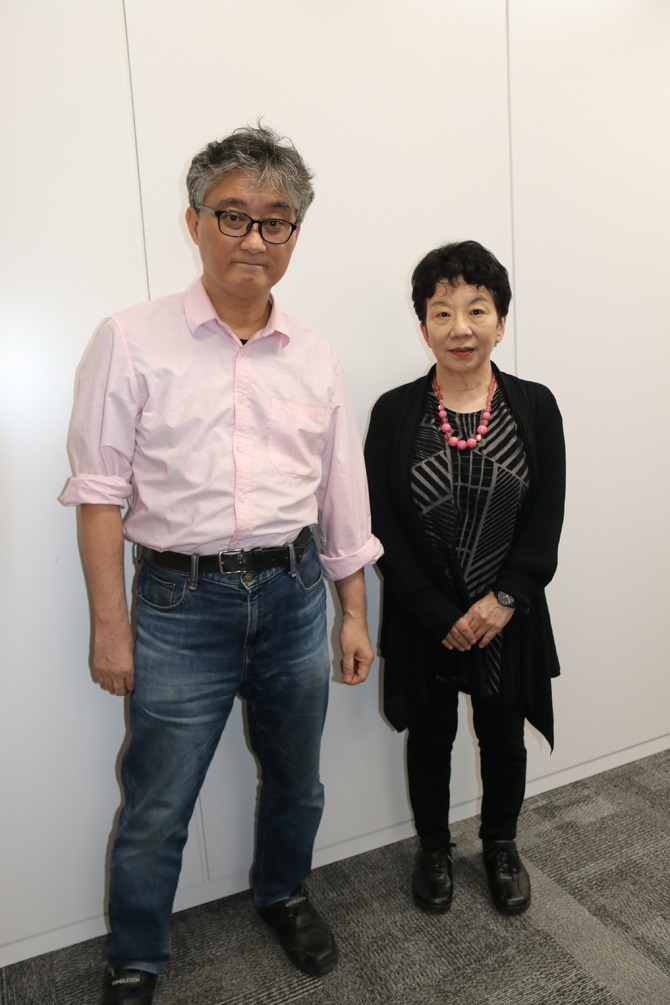
“Dropping Drops” is a physical action puzzle game by Mindware that uses a MIDI controller. We interviewed both Mikito Ichikawa, the game’s developer, and Yuriko Keino, a legend who helped shape the sound of Namco’s arcade games in their early days.
Although the interview lasted a full two hours, it was packed with fascinating moments—including the revelation that the game was not originally intended for commercial release, details about Ms. Keino’s career outside of gaming, and discussions on how sound has changed over the years.
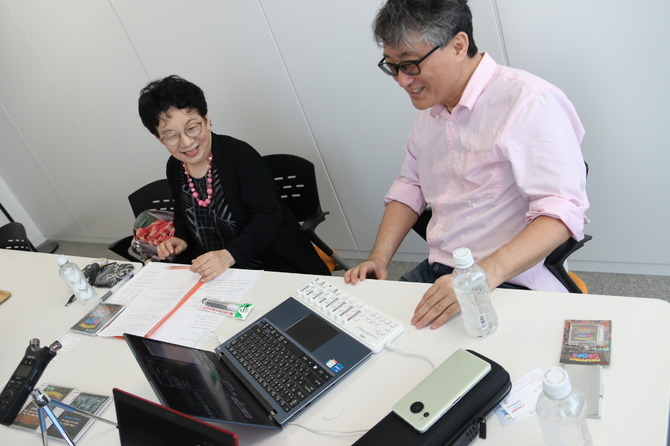
A MIDI Controller as a Game Controller? Mr. Ichikawa Discusses the Potential of Music Devices
――First, could you please introduce yourself, Mikito Ichikawa?
Mikito Ichikawa (hereinafter Ichikawa): I grew up in Fuchu City, Tokyo. In the early ’80s, there weren’t many game development companies, so in 1985, I worked part-time at Nihon Falcom in Tachikawa—a game company located near Fuchu.Later, in July of my first year of high school, I moved to work at Denpa Shimbun. One day, while passing through Higashi-Fuchu Station on my way from Fuchu to Shinjuku, I saw an advertisement for MicroProse—a company known for having been led by Sid Meier.
While working that part-time job, I founded M.N.M. Software during my second year of high school, and when I turned 20, I released *Star Wars: Attack on the Death Star* for the X68000.
I also worked on Sega’s *Bare Knuckle II: Requiem for a Fatal Fight* and *Slap Fight MD*, among others, but then I fell seriously ill—to the point where my weight dropped to about 36 kg—and became bedridden.
I eventually recovered, and in 1995, I changed the company name from M.N.M Software to Mindware.Since then, the company has worked on firmware development for digital home appliances, as well as *The Shape Game: Circle, Triangle, Square* for WiiWare, and in the 2010s, *Heian-kyo Alien 3671*, a remake of *Heian-kyo Alien*.
The reason I originally wanted to make games was that I wanted to use a computer to perform aerodynamic calculations. Since this was before the Famicom hit the market, whenever I talked about aerodynamic calculations in elementary school, no one around me understood a thing.However, when *Dig Dug* was released in 1982 and became a huge hit, people around me started saying, “You should make something like *Dig Dug*.” I went to see it, asking, “What is *Dig Dug*?” and was completely blown away. That’s when I started making games.
I never would have imagined that in 2022, I’d have the chance to make a game with Yuriko Keino, who created the music for *Dig Dug*.
――I see. So you entered game development during a time when you could really feel the industry’s momentum building.
Mr. Ichikawa: (I actually started a little before) I could really feel the excitement in the gaming world. That’s because the atmosphere in the community was different around the time the Famicom was released. If I’d started making games after the Famicom came out, people probably wouldn’t have been so quick to embrace it.
In that sense, while the development environment is much richer now, even as recently as 10 years ago, there weren’t many amateurs developing games.That’s because, in the 2010s, with rich console games like the PS4 released by major companies and free-to-play mobile games dominating the market, games made by amateurs would inevitably pale in comparison. In that sense, too, I was able to keep creating because there were users who enjoyed playing my games.
I remember starting development on *Dropping Drops* around 2:00 a.m. on October 2, 2025.
――Did you come up with the idea at that late hour!? By the way, had you been mulling over any ideas leading up to that?
Mr. Ichikawa: I hadn’t originally planned to release this game.On October 12, 2025, there was an event called the 15th Microcomputer Infinite PRO-68K, where X68000 fans and other retro PC game enthusiasts gather. Not only have I exhibited at that event without fail since the 3rd edition, but I’ve also given presentations there.In that talk, I discussed the idea that “changing the controller changes the experience.” To put it simply, since “changing the controller changes the object you’re constantly touching while playing,” the experience is bound to change. The Nintendo DS, a handheld game console equipped with a touch screen, is a prime example of this.
I created *Dropping Drops* as a sample game designed to let people understand this concept not just through words, but by actually experiencing it for themselves.By the event, the game was playable, and it was a huge success—so much so that many people who tried it, including my friend Naoki Horii from M2, were thrilled. Since so many of those who played it asked, “When is this coming out?” I felt encouraged by the response and decided to get serious about development—that’s the background behind this game’s creation.
――This game has an early-’80s Namco-style vibe, including the UI. What was the reason for choosing that ’80s style?
Mr. Ichikawa: That’s because a game we made in the past, called *Space Mouse 2*, fit perfectly into Namco’s arcade screen format of 288 dots vertically by 224 dots horizontally, so we decided to align the game’s screen format with the Namco style right away.We also adopted the Atari font and used “1UP” (UP = User Player) to display the single-player score.
Since we hadn’t originally planned to officially release this title, we reused the engine we’d built for *Space Mouse 2*.Not only did I use this engine for *Uttui 3671*, released in 2024, but I also used it for *Denshi Life*—my first collaboration with Mr. Keino—where working alongside a Namco legend led me to align the game’s style even more closely with Namco’s aesthetic.The combination of “not originally intending to release it” and “reusing the engine in a standard, formulaic way” resulted in a Namco-style look. Since almost none of the designs created by the graphic designer made it into the final game, we didn’t intentionally aim for an ’80s aesthetic in that sense.

I was also really happy to hear people say, “It gave me the same sense of fresh surprise I felt when I first saw a Namco game from the ’80s.” I’m sure one of the things everyone is looking for is “that sense of wonder you felt when you first saw it back then.” I was committed to delivering that sense of wonder, and in terms of sound, the *Denshi Life* series featured music that evolved in sync with the game’s progression.
If I had to name a major feature of creating this title, it would be that I worked not just with composer Yuriko Keino, but with Yuriko Keino the creator. That’s because our relationship went beyond her simply delivering the commissioned soundtracks—she even helped proofread the game’s English text.
Yuriko Keino (hereinafter Ms. Keino): It’s not just this time—it’s always like this when I work with Mr. Ichikawa, and it’s a lot of fun. I even helped with debugging (laughs).
――So Ms. Keino wasn’t just composing music; you were also handling various other checks as well. Also, when I played this game using a MIDI controller, it felt just like I was playing on a real arcade cabinet.
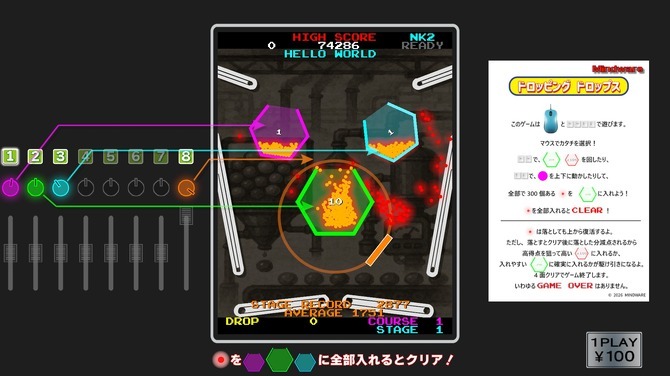
Mr. Ichikawa: We also handle pinball machines because we believe that for arcades to survive in the future, it’s crucial to offer experiences you can’t have at home—starting with hosting events. Aside from that, home consoles suffice for everything else, so arcades don’t really have a unique advantage.In that sense, the style of playing this game with a MIDI controller is no different. Since it offers a different feel than playing with a gamepad or a mouse and keyboard, I believe it allows us to maximize the game’s strengths.
――I found the MIDI controller’s lighting effects and the real-time changes when moving the faders to be intuitive and fun.
Mr. Ichikawa: We placed great importance on the fun of having those controller inputs reflected directly in the game. It’s a very important point—you could even say that without that interactivity, there’s no point in having players use a MIDI controller.
On the other hand, if we were to focus exclusively on the MIDI controller, the question arises: “What about people who don’t have one?”Realistically, if we assumed a MIDI controller was mandatory, we’d lose the entire market. So we had to create something that could be played properly—to the point where you wouldn’t be hindered in score attacks—even without a MIDI controller, while also making it something that feels even more fun when you do have one.

Also, in 2019, I exhibited a title using the nanoKONTROL2 at Microcomputer Infinite 64. It was well-received at the time—it made such an impact that Mr. Horii from M2 told me, “I’ll set up the environment, so please send me a sample!” It was a surprise unlike anything I’d ever experienced before.
Furthermore, the version I exhibited in 2019 only used a portion of the MIDI controller’s faders. I also observed a phenomenon where players who had finished the game would explain it to the next person in line—it was like a child who knew how to play explaining it to a child who didn’t, drawing them in to play together—and I thought, “This is truly a wonderful thing.”However, a major drawback of that game was that it required the nanoKONTROL2. That’s why it never made it to release.
――So, this title was also one that solved the problem of “not being playable without a dedicated controller,” wasn’t it?
Mr. Ichikawa: That’s right. I feel like we really got the hang of it after creating *Denshi Life* and *Denshi Life 2*, which were compatible with MIDI controllers.
――When did you first come across this MIDI controller, the nanoKONTROL2?
Mr. Ichikawa: From 1986 through the early ’90s, Yuzo Koda was often in charge of the sound for our projects,and because of that relationship, I also ported Mr. Yuzo Koda’s sound drivers. We often talked about sound drivers, so I realized I needed to understand music to some extent just to hold a conversation. That’s why I experimented with PSG and FM sound sources on my own and bought synthesizers to play around with various sounds.Given that background, I still keep an eye on new product announcements for synthesizers and MIDI devices, and among them, the KORG nanoKONTROL2 was the one that really stood out to me—I thought, “Oh! This looks interesting!”
Within half a second of seeing it, I thought of table soccer: “Isn’t this a gaming device?” and “Wouldn’t it be amazing to connect two of these to a PC and play?”
Also, while it now costs nearly 10,000 yen as of 2026, back around 2016 it was reasonably priced at around 3,000 yen. I bought it thinking, “At this price, it’s okay if it doesn’t work out,” and that was the starting point.
After playing with it for a bit, I called KORG. I was convinced that “everyone must be using this for gaming,” so when I asked, “How many companies have contacted you about this?” they replied, “You’re the only one thinking that!” and burst out laughing (lol).
――There are about three models in this nano Series 2 lineup. Aside from the one you used this time, did you have any other models in mind?
Mr. Ichikawa: It’s not so much that I had specific models in mind—it would actually be unnatural not to have any in mind (for use in gameplay).For example, the nanoKEY2 keyboard has a range of about two octaves, and I think every company making music games for PC should support it. In fact, I’d even go so far as to say that if someone trying to make a music game hadn’t checked out devices like that, it would be fair to say they’re “not doing their homework.”
A Conversation with Yuriko Keino on Music Production: What Kind of Work Did She Do After Leaving Namco?
――First, could you please introduce yourself, Yuriko Keino?
Ms. Keino: I’m a composer. In the 1980s, I worked at Namco, Ltd.I was a full-time employee from April 1981 to March 1985. After a brief hiatus, I worked there on a contract basis from June 1986 to March 1989. I’m currently a freelancer. This is the third project I’ve worked on for Mr. Ichikawa.
――Thank you. Let’s jump right into the music. From your first project, *Dig Dug*, all the way to *Rompers*, I think the 1980s were a time of rapid evolution not only in graphics but also in game sound. How did you perceive those changes at the time? Also, what kind of developments did you anticipate for the future?
Mr. Keino: Although my name and caricature appear in the credits for *Rompers* as the “Original Sound Creator,” while I was involved during the prototype phase, I did not compose any music for the final product.The last titles I worked on at Namco were the 1988 arcade game *Pro Tennis World Court* and the PC Engine version of *Packland*. The PC Engine version of *Packland* featured stereo sound as well as additional tracks. It was a fun project.
Let’s talk about the sound sources for arcade games. *Dig Dug* and *Xevious* used three channels of the arbitrary waveform generator circuit, while later titles used the Custom 15, which had eight channels. Up to that point, noise could not be controlled by the sound program; there was only one type of noise, generated by the main program.
The subsequent Custom 30 (C30) was actually designed to switch to 16 channels, but since this resulted in a decline in sound quality, we only used the 8-channel mode during my tenure. Of those 8 channels, 4 could be switched to noise, and that noise could be freely manipulated within the sound program.We could select specific frequency bands—not just the single “boom” explosion sound used previously, but also sounds like a “hiss”—and freely create envelopes. We were able to put these capabilities to use in games like *Packland* and *Dragon Buster*.
In 1986, the system evolved into the SYSTEM86 board, featuring a configuration of FM sound source + Custom 30 (C30) + synthesized speech.Later, the successor SYSTEM1 board was released. Although I was only responsible for the FM sound source among these three types, I was fascinated by the potential of FM sound and created a prototype track—one of which was adopted for the “Jungle Step” stage in *Pack Mania*. It was truly exciting to be able to do things like that.
Back then, I couldn’t predict what the future held. I was already stretched thin just trying to complete the tasks I was assigned.
――So you focused first on the tasks you were assigned.
Mr. Keino: That’s right. Especially after 1986, the division of labor had become more pronounced. Back in 1981, when I first joined the company, we’d all work together in a lively, bustling atmosphere, with everyone sharing their opinions.In some ways, it was similar to working with Mr. Ichikawa. I think part of it had to do with my status as a non-regular employee after 1986, but it wasn’t a collaborative style of development. I do recall attending meetings regarding individual projects, but we didn’t discuss the big picture.
――Looking at Yuriko Keino’s work history, there isn’t much mentioned about the 1990s and beyond. Also, when tracing her career, the 2016 titles *Kirakira Star Night DX* and *8BIT MUSIC POWER* stand out. What were you doing during the 25 years after you left Namco?
Ms. Keino: It’s just that I stepped away from the gaming industry after the ’90s; I continued composing music itself.I worked the longest at a private music agency—for over 18 years—where I was involved in producing concerts and CDs featuring traditional Japanese music. Under my production, we won the Excellence Award in the Record Category at the Agency for Cultural Affairs’ Arts Festival twice, and the New Artist Award in the Performance Category once.
During that time, around the period when Namco was transitioning to Bandai Namco Games, we also collaborated on various projects. There’s a track from the early days of *Taiko no Tatsujin* that features the shakuhachi and koto. We recorded those tracks at the studio where I was working, and I served as A&R and co-director.
Although it was very demanding work, I also composed music commissioned by a duo specializing in the koto and the jushichigen (a low-pitched koto), as well as composed ringtones for cell phones featuring live instrument performances for Roland’s “Wearable Instrument Paradise” content.
I left that agency at the end of 2010, and starting in 2011, I set up a computer-based music production environment at home.I received offers from various sources and worked at a sound production company and the Japan Foundation for the Promotion of Traditional Culture, which was spun off from Victor’s traditional Japanese music division. I was also invited to various venues to give lectures and participate in talk shows about video games. For those lectures, I would compose chip-tune-style pieces on the spot to illustrate how “early video game music sounded.”
In 2012, I provided demonstration tracks for “iYM2151,” an iOS app that emulates Yamaha’s YM2151 FM sound module, and in the same year, I composed a piece for flute and piano. This piece was later arranged for flute ensemble, and the sheet music was published in 2024.
Also in 2013, I received a commission from a researcher and performer in Osaka—who specializes in the Japanese koto and its Korean counterpart, the kayagum—to write a piece that everyone could play simultaneously for a concert comparing the sounds of the two instruments. I composed a piece for the koto, kayagum,25-string kayagum, and chang.The Japanese koto has 13 strings, while the Korean kayagum has 12. The Japanese koto is played by wearing a pick—called a “tsume”—on the fingers, whereas the kayagum is played by plucking the thick strings with bare fingers, using a technique known as “choking.”The 25-string kayagum is a modern instrument developed from the traditional kayagum, while the chang is a drum-shaped percussion instrument that always accompanies performances of the classical kayagum.
This work premiered at two venues: Yamaha Hall in Tokyo and Phoenix Hall in Osaka. Unexpectedly, a Yokohama City government official was in the audience at Yamaha Hall and listened to the performance.In preparation for the Agency for Cultural Affairs’ “East Asia Culture City 2014 Yokohama” project the following year, a proposal was made to the organizers to hold a concert at Philia Hall in Aoba Ward, Yokohama, featuring zithers from three countries—Japan, South Korea, and China. The organizers commissioned me to compose the piece, so I accepted the commission.
Although I had studied the kayagum during my student days, I knew nothing about the Chinese zither, so I relied on contacts from my university days to conduct research while composing a piece for the zithers of Japan, China, and Korea.At the reception following the performance, the Deputy Mayor of Yokohama and the Mayor of Aoba Ward both said in unison, “Listening to Mr. Keino’s music, we realized that Asia is one,” which made me very happy.
――Having heard about your background, Mr. Keino, as someone who has worked in parallel on chip tune and music for actual instruments, have you noticed any differences between the two?
Ms. Keino: Even before the term “chiptune” existed, I’ve always viewed game boards as instruments and tried to let them do what they do best.Whether it’s the Japanese koto, the Korean kaguyam, or the Chinese zither, by using traditional tunings and phrases found in classical pieces to make the most of each instrument’s characteristics, the unique qualities and charm of each instrument come to the fore.
As I often say, computers aren’t good at what humans are good at, but they’re good at what humans aren’t good at. For example, if you accidentally type a command to repeat something 33 times instead of 3, the computer will repeat it 33 times without tiring, and if you write a note one octave higher by mistake, it will play the note one octave higher.

I believe that music created with computers is all about taking advantage of this unique quality—the fact that it performs tasks humans are not good at without complaint. That’s why, when it comes to creating music with computers, I didn’t really think much about making it sound like music created by humans.Depending on the game’s specifications, there are times when that kind of music is required, but my basic approach has always been the same: to bring out the very best qualities of that instrument.
――The track “EIGHT BIT JUNGLE” from *8BIT MUSIC POWER* had a 70s progressive rock vibe… I was particularly struck by the EL&P “Tarkus”-esque sound.
Mr. Keino: Now that you mention it, it might indeed resemble “Tarkus”... Since this was a music album shaped like a cassette for an 8-bit console, it was a project where I could do whatever I wanted without the constraints of having to cater to a specific purpose or genre.
I don’t remember the exact time limit, but we were allowed to use a certain amount of DPCM data. While many composers break it down into small pieces to use as drum sounds, I decided to bundle it all together and have a gong sound ring out at the beginning. It was fun being able to pull that off—I just wanted to try whatever was possible. I also tried drastically changing the mood of the song midway through.
—So that song was essentially a compilation of everything you were able to do. By the way, do you have a genre you’re particularly good at?
Mr. Keino: Since I’ve been studying so-called classical music since childhood, it’s easy for me to compose classical-style pieces. I’m also accustomed to creating harmonies and polyphonic movements. But it’s not just that—I always want to keep experimenting. I’m constantly thinking, “If I do this, could I try something like that?”
The Cumulative Development from *Denshi Life* to *Dropping Drops*
――Regarding the sound of this game, I sensed an essence reminiscent of early ’80s Namco arcade games compared to the music in the previous title, *Denshi Life 2*. Was there anything in particular you kept in mind during sound production?
Mr. Keino: I always compose music for games to match the game’s worldview. This time, it’s a dreamlike world reminiscent of a candy-themed wonderland.
Mr. Ichikawa: In *Denshi Life 2*, up to seven different tracks could play simultaneously—each part had its own on/off state, and they’d switch every four seconds…
Mr. Keino: I was the one who actually said, “Let’s do it that way!”
Mr. Ichikawa: That approach itself turned out to be very experimental. This feature was originally created for debugging purposes. It’s quite unique—there’s really nothing else quite like it.
Author’s Note: *At this point, Mr. Ichikawa launched *Denshi Life 2* and showed us what the test mode looked like. When I adjusted the volume by moving the faders on the nanoKONTROL2 up and down, the sounds from each channel came through clearly, and it felt just like watching a DJ perform.

Mr. Ichikawa: It feels great even after playing around with it for a while like this.
“Denshi Life” itself wasn’t originally created with the intention of being sold as a game. When you sell a game on Steam, there are PC system requirements, right?There’s a game called “Uttui 3671” that I made with Unity, but at the time, I didn’t understand the load Unity places on the system. So, I developed “Denshi Life” as a Unity benchmark and distributed a version where only living organisms existed and mutations could be applied.
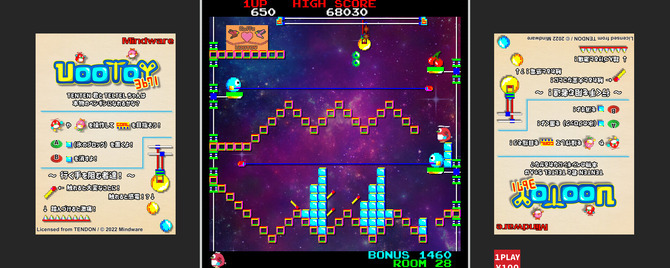
I asked people to send me the load reports generated by the app, but all I got were screenshots saying things like, “Look at this creature I created!”Since I hadn’t created it as a game, I received off-the-mark feedback like “This is interesting” or “This is actually pretty good.” While I thought, “That’s a bit rude,” hearing people say it was fun gradually made me decide to turn it into a game.
This title was the game that led to my first encounter with Mr. Keino. Initially, when I created the sample, I had planned to have Junko Ozawa compose the music.Ms. Ozawa was fully on board, but during a meeting one day, she mentioned, “I’m not really coming up with anything like this…” I was struggling with it when someone suggested, “Why don’t you ask Ms. Keino?” To me, Ms. Keino and Ms. Ozawa are like goddesses, so once I heard a message from the goddesses, there was no reason to refuse, right?
Ms. Keino: Up until then, we’d never been in contact at all, and I didn’t know who Mr. Ichikawa was.
Mr. Ichikawa: That’s right. So, right after that meeting ended, while Mr. Ozawa was writing a note saying, “You’ll hear from someone named Ichikawa,” I was already on my way to contact Ms. Keino. When I explained the concept to her, she really liked it.
Ms. Keino: Mr. Ozawa really appreciated Mr. Ichikawa’s quick thinking.
Mr. Ichikawa: Ahahahaha! (laughs) So just a few hours later, I was already thinking, “Let’s do this!”
That was around March 22, 2023, and shortly after that, I met with Mr. Keino, and the release date was set for June 23. We finished it in exactly three months.
*Denshi Life* was the first game to properly express the idea that music changes in response to the game’s situation.The operational logic is completely different between the first and second games, but in the first one, it used a 32-second track that would switch to a theme featuring clusters of electrons gathering every 8 seconds. In other words, even if it suddenly switched to a different song at 8-second intervals, it still made sense. They made this incredibly unique concept a reality.
Mr. Keino: In the original *Denshi Life*, only one sound plays at a time, but depending on the situation, a different song might play 8 seconds later. Depending on the situation, it might continue playing. We designed it so that whether it continues or switches to a different song, the transition flows seamlessly.
Mr. Ichikawa: Even the songs you can’t hear are playing at zero volume the whole time. So no matter which song it suddenly switches to, it all makes sense—he composed music that made us ask, “Is such music even possible?” and this system brought it to life. It’s certainly true that Mr. Keino is able to express this because he works with all kinds of music, including folk music.
――So, this system truly embodies all of Mr. Keino’s past experience.
Mr. Ichikawa: I think it’s absolutely packed with it!
Mr. Keino: On the other hand, this might be something that could only be done in a game. It might not be impossible to line up eight performers and have them change when the conductor gives the signal, but…
Mr. Ichikawa: Also, for *Denshi Life*, in the time-based mode, we had it change every second. This happened by chance—the arranger who was working with us said, “Since this is 120 BPM, switching every second will work just fine!” We tried it out a bit, and it turned out to be really interesting.
Mr. Keino: My suggestion was, “Let’s make the 8-second switches the main focus. For people who are used to 8-second switches, I think 1-second switches would work well too.”
――I sensed an essence reminiscent of early ’80s arcade games in *Dropping Drops*. Was that something you were specifically aiming for?
Mr. Keino: I didn’t consciously think of it as an arcade game. The previous projects I’d worked on with Mr. Ichikawa—*Denshi Life* and *Denshi Life 2*—both had very abstract concepts, so I just assumed, “This one must be the same!”
So, for the BGM, I set some constraints—such as progressing by second intervals (C-D, D-E, etc., using adjacent notes) in Stage 1, third intervals (C-E, E-G, etc.) in Stage 2, and fourth intervals (C-F, F-B, etc.) in Stage 3—and began creating prototypes.This was incredibly difficult, and just as I was really struggling, the working title *Arisu and Yuu’s Candy Factory* was announced, and even illustrations of Arisu and Yuu were revealed. As I explained in detail in the interview published in the booklet for the *Dropping Drops* soundtrack CD,The worldview we had built up until then came crashing down… Although it was later decided that Arisu and Yuu wouldn’t appear in the game, Mr. Ichikawa told me that the worldview would still retain its cute image. So I thought, “Well then, I have to make it cute through the music!” and composed it as a waltz.
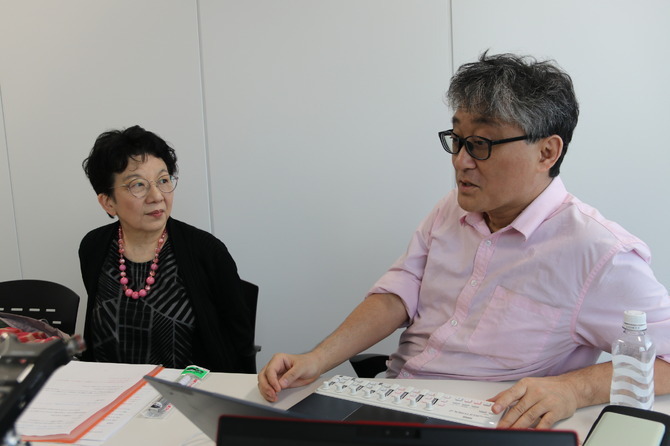
Mr. Ichikawa: “Arisu and Yuu” are the four-year-old protagonist Arisu and her friend Yuu, who appear in our games *Arisu and Yuu: The Star of Numbers* and *Space Mouse 2*. I had been thinking about creating a world where these characters would appear, but since introducing the protagonist didn’t quite fit with this title, we suddenly decided to drop the idea.
Mr. Keino: I was wondering, “Where are they going to show up?” Would they fall down along with the candy, or would they be at the bottom of the screen…?
Mr. Ichikawa: I’d envisioned them as mascots or narrators, but that wouldn’t have been very interesting. Since they existed, I wanted to give them a chance to shine. But since this isn’t a game where those characters take center stage, I decided to drop the idea… I irresponsibly scrapped the plan twice.
――So you rebuilt everything from scratch, including the musical direction?
Mr. Keino: That’s right~
Mr. Ichikawa: As for why it turned out that way, one reason is that we didn’t originally set out to create it with a release in mind. So at first, we didn’t have a world setting or anything—our goal was simply to demonstrate that “having a controller changes the gameplay, right!?”—so the actual game content didn’t change at all.
With so many games out there now, I think one of the downsides is that developers end up making games that seem to be catering to what players want.That causes the game to lose its individuality, and the concept itself becomes diluted. With that in mind, I believe small-scale games have no choice but to be bold and distinctive. That’s also why I agonized over how to express the game’s world. Even if the candy factory itself didn’t change, I had to make sure it was clear that it was some kind of facility.
Author’s Note: *Additionally, this game features a “100 yen per play” icon. It can be switched between 100 yen and 50 yen, and this design was implemented with permission from Seimitsu Industries, a company known for manufacturing sturdy, high-precision joysticks.Furthermore, the developer explained each element that gives this game its arcade-like feel, such as the screen design that replicates the white border found on table-style arcade cabinets.

Mr. Ichikawa: With the original *Denshi Life*, the number of dots caused constant frame drops when displayed in full-screen mode, so we opted for a table-style cabinet design to avoid complaints that the screen was too narrow to see clearly. As a result, the game ended up resembling classic arcade games.If this installation includes the “1 Play” label, it certainly does feel like an arcade game. At the “Microcomputer Infinite 68” event where we first unveiled this title, we left the 100-yen label as-is, and there was even an instance where, when I said “Go ahead” to one visitor, they actually pulled a 100-yen coin out of their wallet (laughs).
――KORG’s KAMATA reconstructs the “waveform memory sound source” that was used in Namco’s classic arcade boards. Mr. Keino, did you discover anything new when you tried it out?
Mr. Keino: From my perspective, even though the KAMATA and the Custom 30 use the same method for creating sounds, I feel there’s a very significant difference between them.First of all, with the Custom 30, there’s inevitably some distortion in the sound due to hardware limitations. I once had someone show me the waveform on an oscilloscope, and the peaks of the square wave weren’t parallel to the centerline—they sloped slightly upward to the right.
Just recently, during an interview at Bandai Namco Entertainment, a long-time employee asked me, “There’s this one incredibly high-pitched note—what is that?” I replied, “I think that’s probably a sound produced by distortion resulting from hardware limitations.” The tone wasn’t nearly as clean as it is now.
The biggest difference is the number of sounds that can be played simultaneously. As I mentioned earlier, the Custom 30 basically has a maximum polyphony (i.e., number of channels) of 8.With only 8 notes available, we had to play both the background music and all the sound effects. For example, if we wanted to play a single sound effect, we had to reserve one of the 8 notes for it. If we wanted to play two, we had to reserve two. We were constantly making these adjustments throughout the entire game.
“Pac-Land” was particularly challenging. During gameplay, ghosts would appear riding various vehicles, and all sorts of objects would pop up, triggering sound effects one after another. Every time that happened, we had to constantly manage which sounds to play and which to mute.
Let me explain using the example of the “First Place Name Entry” track from *Dropping Drops*, which Mr. Ichikawa really liked. In this track, a bell-like sound performs a glissando (a technique where the pitch transitions smoothly up or down along a scale), so while each note is played individually, the next note begins as the previous one is still decaying.If we tried to do this within the Custom 30’s 8-note limit, the other notes wouldn’t play. To solve this, we’d need to use multiple sound chips—it would become that complex.
――So that means the music played in *Dropping Drops* is incredibly rich, isn’t it?
Mr. Ichikawa: That may well be true.
Mr. Keino: We did everything we could with KAMATA. But we’re still learning.
Mr. Ichikawa: I hope we can work together again someday…! I’ve actually become a fan myself—being the first to hear the songs Mr. Keino creates is such a privilege! Plus, it feels like I’m not just hearing Mr. Keino’s songs first, but also the ones Mr. Ozawa wrote. It even made me feel like I was one of the bigwigs at Namco back in the day (laughs).
Mr. Keino: Back then, even if you weren’t a big shot, everyone in the room would listen. By around ’86, everyone was wearing headphones, but back in ’81, we weren’t using headphones at all, so whenever we played a sound, everyone in the room would hear it.
The hardware designers, programmers, and sound engineers for video game development were all in one section—a total of a dozen or so people—and there were several arcade cabinets set up in that room. We were all working away in a lively, bustling atmosphere.
Mr. Ichikawa: Ms. Ozawa mentioned this, too—how whenever a new sound effect was added, everyone in the room would react with an “Ooh!”
Mr. Keino: A lot of people from Ms. Ozawa’s generation joined the company, and since we’d moved to a new office building the year before—which meant we had more space—the atmosphere was even more intense before she joined.
Mr. Ichikawa: On *Dropping Drops*, I really looked forward to receiving the music data from Ms. Keino. If I was at my desk when the data arrived, that was fine, but if I was on the move, I’d find myself thinking, “I hope the train gets here soon!”
――By the way, do you have any favorite sound effects or tracks from this project?
Ms. Keino: The piece I found most rewarding to create wasn’t one of the tracks in this game itself, but rather “Candy Box Waltz”—a track I remixed from the game’s music for a mini CD keychain embedded with an NFC tag.
Mr. Ichikawa: The mini CD case, modeled after this game’s soundtrack, has a built-in NFC chip; when you hold your smartphone up to it, it takes you to a page where you can listen to the track.
Author’s Note: *At this point, Mr. Ichikawa played the actual track for us.


――It’s such a fun song!
Mr. Ichikawa: The remix is fantastic!
Mr. Keino: We incorporated some of the BGM and sound effects into the remix. It’s a track just over two minutes long with a structure different from the looping BGM.
Mr. Ichikawa: Personally, I like the “Top 1 Name” track the best.
Mr. Keino: The ending of this track is designed to lead into the “Top 1 Name” theme. I think we managed to create a particularly elaborate “Top 1 Name” theme for this game.
Mr. Ichikawa: While there are many games with name-entry screens—like *Galaga* and *Xevious*—I mentioned to Mr. Keino that there tend to be more classic tracks among the songs ranked 2nd or lower than the 1st-place track. He replied, “I’ll make the 1st-place track a classic too!” and what he came up with was truly amazing. It really made me think, “That’s Mr. Keino for you!”
Mr. Keino: Unlike at arcades, since people play at home, it’s pretty easy to listen to the No. 1 track (laughs).
Mr. Ichikawa: Not just this “Dropping Drops” track, but ever since the very first “Denshi Life,” the sound effects Mr. Keino creates have been outstanding.
Mr. Keino: I think I did a good job with the sound effect for the drops.
――It definitely felt great. The sense of satisfaction when you dropped a candy into the “Shape” was incredibly intense.
Mr. Ichikawa: We’re using all three types of sound effects you provided, and we’ve set it up so the pitch changes based on the color of the candy you hit. In that sense, when you hit the same type of candy, the same sound always plays, but when you hit a different type, the pitch changes.
Actually, since there are hundreds of candy pieces, if we were to play every single sound literally, it would become so overwhelming that it would be jarring to the ears. So, we limited it to playing only four channels, and furthermore, if one sound plays, we made sure it doesn’t play again if the piece comes into contact with anything else within three frames.We also made it possible to adjust the number of channels analogically, so we had Ms. Keino test it to ensure it matched human perception and fine-tuned it accordingly.
What really elevated Ms. Keino’s “goddess status” was when she asked right from the start, “Would it be okay if I handled the sound effects too?”Personally, I was worried it might be too much of a burden, so I was thinking I’d have to make other arrangements. But then Ms. Keino told me, “I want to create all the sounds for the game world,” and I thought, “My childhood dream has come true!”—it was wonderful.
Ms. Keino: Being called a “goddess” made me realize—gods are supposed to grant their followers’ wishes, aren’t they? (laughs)
Mr. Ichikawa: The more followers you have, the more wishes you have to grant, right? (laughs)
――What kind of games would you like to make in the future?
Mr. Ichikawa: There’s this current project, and there’s also a game that’s like the ultimate evolution of a legendary title. Besides that, there are projects involving original hardware, and things like building a real pinball machine—the possibilities are endless. I think I’ll have to keep creating, day and night.
Mr. Keino: You’ll probably just come up with another idea out of the blue, won’t you?
Mr. Ichikawa: Exactly! Sometimes ideas just come out of the blue—like, “This is it!” (laughs) Anyway, I want to create these new types of games and let everyone experience them. When I returned to work after a serious illness, I realized something: games aren’t essential to daily life, and for people outside the gaming industry, not having them won’t kill you or leave you unable to make a living.
So when I asked myself, “Then why am I doing this?” I realized that when people have fun through entertainment, they feel more open-hearted and become better people. I think my “mission as a game creator”—the one God has given me—is to help people release their daily stress, become better versions of themselves, and start the next day with a fresh outlook.The fact that I have to create games that everyone can call “a pillar of their heart” is why our company is named Mindware, and I want to keep making games like that.
――Thank you very much!