


On October 1, 2026, *Ghost of Yōtei Complete Edition*, which includes new content and more for the PS5 action-adventure game *Ghost of Yōtei*, was released.With Patch 2.0, released on October 2, the story expansion “Echoes of Sekigahara / A Tale of Longing at Sekigahara” and the combat survival mode “Most Wanted / A Swordsman’s Tale,” which incorporates roguelike elements, are now available to play.
“Echoes of Sekigahara” explores the protagonist Atsushi’s past, his relationship with Nagato, and the historic Battle of Sekigahara. Meanwhile, in “Most Wanted,” players can combine swordsman skills (perks) with each challenge to enjoy the battles over and over again.The return of *Ghost of Tsushima*’s protagonist, Jin Sakai, as a playable character also generated a lot of buzz.
Game*Spark recently interviewed Joanna Wang, Art Director at developer Sucker Punch Productions, and Parker Hamilton, Lead System Designer.We asked them about their reasons for depicting the romance of the avenger Atsu, their approach to historical accuracy, the rationale behind adopting the roguelike genre, and the character model for Jin Sakai.
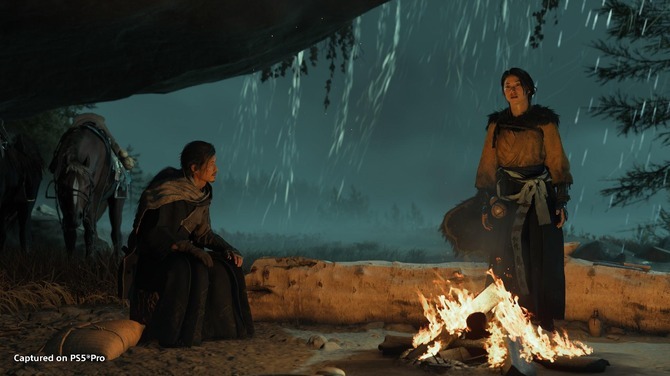
Why did you choose to depict a romance for Atsushi, the Avenger?
――At first glance, “a person consumed by revenge” and “a love story” seem like contradictory elements. Could you tell us the reasoning behind your decision to deliberately include Atsushi’s romance in this game?
Joanna Wang (hereinafter Wang): First, as a premise, we wanted the main story of *Ghost of Yōtei* to be a self-contained work.
At the same time, there was still room to explore the events that occurred between the time Atsuko lost her family as a child and the time she returned to Ezo as an adult to embark on her journey of revenge. While the main story touches briefly on her past, we felt there was an opportunity to delve deeper into what happened during that period.
In crafting the story, I also wanted to show a different side of Atsu as a character. She is, after all, a human being, and over the course of her long journey, she must have experienced a range of emotions, met people, and changed as she built relationships with them. “Sekigahara: A Tale of Longing” became an opportunity to revisit Atsu’s past and portray a new facet of her personality.
Through her relationship with Nagato, we depict the joys and sorrows Atsu has experienced, as well as how she herself has changed. We wanted players to see a different side of Atsu than they’ve seen before and to gain a deeper understanding of who she is as a person.
――This version of Atsuko also depicts her in a romantic relationship—a side we didn’t see much of in the main story. Were there any disagreements within the development team, such as “Atsuko wouldn’t say something like that!”?
Wang: Of course, there were various discussions within the team, and there were times when we didn’t see eye to eye. However, I think that’s actually a very healthy thing. It’s precisely because everyone cares so deeply about the character of Atsuko that those discussions arise.
One particularly major point of discussion was how to position the story of “Sekigahara: A Tale of Longing” within the main story. As I mentioned earlier, the main story is a self-contained narrative. When adding a new story to it, we needed to carefully consider what significance it would hold in Atsushi’s life.
By depicting her relationship with Nagato, we wanted to show Atsu’s vulnerable side. We wanted players to better understand the experiences she’s gone through and the emotions she’s felt. Of course, at the same time, we didn’t want to lose the essence of Atsu that everyone knows from the main story.We needed to depict new facets of her character while remaining true to her established persona.
Regarding that balance, the entire team openly exchanged ideas and worked together to bring it to life.
The Reason for Reintroducing “Snake,” Who Was Eliminated Early On
――In *Sekigahara: A Tale of Longing*, the spotlight is also shone on “Snake,” one of the Six of Yotei who was defeated very early on in the main game. Was this planned from the development stage of the main game? Or was it conceived in response to player feedback?
Parker Hamilton (hereinafter Hamilton): That’s an interesting question. “Snake” is a really fun character. Of course, he’s terribly despicable and a thoroughly unpleasant person, but as a character, he’s incredibly entertaining.
Unfortunately, since he was the first of the Yotei Six to be defeated, he didn’t have much screen time in the main story. So, when we were thinking about how to further explore Atsushi’s story—and in which era and setting to do so—we thought this might be an opportunity to delve deeper into Snake as well.
Learning more about Hebi provides an opportunity not only to explore Atsu’s past but also Hebi’s own past and the impact he had on Ezo. It was also important to show how his influence would persist after he was gone. For example, those who served under him might fight over the power he left behind.
This would serve as a new trial for Atsu, while also giving her a chance to reflect on the consequences of her own actions. In that sense, I believe that delving deeper into the character of the Snake once again was a wonderful opportunity to further expand Atsu’s story.

We Did Not Aim for a “Perfect Recreation” of the Battle of Sekigahara
――This DLC depicts the “Battle of Sekigahara,” one of the most famous battles in Japanese history. When portraying such a large-scale battle based on actual history in a game, could you tell us what aspects you were particularly focused on and what challenges you faced?
Wang: The first thing I’d like to clarify is that we did not attempt to create a 1:1, exact replica of the Battle of Sekigahara based on historical facts. Since the Battle of Sekigahara is one of the largest battles in Japanese history, it’s impossible to recreate every single detail exactly as it happened historically.
However, ever since the development of *Ghost of Tsushima*, we’ve worked closely with experts well-versed in Japanese culture and history. We’re doing the same this time, learning about various historical contexts and gathering information.
For example, we’ve researched the time of year the battle took place, the weather conditions at the time, the location of the battlefield, the scale of the fighting, and how it ultimately ended. Since the Battle of Sekigahara took place on Honshu, not in Ezo, we also investigated these geographical aspects.
While maintaining respect for the information we gathered and the historical facts, we incorporated them into a story told from Atsu’s perspective. Atsu finds herself caught up in a battle so vast that she cannot possibly handle it on her own. And that battle becomes a pivotal event that changes her life.

▲ Atsu and Nagato face off amid the flames of battle. Image source: PlayStation.Blog / SIE・Sucker Punch Productions
One of the biggest challenges during development was expressing the grandeur of the battles while ensuring the game remained playable. We had to allow players to feel the intensity of the vast battlefields, while also providing a space where they could actually control and move their characters to advance the story we wanted to tell. Furthermore, we needed to incorporate major duel sequences right in the midst of the battles.
Balancing the narrative flow with the flow of actual gameplay was a major challenge. There were some technically very difficult aspects, and I don’t think we could have pulled it off without the entire team working together.
The Purpose of Introducing Roguelike Elements to “Kenka Gitan”
――Next, I’d like to ask about *Kenka Gitan*. Why did you decide to incorporate roguelike elements into the combat system of the *Ghost of* series? Please tell us how the idea came about and what kind of experience you aimed to create during development.
Hamilton: With “Swordmaster’s Tale,” we first wanted to create a mode where players could focus solely on combat—one that would make them want to play repeatedly. We wanted players to enjoy a combat experience distinct from the main story by honing their skills and taking on increasingly difficult challenges.
In the main game’s combat, we need to balance it with the story and exploration. However, in “Swordmaster’s Tale,” we can break free from those constraints and focus on delivering a memorable combat experience where players can unleash powerful abilities.
So, we started by creating a “loadout” system that places certain restrictions on the equipment and actions players can use. On top of that, we incorporated roguelike elements. We designed the game so that the Swordsman Skills acquired with each challenge would lead to different fighting styles and fresh experiences.
Our goal was to create a mode where, after playing for about 15 minutes, players would find the experience so enjoyable that they’d want to play it again. And in the next challenge, they’d have a different experience from the last. We wanted to create that kind of fun that keeps players coming back for more.
We’ve prepared some truly fun and exciting Swordsman Skills that can be acquired in each challenge. By combining them, we hope to create a different combat experience every time.

――Jin Sakai, the protagonist of *Ghost of Tsushima*, makes a surprise appearance in *Kenka Gitan*.Compared to the previous game, Jin’s features seem more rugged, and the level of detail appears to have increased. Is this the result of re-enlisting Daisuke Tsuji, who voices him, and performing new facial capture? Also, if there’s a story behind bringing Jin back, please share it.
Wang: I’m very happy to have had the opportunity to work with Daisuke Tsuji again.
*Ghost of Tsushima* was originally developed for the PS4. *Ghost of Yōtei*, on the other hand, was developed for the PS5 from the very beginning. There’s a six-year gap between these two titles, and during that time, our rendering technology has advanced significantly.The features and technologies available for rendering characters have also improved significantly compared to before.
Therefore, for Jin in this game, we’ve refined the model so that he can be rendered with the same level of detail as the characters in *Ghost of Yōtei*. However, we did not perform a new face scan specifically for Jin.

“Sekigahara: A Tale of Longing” depicts the joy, suffering, and relationships with others that lay behind Atsushi, who threw himself into a quest for revenge in the main story. It seems that a major theme in development was to portray a large-scale battle as the experience of a single individual, while maintaining respect for historical facts.
On the other hand, “Swordmaster’s Tale” marks a shift from the main game—which prioritizes a balance between story and exploration—by focusing on the repeated enjoyment of combat itself. It was impressive to see the developers explore a different direction while still cherishing the series’ traditional strengths, including the return of Jin Sakai.
*Ghost of Yōtei Complete Edition* is now available for PS5. Owners of the standard edition can play the additional content by purchasing the “Complete Edition Upgrade.”


