


Colorful tropical fish swim through the ocean, where beautiful coral reefs stretch out, and Clione-like fairies dance about. This city-building simulation lets you protect and nurture a paradise for marine life that resembles the Dragon Palace from a fairy tale. That’s *Life Below*, the game we’re introducing today.

*Life Below* is a city-building simulation released for PC (Steam) on May 26, 2026. It is published by Kasedo Games and developed by the Norwegian indie studio Megapop.
The game is set in a marine ecosystem centered around a coral reef. As a rookie guardian, the player expands the coral reef, creates habitats for marine life, and guides this ecosystem toward prosperity.As befits a game centered on ecosystems, terms like “biodiversity” and “pH level” (a measure of acidity or alkalinity) do appear, but no specialized knowledge is required to enjoy the game. If you have experience playing city-building games, you’ll quickly get the hang of the systems.
In this article, the first half features a playthrough report detailing the actual gameplay, while the second half presents an interview with Lise Hagen Lie, the game’s director and project manager, conducted at the Megapop booth during the Tokyo Game Show 2026.
Click here for the*Life Below* Steam page!

"Life Below" Coral Reef Simulation Gameplay Report
The protagonist of *Life Below* is a rookie guardian who resembles a clione. Her name is Thalassa. Appointed as the guardian of the coral reef by the will of Gaia, which dwells within a giant coral, Thalassa works to make the reef flourish with the help of other clione-like water sprites.

That said, the coral reef is rather barren at the start of the game; aside from the giant coral in the center and Tarassa and her companions, there are no living creatures to speak of. In this state, it’s not a coral reef at all—it’s just a rocky outcrop. Let’s get started right away by giving instructions to the water nymphs to expand the coral reef.

The Water Fairies will build structures like coral in the locations you specify. Construction requires a resource called “Coral Matter,” which can be obtained by building resource-producing coral on specific terrain types.It’s easy to understand if you think of it like building a sawmill in a forest to produce lumber. However, since resources never run out in this game, you can feel free to produce as much Coral Matter as you like.
Similarly, “Pearls”—the game’s currency—can be produced by building bivalves. Since the only resources needed for construction in the early game are Coral Matter and Pearls, resource management is very simple. Even beginners can feel at ease. If you ask the Water Fairies, they can also convert structures back into resources for reuse.

To maintain structures such as coral, you need energy produced by a special type of coral called Moon Coral. Energy from Moon Coral reaches only within a certain distance; anything built outside that range will be useless.Moon Corals must also be placed within range of each other so their energy can reach one another. It’s easiest to think of this as a system similar to a power plant and a power grid.
Since there are no complex mechanisms like power transmission losses, you’ll be fine as long as you gradually increase the number of Moon Corals as the reef grows. Even those unfamiliar with this genre should be able to play without getting lost.

As I progressed through the game, and coral began to appear here and there on the once-barren rocky shore, the previous guardian, Pontos, appeared in the story. Pontos acts as a reliable mentor, sometimes offering advice to the newcomer, Tarassa, and other times coldly rebuffing her.Their witty banter is a joy to watch and adds a touch of color to gameplay that can otherwise become too absorbed in building.

Now, while corals and bivalves have started to appear on the rocky outcrops, this alone doesn’t yet constitute a rich ecosystem. Next, we’ll want to attract fish.
Preparing the reef is essential for fish to inhabit it. First, you must provide anemones—which serve as homes for the fish—and algae and coral, which serve as their food. Research is key to achieving this. The research system in this game follows a traditional style, where you consume resources to advance through the tech tree.Research may sometimes require “biodiversity,” which can be acquired by attracting various types of creatures to inhabit the coral reef.

The game also features crafting elements. Lures, which can be crafted using seaweed growing on the seafloor, are tools used to attract fish to the coral reef. Additionally, by crafting fairy eggs, you can increase the number of water fairies that assist Tarassa.
When I used the lure, small fish like clownfish immediately gathered at the coral reef, settled into the anemones, and began swimming around freely. With the fish taking up residence, biodiversity increased. By utilizing this biodiversity to advance my research, the giant coral at the center of the reef finally evolved to the next stage.

Thanks to the giant coral’s evolution, we were able to expand into other areas of the ocean known as “zones.”The zone at the start of the game had water temperatures and pH levels suitable for coral growth, but surrounding it are zones with various environmental conditions, such as freezing fjords and high-temperature undersea volcanoes. To expand into new zones, biodiversity is necessary, and research must also be conducted to adapt to these new environments.

The author chose the fjord zone as the next destination for expansion. In this zone, the water temperature is low, and the Moon Corals built to supply energy suffered stress one after another and ceased functioning. Without energy, it is impossible to grow other corals.
Therefore, I first began researching Heat Corals, which have the effect of raising the water temperature in the zone. I built these Heat Corals on rocky outcrops where energy could just barely reach them, improved the environment within the zone, and then reintroduced Moon Corals to establish a foothold.

Although we struggled immediately after the expansion, we were steadily expanding the coral reef when, suddenly, a warning appeared on the screen. It stated that a heatwave was about to hit the first zone. A countdown began, and once it ended, the water temperature gradually began to rise. The temperature continued to spike sharply, and in the blink of an eye, it exceeded the range suitable for coral growth.

As the coral screamed in distress all around, I remembered the “Cooling Coral,” which I had researched in preparation for a future expedition to undersea volcanoes.As the name suggests, “Cool Coral” has the effect of lowering the water temperature in its zone. The Cool Coral, constructed in a rush, demonstrated its full potential and protected the coral reef from the threat of the heatwave.
In addition to environmental changes like this, *Life Below* features numerous events, such as quests commissioned by “lost souls” wandering the depths.

Additionally, “Wildlife View” is the perfect way to take a break from gameplay, which can sometimes get hectic. This mode allows you to leisurely admire the coral reef you’ve nurtured from the perspective of marine life, and you can switch to it at any time during gameplay.Gameplay pauses while you’re in this mode, so you can immerse yourself in this beautiful, aquarium-like world at your own pace, without feeling rushed.

My coral reef, which had adapted to diverse environments—including deltas, undersea volcanoes, and wastelands—and grown into something strikingly beautiful, finally faced its “first real trial.” Pontos, a senior guardian, vanished after telling me, “Be prepared for whatever comes your way.” There’s no one left to offer advice.
What exactly is this “true trial,” and what awaits you on the other side of it? From here on out, I encourage you to play *Life Below* yourself to find out.

*Life Below* Steam page!
*Life Below* Game Director Interview
Here, we bring you an interview with Lise Hagen Lie, Game Director and Project Manager for *Life Below*, conducted at the Megapop booth during the Tokyo Game Show 2026.
Megapop was exhibiting in Hall 8 at the Tokyo Game Show 2026, located in an area where Norwegian-based developers gathered. The displays, packed tightly together, showcased beautiful footage from *Life Below*.
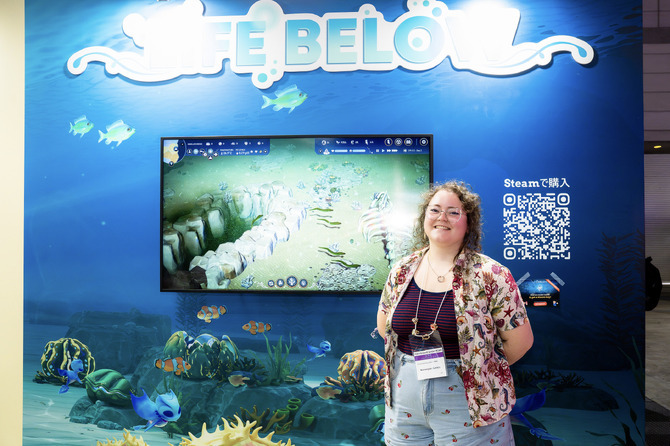
――First of all, please tell us about the development studio Megapop.
Lise Hagen Lie (hereinafter referred to without honorifics): Megapop is a studio based in Oslo, Norway, and has been in operation for 14 years. We’ve produced numerous games to date. Initially, we focused primarily on mobile games, but for the past six years, we’ve been developing for Steam and home consoles, aiming to create an eco-friendly city-building simulation.
――Could you tell us about the scale of the “Life Below” development project?
Lise: There were 12 people involved in development within the company alone, and 15 people in total when you include external contractors for the story, music, and other elements. It took three and a half years to complete the game.
――What prompted you to start developing this game?
Lise: I’ve always personally enjoyed the city-building simulation genre.I used to play *StarCraft* as a teenager, and more recently, I played *Frostpunk*. Also, since I grew up by the ocean, I love nature, so I wanted to create something from a natural perspective. The catalyst was my desire to blend all the things I love to create a unique work.
――*StarCraft* is generally known as an RTS (real-time strategy) game, but as a city-building simulation, how was this game influenced by *StarCraft*?
Lise: Of course, I love *StarCraft* as an RTS, but what I especially enjoy is the element of building and expanding a base. I love nothing more than watching the world expand from nothing, and this was a major source of inspiration for this game.
――Are there any other works that influenced you?
Lise: The game that influenced me the most was *Frostpunk*, but I also drew inspiration from *The Wandering Village*, *IXION*, and *Terra Nil*.

――The theme of this game is the marine ecosystem centered around coral reefs. Could you tell us why you chose this theme?
Lise: I think growing up by the sea played a big role. My grandfather worked in shipbuilding, but he also built boats for our family. Every summer, we’d take that boat out to sea and spend time on an island. Those experiences have had a major influence on this game. If I hadn’t been working on this project, I might have become a marine biologist.
Also, Norway is home to the world’s largest coral reef in cold waters, but since it’s not very well known, I wanted to share it with as many people as possible.
――How do you balance the gameplay elements of a city-building simulation with the concept of an ecosystem?
Lise: That’s a great question. We consulted with marine biologists and adapted the mechanisms essential to city-building simulations to real-world ecosystems—all without compromising the fun. For example, since coral reefs cannot grow without rocky outcrops, in the game, coral can only be placed on rocky outcrops.
Also, while it’s common in the city-building simulation genre to destroy nature when expanding, we aimed to avoid destroying nature in this game.
――As a city-building simulation, could you tell us what makes this game unique compared to other titles?
Lise: The approach of coexisting with nature rather than fighting against it is what fundamentally sets this game apart from others.
The game incorporates the concept of “biodiversity,” which is at the very core of the game. To advance new research or expand into new ocean regions, you must collect various types of marine life to increase biodiversity. In that sense, too, it’s an eco-friendly game.
Additionally, humans do not appear in this game at all. Just as external crises are caused by natural threats rather than humans, the game’s systems are designed to function with nature at the center.

――While playing, I felt a sense of calm, as if I were gazing at an aquarium. Could you tell us what efforts you made to create that atmosphere?
Lise: It was extremely challenging to maintain a sense of strategic depth while also allowing players to explore the world they’ve created as if it were their own garden. To strike a balance between the two, we’ve included multiple difficulty levels in the game. Also, since many people rarely have the opportunity to visit beautiful coral reefs in real life, we focused on allowing them to experience that beauty within the game.
――What kind of efforts did you make regarding the graphics?
Lise: Since “blue” is the first color that comes to mind when thinking of the ocean, we needed to choose colors for the game’s elements that complemented it. At the same time, it was important to select colors that would allow players to visually distinguish what was happening in the game. We fine-tuned the color palette to ensure all of these elements worked together seamlessly.
――Could you tell us about any challenges you faced in localizing the game into Japanese?
Lise: I worked closely with the translators to ensure a high-quality translation, because I wanted as many people as possible to experience this game. The translators did an excellent job of conveying the characters’ personalities and atmosphere. Also, after receiving feedback from the translators that the font was hard to read, I got involved in selecting a new font myself and changed it to something more legible.
――At what stage of development did you begin planning for Japanese localization?
Since there is a lot of text in the game, we had been considering the implementation of a translation system from the early stages of the first year of development. At that point, Japanese was already high on the list of languages we planned to support.

――Do you hope players will be inspired to “look into” the ocean and coral reefs?
Lise: I don’t expect players to research anything in particular. I didn’t want to make this an educational game. Rather, I want to convey a sense of wonder and curiosity—to make players think, “Wow, a world like this exists!”
――What’s your favorite marine creature?
Lise: My absolute favorite is the coral crab. I used to fish for crabs a lot when I was a kid, so I have a special fondness for them. Other than that, I also love orcas. They’re incredibly intelligent. Orcas don’t appear in the game, but maybe we’ll add them someday.
――Finally, please share a message for players who are about to play this game.
Lise: Once you start the game, I hope you’ll immerse yourself fully in this world. And please take your time and enjoy it at your own pace. If you’re looking for a game that lets you relax and unwind, I highly recommend this one.
――Thank you very much for taking the time to speak with us today.
“Life Below” is now available for PC (Steam).
Click here for the*Life Below* Steam page!



