


This series features interviews with developers of intriguing new indie games. In this installment, we present a mini-interview with the developer of *Re:Story: The Memory Repair Shop*, an electronics repair shop management simulation developed by Mandragora and released for PC and Mac on August 7.
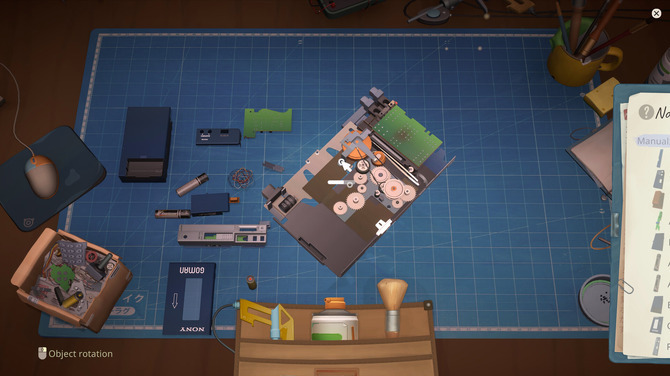
Set in Tokyo in the mid-2000s, this business simulation game follows the owner of an electronics repair shop tucked away in a corner of Akihabara. The items to be repaired range from nostalgic game consoles to cell phones and music players.Players disassemble these devices, clean off dirt, and replace parts to complete repairs. The game is also available in Japanese.
“Re:Story: The Memory Repair Shop” is available for 1,999 yen.


――First, please introduce yourself. What is your favorite game?
I’m Eugene Kisterev, founder and CEO of EugeneMandragora. Our studio was established in 2015. I’ve been working in the game industry for about 15 years, and I served as the game director for this title, “Re:Story: The Memory Repair Shop.”
One of my favorite games is *The Last of Us*; I consider it one of the greatest games of all time. I also play *Hearthstone* quite often, and I love nearly all of the titles developed by Supermassive Games, starting with *Until Dawn*.
――Could you tell us about the game’s key features? Also, how did you come up with the idea?
Eugene: The idea for *Re-Story: The Memory Repair Shop* came from a system we implemented in our previous game, the heartwarming survival title *I Am Future: Cozy Apocalypse Survival*. In that game, players could find household appliances like microwaves and electric kettles, take them apart, and use the parts they obtained for crafting.
When we realized that players were particularly enjoying this “disassembly system,” we felt we hadn’t yet fully explored its potential. So, we decided to make it the centerpiece of a standalone game. We already had this highly satisfying and addictive core system right at our fingertips.
That said, what truly makes *Re:Story: The Memory Repair Shop* a special title is our extraordinary love for nostalgia and the technology of the good old days.We still long for that era when slide-out and flip phones were part of a person’s personality and identity. We were young and happy back then. And it seems that many of you share those same feelings.
――Were there any works that influenced you while developing this game?
Eugene: In terms of the game system, we drew inspiration from titles like *I Am Future: Cozy Apocalypse Survival*, *Assemble with Care*, *PC Building Simulator*, and *PowerWash Simulator*.
To create the atmosphere, we drew inspiration from old video footage from the 2000s—for example, documentaries following PC enthusiasts in Akihabara. That kind of footage was extremely helpful in recreating the atmosphere of that era.
As for the characters and story, they developed more organically as development progressed, so it’s difficult to pinpoint a single work that served as a reference.

――Please tell us about one episode that left the deepest impression on you during the development of this game.
During the early stages of Eugene’s development, when we were creating a demo version, the game leaned more toward an adventure game than it does now. The flow involved customers bringing in their devices, repairing them using parts provided by the store, and returning them.
While it was a fun game, it still felt somewhat lacking—both as a business simulation and as a creative experience. So we added repair requests sent via email that offered a high degree of freedom, and incorporated a flea market element where players could buy inexpensive devices and take them apart for parts.
That was the very moment when “magic” happened. After playing it myself, I was convinced that “it had finally taken the form I’d envisioned.” From that point on, development went incredibly smoothly.
Immediately after announcing the game, we released a playable beta version and received an enormous amount of feedback from players right away, which further strengthened our confidence that “our decisions were correct.”
――What kind of user feedback did you receive after release? Please share any particularly memorable comments.
Eugene: What surprised us the most was the overwhelming response to the game’s “nostalgia.” Almost every conversation about *Re:Story: The Memory Repair Shop* begins with memories—like “the cell phone I used when I was younger” or “the game console I used to own.”
Retro gadget enthusiasts from all over the world began reaching out to us. We discovered a wonderful community of like-minded people. Realizing that so many people shared the same memories and emotions was the most meaningful experience for us.
――Based on user feedback, could you tell us about your plans for future updates?
Eugene: More devices, of course! We’ve already released several updates that include optimizations, usability improvements, bug fixes, and other tweaks.
And right now, we’re hard at work creating a massive amount of new content. We’ve received a lot of feedback from players saying, “We want support for more devices,” “We want more story,” and “We just want more content to keep us playing longer.” We plan to continue expanding the game in that direction.
――Could you tell us about the Japanese language support for this game? What was implemented, what were the challenges, and what has the reaction been like from Japan?
Eugene: “Re:Story: The Memory Repair Shop” has supported Japanese since its initial release. We’ve received extremely positive feedback from Japanese players, which makes us truly happy. We will continue to support the Japanese version moving forward. We’d like to express our heartfelt gratitude to all our Japanese players.
――Is it okay to stream or monetize this game?
Eugene: Of course. Players do not need to obtain our permission to create gameplay videos or livestream *Re:Story: The Memory Repair Shop*. We do not impose any restrictions, including those related to monetization. We are truly delighted that you are sharing your experiences with this game.
――Finally, please share a message for our Japanese readers.
Eugene: Japan has had an immeasurable influence on us as gamers. This is true not only in terms of its approach to game design but also through the countless wonderful games and consoles we enjoyed during our childhood.
We also view Japan as a country that has had an immense impact on the world through its creativity and innovation in technology and electronics. That is precisely one of the main reasons we chose Japan as the setting for *Re:Story: The Memory Repair Shop*.
We would like to express our heartfelt gratitude to all the Japanese players who enjoy our game and provide us with so much feedback. Thank you so much!
――Thank you very much.

◆ About “Spotlight on Indie Mini-Q&A”
This series features email interviews with indie developers shortly after the release of their games. To ensure regular publication, we’ve standardized the questions, with the goal of sharing the perspectives of as many developers as possible. Please also enjoy our archive of over 1,000 other interview articles.
