


The Tokyo Game Show 2026, one of Japan’s largest game expos, was held at Makuhari Messe in Chiba from September 17 to 21 (the in-person event on the 21st was canceled due to a typhoon, with only the online portion taking place). To coincide with this event, Microsoft held a joint media presentation for its new hack-and-slash title, *Minecraft Dungeons II*.
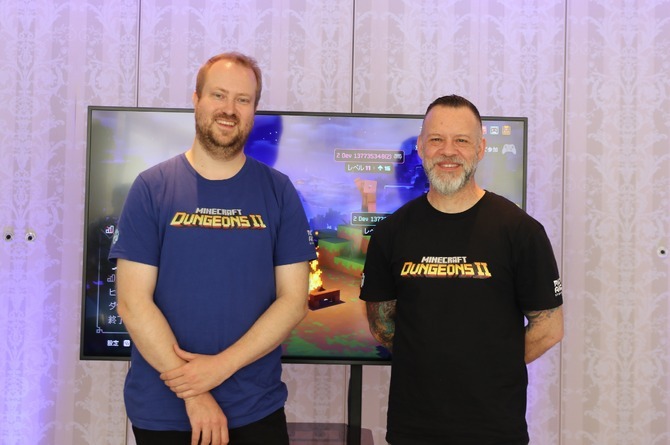
Game Director Mons Olson (hereinafter referred to as Mr. Olson) and Production Director Nathan Rose provided commentary during the presentation.
The impetus for developing this title came after the completion of the first game, when various ideas—both from within the company and the community—emerged along the lines of, “We’d like to try something like this next.” The team decided it would be better to create a sequel rather than add those ideas to the original game. Among the ideas for the sequel, one area that underwent a significant change was exploration, which had been a frequent request from players.

While the first game had a relatively linear progression, this installment features an interconnected world with a map that is larger than the first. Within this world, you’ll find both player-created and procedurally generated content, as well as structures known as “Lifts.” However, although the exploration mechanics have changed significantly, the game is not an open-world title like *Skyrim*.
In addition to exploration, multiplayer is another major feature of this game. While solo play is available, there are several multiplayer modes. These include local multiplayer for face-to-face play, online co-op, and a mode that allows you to connect online while playing in local multiplayer (where two players can cooperate locally while adding more players online).In addition, the game supports matchmaking, sessions using party codes, a friends list, and cross-play. Significant changes have been made not only to these multiplayer features but also to the game systems themselves.

Compared to the first game, the number of equipment slots has increased from one to four, expanding the range of customization options—much like in *Minecraft*. A new feature allows players to equip talismans to grant their character passive buffs. These effects include increasing the number of arrows, allowing players to bring a pet, and boosting the attack power of melee weapons.Talismans level up alongside the player, meaning they become stronger the more you play.
After the overview of the game system concluded, a video introducing the game’s story was shown. The video depicted a village that had enjoyed a brief period of peace since the first game; deep underground, an evil villager discovers a portal and abuses the power pouring out of it in an attempt to subjugate the world.The opening scene of this demo begins with the rescue of villagers from the first game and their subsequent journey to a new village called Brave Haven.
Gameplay with Well-Balanced Multiplayer Mechanics
From this point on, I was able to experience the game’s actual gameplay. Since I’m not very familiar with hack-and-slash RPGs and haven’t played the previous title, I can’t speak to how the feel differs from the original.
However, the controls themselves were intuitive and responsive, and I found the explanation—that the ability to jump adds depth to exploration and action—to be very convincing. Additionally, the “path of light” that indicates the direction to your destination could be activated to prompt movement, which I felt greatly enhanced the game’s accessibility.
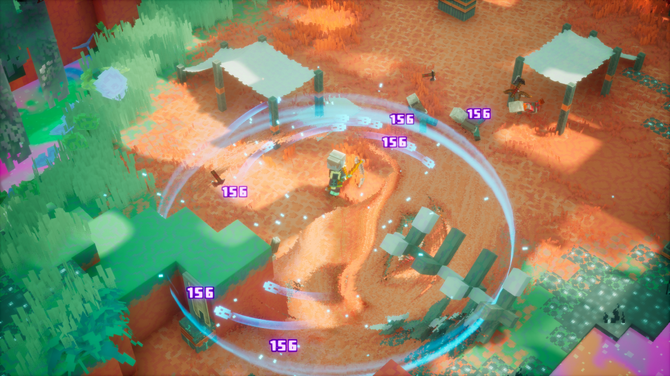
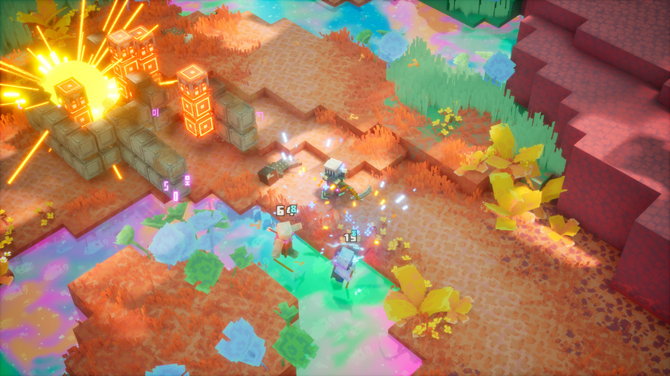
Each player’s melee attacks have distinct characteristics; not only is there a noticeable post-attack stun, but ranged attacks are also available. While simple, each mechanic functioned effectively.
One of the game’s most interesting aspects is how the ways to escape tight spots change as the number of players increases. In this game, the difficulty rises in proportion to the number of participating players. On the other hand, it becomes possible to revive other players simultaneously, and the fact that players naturally form various types of teamwork—unless they act independently—is a particularly engaging feature.Furthermore, playing with three or more players speeds up the revival process, so increasing the number of players itself becomes an advantage. These features are designed to make you want to invite others to play.
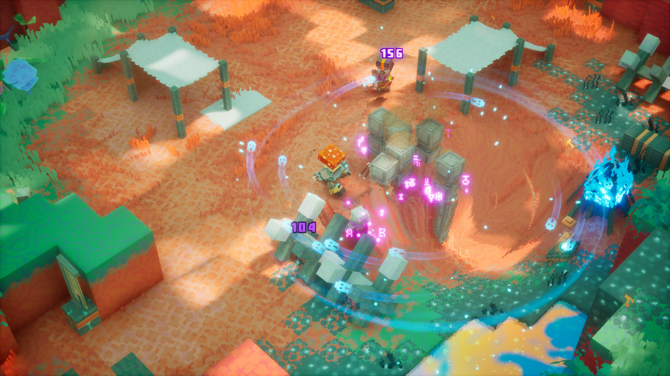
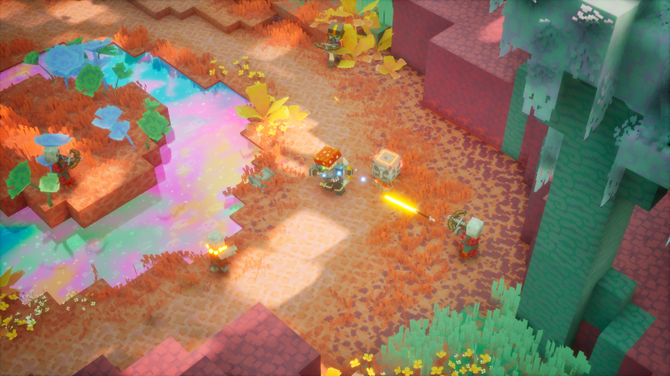
Additionally, the new “jump” mechanic adds depth not only to combat but also to map exploration, allowing a single player to scout out alternate routes and discover new items. Furthermore, since the entire party can warp to the item’s location to regroup, there’s no need to retrace the same route, which reduces the hassle.
Although the gameplay session lasted only about 20 minutes, the game’s approach as a casual hack-and-slash title that’s easy for even beginners to enjoy seemed to be working well.
After this hands-on session, a brief interview was held for the media.
――It seems the game has gained more depth as a hack-and-slash title with the addition of talismans, but since this is based on the *Minecraft* IP, I imagine young children will be playing it as well. Was there a conscious decision not to make the game too complex?
Mr. Olson: We want this to be an accessible game, so we’re mindful of lowering the barrier to entry—or at least maintaining that level of accessibility. However, we did want to add a bit more complexity.It might seem like reaching children and increasing complexity are mutually exclusive, but I believe it’s possible. To give one example, the “Guiding Light” feature I mentioned earlier is a prime example. Also, when it comes to equipment, enchantments are surprisingly deep and offer plenty of room to explore.
In that sense, the right side of the equipment screen displays all the effects currently active on your character, and as you scroll, the effects from each piece of equipment are highlighted. To ensure that players who enjoyed the first game can also have fun, we developed this title with a target audience about one year older than that of the previous game in mind.
――What kind of approach did you take for new players?
Mr. Olson: We wanted to make it enjoyable even for those who haven’t played the first game. For example, while the story picks up immediately after the first game ends, the cutscenes you just saw explain the entire backstory, so players can follow along even without having played the first game.In addition, we aimed to create a game where players can pick up the controller and start playing immediately—even without hearing any instructions or going through the tutorial. That’s exactly what we’re testing at TGS 2026 and in this demo.
――With several thoroughly hardcore hack-and-slash titles out there, what makes *Minecraft Dungeons II* appealing?
Mr. Olson: We’re not competing directly with games like *Path of Exile* or *Diablo*, but at the same time, we’ve included features that will resonate with players who want a deep experience.Since there are players who have put hundreds of hours into the first game, I believe this is a game you can keep playing for a long time if you want to. I think what sets this game apart is its approachability, low barrier to entry, and the fact that you can jump right in—things that distinguish it from others. Furthermore, I believe the fact that it tells a story set within the *Minecraft* universe is another key difference.
Since the game places a strong emphasis on multiplayer, players can revive one another, join or leave the game at any time, and cross-play support is another major feature. Also, regarding the first game, many people told us, “It’s so much fun to play this with your kids.” Parents can fully enjoy the complex mechanics, while the game also has elements that are simple enough for children—I believe it’s a game that parents and children can enjoy together.
――Thank you very much!
*Minecraft Dungeons II* is scheduled for release on September 29, 2026, for PC (Steam/Microsoft Store),PS5,XBOX Series X|S, Nintendo Switch, and Nintendo Switch 2. It is also available on Game Pass.
