


This series features interviews with the developers of intriguing new indie games. In this installment, we present a mini-interview with the developer of *Asterica: Phantom Rose Reprise*, a high-difficulty bullet-hell rhythm game developed by makaroll and released for PC and Mac on September 3.
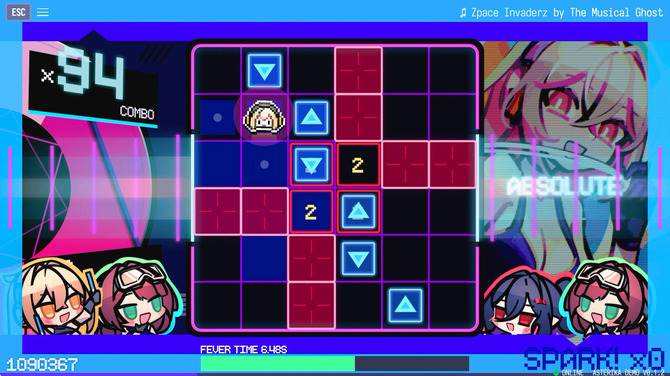
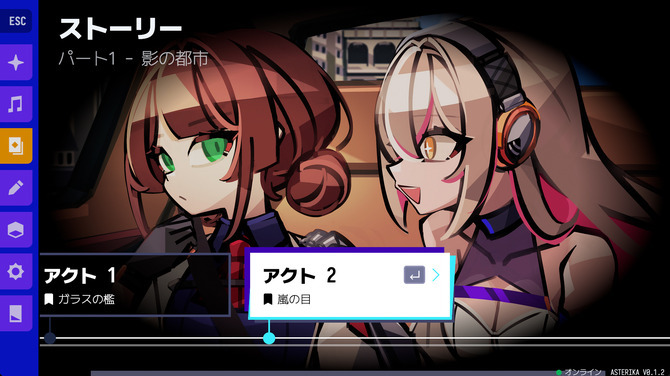
This high-difficulty bullet-hell rhythm game challenges players to carve out their own path across a 6×6 grid. Players must move and react in time with the rhythm to dodge the barrage of bullets. The game also features a story mode with text-based narratives woven around the Phantom Hunter “Iris,” the Phantom Thief “Vignette,” and the Engineer “Claire.” Japanese language support is included.
“Asterica: Phantom Rose Refrain” is now available for 1,900 yen.

――First, please introduce yourself. What’s your favorite game?
makaroll: I’m makaroll, the developer of *Asterica: Phantom Rose Reprise* (hereinafter *Asterica*). I’m an independent game developer and illustrator. So far, I’ve developed *Phantom Rose* and *Phantom Rose 2: Sapphire*.
Since being a game developer involves experiencing a wide variety of games as part of the job, it’s quite difficult for me to pick just one “favorite game.” Lately, I’ve been enjoying *Uma Musume* and *Zenless Zone Zero*, and when it comes to music games, I’m particularly fond of *Deemo* and *jubeat*.
However, if I had to name one game that feels like a “soulmate” to me, I’d say it’s *Final Fantasy XIV* (hereinafter *FF14*). It’s the game I’ve been playing the longest, and Naoki Yoshida has had a huge influence on me as a game developer. It’s a very special title to me—not only because of its story and world-building, but also because of the memories I’ve created within it.
――Could you tell us about the key features of this game? Also, how did you come up with the idea?
makaroll: At the core of *Asterica* is a system where you move across a 6×6 grid in time with the music’s beat while dodging various bullet patterns and obstacles. Unlike typical music games, where you wait for notes to appear and input them at the right moment, the key feature here is that “moving itself becomes the rhythm input.”
Neither moving in time with the beat nor games where you move across a grid are new ideas on their own. What interested me was wondering what kind of game would result if I took those existing elements and pushed them to the extreme in a single direction.
I’ve loved music games since I was a kid.I’ve played a wide variety of them, including *DJMAX*, *beatmania*, *Ossu! Tōe! Ōendan*, *jubeat*, *Muse Dash*, and *Deemo*. When I visit Japan, I play *Taiko no Tatsujin* and *pop’n music*, and whenever I find a new music game at an arcade, I give it a try.
However, precisely because there are already so many music games I love, I felt there was no need for me to add yet another game that offered a similar experience.I wanted to create a game where people looking for a different kind of thrill from the music games they usually play—or those who weren’t particularly interested in traditional vertical-scrolling rhythm games (VSRG)—would see *Asterica* and think, “What’s this? I’d like to give it a try.”
――Were there any games that influenced the development of this title?
makaroll: There isn’t a single specific game that I can point to and say, “I made *Asterica* based on this one.” I see it as a game that gathers experiences and ideas from various games and combines them in a rather extreme way.
For example, *Crypt of the NecroDancer* clearly demonstrates the joy of moving in time with the beat, and I personally really liked the grid-based gameplay that used to be in *Zenless Zone Zero*.
And when it comes to assessing safe spots by observing obstacles, I was definitely influenced by the raid experience in *FF14*. Anticipating what’s coming next, determining a safe zone, and moving there at the right moment—I really love that feeling.
“Asterica” was born from gathering these different experiences and asking, “What would happen if we took all of this and pushed it to the absolute limit as a ‘music game’?” I didn’t want to make a roguelike or RPG with rhythm elements; I wanted to create a pure music game built on the very foundations of moving to the beat, grid-based movement, and obstacle pattern recognition.

――Could you share one episode from the game’s development that left the deepest impression on you?
Around the time we were holding public demos for *makaroll*, while one player told us, “It’s already pretty difficult,” another said, “I want harsher penalties when I make a mistake” and “I want more tension.” Those are almost completely opposite requests, aren’t they?
Originally, I wanted to make *Asterica* a casual game that anyone could enjoy without pressure. However, as I released demos repeatedly and made improvements, I began to realize that might not be realistic.There’s a limit to how accessible we can make *Asterica* while still preserving its unique character. So, I decided to accept that *Asterica* is a challenging game that people either love or hate, and to actually make that distinctiveness even more pronounced.
While we’ve added “Survival Mode” and “Nightmare” difficulty levels for players seeking a greater sense of tension, we’ve also thoroughly improved the tutorial, visual clarity, and in-game feedback.
That’s one of the reasons we’ve kept the free demo available even after the full release. We want players to actually try the game before purchasing to decide for themselves if it’s the right fit.
――What kind of user feedback have you received since release? Please share any particularly memorable comments.
makaroll: What makes me happiest is seeing players compete against each other. I check the ranked server status every day, and it truly delights me to see thousands of scores being submitted, players chasing each other’s records, and them posting their scores in the community.
If I had to put into words the emotion I most wanted to evoke with *Asterica*, it would be, “I can do better. Let’s try again!”
One interesting example is the sound effects. Personally, when playing music games, I prefer to listen to the songs themselves without any distractions, so at first, I didn’t want to include many sound effects. However, we received repeated requests from players saying, “We want more audio feedback” and “We want more sound effects.”As a result, we added quite a few sound effects and audio feedback cues, while also making it possible to turn them on or off and adjust their levels in the settings.
One thing I’m glad about from releasing multiple public demos is that I learned time and again that what feels good to me isn’t necessarily easy for other players to play.
――Taking user feedback into account, could you tell us about your plans for future updates?
makaroll: The most common request is very simple: “We want more songs!” Of course, I want to increase the number of tracks going forward, and I already have a pretty long list of artists I’d like to approach someday. Obtaining music licenses isn’t that difficult in itself. The biggest casualty is usually my wallet.
On the other hand, there have been times when incredibly talented artists have kindly allowed us to use their music. I want to showcase that wonderful music as attractively as possible through the game.
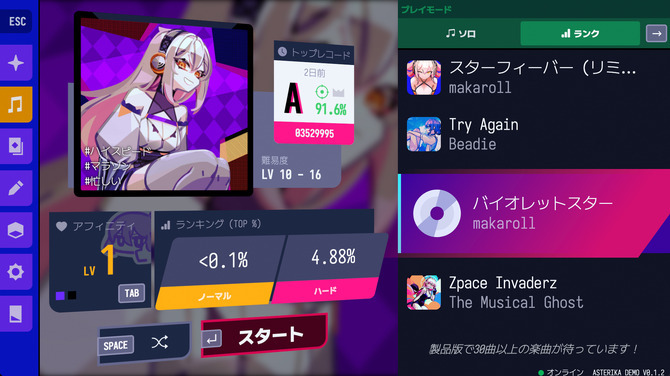
Aside from adding more songs, I’d like to create a wider variety of goals and rewards within the game.Ranked Mode serves as a strong motivator for players who enjoy competition. However, in reality, the majority of players don’t actually play in Ranked Mode. For that reason, I don’t want *Asterica* to be a game where “competing for rankings is the only long-term goal.” I’d like to increase the number of unlockable elements, rewards, and goals that players with different playstyles can each pursue.
It’s only been a few weeks since launch, so it’s a bit early to discuss the specifics of future updates, but we’re currently considering a new game mode with rules different from the standard ones, similar to Survival Mode. However, rather than focusing on a cutthroat survival competition, the mode will center on clearing various challenges to unlock new rewards.
As we continue to develop *Asterika*, there are still many musicians, illustrators, and creators I’d love to collaborate with.
――Is it okay to stream and monetize this game?
makaroll: Yes. You are free to stream and monetize “Asterica” gameplay videos and live streams as you wish.
We’ve also included a “Streamer Mode” in the game settings. If you want to minimize the risk of issues arising from Content ID or similar systems, we recommend enabling “Streamer Mode” before streaming or recording videos.
――Finally, please share a message for our readers.
makaroll: I created *Asterica* for people who, like me, love music games but are looking for something quite different from the ones they usually play. After all, it’s rare for a music game player to stick to just one title, isn’t it?
At the same time, I realize that if you only watch videos of the intense parts of *Asterica*, it might seem like a game where “you can’t tell what’s going on” or that it’s a bit confusing. That’s why we’ve prepared a free trial version so you don’t have to make up your mind based solely on videos or text. Please give it a try for yourself.
And I’d be thrilled if, someday, after finishing a song, you find yourself thinking, “I can do better. Let’s try it again!”
――Thank you very much.
◆ About “Spotlight on Indie Mini-Q&A”
This series features email interviews with indie developers shortly after their games are released. To ensure regular publication, we’ve standardized the questions, with the goal of sharing the voices of as many developers as possible. Please also enjoy our other interview articles—we’ve already published over 1,000 of them.
