Koei Tecmo Games plans to release the dark Three Kingdoms action RPG *Wo Long 2: Wings of Ember* for PlayStation 5, Xbox Series X|S, PC (Steam, Microsoft Store), Nintendo Switch 2, and Xbox Game Pass on March 4, 2027.
As the latest entry in the series, which has evolved even further from its predecessor, *Wo Long: Fallen Dynasty*, this title is packed with new features, including the introduction of an open field, the new “Phoenix Techniques” action system, and a buddy system with the military strategist Pang Tong.
We spoke with Producer Hirayama and Development Producer Yamagiwa about the concept behind this significantly transformed title and the behind-the-scenes story of its development.
The Long-Awaited Sequel
That Got Underway After the Previous Game’s DLC Was Completed
―― This is the second title in the series. Could you tell us what prompted the start of development for this game?
Hirayama: During the development of the previous title, *Wo Long: Fallen Dynasty*, and in media interviews, plans for a sequel were still completely up in the air. We were initially focusing all our efforts on developing additional downloadable content (DLC).
Then, in February 2024, after we finished releasing all the DLC and launched the Complete Edition, discussions began about “what new challenges we should take on next,” and that’s when we really got moving.
From “Overcoming Adversity” to “Overwhelming the Battlefield”
―― Having actually played the game myself, I sensed a different approach from the previous title, even though it shares the same world. Could you tell us about the overall concept for this game?
Yamagiwa: The theme of “Overcoming Adversity” lies at the core of the entire series. In this title, we’ve expanded that concept even further and adopted the theme of “Turning the Tides of Battle.”
Our goal was to create an open-world setting based on famous battles from the Romance of the Three Kingdoms, where players, as the protagonists, experience how to overcome the challenges of the battlefield and the story’s adversities.
The battle concept centers on expanding the range of combat options.“Hua Jing,” which became synonymous with the previous title, felt great to use and was enjoyed by many players. However, on the other hand, there were polarized opinions, such as “If you can just use Hua Jing, you can clear the game” or “It’s too difficult for those who aren’t good at Hua Jing.”
So in this title, while keeping the satisfying feel of “Hua Jing” at the core, we aimed to significantly broaden the range of other approaches and strategies for clearing challenges.
Hirayama: We’ve further enhanced the core “dynamism of Chinese-style action” while firmly preserving the exhilaration of Hua Jing. While the previous game let players experience the battlefield through closed, mission-based stages, this time we’ve utilized the vast open-field environment to create a game that makes you feel like you’re truly on the battlefield itself.
The Protagonist of Martial Arts and Pang Tong, the Strategist—The Emotional Connection and Revenge Story Born from Their Partnership
— Famous historical generals appear right from the start, and I got the impression that it’s easier to immerse oneself in the story than in the previous title. What were your goals regarding the story and characters?
Yamagiwa: While there’s a sense of continuity with the previous game in terms of the historical era, this installment features a completely new protagonist and depicts a new era. To make the story more compelling, we took two approaches.
One is the presence of the military strategist “Pang Tong.” We depict a buddy-like relationship between the protagonist and Pang Tong—known as the “Reclining Dragon and the Phoenix Cub”—who is also called the “Phoenix Cub.”The protagonist embodies “military might” by fighting on the front lines, while Pang Tong embodies “strategic wisdom” by devising plans; this contrast enriches the narrative.
The other approach was to establish a clear personal goal for the protagonist: a “revenge plot.” By creating a straightforward narrative structure—where the protagonist and Pang Tong’s village are attacked by Cao Cao’s army at the beginning, and the protagonist rises from that to challenge Cao Cao—I aimed to make it easy even for readers unfamiliar with the Romance of the Three Kingdoms to empathize with the protagonist and naturally immerse themselves in the world.
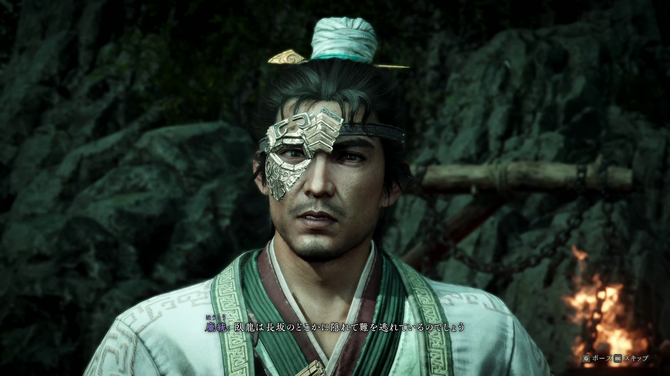
Hirayama: In games that allow for character creation, the player’s ability to project themselves onto the character is crucial.However, we faced a dilemma: if we made the protagonist’s personality too strong, it would be hard to project oneself onto them; if we made it too weak, immersion in the story would diminish. So, by having his buddy, Pang Tong, take on the role of driving the drama and emotional exchanges, we’ve ensured that players can experience a more human story while the protagonist maintains his distinct position.
―― Compared to the “Travel Companion” system in the previous game, it feels like the bond as “partners” has deepened this time around.
Hirayama: Moving a step forward from the era depicted in the previous game, this installment takes place in an era where military strategists play a more prominent role.That said, it’s a bit hard to imagine strategists themselves wielding swords and engaging in intense Chinese-style action, isn’t it? That’s precisely why we wanted to express the inseparable duality of the “strategist who provides tactical guidance” and the “general who fights on the front lines”—two essential elements of the Romance of the Three Kingdoms—through the relationship between the protagonist and Pang Tong.
Yamagiwa: Of course, the “Travel Together” system offers a high degree of freedom, so you can bring along not only Pang Tong but also your favorite generals—or even fight alone. I hope you’ll choose the option that best suits your playstyle.
Three-Dimensional Acrobatics Brought by the New “Phoenix Technique” Action
―― Please tell us about the most significant evolution in combat.
Hirayama: The biggest change is the “Phoenix Techniques” system. The protagonist possesses the power of the divine beast, the phoenix, and by combining the Shift control with various action buttons (attack, jump, Hua Jing, etc.), all actions are transformed into advanced moves.
With the “Phoenix Technique Jump,” you can dodge enemy attacks while rapidly closing the distance, or spectacularly knock enemies back and slam them into walls—enabling acrobatic combat that makes use of both enemies and the surrounding environment.
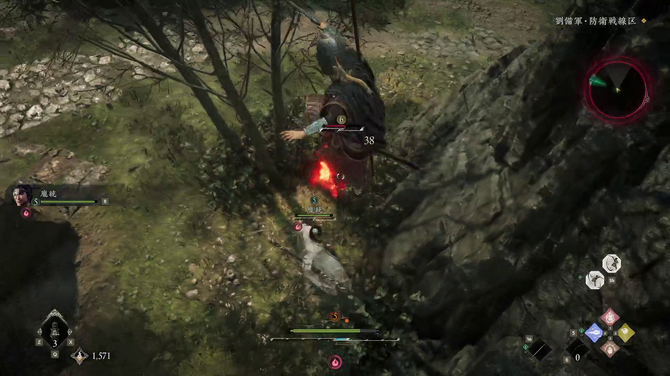
Yamagiwa: The previous game focused on rapid-fire back-and-forth combat on the ground. When considering how to evolve that for this title, we decided to incorporate “vertical movement through leaping and aerial combat,” as seen in Chinese action and wuxia films.
Acrobatic Chinese-style action that allows players to move freely and dynamically throughout the three-dimensional field. The “Phoenix Techniques” system is the approach we’ve taken to make this a reality.
―― Why did you choose the “phoenix” as the divine beast?
Hirayama: One source of inspiration was that Pang Tong’s alias, “Fengchu,” means “a phoenix chick before it takes flight.”Another reason was to lend credibility to the superhuman, otherworldly action sequences. Even dynamic moves like knocking massive enemies out of the sky aligned best with the concept—that such feats are possible precisely because the character possesses the power of a divine beast—both in terms of the setting and the action itself.
The Tug-of-War Between Historical Accuracy and Dark Fantasy
―― The demons and bosses that appear as enemies also have very distinctive visuals. How did you finalize the design concepts for them?
Yamagiwa: Our basic approach has remained consistent since the previous title. We draw inspiration from ancient Chinese legends, anecdotes, and texts—such as the *Shanhaijing*—and reinterpret them as our own brand of dark fantasy. For example, the “Flame-Faced Dragon” that appears in the demo was designed by expanding on ideas based on descriptions in the original texts.
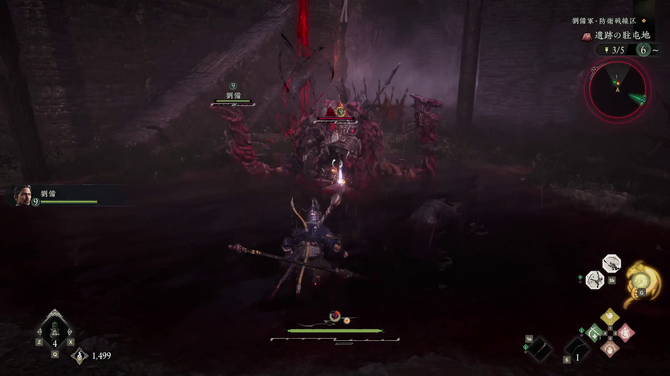
Hirayama: One challenge we faced was striking a balance between the “splendor” unique to Chinese culture and the “gloom and darkness” characteristic of dark fantasy. If we lower the saturation too much to make it darker, we lose that Chinese feel; conversely, if it’s too flashy, it diminishes the tension inherent in dark fantasy.
Ultimately, by making the most of the distinctive silhouettes of the architecture and effectively utilizing elements like the red crystalline representations of “demonic energy”—a concept from the game’s lore—we were able to construct a worldview that is instantly recognizable as Chinese yet also distinct and dark.
Yamagiwa: Regarding the story and setting, our Chinese staff members conducted thorough historical research, and we adopted an “if” approach—imagining what would have happened “if the protagonist had actually existed during that era and been secretly active or made a name for themselves behind the scenes of famous battles and events.”
Freedom of Strategy Enabled by the Open Field and Morale System
―― How has the gameplay experience changed with the “open-world” system introduced in this title?
Yamagiwa: We’ve recreated famous battlefields like Nagasaka and Red Cliffs as vast open fields. However, since the major events of the Three Kingdoms unfold over time, we opted for a “separate open field for each battle” format rather than connecting the entire map into a single continuous area.
Combining this with the series’ unique “Morale System” creates a high degree of strategic freedom.
Since morale is set for each stronghold and area within the field, you can steadily capture areas that are on par with or weaker than your own, or you can choose to immediately challenge stronger, more difficult areas to aim for higher rewards. This is a major evolution from the linear stage progression of the previous game, as players can now decide for themselves “where to attack and how to capture” each area.
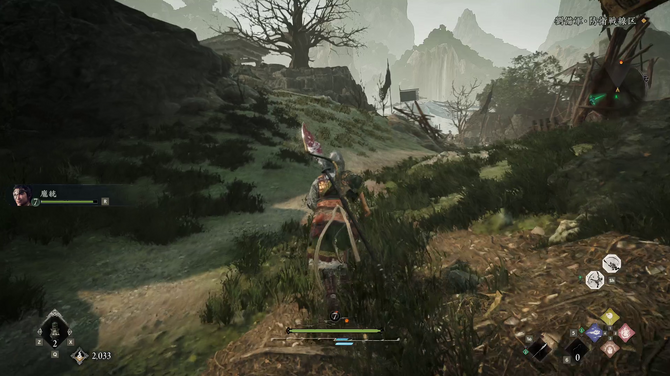
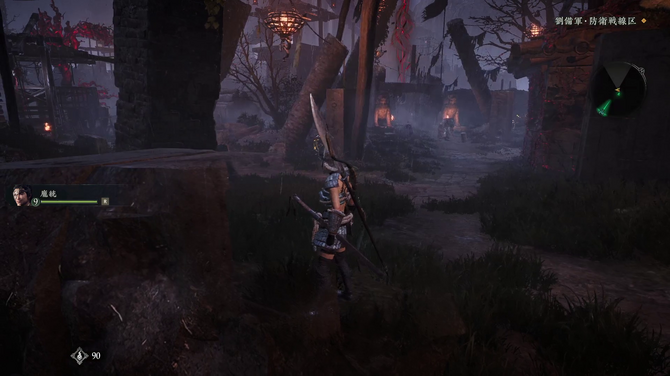
Hirayama: In the previous game, the stage-based structure meant there was a sense that “you couldn’t defeat the boss without raising morale by planting a military flag,” which felt somewhat linear and restrictive.In this installment, the open-field design allows you to enjoy a wide variety of strategies—such as skipping a powerful enemy for the time being, leveling up and upgrading your equipment via a different route, and then returning to challenge it later.
The New “General Deployment” System and Multiplayer
―― Could you tell us about any notable new systems unique to this title?
Hirayama: One system I’d really like you to pay attention to is the “General Deployment” system. By stationing generals you’ve recruited at captured strongholds, you can gain various benefits—such as buff effects—across the entire field based on each general’s traits. It’s similar to the “domestic governance” element found in strategy games.
Furthermore, we’ve included the kind of strategic combinations that only *Romance of the Three Kingdoms* fans will appreciate—for example, placing generals with deep historical connections near each other at the same outpost triggers even more powerful effects.
Yamagiwa: By defeating enemy generals on the field, you can recruit them. Not only can you station them at outposts, but you can also acquire unique weapons, armor, martial arts, and mystical arts from them. You’ll be able to experience the cycle unique to open-world games: defeating powerful foes, using the combat power you gain as a stepping stone, and using that to advance to your next conquest.
―― What about multiplayer and online features?
Yamagiwa: In addition to “Co-op,” where you can progress through the story from start to finish with friends and players from around the world, we’ve also implemented spot-based cooperative play that allows you to call for help when you’re stuck in a difficult area. We’ve designed the game so that players can communicate casually using gestures and other means, without the need for dedicated chat tools.
Additionally, as an asynchronous online feature, we’ve introduced a system where characters raised by other players appear as “enemy generals” at enemy strongholds. We hope you’ll enjoy discovering new ways to fight—like thinking, “I didn’t know you could fight like that!”—as you see other players’ unique builds and equipment combinations.
A Message to Fans
―― Finally, please share a message for fans looking forward to the demo and the game’s release.
Hirayama: Thank you so much for your continued support of the *Wo Long* series. The alpha demo for *Wo Long 2: Wings of Ember* is now available, and we’ve prepared special equipment that can be carried over to the full game as a reward for completing it.While we’ve retained the satisfying feel of the *Hua Jing* combat from the previous game, the *Huang Ji* abilities and open-world environment have greatly expanded the range of action and strategy, so please give it a try for yourself.
Yamagiwa: With *Wo Long 2: Wings of Ember*, we aimed to deliver Chinese-style action that’s evolved to be even more acrobatic, along with the freedom to strategize your way through the battlefield in an open world. The alpha demo is now available, so we’d love for you to play it and experience it for yourself. We’ve also prepared a survey—your feedback will be invaluable for our future development and a great source of encouragement.We’ll continue to share updates on our official social media channels, so please follow us and stay tuned for more news!
*Wo Long 2: Wings of Ember* is scheduled for release on March 4, 2027.